• Skip to primary navigation
  • Skip to main content
  • Skip to primary sidebar

John August

  • Arlo Finch
  • Scriptnotes
  • Library
  • Store
  • About

Drew Marquardt

The 101 Habits of Highly Successful Screenwriters

July 26, 2011 Books, Stuart

by_stuartAt some screenwriting panels, there’s a palpable novice vibe in the room.

The moderator asks basic questions. The panelists have a look that combines boredom and ego: “This is what they’re asking us? And people actually care about our responses?” The audience applauds after every answer, noteworthy or not. The microphone is passed, and it repeats.

Karl Iglesias’s *The 101 Habits of Highly Successful Screenwriters* feels like the transcript of one of these panels. It’s not a list of 101 habits as much as a collection of broad but basic interviews, edited and assembled under 101 different headings.

An example:

>Ron Bass: There’s only one reason to become a screenwriter, or a writer of anything, and that is you can’t avoid it. It’s what you love to do. It’s who you are. I write because there’s no way I couldn’t write.

If you’ve been to film school, read a lot of screenwriting literature, or attended Academy or WGA events, the advice in this book will feel old hat. On the other hand, if you don’t have access to screenwriters, or your screenwriting obsession is new, you may find a lot of value here.

The clichés are familiar, but useful; there’s a reason they’re clichés.

Still, 101 is a very appropriate number for this book to have in its title.
Writing Movies for Fun and Profit

July 13, 2011 Books, Stuart

I don’t read many screenwriting books, but Stuart does. So I’ve asked him to start reviewing some.


by_stuartAs you would expect from two members of The State, Thomas Lennon & Robert Ben Garant’s Writing Movies for Fun and Profit is very entertaining.

It is also full of good information for aspiring screenwriters hoping to write studio movies.

The book is significantly less blithe than its Funny or Die promo video, but it is still light in tone. Topics run the gamut, from basic 101s, like story structure (“If Your Screenplay Doesn’t Have This Structure, It Won’t Sell, Or Robert McKee Can Suck It.”), to a step-by-step explanation of how an unpaid intern can make or break your script’s shot with a major.

Some of the seemingly less serious chapters in that same vein are some of the book’s most useful. Lennon & Garant provide a fun and surprisingly helpful studio-by-studio breakdown of how to tell what your employer thinks of you based on your assigned parking spot:

PARAMOUNT

Important = Melrose gate, VALET. […] Ask the guy in the car next to you if he happens to have some Grey Poupon. He won’t laugh, because almost nobody remembers those commercials anymore.

Not Important = The open parking lot that’s JUST TO THE LEFT of the Valet. You’ll find a spot, sure. And it’s out in the open, under the big fake panorama of sky, no real shame in that … BUT YOU’RE ALSO CLOSE ENOUGH TO THE VALET TO KNOW THAT YOU WEREN’T ALLOWED TO PARK THERE. Yep. And there’re so many open spots in the Valet area? Well, you fell just short of making that list. Chew on that as you walk the extra 300 feet to your car.

In a later chapter, they dispense advice on what to say if a star giving you notes brings up or compares your script to one of her previous flops:

It’s best not to discuss flops at all. BUT, if they come up, YOU SHOULD HAVE ONE POSITIVE DETAIL ABOUT THEM TO DISCUSS.

For example: you’ve just sat down in the trailer of, say, JENNIFER LOPEZ […]

JENNIFER LOPEZ

Wow. I can’t believe how crappy Gigli turned out.

YOU

I dunno, I thought you looked great in those fight scenes.

JENNIFER LOPEZ

Ha, thanks. I worked really hard on those. Now here’s my notes ...

Whew! Nice save.

Another particularly useful section breaks down WGA credits and what each means in terms of dollars, with a detailed explanation of the arbitration process and strategies for winning.

The appendix provides three sample outlines, one of which is the treatment/script/plan for the unproduced Reno 911!: Miami sequel. For any Reno fan jonesing for new content, this alone makes the purchase worthwhile.

Staying indie after getting big

May 2, 2011 Film Industry, Indie, Talk

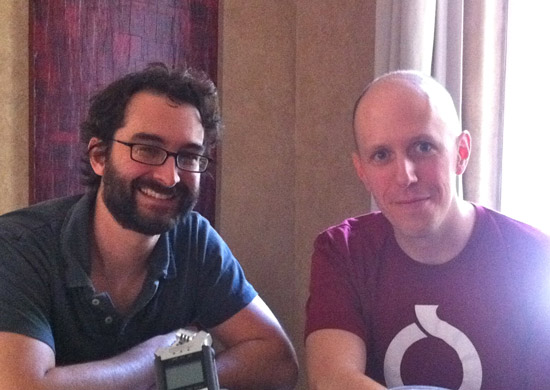
Jay Duplass and John August Prompted by a recent post about Kickstarter, writer/director Jay Duplass (The Puffy Chair, Baghead, Cyrus) emailed me about an indie documentary he’s putting together through the crowdfunding site.

His email suggested a larger discussion about why filmmakers continue to pursue indie projects after they’ve found studio success. I certainly do it, with both The Nines and The Remnants, along with other experiments like The Variant.

None of them are a good use of time, at least in a monetary sense.

I’d make more money simply writing more screenplays. If I want to direct something, it should be a studio feature. My agent tells me this. It’s his job to tell me this.

And yet Jay and I still find ourselves drawn towards the little, difficult, uncategorizable things. Is it boredom? Fear of failure? The appeal of new frontiers? A desire to reclaim our scrappy youth?

Rather than keep the conversation between us, I suggested to Jay that we record it. He was game, so he came by the office today.

This is our half-hour conversation, un-edited:

https://dev.johnaugust.com/wp-content/uploads/2011/05/jay_duplass_john_august_kickstarter.mp3

Some links to things we mention:

  • Jay’s documentary Kevin, on Kickstarter
  • Jay’s credits
  • The Remnants
  • Topspin
  • A Thousand True Fans
  • Lena Dunham’s Tiny Furniture

Runtime is 30 minutes. You can also download this as an MP3.

My thanks to Jay. Check out his doc.

How Less IMDb came to be

January 5, 2011 Follow Up, Geek Alert

Less IMDb Icon Less IMDb, our browser extension for de-cluttering the otherwise useful movie site, seems to have achieved good traction. In its first month, it was installed more than 8,000 times, and made it to the main page of Apple’s Safari Extensions Gallery.

It is now available for Safari, Chrome and Firefox. A quick break down by the numbers: ((These stats reflect downloads from our site, not any direct installs via the Safari Extension Gallery. As the extension updates, we should be able to pull more precise figures.))

  • Safari: 6,118
  • Chrome: 849
  • Firefox: 1,088

I’m not surprised the Safari version is way ahead of the others; it came first, and got a big boost from the Apple-centric Daring Fireball site. But I would have expected more love from Chrome, honestly.

I’ve asked Ryan Nelson, who did all the design and coding, to give a walk-through of our process building and deploying the extension. This recap has a fairly high geek factor, but you may find some of the decision points interesting even if the details whoosh over your head.


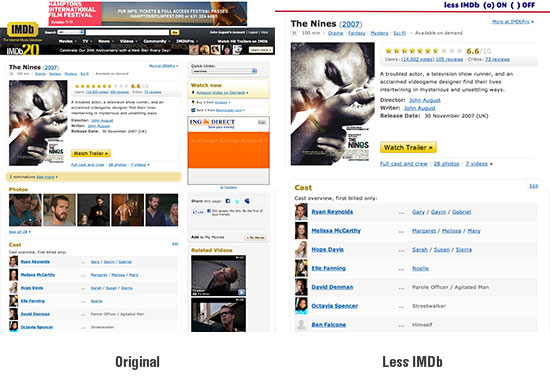
Per Twitter, most people hated the newly-redesigned IMDb. When John first brought up the idea of reformatting it with a Safari extension, his direction was minimal and straightforward: move credits from below-the-fold to up near the top.

He even provided a mockup of how it should look. When working on a new design, it’s fairly typical for John to create a wireframe or rough as a starting point:

Original Less IMDb mockup

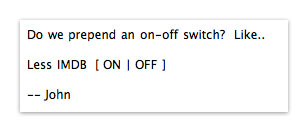
And how would the user control the extension? John’s original suggestion:

John's original control suggestion

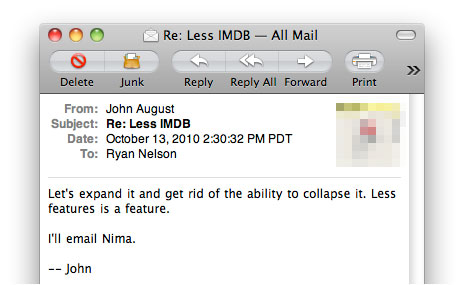
John essentially decided what content Less IMDb would show, and what it would hide. But how would it deal with other bits of the interface, like IMDb’s ability to expand or collapse filmography listings?

Less features is a feature.

The “less features is a feature” attitude informed the rest of the choices made when stripping IMDb to its bare bones.

[Read more…] about How Less IMDb came to be

« Previous Page
Next Page »

Primary Sidebar

Newsletter

Inneresting Logo A Quote-Unquote Newsletter about Writing
Read Now

Explore

Projects

  • Aladdin (1)
  • Arlo Finch (27)
  • Big Fish (88)
  • Birdigo (2)
  • Charlie (39)
  • Charlie's Angels (16)
  • Chosen (2)
  • Corpse Bride (9)
  • Dead Projects (18)
  • Frankenweenie (10)
  • Go (29)
  • Karateka (4)
  • Monsterpocalypse (3)
  • One Hit Kill (6)
  • Ops (6)
  • Preacher (2)
  • Prince of Persia (13)
  • Shazam (6)
  • Snake People (6)
  • Tarzan (5)
  • The Nines (118)
  • The Remnants (12)
  • The Variant (22)

Apps

  • Bronson (14)
  • FDX Reader (11)
  • Fountain (32)
  • Highland (75)
  • Less IMDb (4)
  • Weekend Read (64)

Recommended Reading

  • First Person (87)
  • Geek Alert (151)
  • WGA (162)
  • Workspace (19)

Screenwriting Q&A

  • Adaptation (65)
  • Directors (90)
  • Education (49)
  • Film Industry (489)
  • Formatting (128)
  • Genres (89)
  • Glossary (6)
  • Pitches (29)
  • Producers (59)
  • Psych 101 (118)
  • Rights and Copyright (96)
  • So-Called Experts (47)
  • Story and Plot (170)
  • Television (165)
  • Treatments (21)
  • Words on the page (238)
  • Writing Process (177)

More screenwriting Q&A at screenwriting.io

© 2026 John August — All Rights Reserved.