• Skip to primary navigation
  • Skip to main content
  • Skip to primary sidebar

John August

  • Arlo Finch
  • Scriptnotes
  • Library
  • Store
  • About

Drew Marquardt

Kurtzman and Orci on Trek and writing together

May 27, 2009 Adaptation, Film Industry, Story and Plot, Writing Process

My assistant Matt went to the Writers Guild Foundation event in Beverly Hills last night featuring Roberto Orci and Alex Kurtzman, and took notes for readers who couldn’t make it.

Take it, Matt.

The Writers Guild Foundation hosted and coordinated the ticketed event, which was ably moderated by Paul Attanasio.

Working first as assistants for Sam Raimi on his Xena and Hercules series, the then twenty-three year old Orci and Kurtzman broke in early but struggled to get past the stigma of the fantasy genre until they met J.J. Abrams. Abrams appreciated their ability to give “A treatment to B material” and brought them onto Alias. The success of that relationship lead to work on Abrams’s Mission Impossible 3, Fringe (which they co-created), and Star Trek.

Collaborations with Michael Bay include The Island, Transformers and its upcoming sequel. They produced Eagle Eye (with Steven Spielberg) and the Sandra Bullock/Ryan Reynolds comedy The Proposal.

The ninety-minute talk to a theater nearly full of writers and a sprinkling of suits, notably Stacey Snider and her posse from Dreamworks, covered collaboration, craft and the creative process.

The partners also defined a new-to-me screenwriting term: the structurefuck.

But most in attendance were there to ask (and gush) about the duo’s latest hit, which elicited some story lessons worth sharing.

Nero

Nero’s storyline in Star Trek was much longer in both the script and the shoot. Much was left on the edit room floor. Nero was tortured by Klingons, had to wait out twenty-five years somewhere and spit out bitter monologues, etc. All but one shot was cut from the final version. They found in post that anytime they took the story away from the heroes it sagged. Nero served only as a force to bring everyone together. The more screentime spent away from Kirk and Spock, the more defocused the movie became so they reeled him in significantly in post.

Lesson: Sequels are for villains; origin stories are for heroes. Heroes determine structure. In further support, Alex Kurtzman offered the example of Iron Man, which he said was all about Robert Downey Jr. and the suit he forges. As for what Jeff Bridges was up to? No idea. Didn’t matter. Good as he may be on screen, we’re really just waiting to see Downey in the suit again. (Not much Vader in Star Wars Episode IV compared to The Empire Strikes Back come to think of it.)

Kirk n’ Spock

Kurtzman and Orci researched heavily, studying partnerships – Lennon and McCartney, Billy Wilder and I.A. Diamond, for example — to explore why the core relationship of Kirk and Spock worked so well creatively for the series. Like Lennon and McCartney, both Spock and Kirk lose a parent. It’s something fundamental and shared that allows for a connection even with the contention and heated power struggle. Halfway through writing the first draft, Kurtzman and Orci discovered their own relationship as friends and writing partners had infused itself into the Kirk and Spock dynamic.

Destroying Vulcan

The writers felt they had to tie in the current climate and break from the past in a visually and emotionally dramatic way. Destroying Vulcan felt to Orci like seeing 9/11 and the Holocaust all at once. While that was said in jest, I think, the sentiment and desire to break this movie out from the era of the series was genuine. Something radical needed to happen.

Why does Spock get the girl?

It was a visual way to show Spock’s choice: his human/mother’s side had won out over his Vulcan side. It compressed Spock’s arc and made the writers love Uhura more for making the unexpected choice while messing with audience expectations.

Finally, for those interested in process, it took five months to break the story and two-and-a-half more for them to write it.

Advice for the aspiring

Mop floors, do anything you can to get inside and “reveal a surprise.” At age 23, the partners fetched coffee for the producers of Xena and Hercules. They wrote a spec episode and had it ready when the time was right. Wasn’t quite good enough but they were given an episode to play with and when the showrunner left, they were given the helm. They were twenty-four.

Kurtzman noted that P.T. Anderson was a PA smoking outside a set and started chatting with Philip Baker Hall. They hit it off, which lead to Hard Eight. In short, move to Hollywood, look for your moment and be ready when luck strikes.

Once you’re working, see studios as clients not villains out to ruin your art. Learn to love the process of rewriting. Be married to the sprit of words but not the words themselves. Often the studios have forced them to get beyond the “kernel” of the story in the first draft to explore new avenues and ultimately improve the story. (Notably, there were no horror exec stories typical of writers’ panels.)

How does their partnership work?

They’d met in high school but it wasn’t until after college when they began editing each other’s love letters that their partnership began. Neither had any idea how to write, but they were able to expose embarrassing parts of themselves without worrying about being judged or “thrown in a locker.” Each has their strength – Kurtzman at creating moments and Orci on the macro story elements.

They’ve been writing partners for 17 years. They credit that success to treating their relationship with the care of a marriage and applying some of the same addages: Don’t go to bed angry. Make sure one side doesn’t feel like they’re doing all the heavy lifting. Respect strengths and weaknesses.

UPDATE

To structurefuck is to disrupt a linear narrative by playing a scene twice in order to achieve a surprise reveal upon second viewing of that scene. The idea being to plant information in the audience’s heads early, when they’re likely to accept it as truth. When the scene plays again later, you alter (or “fuck with”) the perception of fact and force the audience to reevaluate the story by ripping off a mask or showing that the gun shot a blank or that the heroine actually dodged the bullet and didn’t fall to her death but was hanging naked by a bed sheet caught on a piece of glass.

Watch out for Dana

June 22, 2007 News

Hearty congrats to Dana Fox, who shows up in Variety’s Ten Screenwriters to Watch feature this morning. Dana was my assistant between Rawson and Chad, and has worked steadily since. Her latest script, What Happens in Vegas, goes into production soon.

In the picture which accompanies the article, you can see her with the SafeType vertical keyboard which looks like a joke but has saved both of our wrists. If conventional ergonomic keyboards aren’t working for you, the SafeType might be worth a try.

Inciting Incident: Koo Koo Roo edition

May 7, 2005 Genres

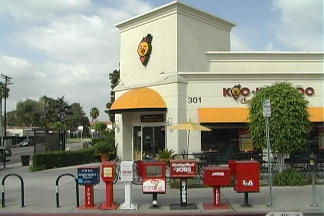
kookoorooI went to Koo Koo Roo on Larchmont last night to grab dinner: half rotisserie chicken, cucumber salad, mixed veggies, to go.

While I was turning to go into the parking lot, I noticed a white SUV near the curb. It was bucking strangely. My first instinct was that the driver didn’t know how to use stick. Then I thought, maybe it was crazy custom low-rider shocks. But you really don’t see that on SUV’s, even on Pimp My Ride.

Then I saw that there was a man standing on the passenger side running board. It looked like he was strapping something down to the roof. That would explain why the car was shaking.

My curiosity satisfied, I parked.

When I came back around to the front of the restaurant, I noticed the SUV was still in roughly the same spot. The guy was still standing on the running board, but he wasn’t trying to attach anything. Rather, he had both hands on the roof rack, holding on tight while the SUV’s driver (a woman) tried to shake him off. That’s why the car was “bouncing” earlier.

I stood at the door of Koo Koo Roo for about 10 seconds, trying to figure out what the hell was going on — and what, if anything, I should do. Here’s roughly my thought process:

  • The woman’s on her cell phone. She’s in her late 20’s, maybe. It’s hard to see inside the car.
  • The man is maybe 40. Latino. He keeps knocking on the windows.

  • She seems upset, but not terrified. Almost more annoyed. She’s not crying.

  • I wonder who she’s talking to on the phone. A friend? The police?

  • He keeps saying (in English), “I need to talk to you.”

  • He seems really rational. But rational people don’t cling to moving vehicles.

  • She should drive to a police station. That’s what I’d do.

  • Where is the nearest police station? I have no idea.

  • I don’t know if he knows her. He’s not saying her name.

  • He’s wearing white. Maybe a uniform. Maybe a parking attendant.

  • She should keep driving down Larchmont. There’s a ton of people, so if she really does need help, she can get it.

  • I bet he’s a parking attendant, and she drove off without paying.

  • There’s only one other spectator watching. That guy at the bus stop.

  • He was there when I pulled in, so he must have seen more of this. He probably knows what’s going on.

  • If I got involved, maybe he’d back me up.

  • She’s trying to shake him off again.

optical illusionThe weirdest thing was how my perception of who was the “good guy” kept flipping back and forth, like one of those foreground-background optical illusions where you see either the Young Woman or the Old Crone but not both at the same time. Second by second, I thought, “she’s in danger” or “he’s in danger.”
He’d bang on the windows, so I’d decide he was a threat. Then she’d try to shake him off, and I was suddenly worried he’d fall to the pavement and get run over.

With both scenarios equally plausible, I decided I’d cautiously approach and ask the man what was going on. With the right tone of voice, it wouldn’t sound like a direct threat. If he gave a reasonable answer, I could talk to him like a reasonable person. If he gave me a Crazy Man answer, I’d know he was the problem, and…well, I didn’t know what I’d do, but at least I’d know he was the bad guy.

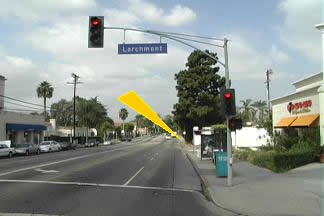
Just as I stepped forward to move from Spectator to Participant in this drama, the SUV pulled around the corner onto Beverly, picking up considerable speed. The man seemed unfazed. I realized that it’s surprisingly easy to cling to an SUV. No one would consider clinging to my little Toyota.

larchmontThe SUV took the first right turn, then disappeared from sight. I looked over to the guy at the bus stop, hoping for some gesture or nod that would reassure me that everything was okay, that neither of the two parties would end up harmed tonight.

Bus Stop Guy gave me nothin’. He just turned back to the street, waiting for his ride.

At the Koo Koo Roo counter, John August Concerned Citizen slowly reverted into John August Screenwriter, as I tried to construct scenarios to explain what had just happened. The parking lot attendant theory made the most sense, because I’ve encountered some surprisingly zealous asphalt barons in Los Angeles. Would one really risk his life by clinging to the side of a car? Maybe.

But the other scenarios — Furious Boyfriend, Eerily Calm Stalker, Random Psycho — also seemed to fit.

After watching this scene unfold, I wasn’t even sure what “genre” it belonged in. If you put Will Ferrell in the guy’s role, clinging to the side of an SUV, then it’s a comedy. Hugh Grant, and it’s a romantic comedy. Sean Penn, and it’s a thriller. (Unless Sean Penn’s playing mentally handicapped, then it’s I Am Sam.)

As I was driving home a few minutes later, I kept mulling over the scene — though part of me was busier contemplating actors and their career choices. Sean Penn used to be funny, damn it. C’mon, Spicoli!

I drove past the intersection where the SUV had turned, and glanced up the street out of idle curiosity.

The SUV was stopped there. The man was on the roof.

He was hugging the top of it like every action movie cliche, ankles dangling off the edge. The SUV wasn’t moving, but the guy seemed braced for doing 60 on the freeway.

By the time I spotted them, it was too late to make the turn. Instead, I hung three rights to circle around the block. It seemed to take forever. These were quiet residential streets — exactly the place you shouldn’t go if there’s some random lunatic clinging onto your car. Also troubling: my stubborn parking lot attendant theory was making less sense by the moment. Whatever urban logic makes it reasonable for a guy making minimum wage to wrestle a car also dictates that at some point he gives up.

This guy wasn’t giving up.

As I turned the third right, I figured that the driver and I would now at least be adjacent. I could roll down my window and ask if she was okay, if she was in danger. I could do something. By now, it was obvious I should have done something back at Koo Koo Roo.

But when I got back to the corner, there was no SUV. While I was circling the block, she must have driven off, with the guy still presumably clinging to her roof-rack. They were gone, and I didn’t know which one to worry about.

Do you call the police in this situation? Do you just forget about it, and check the papers in the morning? I was left — I am left — with an unsettling lack of closure. Yes, I want to know that no one’s hurt, but even more, I want to know what the hell I saw.

Was it funny or scary? Young Woman or Old Crone? I don’t know. Real life sucks that way.

« Previous Page

Primary Sidebar

Newsletter

Inneresting Logo A Quote-Unquote Newsletter about Writing
Read Now

Explore

Projects

  • Aladdin (1)
  • Arlo Finch (27)
  • Big Fish (88)
  • Birdigo (2)
  • Charlie (39)
  • Charlie's Angels (16)
  • Chosen (2)
  • Corpse Bride (9)
  • Dead Projects (18)
  • Frankenweenie (10)
  • Go (29)
  • Karateka (4)
  • Monsterpocalypse (3)
  • One Hit Kill (6)
  • Ops (6)
  • Preacher (2)
  • Prince of Persia (13)
  • Shazam (6)
  • Snake People (6)
  • Tarzan (5)
  • The Nines (118)
  • The Remnants (12)
  • The Variant (22)

Apps

  • Bronson (14)
  • FDX Reader (11)
  • Fountain (32)
  • Highland (75)
  • Less IMDb (4)
  • Weekend Read (64)

Recommended Reading

  • First Person (87)
  • Geek Alert (151)
  • WGA (162)
  • Workspace (19)

Screenwriting Q&A

  • Adaptation (65)
  • Directors (90)
  • Education (49)
  • Film Industry (489)
  • Formatting (128)
  • Genres (89)
  • Glossary (6)
  • Pitches (29)
  • Producers (59)
  • Psych 101 (118)
  • Rights and Copyright (96)
  • So-Called Experts (47)
  • Story and Plot (170)
  • Television (165)
  • Treatments (21)
  • Words on the page (238)
  • Writing Process (177)

More screenwriting Q&A at screenwriting.io

© 2026 John August — All Rights Reserved.