• Skip to primary navigation
  • Skip to main content
  • Skip to primary sidebar

John August

  • Arlo Finch
  • Scriptnotes
  • Library
  • Store
  • About

Drew Marquardt

Scriptnotes Ep. 2: How to get an agent and/or manager — Transcript

September 7, 2011 Scriptnotes Transcript

The original post for this episode can be found here.

JOHN AUGUST: Hello and welcome. My name is John August.

CRAIG MAZIN: And I’m Craig Mazin.

JOHN: And here we are recording another podcast. The topic of Scriptnotes is really things that would be interesting to screenwriters, so screenwriting, for example, film making, the film industry. What else are we going to talk about?

CRAIG: Napping, video games, procrastination, substance abuse. [laughs] Just running down the stuff that I think of when I think of screenwriters.

JOHN: At some point I think we need to have a podcast that talks about why you always see screenwriters’ careers falling off after 40, and it’s because of children.

CRAIG: Yeah.

JOHN: Children are the death of all screenwriters.

CRAIG: God, it’s true. My kids are just killing me. You basically replace yourself. It’s like nature knows that you’re obsolete.

JOHN: Yeah, it’s a very sad thing. You always wonder why do writers have such great careers in their 20s, and they really achieve stuff in their 30s, and then at 40, it’s just a wall. It’s not really ageism, it’s children.

CRAIG: Children. And I have two of them, John. Two.

JOHN: I have one child. Kids are great, kids are amazing, kids are awesome, but they really do sap it out of you.

CRAIG: They do. It’s amazing how nature creates them to be so lovable and sweet so you almost don’t even mind it as they dig your soul out and your energy with a spoon and just eat it in front of you, and slowly choke your life out.

[laughter]

Just kind of love them for it.

JOHN: It’s the sunken costs. You spend the first three years of their life trying to keep them alive and afterwards you’re like, “Oh, I’ve kept them alive,” and you’ve built this love for them, so therefore you forgive them of everything that they have taken from you. You also forget all the things you used to have when you didn’t have children.

CRAIG: It’s amazing, I’m tired all the time.

JOHN: Yeah.

CRAIG: I honestly feel like I need Geritol or whatever the modern Geritol is [laughs] because…

JOHN: Wasn’t Geritol actually just alcohol or it was some sort of…

CRAIG: No, no, [laughs] but that’s a funny idea. Geritol was iron supplements. I always remember Geritol because the famous, or not really famous, Australian tennis player Evonne Goolagong would flack for Geritol and she would talk about her iron poor blood. Evonne Goolagong, I think she was half aboriginal and she had this funky accent. I just thought the name Goolagong plus iron poor blood was the funniest thing I’d ever heard as a kid.

JOHN: Yeah. You realize though that men don’t need more iron. It’s only women who need iron because they lose blood every month.

CRAIG: Yeah, and by the way, this podcast, I think we should regularly talk about menstruation.

JOHN: [laughs]

CRAIG: We should always talk five minutes to just get into any kind of gynecological issues.

JOHN: Yeah, because if there’s one thing we know even more than screenwriting, it’s women’s reproductive health.

CRAIG: I am so uterine. I’m uterine.

[laughter]

JOHN: I think we should focus on something we do know a lot about. We’re going to rip off the band-aid this week and we’re going to talk about something that in six years of running the blog, I’ve never actually written a post about this because it’s just such a dreadful morass of something to talk about.

CRAIG: It’s the worst, it’s the worst.

JOHN: It’s the worst, and at least 80 percent of the questions that come into the site are basically this question. You’re ready? I’m going to paraphrase the one question that I’ve heard my entire blogging career.

CRAIG: Just do it, do it fast.

JOHN: “How do I get an agent and/or manager?”

CRAIG: Oh, God. Now, let me just say, just so that anyone out there who is struggling to get an agent or manager doesn’t think that we are mocking your pain.

JOHN: No, not at all.

CRAIG: We’re not. Really what we are embracing is the pain of the question itself because here’s what’s difficult, guys. If you really get down to what John and I know about getting an agent or a manager, what we know is how we got an agent in 1995. [laughs] That’s what we specifically know.

Some of the pain of this question is it’s like a 15-year-old boy coming to you and saying, “How do I lose my virginity?” I could tell you how I lost my virginity [laughs] in 1986. I just don’t know if it’s going to be applicable to you.

JOHN: I think I do have a little bit more experience just because I’ve gone through generations of assistants who have become writers themselves and have gotten agents, so I’ve seen their process.

CRAIG: Good point.

JOHN: Yeah. It’s not identical to what my process was and a crucial thing for framing this whole discussion is that there’s not one way it happens. Just like everyone does lose their virginity in a slightly different way…

CRAIG: Right.

JOHN: …everyone gets to an agent or a manager in a slightly different way. We can only talk about general systems for success that people tend to find when they’re looking for agents and managers. I think we need to start by talking about what the hell an agent or a manager really is because they’re used interchangeably and they’re actually different things.

CRAIG: Very, very different, yes. There’s something called the Talent Representation Act or Talent Agency Act, I can’t remember quite the exact name, but it’s California state law. Basically, the law says if you want to represent artists of any kind as an agent and procure them employment — that’s the big one — you are regulated. You have to be licensed by the state, you cannot charge more than 10% of what they earn and you also can’t own any of it. For screenwriters what that translates into actually is that agents cannot produce your material because producing is a kind of an investment in the material itself.

That was the way it was for a long, long time. Then came the rise of managers who are not beholden to that law and they can, in fact, charge any percentage they want, and they can also produce your material. Technically, however, they are not allowed to procure you employment.

JOHN: Now, procure sounds like a very legal term and I assume that, obviously I know that there’s a lot of overlap between what an agent does and what a manager does, but what is the difference between procure? So the manager is not allowed to say, “Pay us this amount of money?”

CRAIG: The manager I do not believe is allowed to directly negotiate the terms of employment, I think. I’ll have to check on that one. By the way, as a general note, if there’s anything like this where I’m not quite sure, I can always lob a clarification on your blog when you put up the link. I know for sure that managers legally can’t seek employment. In other words, they can’t field requests for employment. They certainly can’t call up and say, “My client is available. Do you have anything that they might be interested in?”

Essentially, the manager is supposed to manage. Again, this is all the technical side of it and then there’s the real side. Managers are supposed to handle your day-to-day life. They help you develop material if that’s the way you want to use them. They help take care of your day-to-day needs when you’re working on a project. Let’s say you’re out of town working on something and they help facilitate your life. They’re not supposed to actually go out and get your a job.

JOHN: Right. Now, it’s not an either/or situation. Many writers will find they have both a manager and an agent, and in many cases they’ll have a manager a year before they have an agent.

CRAIG: Right.

JOHN: It feels like there are many more managers in the business and that they’re easier to gain access to than an agent.

CRAIG: I agree.

JOHN: Agents tend to be gathered together in very big, powerful agencies. There are certainly smaller boutique agencies that represent writers. Managers tend to be in smaller shops where they’re representing a smaller group of writers, or directors or other talented people and focusing on them. Managers, in general, might read every draft and an agent very likely would not read every draft. A manager might give you notes. An agent would be much less likely to give you notes.

CRAIG: Right.

JOHN: I approach the conversation with a dim view of managers, and this is just my generational bias. I’ve been called out for my generational bias because when I started in this business, the writers who had managers weren’t getting a lot out of their managers and they were just looking for the excuse to fire their managers. Now more writers who are working regularly are talking about having success with their managers and keeping their managers as an active part of their career even after they’ve had a few features produced.

CRAIG: Yeah, I’m with you in the generational [laughs] bias. I’m somewhat suspicious of managers. I had a manager for a long time, and in many ways it was a good thing and in a number of ways it wasn’t, and it didn’t end particularly well.

I think that there are basically three reasons that writers gravitate towards…I’m going to give myself a fourth reason. One is, as you pointed out, sometimes they’re the easier representation to get just to start with. Two, managers are much more willing to help you develop your material. If you’re the kind of writer who actually wants to bounce material off of somebody who isn’t a writer or a producer, a manager can help with that. Three, I think some writers feel like look, “I can’t have two agents at once. I can’t be represented by CAA and UTA, but I can be represented by CAA and Three Arts. That’s twice the bang for the buck.”

I wish I could remember what the fourth one was but that was probably the most important one of all.

JOHN: Those are three good points. To bounce off your third point there, being represented by two different people gets you exposure to more people who you could potentially be working with.

CRAIG: Right.

JOHN: And so even though the managers aren’t supposed to be out there giving you employment, they may be sending you out to meet with somebody and that someone they have you meet with ends up becoming an important link for future employment.

CRAIG: Yeah, that’s absolutely true. I don’t have a huge problem with it, and if you love your manager, awesome. New writers who are seeking desperately for representation, and understandably so, I think can actually benefit a lot from a manager. But just be aware — this is the great currency problem –€“ when you are a new writer without a track record and limited earning potential, you’re going to get a certain kind of manager. As your career advances, you owe it to yourself to fairly evaluate whether or not your manager [laughs] is appropriate for where you are in your career if you advance.

JOHN: Yeah. Let’s start the next part about what is an agent or a manager actually looking for. Let’s stop looking at it from the writer’s point of view. I need someone to represent me, to take me in and introduce me to all the right people and get me jobs. What does an agent want?

CRAIG: They want to make money. Bottom line.

JOHN: They’re there to make money for themselves, for their agency. They’re there to try to get their clients hired and working continuously in the business. From that perspective if they’re looking at a range of possible writers who they could represent they’re going to look at the ones they believe are talented, the ones they believe will work really hard, the ones that they believe can actually land the job which means going in there to the meetings for the nine meetings and convincing a bunch of people that they are the right person to be hired for the job.

The ones who are going to deliver. If an agent has a client that can land a job but then won’t actually turn in the script or finish the script or will turn in a really substandard version of what the script should be, that’s going to hurt. The agent has a limitation of time. The agent can only represent so many clients. There’s only so many hours in the day.

They can only put up so many clients for jobs. Taking on a new person is bringing a new person into the fold, someone they have to introduce to everybody, someone they have to try to keep employed, someone they have to be talking on the phone all the time and trying to get them hired.

CRAIG: Also, just as an extension of that, too, when an agent takes on a client that client is an extension of their reputation. I’m vouching that if I’m an agent I have a brand just the way that you and I have a brand. We’re known for writing certain kinds of things. Agents are known for representing certain kinds of people.

They take on the wrong person and that person craps out, that’s an uncomfortable phone call for that agent. That damages their standing and that’s going to hurt them. There’s a ripple effect. When writers approach getting an agent and they look at this incredibly steep wall and the barrier to entry and they go why? Why is this so hard to do? It’s because of that.

JOHN: Yeah. It’s important to remember screenwriting is about pushing those words around on the paper and it’s being able to write a really good script. Screenwriting, the career screenwriting, is also the ability to land a job and to get paid for what you are doing.

An agent is excited to read a really good script. They’re not going to sign a writer, in general, without sitting in a room with that writer and making the judgment call, “Could I send this person out on a job and get them hired to do something?” They are measuring the social skills of a person who they are going to be possibly be representing.

CRAIG: Yeah. That’s right. You can definitely be a complete Asperger’s weirdo if you are just killing it on the page. If you are a conventional screenwriter writing conventional material and you’re just a zero in the room, it’s going to be tough. I have to say that part of the business is unfair, but it’s real.

We can’t deny the fact that part of what we’re offering the people who hire us is a sense of comfort that we’re going to deliver and everything’s going to be okay. They’re just as scared as we are. Everybody’s scared.

JOHN: It’s very much a business of trust. As the person hiring you, I am trusting that you will actually be able to deliver me this script. I base that trust on the things I’ve read on the paper but also looking you in the eye and seeing “Okay, he gets it. He gets what it is we’re trying to do here.”

Yes, it’s incredibly important when you’re talking to the writer you’re bringing in for $1,000,000 to finish the script that’s about to go into production, but it’s also important just that the scale job that you’re trying to get made. Every step for one of us executives is important.

CRAIG: All right. Here’s the big question as we hit the midpoint of our podcast and everybody’s been really patient. They’ve listened to us talk about uteruses and the law. John, how do these people get a manager or an agent? [laughs] We ripped the Band-Aid off that 15 minutes ago. We’re still dancing around it aren’t we?

JOHN: I think you get an agent or manager through…I can think of three ways. The first is recommendation. So someone has read your work, has met you, and said, “This guy is awesome. This guy should be writing movies for Hollywood and I’m going to take this script and I’m going to take you, introduce you to this agent or manager, and say you should represent this person because this person is great.”

If that person has the ear of the right agent or manager and there’s already trust and taste being established between them that agent or manager will read your material, say yes or no, and be interested and excited about possibly representing you. That’s how I got an agent, is a friend took the script I had written to his boss.

He was interning at a small production company. The boss liked it, wanted to take it to the studio. I said, “I really need an agent, can you help me get an agent?” He said yes and he took it to an agent he had a relationship with. The agent read it because this guy who he trusted said that it was worth his time reading. He took it, read it, met with me, and he signed it.

That’s a very, very common story for how writers get represented. Second way, I would say, is agents read material that they found through some sort of pre-filtering mechanism. A pre-filtering mechanism could be a really good graduate school program. If you graduated from a top film school and you were the star screenwriter of a USC graduate film school program, some junior agent at an agency is likely reading those scripts and saying, “Oh this is actually a really good writer. This is a person we should consider.”

Even without that writer hunting down that agent the agent was looking for who are the best writers coming out of these programs or the best writers coming out of a competition. These are the Nicholls finalists. Those scripts get read and those people will be having meetings with the people they think are potentially really good clients.

CRAIG: Makes sense. What’s the third one?

JOHN: Just scouring the world to find interesting voices. I don’t know how much of this story is really accurate, but the apocryphal story of Diablo Cody is here’s a young woman who’s writing a funny blog. An agent reads the blog and says, “This woman can really, really write. She’s funny, she has a voice. I bet she could become a screenwriter.”

I don’t think all those details are quite accurate, but there’s always those writers who they were doing standup and they’re clearly very funny and someone sees their act and says, “I think that person is a performer but I also think that person is a writer and there’s something there that’s worth pursuing.”

CRAIG: I like those. Of course, all of them are predicated on you being a good writer and writing a good script, as is always the case, but those all make sense. I actually asked an agent at CAA named Bill Zotti, I gave him a call earlier today and I asked him the question. Of course, he groaned because it was that question, but he had a couple of pieces of really good advice that I figured I should pass along.

One is to make sure that, if you are specifically pursuing an agent, to really know who they represent and ask, “Is this agent appropriate for my material?” He said one of the most frustrating things is when he’ll get query letters or log lines for the kind of movies that his clients just don’t write.

Right now there are a lot of resources out there that are relatively inexpensive, like IMDb Pro for instance, where you can actually see, “OK, let’s say I write movies like Judd Apatow. Who represents Judd Apatow? Let me see. I write movies like John August. Who represents John August? Let me see.”

If I send that person a query letter and say, “Listen, I’m a huge fan of John August, I’m aspiring to write like John August, here’s my log line,” you might actually have a shot. Whereas, if you send it to a guy that represents writers who write rated R broad comedies, that person’s going to go, “Well what do I care? It’s not for me.”

Do your homework. If you’re going to go through the effort of trying to break the rocks to get a rep, do your homework about the rep. The other advice that he gave that I thought was pretty smart was to get a job in the business, which seems so blindingly obvious, but yet so many people resist it. I know why because it’s hard and it involves a commitment that you may not be willing to make.

He said listen, 80 percent of the people in the mailroom at one of the big talent agencies are not really interested in being agents. They’re there to learn the business because they want to do other things. They want to produce. They want to write. They want to direct. When you work in that business and you work in that place you get to know the other people there.

You work next to a guy who suddenly is now an assistant to an agent. You say to him, “Listen, I’ve written a script and I’m going to tell you what the idea is.” If he loves it he’s got a chance now to impress his boss with a great piece of material so he’s going to read it. These personal connections are invaluable.

It’s nearly impossible to do that kind of thing from Rhode Island.

JOHN: Yeah. I would also say what your example stresses is the horizontal networking. Everyone always thinks, “Oh to become successful you have to meet more powerful people and get more powerful people to love you.” It’s really not that case at all. It’s been my experience, but it’s also been the experience of all my assistants, the way they got to their next step was by helping out everyone else at their same level.

They were reading other people’s scripts and giving them notes. Those same friends were reading their scripts. Eventually they wrote that thing that was, “You know what? This is the script I’ve been waiting for you to write and I think I know the right person to take this to.” It’s always been those people who were doing exactly the same stuff you were doing who were the next step.

CRAIG: That’s right. That’s exactly right. I think people should think, as they are horizontally networking, about how they should market themselves. The funny thing is Hollywood, with one hand is saying, “Get out, stay out,” and with the other hand, is saying, “Please, somebody show up,” because they’re hungry for new talent, they’re desperate for new talent.

Nothing makes them happier than a writer who’s better than a guy who makes a million dollars that they don’t have to pay a million dollars to.

They’re actually looking, believe it or not. If you can market yourself properly; for instance we have a couple of friends who wrote a pretty crazy script and just put it out on the Internet and marketed it as this insane thing. It caught on.

JOHN: You’re talking about the Robotard 8000?

CRAIG: I’m talking about the Robotard 8000. You may say, “Why would you put your screenplay on the Internet, and why would say it was authored by the Robotard 8000?” Well, why, because they have agents at CAA and they’re working. It really got them a lot of attention.

Also, it didn’t hurt that other writers that people trusted were saying, “We read this script. This was really funny.”

Similarly, I’ll tell you, if I were 22 again and I were in a writer’s group, I would say…You and I didn’t have this in the 90s. Let’s get a web page for our writer’s group, and let’s just start blogging about the experience of our writers group. Let’s track the progress of our scripts and the log lines and the rest of it. If one of us catches somebody’s attention, suddenly our writer’s group has a little bit of buzz to it. “What will this writer’s group come up with next?” That’s why that Fempire thing was so cool, with Diablo…

JOHN: Dana and Lorena.

CRAIG: Dana and Lorena. It was like, Okay. There’s a group. Now, it’s not really a group; they all have to write their own scripts. But something about it, there’s a little bit of sparkly dust to it. It’s interesting.

How do you make yourself interesting? Maybe then somebody will be attracted to your script.

JOHN: We talked about marketing, but it’s really almost positioning. People need to know how to consider you, or what to consider you as. Here’s a terrible way to go into your first meeting: You wrote a really good comedy script that people liked, so they brought you in, a manager and agent sat down to meet with you. They say, “I really liked your script; it was really funny. What do you want to write?”

It’s like, “Well, I mostly want to write period detective stories with monsters.” The manager is going to hem and haw and make conversation for about another 10 minutes, but they’re not going to want to sign you because they were thinking about you as a comedy person. Let them pigeon hole you for five minutes until you actually get something going. They need to know how are they going to make the next phone call to somebody else, saying, “This guy has a really funny comedy script, but he’s exactly the right person to hire for your period action movie.” That just doesn’t make sense.

CRAIG: It doesn’t. Listen, these guys, what is their training in? Managers and agents are not there to tell you what to be. Their expertise is watching trends and patterns and pulling people out that fit what they believe is going to generate cash. They can’t tell you who to be. What they can do is see who you are and say, “That looks like money.”

So know who you are. Go in there and be who you are.

It doesn’t mean that you have to go in there as Michael Bay. Not everybody has to make $200 million movies; not everybody has to sell $3 million scripts. To be successful in this business, you just have to work. If I could walk into an agent’s office and say, “I will never make more than $200,000 a year, but I will make $200,000 every year for the next 20 years and I won’t bother you a lot,” that’s an instant signing. Why not? That’s great.

It’s not about how much you’re going to do, but just will you do. If you walk into an office and you say, “Look. I wrote this script and this is how I want to come off. These are the movies I love; this is the niche I want to fill.” If they feel like that’s a real niche and that niche needs filling, that’s a big deal. But they can’t tell you who to be.

JOHN: Exactly. You have to be able to come to them with material that shows what your talent is, and a story, or at least a way of presenting yourself that leads them to believe, “Yeah, I see what he’s going for and I think he or she can achieve that.”

CRAIG: People have to understand that agents and managers are…Let’s call them representation. They’re never going to be your mommy or your daddy. They’re not your savior; they’re not Superman. What they are, essentially, are the vanguard of the endless decision process that leads to a writer being hired. They’re the first people in line to say, “OK, I’m willing to take a shot on you.” You still haven’t made a dollar when you get an agent. But it all is driven by you.

JOHN: I always get the question of, how do I get an agent or manager? Generally, it’s the person who’s like, “I just finished my first script. How do I get an agent or manager?”

CRAIG: [laughs]

JOHN: OK, you wrote a script, that’s great. After your second script, then I’ll believe you actually can write a second script. Or they’re like, “We just started working on our first script. How do we get a manager?” It’s acknowledging that part of the process is the ability to prove that you can actually do this repeatedly.

I think we’ll probably say endlessly in the series of this podcast is that the career of being a screenwriter is not about one script. It’s about being able to write 50 scripts. While there may be one script that really gets representation’s attention, they’re really signing you for the next 30 things you’re going to write. They would love to be able to sell this one script. They mostly want to be able to sell you every year to different producers, different studios, to continue generating cash flow and continue making movies.

CRAIG: Yeah, there’s a certain naiveté about the question in and of itself. Again, why we hate the question is just that some people are asking it and they haven’t quite earned it yet. “How do I get an agent or a manager?” Maybe the better way to phrase it is, “Which agent or manager should get me?” Start thinking that way.

Then if you think that way, you realize, “Well, I’d better have something worth getting. I’d better know who these people are and I’d better know what I want, and where I want to work, and what kind of movies I want to be known for.” It’s the American Idol syndrome. “I go on TV, they like me, they pick me, I’m a star.”

JOHN: The lottery mentality, which kills me about screenwriting is that, by writing this one script, I will sell it for X dollars and then I will be set and everything will be wonderful and happy for here on out. It rarely happens that way.

I really liked the way you rephrased it, and I’m going to rephrase it again slightly, is, “How will the right agent find me?” If you can think about it in that perspective, a lot of things become more clear. How do I make myself visible enough that the right agent will recognize my talent and my determination and say, “This is the client I have to represent.”

What you may discover in that process is that, I say “the right agent find me,” the right agent probably isn’t the super-power agent who has Judd Apatow. It’s more likely the guy who has just a couple of clients, but they’re really good clients. I left a bigger agent and went to a smaller agent right before Go, and I made the change because I needed somebody who was generationally closer to me who was hungry in the same ways I was hungry, and I could grow with.

I get frustrated when people aim too high, too fast. You want the person who can grow with you, ideally.

CRAIG: So true. The only thing worse than not having an agent is having the wrong agent. Because then you feel like you are represented and everything’s going to be fine, but it’s a mismatch, so you have all of the lack of benefit of no agent, but none of the drive to get a new one because you have a one.

JOHN: [laughs]

CRAIG: That’s the worst situation. I don’t care about the size of your agent, how big they are, who their clients are. If you’re just starting out and you’re lucky enough to attract the eye of a very powerful agent, you should ask, because it’s going to happen anyway, that they assign a junior agent to you. You’re going to need more help, and you’re going to need more attention. They’re going to be busy talking to people that earn $20 million a year. They have directors and actors who out-earn every screenwriter. They just won’t talk to you.

[laughs] Get the right guy or girl.

JOHN: And if you get the wrong guy, you can tune into a later podcast in which Craig will tell you how to fire your agent or manager.

CRAIG: [laughs] It’s the best.

JOHN: It’s actually one of Craig’s specialties. It’s one of the things I think he’s best known for, is really how to sever ties and move on with grace.

CRAIG: [laughs]

JOHN: I’ve seen him do it for many, many other screenwriters. It’s a master class.

CRAIG: I’m the Kevorkian of talent representation.

JOHN: Well, for a terrible question, I hope we were able to cover some of most crucial things. I think my recap for our conversation is, think like an agent or manager. What are they looking for? When you flip the question that way, it’s like, “How do I present myself as the person that they want to represent?” You can find that right match.

CRAIG: I like that horizontal networking point you made, too. You don’t have to always be looking up. Your friends are your best resource.

JOHN: With horizontal networking, living in Los Angeles becomes more obvious. You’re not going to be able to be around all those same people who are doing what you’re trying to do if you are in Austin. Austin’s great, but the agents who are going to represent you are not in Austin, so they’re not going to know who you are.

CRAIG: That’s true.

JOHN: Also, I would say win the Nicholl Fellowship, because that’s a good start for anybody.

CRAIG: [laughs] Yes, win the Nicholl Fellowship. That’s the easiest way. Also, be related to a great agent.

JOHN: That’s a giant help, yeah.

CRAIG: It’s a huge boost.

Let us never answer this question again.

JOHN: Yeah, done. We did it once. We never have to do it again. That’s the great thing about a podcast, is this will be around for forever.

CRAIG: I feel like I need to sleep now for 10 hours.

JOHN: [laughs] It’s the worst. All right, thank you very much, Craig.

CRAIG: Thank you very much, John.

JOHN: All right, talk to you soon.

CRAIG: Bye, guys.

How to get an agent and/or manager

Episode - 2

Go to Archive

September 6, 2011 Scriptnotes, Transcribed

For our second podcast, Craig Mazin and I decided to tackle the question we’ve both been ducking since we started our blogs: “How do I get an agent and/or manager?”

It’s an intractable question because while most working screenwriters have representation, no two of them got it the same way. If you ask a panel of writers, you’ll hear a series of anecdotes, but you won’t get a better sense of what next steps you should take.

Craig compares it to losing your virginity, which seems fair. I opted to flip the question to ask, “How do I get the right agent or manager to notice me?”

We won’t typically devote an entire episode to one issue, but this one seemed to require it.

In related podcast news:

  • We’re now listed in iTunes. The first episode is up, and the rest will begin posting automatically. You can subscribe here.
  • Transcripts. Several days after an episode airs, you’ll find the text of the podcast appended to the post (c.f. episode one).

You can download the episode here: AAC.

Using a non-iTunes podcast reader? You can find the podcast feed here.

UPDATE 9-7-11: The transcript of this episode can be found here.

Scriptnotes Ep. 1: Pitching a take, and the WGA elections — Transcript

September 4, 2011 Scriptnotes Transcript

The original post for this episode can be found here.

JOHN AUGUST: Hello, welcome. My name is John August.

CRAIG MAZIN: And I’m Craig Mazin.

JOHN: And this is the inaugural edition of something we’re calling Scriptnotes, which is meant to be a podcast talking about things that screenwriters might be interested in.

CRAIG: Yeah.

JOHN: What would those be?

CRAIG: You know, we can cover craft, the business, the union, psychology.

JOHN: Like, work habits, too. Sort of like, how you’d actually get stuff written.

CRAIG: Yeah, yeah. And topics for people who are working steadily, people who aren’t working steadily, people who want to work steadily.

JOHN: Dig deeping.

CRAIG: Dig deeping things? You said “dig deeping.”

JOHN: “Dig deeping.”

CRAIG: Please don’t edit that out.

JOHN: I will leave that, I will leave my misspoken terms right in there, unedited.

But I wanted to start with a question, because I figure, you know, answer some questions would be a good thing. And I answer questions on my site, you’ve answered questions on your site in the past, and when we answer questions on our blog, we’re just giving one opinion, and often, there’s more than one opinion.

So, here’s a question we got from a guy named Andrew. “What are execs looking for from working writers who come in and pitch takes on assignments? I’d love to hear more about this and what strategies are important. Do you pitch problems with the script and then solutions? Do you pitch your own version? And how you’d do it from the beginning as though you’re pitching a new movie? Is it a conversation? What are they looking for?”

CRAIG: That is a big question with multiple answers, depending on what the project is and who you’re meeting with, but we can certainly give a general sense of how it goes, I guess.

JOHN: Great. So, let’s talk about the kind of meeting and sort of, who sets up this meeting and what conversations you’ve had before you even go into those meetings.

So, usually, if you’re coming in to pitch on assignment, there’s some piece of property that the studio already owns. So, they’ve bought a book, they’ve bought another movie that they want to remake. They’ve bought a script, or someone’s been working on a script and they need, they want someone else to come in and rewrite the script. There’s something to look at.

So, before you even start having a conversation with them, they’ve generally sent over some material, you’ve had a chance to look at it, or at least think about it, if it’s something that’s so abstract, like a board game or remaking, like, a classic movie.

So, there’s some sort of basic conversation, or at least, material that you can, like, push off of.

CRAIG: That’s right. And your job, essentially, is to help them improve it. I mean, the only reason that these things exist is because, for one reason or another, and often times, the reason has nothing to do with the merit of the script that has been written.

They’re not happy enough. They aren’t at a place where they look at the screenplay that they have and say, yes, we want to commit however many millions of dollars to actually go into production and make this. So, your job, your primary job, first of all, is to figure out how you would do it in such a way that they might want to make it.

JOHN: To me, the crucial first step is envisioning what is the ultimate movie that you would make out of this project? And figuring out, like, what movie would you as a screenwriter want to make? What movie would the studio want to make? Or the other film makers involved? What are they looking to make? And if there’s common ground to be found there, that’s great.

A lot of times, those first meetings are not even, sort of, pitching your take on a story, it’s just trying to come to terms with, like, what is it that we’re trying to make here? For the first Charlie’s Angels, there was a pre-existing script that Ed Sullivan and Ryan Row had written. They had a great opening set piece, and everyone loved that set piece, and then the movie went in a very, very different direction.

So, my first meetings with Drew Barrymore and with the studio really weren’t about the story, it was about the tone. It was about, like, what does this movie feel like? And what I got from Drew, I think our point of overlap was that, it was a comedy where the Angels were very good when they were on the job, and they were total dorks when they were off the job. Because comedy is never about cool people, comedy is about dorks.

And that the ultimate tone I was going for was something weird for an action movie, which was, that you want to me kind of weirdly proud of the girls. And so, you know, it was probably three meetings into the project before we actually started talking about the plot, and, sort of, the kinds of things that would happen in the movie. It was more what it would feel like.

CRAIG: Well, that’s exactly, that’s what it sort of comes down to, no matter what the project is. I actually never really approach it and think to myself, I always ask the question, of course, is there any input that you have on the studio side for me as I read this material? And I just sort of want to know that, a priori, OK, we want to make this funnier. We don’t think that this works with, we didn’t think that that works.

I listen to that and I take it to heart, but ultimately, I always feel like, the only way to be successful at this is to hear that, acknowledge it, put it aside, read the material, and then have a reaction. What is the movie that I think, if I were running this studio, what would I want, and how, what would I do?

And in the case you just described, a lot of people will ask, well, what is this, people say the word “take” all the time. What’s your take? What the hell does that mean? It means exactly what you just articulated. A gut feeling about what the movie ought to be and some kernel of thematic value or character value or plot value that you can say, this is the direction you should go.

This is a positive place that we can all move toward. And then, if they say, “no, no, no, it’s not very good,” probably the job’s not for you. But if they like it, now you get to go to the next level.

JOHN: And there’s some projects here that come in, you’re going to be the very first person they’ve heard from on the project. So, maybe it was a brand new book they bought and they’re listening to see, like, what people would want to do with the material. A lot of cases, you’re coming in, there’s already some scripts available. They’ve already been through this process for a while. And it’s important to remember that you are fresh eyes on things.

So, one of the very first things I tend to say as I talk to people about a rewrite is to point out all the things that are really, really good. Because they’ve forgotten. I mean, all the things that are new and great to you are old to them. And they only sort of see the problems; they don’t recognize what’s working.

I got to work on Hancock, which was a really good script when it was sent my way. And there were problems, there was stuff that wasn’t working in the third act. But, like, it was really good, so I felt like my first phone calls with them was telling them, “By the way, don’t forget you have a really, really good movie. And I know we need to work on this section, but don’t forget all the stuff that’s working really well.”

CRAIG: That’s a good point, because as people go through any working relationship with a writer, there’s this strange invisible commodity that’s entirely separate from the quality of the writing. And that is comfort. And when they lose a sense of comfort with the writer, almost like an insecurity that they’re not sure that the writer is taking them to the promised land, they will start to doubt everything, including choices that the writer has made that are good choices.

And when you’re hired to rewrite a project, I think it’s important to always think that there’s this invisible commodity of comfort that you can offer. Almost a sense of, “Look, I’m here now, and it’s going to be OK, because I’m going to be really honest and really specific about what will work and what won’t work.” And if they have that comfort in you, it’s incumbent upon you to both, as you said, defend the stuff that actually is worth defending, and then be really specific about what should change and how.

JOHN: What you’re really describing is trust. And trust is a commodity that sort of builds up over time and it’s one of the reasons why the people who are brought in to rewrite scripts at the last minute tend to be the expensive older writers who’ve been doing this for a while. It’s because they have a track record they can point to, like, “Trust me, I know what needs to get fixed here, and I’m not going to go in a crazy, crazy direction. I’m going to take you to this next step you need to do.”

CRAIG: Yes, that’s a great point. And that your focus is on the movie, you are going to be less insistent on defending specific things you’ve written. You’re really writing more towards a movie. So, you’re absolutely right.

The trust factor is huge, but even with that trust factor, even if you have that trust factor, more and more, I think, it used to be, I think, that studios were far more willing to have a simple conversation, have a sense in the room that your impulses and instincts were good for this project. And then hire you to deliver on those.

I think those days have given way, to some extent, to a little bit more of, “Look, we do trust you, but in the end, I have to make a much more rigorous case to the people who control the purse strings that we ought to spend all this money on you. So we need more than just that conversation. We need more than just the instinct. We need to, a little more specific about what is it that you’re going to write.”

JOHN: Well, let’s talk about the specifics. Let’s talk about that meeting where you first go in and you sort of lay out your take. To me, those cases are always, it’s a process of reminding and helping people forget. You have to remind them of, sort of, the basic ideas of the project.

So, let’s say it’s a book adaptation. Let’s say it’s not a rewrite, but it’s a book adaptation. You’ll go in, you’ll start talking about the world of the book. You’ll talk about, sort of, what kind of movie it is that you’re trying to make, what things are important about this world that they have to keep in mind.

You’ll talk about the characters, and you’ll talk about the characters in terms of how they function in the movie. And you can’t assume that people are going to remember very specifically what they read in the book. You have to be able to just talk about them as movie characters. So, you’ll set up who your hero is, who the important secondary characters are, no more than two or three or four people, even author mentioning in that. Pitch, just sort of, before you get started.

And then, you’re going to get into the story. And you’re going to tell the story the way the movie wants to tell the story, not the way the book wants to tell the story. And so, once you really start pitching what the movie story is, don’t refer back to the book. Be very straightforward about, “This is what we’re seeing on screen; this is how the movie is moving.”

Along the way, people may interrupt you with questions or want to bring in things from the book and it’s, you should be really happy if people are stopping you during your pitch, because it means they’re listening.

CRAIG: Right, and that they’re engaged in what you’re saying. I mean, if you are speaking in a way that engenders zero questions, you’re probably just being boring or wrong. So, that part of the conversation’s essential. And that sounds like a really good approach to how to pitch adapting a book.

When you have a script that’s been written, and maybe it’s the sixth in a line of scripts, the way I like to approach that is to sort of say, look, this idea, we love. We all love. If you didn’t love it, you wouldn’t be looking to spend more money on another writer. Here’s, to me, the sort of, the way I like to approach pitching a rewrite is: hero, what is his problem? I like to cut right, what is the theme of this movie? Why does this movie deserve to exist? What’s the philosophical payload of this thing? And express that clearly.

And then say, that is going to, now I’m going to tell you, that will inform how I approach the rest of this material. The story should, essentially, deliver the goods on behalf of the character in his journey toward understanding this theme in the end.

And then, I kind of try and lay out what I think the beginning is. The first 10 pages are the most important. I like to, I can be really specific about those. I always feel like, if I can’t see the first 10 pages of this movie almost instantly, it’s not for me. And then I try and talk about how this thing should resolve in a way that makes thematic sense and would be satisfying.

In terms of what the journey is, I like to at least give three or four tent poles along the way, not tent pole movies, but tent poles that are holding up the second act. That’s sort of our thematic storytelling sign posts that this character’s going to go through, and why those are important for character and plot.

And if I can get those ideas across, what I’ve offered them, essentially, is a shape of a movie to come. And I think that that, frankly, is more valuable, I think, at least, more valuable than sort of, and then, and then, and then, and then.

JOHN: One of the challenging things to learn about pitching an original, or a rewrite, or an adaptation, is figuring out how you talk about your hero’s main storyline and how you fold in all the other important details. How do you deal with all the subplots that are actually going to be important to your movie, but don’t feel like the main story? What I was going to say is, at a certain point, let’s just put a pin in that and let me tell you what was happening with those other characters.

You gather up the subplots into a nice little package that you can cut to and show what happened over there, and then you continue on with your main storyline. Where pitches tend to get really frustrating is when you’re constantly ping-ponging it back and forth between multiple storylines. Even if that’s the way it would really work in the movie, that’s not the way that you can really process it as a pitch.

CRAIG: That’s absolutely right. That’s absolutely true.

JOHN: One of the things about a pitch for an original, or for a remake, or for some sort of adaptation, think about a movie that you just saw that you loved, and you’re trying to convince your very best friend to go see that movie. What would you say to him? You would talk about the characters, the world, the story, but it wouldn’t be exactly the story as it’s presented in the movie.

It would be an optimized version of it that would be very front-loaded with the cool stuff that happens, and then sort of cuts to the very awesome beats along the way. It’s like a teaser for it. It’s not the whole movie itself.

CRAIG: Yeah. And then what you start to run into, look, there’s a practical choice that every professional writer has to make when they’re involved in this process of pitching on a rewrite, or just having to pitch their take, so to speak. And that is how to gauge how much pre-work you’re willing to do before you say “Look, you guys have had enough samples of what it is I would deliver. Buy it, or not.”

And meaning “hire me or not.” That is a very difficult thing to adjust, because frankly, the newer you are in the business, the less trust there is in you, and the more they’re going to want to practically see everything. You might have that first great meeting, and their response is “Terrific. You’re our front-runner, we love your ideas, now you do need to come in and pitch us the ‘and then, and then, and then’ version.”

And it’s hard to avoid that. If you are a little further along, you’re in more demand, you may be able to say “Guys, I’ve done this before. I’ve done it a number of times, so you know I know how to do it. If you like what I have to say here, and you’ve read my other work and you like it, we have enough information for you to make a decision about whether you want to proceed with me or not.”

JOHN: That’s absolutely true, and the very first projects I was pitching to try to land the assignment, it was the countless meetings and countless… There was pre-writing, which you’re really not supposed to turn in, but you end up sharing so people can have notes to pitch off of. That’s a whole other complicated conversation, but originally there was a lot of that.

And as I had a bigger track record, I could land assignments without going through all those steps and hoops. In a lot of cases there was already a giant director attached who wanted to hire me, so it became more like “Well, that’s what Tim wants”, and that would answer a lot of their questions. The pendulum swings back and forth, and recently I’ve been up for projects and I really had to, I felt like, exhaustively document what I was going to do in a way that’s frustrating.

You’re not going to ask the top level of director, “Show us your storyboards.”

CRAIG: Right.

JOHN: So, that can get maddening.

CRAIG: It can, and this is an area where they can exert far more control than when it comes to hiring a director, because that is always a prospective thing. You just can’t get the film until you hire the guy. When it comes to pitching out the story, ultimately, again, what it really comes down to is that comfort level. And you have to ask yourself “How much work am I willing to do to engender this comfort?” Knowing that you are essentially betting on yourself, because you may not get that job.

You may sweat a lot and have nothing to show for it, and that, frankly, is the standard operating procedure now, more and more than it used to be. And that can be tough, and I should say also, what’s interesting is, we know inherently as writers that the process of coming up with an outline — a full, scene-by-scene step treatment, whatever you call it — is one creative process. Then there’s this other creative process called writing a screenplay, and I don’t know a single writer who doesn’t veer away from that initial plan when they’re actually writing.

It’s inevitable, so from the studio side, I always feel like saying “You know guys, this is a theory”, but in the end, just like a surgeon who takes a look at a patient and says “I’m pretty sure it’s the following things,” once you cut the guy open, who knows? So, it’s always going to involve them having to make a leap of faith, and I think that they try to mitigate that a little bit by demanding more and more work ahead of time.

I’m not sure that there’s anything of greater value than hiring somebody who has a track record, knows what they’re doing, has achieved in the past, and gives you a presentation that you think would make a great movie. At its heart, not necessarily scene by scene, but at its heart. So we don’t always have the choice to just do that short little bullet point presentation, but every now and then somebody goes with their gut and hires you just on that conversation.

JOHN: I’ll also say that early on in my writing career, I was pitching on a lot of projects that I didn’t get, and that’s par for the course. My friends Chad and Dara, the Creaseys, they’re pitching on things probably every week. I was like “Oh, that must be so exhausting,” but that’s also incredibly good practice.

CRAIG: Huge.

JOHN: I have these folders and folders of pitches that I’ve written for myself on projects that I didn’t get. I was going to write the Highlander sequel, and this is my take on the Highlander sequel, and this is really good practice because maybe I spent three days figuring out what this was going to be. It’s a movie I’m never going to write, but I did my Highlander, and I got that out of my system to a degree, and I figured out what kind of sword action movie I would want to do.

It’s not the same as writing, it’s not the same as actually sitting down and writing 120 pages of script. It’s very much a part of the career process of a screenwriter, so it’s not just good practice, but it’s actually part of the craft.

CRAIG: Without a doubt.

Well, I hope that answered his question.

JOHN: Yeah, I think that was a good start there.

Now, we’re not going to be a generally very news-following kind of podcast, I wouldn’t guess. There’s not going to be a lot of timely news that happens in the world of screenwriting, but we do have something timely happening now, which is that we have the WGA elections coming up.

CRAIG: Yeah, there’s an election every year, but every other year there’s an election for officers. So every two years, the Writers Guild elects a President, Vice President, Secretary-Treasurer, and then also eight directors. There are sixteen directors on the board, eight of them are up for election each year. But every two years, there is what we think of as the “big election,” where we’re voting for the leader and we’re saying, “For the next two years, this is who we’re following, and this is who is going to set the agenda for the guild.”

JOHN: Now, Craig, were you on the board of directors at some point?

CRAIG: Yeah, I ran and was elected in 2004, so I served from 2004 to 2006. I opted to not run again [laughs], in large part because it was very frustrating exercise for me. Although I did get quite a bit done while I was there, and I was very proud of that, but I do have experience as a director on the board of directors and I still chair a committee, so I’m still involved.

JOHN: So, talk to us about the board of directors and how when they’re meeting, what their focus is during a non, leading up to a contract.

CRAIG: Sure. Almost everything is leading up to a contract in a weird way. Our contracts run three years, so you spend most of those three years getting ready for the next one. It’s an endless, exhausting Sisyphean thing. The board of directors of a union is essentially the governing body of this organization. Unions are Federally chartered organizations; they are created, authorized and have to be responsible to Federal law.

And the board of directors are elected by the membership at large. If you are eligible to vote, and there are certain…you have to occasionally work. You can’t just sell one thing or work once, then expect to vote for the rest of your life. SAG you can, actually, but not in the Writers Guild. And the sixteen members of the board along with the three officers meet once a month, and there’s usually this eight hour marathon awful meeting where you go through all of the issues that the union requires the board to decide.

I mean, the board sets policy for the union. The rest of the month, the staff, led by the executive director, essentially runs the day to day affairs of the union. But the big decisions, what do we want out of negotiations, what should our negotiating stance be, how should we handle the budget, these sort of big questions, that’s the board. Once a month.

JOHN: And now, in your experience, is the board leading those discussions, or is it really the President steering those discussions, or does it change based on the personalities involved?

CRAIG: Excellent question. The President, the officers set the agenda for each board meeting. So halfway through the month, the officers get on the phone, and they set an agenda. And the board follows that agenda with the proviso that any board member, given enough time, can either introduce an agenda item that can be approved by the officers, or raise new business. New business gets shunted to the end of the meeting, it almost never happens.

If you want to do something as an individual board member, you need to talk to the officers way ahead of time and make sure it gets on the agenda. In practice, the way the union actually runs is this. The Executive Director and the President talk about what they want and what they need to decide at each board meeting, and that’s the agenda.

JOHN: OK. So, in looking at the candidates for board of directors, for example, some of these people have very lengthy things like “These are the priorities we need to focus on,” some of them basically have their name and a headshot. How much of an agenda can a candidate list in their goals for the board of directors? How much of that, in your opinion, is really achievable as a director spot?

CRAIG: I would love to give you the idealistic answer and say all sorts of achievement is possible, but here’s the truth: you are there as part of a general move towards a general goal, and the general goal for the union is really set by the President. The President and the Executive working together — hopefully working together, it doesn’t always work that way — is going to set a series of priorities for the union. You can, on your own, try and push something through.

If the President isn’t really interested, typically the political realities are that a lot of people on the board have run alongside that President, were supported by that President, were brought into guild politics by that President. They’re simply not going to be interested unless the President is. The President is an extraordinarily powerful position in our union.

They set the tone, and it would behoove you to be on the board with either a President that you support fully, or a President that you don’t support but then there are other allies you have on the board and so you can articulate the loyal opposition. I somehow managed to do both, two years. 2004 I was backing the President, 2005 I was loyal opposition.

JOHN: So, some of what the WGA board is focusing on are the external issues of the contract negotiations, how we deal with the studios, things like late payments, the things that effect all writers and are an external focus. Other stuff is the more internal things, like I know you’re on the Credits Committee right now?

CRAIG: Right, yeah, I co-chair the Credits Review Committee, which is the committee that tries to improve the rules of the credits process.

JOHN: OK. So, looking at the board of directors and at the candidate statements, who are the people who stood out to you, and who are you most excited about being on the board this next year, if you want to name names?

CRAIG: Sure. If we have two parties in the union, and these things are very fuzzy, it’s not like Democrat and Republican, I tend towards the pragmatic. I’m less interested in ideology and philosophy and far more interested in money; in the union getting as much money for its members as possible through compensation, residuals, pension and health. So, I always look for the most pragmatic candidates.

In particular, if I had one issue that I like to zero in on, it’s enforcement. Our union tends to get very big and flowery about what we ought to have in our contract. We don’t do a particularly good job of actually getting the things that are in the contract. So we will occasionally strike and bang a loud drum to get a better residuals formula, while we’re doing that, the actual residuals formula that we have, sometimes people just don’t pay.

And the Kafkaesque nightmare that ensues in trying to enforce those terms is incredibly frustrating and alienating for any writer that has the misfortune to go through it. So, I like to concentrate on pragmatic, practical candidates who have an eye on enforcement above all. At the present level, that’s Chris Keyser, who I think is a terrific candidate. He created Party of Five, I believe, so he’s been around for quite some time, worked in screen and television, which is important because we’re kind of weird.

Our union, screenwriters and television writers are rather different kinds of careers, but we’re in it together. So he’s done both, he’s a Harvard Lawyer, as is Patric Verone. So we have two Harvard lawyers running against each other, so they both have the business and real world background, and also Chris, who’s on the board of directors, has been sitting on the board of trustees in the pension health fund for many years, which to me is a big, big deal. That, to me, is sort of the most protectable and important thing that we have as a union. So I’m a big fan of Chris Keyser for President.

Vice President is Howard Rodman against John Aboud. I love John and I love Howard, they’re both great guys. I think that Howard is certainly far more militant and ideological than I am, but he’s a good man and a mensch and he listens, so I think we’d be fine with either one of those guys.

Secretary Treasurer’s a great one, it’s David Weiss, who’s way off in firebrand territory. David loves a good strike. And on the other side we have Carl Gotlieb, the legend.

JOHN: Carl Gotlieb, who wrote Jaws?

CRAIG: And The Jerk.

JOHN: And The Jerk. He was President at some point, wasn’t he?

CRAIG: No, he’s never been President. Carl’s never been President, but he’s been on the board, and he’s served as an officer many, many times. He has a tremendous amount of institutional knowledge, which I think is invaluable. There’s no doubt that you need fresh blood and new ideas. The union is particularly susceptible to crusting over and just maintaining status quo, and so you need new people coming in all the time.

The danger, sometimes, as we wipe out so many of the old guard, is that nobody seems to remember. Nobody can say “Oh you know what? We tried. We went down that path twelve years ago, it was a disaster. Don’t try that again.” So, it’s great to have guys like Carl around. Carl has fought many, many times. He spent more time on a picket line than you and I and ten of our friends put together. So I’m a big fan of Carl’s.

On the board end of things, Jeff Lowell is a very strong voice for enforcement. Ian Deitchman, who’s an incumbent, also a very strong voice for enforcement, and Ian was sort of a hero of the strike. He helped run the United Hollywood site along with John Aboud.

JOHN: I turn to Ian a lot for insight to things happening inside the guild, because I’ve always found him to be very knowledgeable about why people were saying what they were saying, and what the reality was on the ground. So, that’s one of the reasons why I singled him out in my endorsements.

CRAIG: Yeah, Ian, he serves a role that I tried to serve when I was on the board, and that is the member of the board that actually talks to writers. Because most of them don’t, they only talk to each other. A lot of times, I would find myself in this discussion with sixteen people, none of whom had actually spoken to anybody. They just talked to each other and convinced each other what’s best.

Ian actually talks to writers a lot, and so he’s always been open to listening, which is a nice thing. David Goyer is a very accomplished screenwriter, who I think has a terrific attitude. I’m a big believer that it’s best to get people on the board who are feet on the ground right now, who still have a lot of skin in the game and who aren’t afraid to fight for what they have now.

There’s a little bit of a fear that sometimes you have guys who cashed out, they’re done. It’s a lot easier to send other people into battle if there’s no chance you’re going to get hit with a bullet. I like Goyer a lot.

JOHN: Yeah, Goyer strikes me as, when I first saw his name there, it’s the kind of name you would expect to see on the negotiating committee, because they tend to bring in the brand names for the negotiating committee so they can sit opposite the studio heads when they do negotiations. But the fact that he was eager to participate in the very, I don’t want to say boring, but the much more day-to-day stuff of the board was interesting to me.

CRAIG: Yeah, same with Billy Ray. Billy Ray and David Goyer both have something that I love, which is a… First of all, like so many of us, they are dual members. They’re members of the DGA and the Writer’s Guild, so they’re able to keep their ear to the ground with the directors. You have to remember, the Directors Guild has always negotiated very, very early, but one of the downside results of our previous strike was that we lost our position, our negotiating position.

We used to go first, now we go last. The Directors Guild would try and sneak in ahead of us by negotiating super-duper early. Now, they are actually; I mean technically, I think they may still be after us; but they negotiate so early that they effectively will be the union of first negotiation for the companies. Because of that, we have to talk to them. We don’t have to like the way they go about their business, but we have to talk to them.

One of the issues with Patrick Varrone is that he is loathed by the DGA. I think it’s common knowledge, really. He’s had just a bad time dealing with them. It would be great to get a President who they were a little less antipathetic toward, and guys like Billy and Goyer, I think, will help. I can’t promise that anybody is gonna completely thaw the ice between these two unions, but maybe bring the temperature down a little bit would be nice.

JOHN: Yeah, there’s certainly a track record of shared membership between our two guilds, and the degree to which you can leverage that shared membership is only a good thing.

CRAIG: Yeah, and it’s a big number too. I can’t remember what the specific stat was, but it was kind of eye opening. Like thirty percent of our members have overlapping affiliations with the guild. It was a lot of writers. A lot.

JOHN: I think my endorsements were very much in line with some of the things that people like you singled out as well. For the board of directors, I only mentioned people that I knew personally, who I thought would be fantastic resources on the board, but Howard Rodman I also singled out. Howard, who in addition to being very involved with the guild in every level, is really focusing on bringing guild contract to indies, to independent films, which I think is crucial.

I get frustrated when I see the WGA spending a lot of time and energy trying to organize reality TV production as a sort of strategic goal. It’s not really what the WGA is about. The WGA is about writing film and television, and the film and television that we’re really known for is dramatic dramas and comedies, and that’s indie film. Our next generation of Hollywood writers comes from indie films.

So we’re trying to get them involved as early as possible, and trying to get them protect as early as possible, it feels like a crucial goal.

CRAIG: Yeah. I mean, let’s be honest about this reality organizing thing. The impetus to organize reality was always artificial. The intent was to organize reality television to improve our ability to strike. That was entirely what that was about, to the point where I think actually the Barone administration failed to organize reality where they might have been able to, in an incremental basis, because they didn’t care about increments.

What they wanted to say was “When it comes time to strike, all TV goes away. Not just scripted programming, but reality programming.” The problem with that is the companies aren’t dumb. [laughs] They certainly saw the intent there, and they are also hamstrung by certain realities that we can’t avoid. Like, for instance, the fact that a lot of people who work in reality are already represented by IATSE, the stagecraft union which represent all the editors, for instance.

And we tried to organize the editors in a way that, frankly, the companies didn’t even have to bother rebutting that one because there was another union saying that it would be a violation of Federal Labor Law. And it would, it would be as if the Screen Actors Guild suddenly decided to try to represent writers. You can’t do it. The great news is that Howard is exactly, his focus on independent film is exactly the right goal.

Similarly, I think trying to organize scripted cable television. That was the thing where I would sit there and go “What are we doing?” We’re trying to organize the writers on America’s Next Top Model, and maybe even trying to organize the editors, possibly. We have people writing scripted television for cable channels that are owned by the same companies that make the movies you and I write, and we are literally just ignoring them because somehow we don’t think they’re going to bolster our strike threat.

It was just a dumb, dumb time in our union, and counterproductive and bizarre, but Howard’s always been a great beacon of hope for independent film writers and a great guy.

JOHN: OK. That’s a half hour. That’s I feel like a good start for our inaugural broadcast. I think I’ve learned a fair amount here.

CRAIG: I think I have as well. I didn’t know how Charlie’s Angels came to be, so I feel educated as well.

JOHN: Absolutely. So, let’s try this again.

CRAIG: Yeah, we’re going to do this fairly regularly, I think.

JOHN: That is the hope.

CRAIG: That is the hope. And this way I don’t have to blog anymore.

JOHN: I know. This is all to save Craig from typing.

CRAIG: Really. Thank you. That’s all I can say, is thank you.

JOHN: And thank you Craig, and we’ll get this up and see how it goes.

CRAIG: See you guys on the podcast.

JOHN: Great. Thanks Craig. Bye.

The Writer’s Journey: Mythic Structure for Writers

August 15, 2011 Books, Stuart

by_stuartI generally am leery of screenwriting gurus who present formulas and spend books twisting and massaging stories to show that every movie fits or is fundamentally flawed. They take three hundred pages to describe what a square is, and then prove all Play-Doh is square by shoving an amorphous example blob through a square hole.
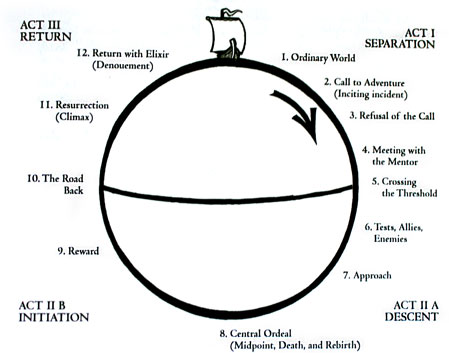
Christopher Vogler’s *The Writer’s Journey: Mythic Structure for Writers* is one of these books at its heart, but it has narrowed its focus in a way that makes it acceptable. It is a surprisingly worthwhile and palatable read.

The book has two major sections: Mapping the Journey, which discusses the archetypes we will encounter, and Stages of the Journey, which takes us through the major plot points.

Like other books of this type, it comes complete with graphs and charts:

We are given power words, and reminded of them when they’re place in bold and all caps. But I never feel like I am being force-fed.

Vogler doesn’t attempt to define All Stories, instead focusing specifically on mythic and epic structure, which is much more manageable and sensible. If one were to try to explain “geometric shapes,” the set would be too big, too general; it is a pointless task. If one were to explain the subset of parallelograms, however, there are common characteristics that deserve definition. The specificity gives us something to discuss.

The subsets of stories he has chosen — myths and epics — are grand by nature. The Middle Ages artwork at the start of each chapter feels like it belongs. The extra-heavy page weight that makes a four hundred-page book look six hundred is somehow forgivable, or even appropriate. He makes statements like, “When you ‘spell’ a word correctly, you are in effect casting a spell,” and they’re not out of place. You may roll your eyes, but you get why he’s doing it.

Vogler is quick to allow and even encourage exceptions to his rules. He doesn’t seem threatened by films that don’t follow his structure, but instead is happy to tackle difficult stories and show how they fit. He offers Pulp Fiction as a case study, demonstrating it fits even with its non-linear story telling, and he does so convincingly. Then he applauds its untraditional nature.

>*Pulp Fiction* reflects the postmodern condition in both style and content. […] The sequences appear to have been sliced up with a samurai sword and thrown in the air, although in fact the order of scenes has been carefully chosen to develop a coherent theme and produce a definite emotional effect. […] *Pulp Fiction* is part of the pop-culture jet stream, flowing easily out of the current collective unconscious, charged with images and sounds from previous eras.

Even if a story doesn’t fit, he can stick by his rules. He’s talking Joseph Campbell, defining Mythic structure, not Story structure. A film that doesn’t work is not wrong; it is simply outside of the structure’s purview. The specificity gives him an out.

Still, the definitions themselves are loose. He never defines characters, but instead defines character roles. No one is the “mentor;” different characters act as mentors at different times. Everyone is free to shift and change as the story progresses, even the hero. And the definitions, both of characters and of plot points, are valuable tools for breaking down stories, mythic or otherwise.

Vogler provides a universally applicable way of thinking without trapping himself into calling it the only way of thinking. He manages to be all encompassing without being suffocating; grand enough to be valuable without being so grand it’s ridiculous.

« Previous Page
Next Page »

Primary Sidebar

Newsletter

Inneresting Logo A Quote-Unquote Newsletter about Writing
Read Now

Explore

Projects

  • Aladdin (1)
  • Arlo Finch (27)
  • Big Fish (88)
  • Birdigo (2)
  • Charlie (39)
  • Charlie's Angels (16)
  • Chosen (2)
  • Corpse Bride (9)
  • Dead Projects (18)
  • Frankenweenie (10)
  • Go (29)
  • Karateka (4)
  • Monsterpocalypse (3)
  • One Hit Kill (6)
  • Ops (6)
  • Preacher (2)
  • Prince of Persia (13)
  • Shazam (6)
  • Snake People (6)
  • Tarzan (5)
  • The Nines (118)
  • The Remnants (12)
  • The Variant (22)

Apps

  • Bronson (14)
  • FDX Reader (11)
  • Fountain (32)
  • Highland (75)
  • Less IMDb (4)
  • Weekend Read (64)

Recommended Reading

  • First Person (87)
  • Geek Alert (151)
  • WGA (162)
  • Workspace (19)

Screenwriting Q&A

  • Adaptation (65)
  • Directors (90)
  • Education (49)
  • Film Industry (489)
  • Formatting (128)
  • Genres (89)
  • Glossary (6)
  • Pitches (29)
  • Producers (59)
  • Psych 101 (118)
  • Rights and Copyright (96)
  • So-Called Experts (47)
  • Story and Plot (170)
  • Television (165)
  • Treatments (21)
  • Words on the page (238)
  • Writing Process (177)

More screenwriting Q&A at screenwriting.io

© 2026 John August — All Rights Reserved.