• Skip to primary navigation
  • Skip to main content
  • Skip to primary sidebar

John August

  • Arlo Finch
  • Scriptnotes
  • Library
  • Store
  • About

John

Normal is not an option

July 21, 2020 Psych 101, Rant

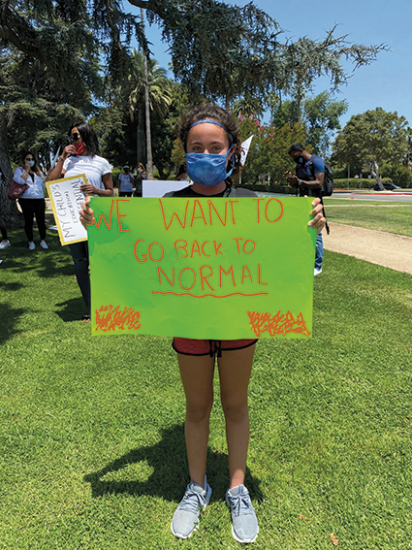
young woman holding homemade sign reading "I want to go back to normal"

The image that accompanies this article on a school reopening protest captures a major mood in July 2020.

The photo comes courtesy of Victoria Conti, who is also quoted in the piece:

I don’t want my kids to stay in front of a computer all day long. It’s not good for health, for mental health, there are too many reasons that it’s not good.

Conti is right, of course. It’s not healthy for any of us to sit in front of computers all day, particularly children.

My daughter is 15. Like most American kids, she finished her school year in Zoom classes of debatable quality. I want her back in school with her friends, just like I wanted her to go to her beloved sleepaway summer camp, and to be able to hug her grandmother.

Just like the girl in the photograph, I want to go back to normal.

But it’s simply not possible. Normal is not an option. Not now. Probably not until there’s a widely-available treatment or vaccine.

Demanding a return to normal in July 2020 is like yelling at the night to be less dark. It’s out of your control and everyone’s control. The more you complain about it, the more miserable you make yourself and others, and the more time and energy you waste.

Conti’s frustration about online classes is valid and understandable. I share it. But the real opponent isn’t the school district; it’s the coronavirus. That’s the barrier between teachers and students and in-person classes resuming. The virus doesn’t care because it’s a lump of genetic data. Scientists and public health officials care deeply but they can’t offer a cure at the moment.

In psychology, one strategy for dealing with these situations is radical acceptance. You start by acknowledging the reality of the situation — and how much it sucks — so you can begin thinking about the future.

  • It sucks that we can’t open most schools safely, so we need to work on ways to make online classes more accessible and less terrible.
  • It sucks that we can’t go to bars and clubs and movies, so we need to find other ways to hang out and socialize that don’t spread the virus.

  • It sucks that some jobs aren’t possible amidst the pandemic, so we need to find other ways for people to pay their bills.

  • It sucks that we have to wear masks and yet it’s clear that they save a lot of lives.

Individually and as a society, we need to move past this idea of “back to normal” when it comes to coronavirus. Stop saying it. Stop pretending it’s an option. It’s night and the sun’s not coming up any faster. We need to do the best we can in the dark.

And we can do surprising things! For example, American retailers quickly adopted contactless payment and curbside pickup, along with a staggering amount of plexiglass. Businesses realized that a lot of work can be done from home. Talk shows figured out how to film from attics.

We’ve been forced to rethink and adapt because normal was not an option. It still isn’t. We need to acknowledge that this pandemic sucks and keep going.
Summer Reading

June 24, 2020 Author, Books, Los Angeles

On Saturday, I hosted a group of local authors to celebrate Chevalier’s Books, LA’s oldest independent bookstore, which recently reopened for pick-up orders.

Chevalier’s is our neighborhood bookstore, hosting many of our launch parties — including Arlo Finch — so we’re excited to see its doors semi-open.

The theme for our Zoom conversation was “summer reading.” We gave our picks for kids, teens and adults, with special focus on books about understanding race in America.

Guests include Stuart Gibbs, Leslie Margolis, Aline Brosh McKenna, Thomas Lennon, Sarah Mlynowski, Julie Buxbaum, Kayla Cagan and Julia Claiborne Johnson.

You can see their reading lists on Chevalier’s site, with links to order directly from Chevalier’s or bookshop.org.

My picks are below, along with a few additions I made as we were recording.

Support your local indie bookstore! Like Chevalier’s, many are partially open, and can easily get any book you’re looking for.

Young Readers:

– Don’t Let the Pigeon Drive the Bus by Mo Willems
– Raccoon Sick Day by C.E. Miller
– Hair Love by Matthew Cherry

Middle Grade:

– My Side of the Mountain by Jean Craighead George
– The Curious Incident of the Dog in the Night-Time by Mark Haddon
– Marvel Encyclopedia by Stan Lee (DK)
– Incredible Cross-Sections by Stephen Biesty

YA:

– Dune by Frank Herbert
– Pride and Prejudice by Jane Austen
– Guns, Germs, and Steel: The Fates of Human Societies by Jared Diamond
– Things to Make and Do in the Fourth Dimension by Matt Parker

Adults:

– Their Eyes Were Watching God by Zora Neale Hurston 
– The Autobiography of Malcolm X as told to Alex Haley
– Trick Mirror: Reflections on Self-Delusion by Jia Tolentino
– Free-Range Chickens by Simon Rich
– Station Eleven by Emily St John Mandel
– Atrocities: The 100 Deadliest Episodes in Human History by Matthew White
– The Hardest Job in the World: The American Presidency by John Dickerson
– Raising White Kids by Jennifer Harvey

#theShowMustBePaused

June 1, 2020 News

https://twitter.com/johnaugust/status/1267640187409952768?s=21

We can’t pretend these are normal times.

We’re postponing the normal Tuesday episode of Scriptnotes in support of Brianna Agyemang & Jamila Thomas’s initiative @pausetheshow.

Read more at theshowmustbepaused.com, which has resources and links.

Getting Things Done in a Pandemic

April 15, 2020 Meta, Projects, Tools

As a screenwriter who works at home, I’m used to having large, shapeless blocks of time. Now that the coronavirus has many people unexpectedly working from home, I wanted to share a tool that’s helped me stay productive.
to do list
It’s a pre-printed sheet of 8.5×11-inch paper folded in quarters. I call it my Daily Plan. You can download the template as a PDF, or customize it in Pages, Word or Google Docs.

I print these up a dozen at a time and leave a stack by my phone charger. Each morning as I drink my coffee, I take one and fill it out.

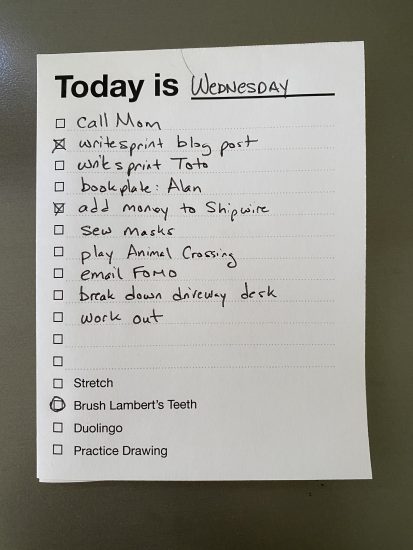
Since the lockdown began, one of the things that’s honestly most helpful is writing the day of the week at the top of the sheet. Often the only way I can tell it’s Monday versus Saturday is by looking.

Below that is a list of blank lines and checkboxes, a classic to-do list. Here I put the tasks I want to get done, referring to the previous day’s sheet to carry over anything that’s still relevant.

What’s important is that this isn’t just for the must-dos, but also the want-to-dos. For example, playing Animal Crossing. It’s not a reward for getting other things accomplished; it’s its own thing worth putting on the list by itself.

There are a few items printed at the bottom of the list for tasks I do every day. For example, I have a 1,251-day streak going in Duolingo French, and no virus is going to break that. My 2020 goal was to learn how to draw, so that’s another daily task pre-printed on the sheet.

Do I actually draw it every day? No. But it’s on the list as a reminder that drawing practice is something I could and probably should do.

The pre-printed lines are also useful for recurring but non-daily tasks. My dog Lambert needs his teeth brushed every other day, so I scratch the line out if it happened yesterday.
back of sheet
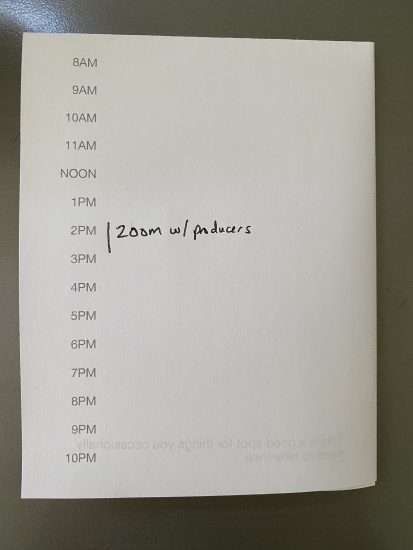
The back of the Daily Plan is my schedule. Pre-pandemic, this was section full of meetings and school events. Yes, these were already in the calendar app on my phone, but marking them down on paper helped me recognize where I had free time to get work done.

My schedule now is basically just zoom calls and hangout sessions with friends. At least I don’t have to budget travel time to get from place to place.
inside of plan
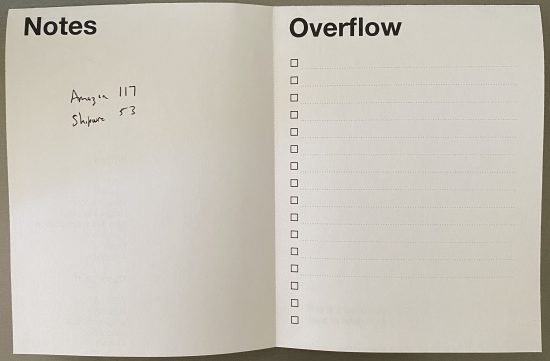
The Daily Plan folds open like a book. Inside, I have an overflow list of tasks, along with a section for notes. For example, how many decks of Writer Emergency Pack we have at the warehouse, or the name of a book I want to order.

I use a proper notebook or the Notes app on my phone for stuff I need to refer back to, but the Notes section is a great place to jot down things that are only relevant today.
inside flap
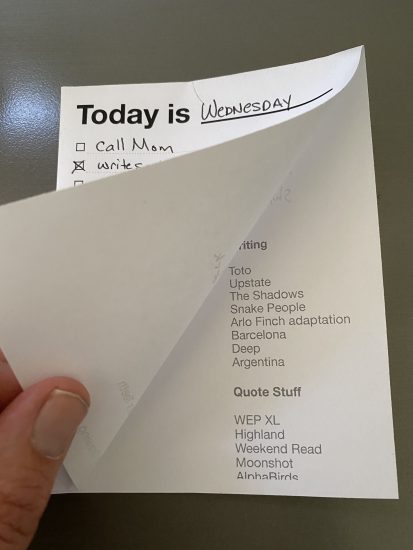
The Daily Plan also has a peek page, a list of all the projects I’m working on — both official stuff and fun things. It’s printed on the back of the sheet, which ends up underneath the to-do list. As I sit down with my morning coffee, I’ll look through this list to consider whether there’s anything related to those projects that could be done today.

Where this all came from

The idea of a daily to-do list is probably as old as paper and writing.

At its heart, my Daily Plan shares a lot with David Allen’s classic Getting Things Done system, in that it describes work in terms of projects and “next actions.” I’ve used GTD at various times in various ways, both in handwritten notebooks and with apps like Things and OmniFocus.

While GTD works great for many people, I’ve found it inevitably devolves into lists of things I never get done, and eventually stop looking at.

What’s helpful about the Daily Plan is that it’s new each day. I have control over it because I only add the things I want to add. In this way, it more closely resembles David Seah’s Emergent Task Planner. ETP is a little narrowly focused for my taste, and I’ve never found micro-scheduling to work for me.

The most direct inspiration for the Daily Plan came from a habit I’ve gotten into whenever I take a long international flight and find myself with 10 to 14 hours to fill. This unstructured free time used to spike my anxiety. What should I do? Should I read the book I brought? Should I play that puzzle game on my iPad? Should I do Headspace? Which movies should I watch on the seat-back screen?

Beginning last year, I decided to make a Flight Plan before the wheels leave the runway. Once I’m in my seat, I pull out a sheet of paper and list the in-flight movies I want to watch, the things I want to read, and the games I want to play. It takes ten minutes and is honestly transformative. I used to dread long flights. Now I see them as a chance to watch and read and learn. I’ve taken this amorphous blob of time and given it purpose.

The Daily Plan is basically my Flight Plan for ordinary life.

I started using it in January, well before the pandemic. While it’s useful in normal times, it’s proved indispensable in this current age of nameless days when the boundaries between work and home life are blurred. It provides a sense of structure and control.

So if you want to give it a shot, you can download the template as a PDF, or customize it in Pages, Word or Google Docs.

Customize however you like, adding the items you want to do every day, and listing your projects on the peek page. (If your printer can’t handle two-sided printing, just print the first page. You can flip the paper and print it again, or just not worry about it.)

Hit me up on Twitter if you find the Daily Plan useful, or come across innovations you want to share.

« Previous Page
Next Page »

Primary Sidebar

Newsletter

Inneresting Logo A Quote-Unquote Newsletter about Writing
Read Now

Explore

Projects

  • Aladdin (1)
  • Arlo Finch (27)
  • Big Fish (88)
  • Birdigo (2)
  • Charlie (39)
  • Charlie's Angels (16)
  • Chosen (2)
  • Corpse Bride (9)
  • Dead Projects (18)
  • Frankenweenie (10)
  • Go (29)
  • Karateka (4)
  • Monsterpocalypse (3)
  • One Hit Kill (6)
  • Ops (6)
  • Preacher (2)
  • Prince of Persia (13)
  • Shazam (6)
  • Snake People (6)
  • Tarzan (5)
  • The Nines (118)
  • The Remnants (12)
  • The Variant (22)

Apps

  • Bronson (14)
  • FDX Reader (11)
  • Fountain (32)
  • Highland (75)
  • Less IMDb (4)
  • Weekend Read (64)

Recommended Reading

  • First Person (87)
  • Geek Alert (151)
  • WGA (162)
  • Workspace (19)

Screenwriting Q&A

  • Adaptation (65)
  • Directors (90)
  • Education (49)
  • Film Industry (489)
  • Formatting (128)
  • Genres (89)
  • Glossary (6)
  • Pitches (29)
  • Producers (59)
  • Psych 101 (118)
  • Rights and Copyright (96)
  • So-Called Experts (47)
  • Story and Plot (170)
  • Television (165)
  • Treatments (21)
  • Words on the page (238)
  • Writing Process (177)

More screenwriting Q&A at screenwriting.io

© 2026 John August — All Rights Reserved.