• Skip to primary navigation
  • Skip to main content
  • Skip to primary sidebar

John August

  • Arlo Finch
  • Scriptnotes
  • Library
  • Store
  • About

flagged

Please take your finger out of your ear

October 19, 2009 Rant, Television

Along the lines of my gripes with cinematic cell phone troubles and air ducts, Lou Lesko takes issue with another movie cliché:

The high technology wireless radio devices that are concealed in the ear canals of the good guys for surreptitious communication work just fine without sticking your finger in your ear. And yet on NCIS Los Angeles last week –- in a pivotal scene where a guy is being shadowed -– there were all the protagonists, obvious as could be, looking like they forgot to take a Q-Tip to their ears for the last month.

For once, writers are off the hook. Nowhere in the scene description do we tell actors to poke their fingers in their ear canals.

Rather, it’s directors who are likely propping up this cliché, worried that the audience — particularly a CBS audience — won’t understand why characters are talking to invisible people.

What’s wrong with the business

October 15, 2009 Film Industry, Los Angeles, Television, WGA

Writers in film and TV are making less money. For 2009, TV writers brought in three percent less, while screenwriters’ earnings dropped 31%.

In a rough economy, it’s no surprise to find workers in all industries making less, but in the case of the writers, it feels a lot different on the ground. It’s not simply the economy.

Fundamental relationships and business practices are changing. More writers are competing for fewer jobs. Established quotes are being ignored. Mid-tier writers are passed over in favor of the very cheap or very expensive, and even they have a hard time actually getting paid.

Get a group of working — or should be working — screenwriters together for more than ten minutes, and you’re likely to discuss all these issues.

Last week, David A. Goodman (Family Guy), Kayla Alpert (Confessions of a Shopaholic) and I did a panel on KCRW’s The Business, discussing these topics. The show is now online, and worth a listen.

Some important points to emphasize:

  • All writers in the industry are essentially freelance. Even being staffed on a TV show is seasonal. Writers aren’t “laid off;” they’re simply unhired. That’s true for many jobs in film and TV, from actors to gaffers to costume designers. Writers are pretty much the only craft that can generate their own work, however.
  • Writing is the R&D of the entertainment industry. Try as they might, studios don’t know which projects — or even which genres — are going to be hits. That’s why they develop a range of properties, knowing that only a few of them will go into production. A studio that doesn’t develop material won’t have movies or shows for upcoming seasons.

  • Studios are small parts of big corporations. While studios have often been owned by larger corporations, from Gulf+Western to Coca-Cola, the current consolidation and integration of the major studios is unprecedented. Film and TV used to be largely insulated for a downturn in the economy — people still wanted their movies and shows. But now that studios are so tightly entwined with their parent companies, corporate cutbacks hit Hollywood much more directly.

  • Quotes are both real and imaginary. A writer’s quote is generally whatever she has recently been paid for a roughly equivalent job. ((Quotes work the same for actors and directors.)) If Sasha Dramaturg received $200K for a draft, set and polish ((“Draft, set and polish” is common shorthand for a writer’s first draft, a rewrite of that draft, and smaller polish on that draft.)) on a movie at Fox, her quote would be $200K. If Fox wanted to hire her to write a movie, her agents would be looking for at least that much money. Recently, however, quotes are sometimes being ignored. Fox might tell her agents that they’re paying $100K, take it or leave it. If Sasha takes it, her quote is now $100K. ((Deals can also be “no-quote,” meaning they’re not supposed to be disclosed. For the animated movies I’ve written, I’ve made significantly less than my quote.))

  • Writers aren’t unique. While this panel was about writers, every facet of film and television is in upheaval. You can take any profession or craft, from development executive to stunt coordinator, and find uncertainty and anxiety about where this is all headed.

Host Kim Masters did a smart job stoking the conversation, and producer Darby Maloney cut an hour’s worth of material down with remarkable finesse.

One thing that didn’t make the cut was a list that a friend had sent me in anticipation of the panel. It’s more bloggy than radio anyway:

What’s Wrong With The Film Business

  1. The conflict and turnover caused by the buying and selling of companies causes confusion, uncertainty, and weakens morale in the production area.
  • The “suits” who control the studios interfere too much with creative decisions; the studios should be run by creative people rather than businessmen, lawyers, etc.

  • The constant turnover of the production head of the studio is disastrous.

  • Overhead is indefensibly high.

  • Authority is not clearly defined.

  • Producers are given exorbitant contracts, and there is no relationship between what a producer receives and the box-office success of his or her films.

  • Screenplay costs are excessive and and the write-off on stories and contracts is enormous.

  • While this seems like a very current assessment, the list actually comes from a 1936 report by Joseph P. Kennedy, who was hired by Paramount’s board of directors to determine what was ailing the studio. ((This list comes courtesy Howard Suber, who makes reference of it in his book The Power of Film. It originally appeared in Leo Rosten’s 1941 book Hollywood: The Movie Colony/The Movie Makers (New York: Harcourt, Brace and Company, Inc., 1941), Pp. 253-254.
    Rosten’s book is out of print, unfortunately.))

    I find it strangely comforting to realize that the industry was just as broken 70 years ago.

    To me, it suggests there’s a cycle to the industry. While we’re in a painful contraction phase now, there is still reason for optimism. Hollywood loves money, and money loves Hollywood. As the economy improves, I suspect we’ll see increased investment in the industry, either through new technology (as happened with home video) or new piles of money (such as foreign investment funds).

    It’s a strange time for a writer to be starting in the industry. Not only will you be competing with every other aspiring writer, you’ll also find yourself up against established writers who’ve been forced to cut their quotes. With uncertainty comes caution, and studios will be less likely to take a chance on an unknown writer.

    But crisis is also an opportunity. When I meet with recent film school graduates, I remind them that whatever happens next in the industry won’t be something my generation does. It will happen among the 20-somethings, the narrative entrepreneurs who figure out how to make the next great thing. Rather than seeking permission to work in the existing industry, they’ll make their own.

    To become one of those inventors of industry, you need to surround yourself with similarly ambitious people. Film school is a good choice, but so is living and working in the right neighborhood in Silverlake or Brooklyn or Austin — or more likely, a place I wouldn’t even realize is a hotbed.

    In the KCRW panel, Kayla Alpert made a final point worth repeating: writers can write. As frustrating a time as this is, screenwriters at every level have the unique opportunity to make something new by themselves. That’s a luxury worth more than dollars.

    Kindle, international edition

    October 7, 2009 Geek Alert, The Variant

    kindleWhen I published The Variant on Kindle, I knew I’d be leaving out most of the world, since the Kindle was U.S. only. No longer.

    Amazon announced today the international version of the Kindle, which lets users in 100+ countries buy content through its Kindle store. It ships October 19th.
    Adobe Story, an early look

    September 22, 2009 Screenwriting Software

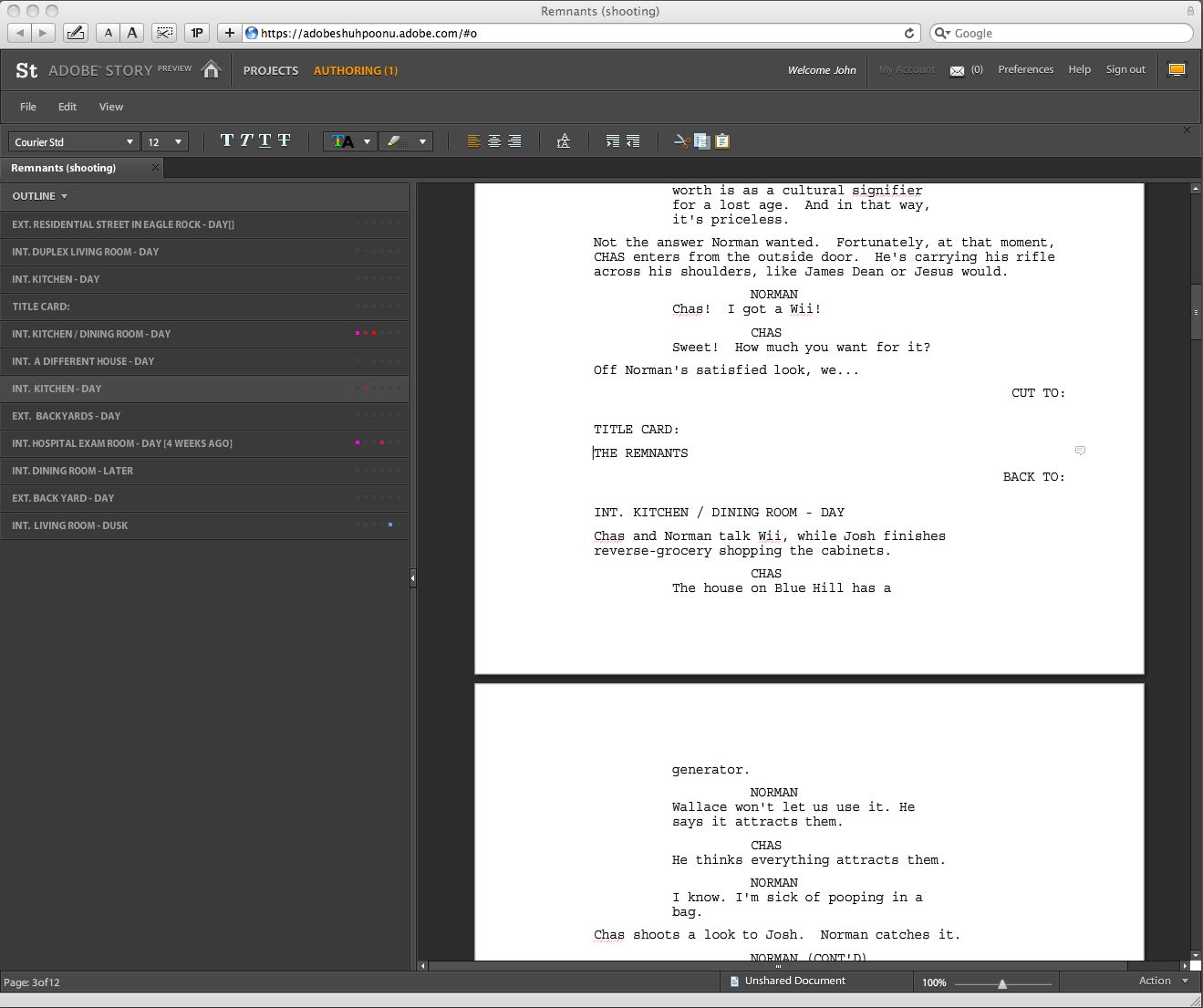
    Reader Andrew pointed me to the preview version of Adobe Story, the new screenwriting application that’s designed to work with Adobe’s Creative Suite.

    It’s Flash-based and runs in the browser (or via Air), but does a credible job duplicating most of what you’d expect from a traditional desktop application.

    screenshot

    Story is definitely a work-in-progress, so it’s not fair to compare it to the dominant players in the field. In its current form, it flubs some fundamentals like drag-and-drop and keeping blocks of dialogue together.

    But while you wouldn’t use it for Actual Work yet, Story does some clever things that are worth calling out.

    • Story tries to identify which characters are in a scene, and uses colored-coded dots to mark them in the outline.
    • The highlighter is really a highlighter, changing the background of text.

    • Full-screen looks good, with everything but the page itself nice and dark.

    • Find and Replace is simply a toolbar in the same window.

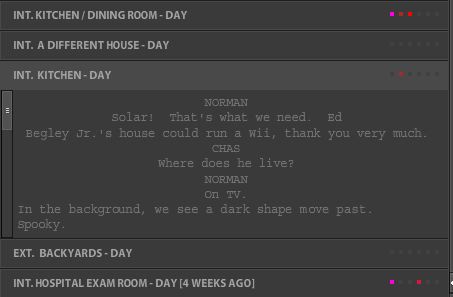
    • Single-clicking a scene header in the outline expands it to a compressed, scrollable version of the scene, so you can check something without losing your place in the script. (Double-clicking a scene header jumps you to that scene.)

    screenshot

    I wish Story well. Competition is good, and a company like Adobe has the resources and experience to keep plugging at it. Yet I have a hard time envisioning it capturing a lot of ground.

    Its text handling is strange, probably a result of its Flash origin. No doubt a lot of that can be remedied, but one of the consequences of platform-independence is that a web application is never going to act quite like a Windows one or a Mac one. With something as basic as text, I don’t want to have to consciously anticipate what’s going to happen if I try to select a word. Just work.

    My other concerns are more philosophical. When the public preview of a screenwriting application lets dialogue spill across page breaks, I get nervous that its developers really don’t understand the format. Properly handling dialogue isn’t a feature; it’s a fundamental.

    The preview version of Story does a good job importing and exporting. I didn’t test out the sharing and version-tracking features, but web-based software has a definite advantage here, and if Story is to make real inroads, it will probably be in this area. For writing teams, this can be very helpful.

    I’ll be looking forward to seeing what Adobe does next with Story.

    ADDED: Whenever I write about screenwriting software, the first questions are about what application I use. I alternate between Final Draft 8 and Screenwriter 6, with no strong preference between the two. I have also tried Celtx, Scrivener and Montage, but haven’t found them adequate for my work.

    « Previous Page
    Next Page »

    Primary Sidebar

    Newsletter

    Inneresting Logo A Quote-Unquote Newsletter about Writing
    Read Now

    Explore

    Projects

    • Aladdin (1)
    • Arlo Finch (27)
    • Big Fish (88)
    • Birdigo (2)
    • Charlie (39)
    • Charlie's Angels (16)
    • Chosen (2)
    • Corpse Bride (9)
    • Dead Projects (18)
    • Frankenweenie (10)
    • Go (29)
    • Karateka (4)
    • Monsterpocalypse (3)
    • One Hit Kill (6)
    • Ops (6)
    • Preacher (2)
    • Prince of Persia (13)
    • Shazam (6)
    • Snake People (6)
    • Tarzan (5)
    • The Nines (118)
    • The Remnants (12)
    • The Variant (22)

    Apps

    • Bronson (14)
    • FDX Reader (11)
    • Fountain (32)
    • Highland (75)
    • Less IMDb (4)
    • Weekend Read (64)

    Recommended Reading

    • First Person (87)
    • Geek Alert (151)
    • WGA (162)
    • Workspace (19)

    Screenwriting Q&A

    • Adaptation (65)
    • Directors (90)
    • Education (49)
    • Film Industry (489)
    • Formatting (128)
    • Genres (89)
    • Glossary (6)
    • Pitches (29)
    • Producers (59)
    • Psych 101 (118)
    • Rights and Copyright (96)
    • So-Called Experts (47)
    • Story and Plot (170)
    • Television (165)
    • Treatments (21)
    • Words on the page (238)
    • Writing Process (177)

    More screenwriting Q&A at screenwriting.io

    © 2026 John August — All Rights Reserved.