• Skip to primary navigation
  • Skip to main content
  • Skip to primary sidebar

John August

  • Arlo Finch
  • Scriptnotes
  • Library
  • Store
  • About

flagged

Introducing Less IMDb

November 15, 2010 Geek Alert, News

Less IMDb IconI love IMDb. I’m forever thankful that such a great and free resource exists.

But the new layout blows.

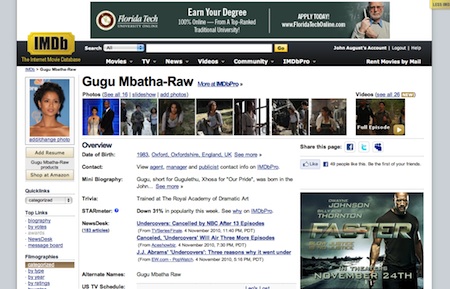
They’ve made it more difficult to do the one thing I come to IMDb to do: look at credits. New sections for photos, videos and trivia (star signs!) push credit lists below the fold, forcing you to scroll.

Rather than complain about it, Ryan and I decided to fix it.

Less IMDb is a Safari extension — and now Chrome and Firefox — that rearranges IMDb’s name and title pages to bring credits to the top. So instead of this:

IMDb Profile Page

You get this:

Less IMDb Profile Page

Just install the extension and you’re done. It will automatically update if something changes on IMDb’s end. And if you need to turn it off for a given page, the switch is always available on the right-hand side.

Check it out, and pass it along if you find it helpful.

Update:

A few readers have written in with suggestions about how to get back to the pre-updated layout by changing settings at IMDb. I think this is a case of rose-colored nostalgia, however. It was always pretty bad.

Here’s the same screenshot with the original layout:
original IMDb layout

Credits are still buried deep on the page, under quite a bit of junk. It’s familiar, but it’s hard to call it “better.”

(Quick tip: Add a + to the end of the URL to force it to use the original layout. Helpful if you want to compare old vs. new layouts. Works with the extension installed or not. Thx Hannes.)

Try out Less IMDb.

The One-Month Manager

October 19, 2010 Film Industry, Producers, Psych 101, QandA

questionmarkWhat’s a reasonable amount of time to give your manager to read a draft of your script? It sometimes takes mine up to a month.

It seems long to me and I have been losing faith in his desire to get me work or sell my scripts. I’ve been with him for two years now and got a lot of meetings with the first script we went out with, but in the last year and a half nothing. At first he was very hands on and now it seems he has pushed me to the very bottom of his to do list.

I’ve stayed in touch with some of the producers I’ve taken meeting with and was wondering if it’s crossing a line to ask them to help me get a new manager or an agent?

— Mike
Hollywood

Don’t worry about firing your manager. He’s already fired you, but doesn’t have the guts to tell you.

Substitute “manager” for “agent” and follow my advice on How to leave an agent. You could have the Big Talk with him, but in the end I strongly suspect you’ll need to move on.

If you’ve kept up relationships with those producers you’ve met, it’s absolutely fair to ask their input on a new manager and/or agent. But it’s going to be really awkward if your only contact was the meet-and-greet months ago. They need to be colleagues, not contacts.

Ask yourself whether you’ve done everything you could to make your screenwriting career happen. As I put it before:

The biggest change shouldn’t be who is representing you, but how you’re representing yourself. As you take meetings, make them understand that you will work your ass off to land assignments, then work five times harder to deliver. Say it and mean it.

I wouldn’t bother firing your manager until you have something new and shiny with which to attract attention.

UPDATE:

Reader James points out I never really answered the question of how long is too long to wait.

If you hand your manager a script on a Monday or Tuesday, you should expect to hear back by Friday — or get a call/email saying that he’ll read it over the weekend. A script delivered on Wednesday or later will probably be weekend reading as well.

He should get back to you by the Monday afternoon with word that he’s read it, or an explanation if he hasn’t. If you haven’t heard back, take the initiative and call/email.

How to write on the spine of a script

September 28, 2010 Film Industry

Back in my ramen days as a young screenwriter, I used to marvel at colleagues’ script libraries, shelves of brass-bradded screenplays generally organized by writer. They were a status symbol. “Oh, you haven’t read POINT BREAK?” they would ask, finger hovering by the title. “You know James Cameron did a rewrite.”

Screenplays were a physical *thing* to be borrowed and traded and photocopied. Moving from one apartment to another — young Los Angelenos generally relocate annually — meant hauling file boxes of scripts. Reading meant heavy lifting.

Now, of course, in the age of iPads and .pdfs, printed scripts are much less important. A shelf full of old screenplays feels quaint, bordering on out-of-touch, much like boasting about one’s CD collection.

I’ll gladly take convenience over nostalgia.

Still, there are times you do need a printed script. For example, production drafts are increasingly only distributed on paper, in order to reduce the chance of leaking on the internet. Or you may have so many hand-written notes in a script that it’s important to retain the physical draft.

Based on some printed scripts I’ve seen recently, a related skill may be on verge of being lost forever: writing neatly on the spine of a script.

Here’s a quick tutorial.

1. Remove any brads or binder clips.
2. Hold the script by the top and bottom.
3. Slam it hard on its left edge. Do it twice or three times if you need to let out some steam. You want every page to be absolutely flush.
4. Put the script near the edge of the table.
5. Pushing down with your non-writing hand to keep the pages pressed firmly together, write the title on the edge with a Sharpie. Include date or draft if applicable.
6. Restore brads or clips.

YES:

proper spine writing

NO:

bad spine writing

If you’re pretty sure a script will go from your hands to the recycling bin, don’t bother labeling it. Any script that is going to be stacked, shelved or filed should be labelled on its spine.

Screenplays are now often printed two-sided, which means they’re half as thick as they used to be. That’s okay. Same technique still works — just write smaller.

In Go, would Todd have shot Ronna?

August 31, 2010 Go, Projects

questionmarkThank you for writing one of my favorite movies. I saw Go at the theater when it was released and it has since been one of my favorite movies. One my favorite characters in one of my favorite movies is Todd Gaines.

There is one part that has always left me wondering. Was Todd really going to kill Ronna?

On one hand, Todd simply didn’t seem like a murderer. A sleazy drug dealer? Yes. Murderer? No.

On the other, in a deleted scene, he did pull a gun on Claire and left Ronna for dead after Adam and Zach hit her with the car.

Todd also didn’t come across as stupid, reckless or naive. It seems if he wanted to kill someone, he would have chosen a better place than a very public party where he likely would have been recognized by his clientele.

This has always been a dilemma to me. I was hoping you could shed some light on it for me.

— Thomas Lehman

todd gainesTodd Gaines never shot anyone, and had no intention of killing Ronna. He wanted to scare her.

Look at events from his perspective: He’d been played for a fool by a cocky teenage girl. Beyond the sting to his ego, she’d cost him money. If word got around out how she’d outsmarted him, other customers might lose their healthy fear of him. He knew where Ronna would be, so he decided to go find her.

When their conversation was interrupted by a poorly-driven Miata, Gaines bolted. I’d consider that fight-or-flight, a self-preservation instinct. When they find a girl’s body, you don’t want to be the guy with a gun.

In conversations with Tim Olyphant before we shot the movie, we discussed that Gaines probably wasn’t a full-time drug dealer. Maybe he went to art school, or worked as a club promoter. For set decoration, we gave him an art table and a bunch of illustrations.

If you met Gaines on a rainy morning — like Claire later does — you might think he’s a pretty nice guy.

« Previous Page
Next Page »

Primary Sidebar

Newsletter

Inneresting Logo A Quote-Unquote Newsletter about Writing
Read Now

Explore

Projects

  • Aladdin (1)
  • Arlo Finch (27)
  • Big Fish (88)
  • Birdigo (2)
  • Charlie (39)
  • Charlie's Angels (16)
  • Chosen (2)
  • Corpse Bride (9)
  • Dead Projects (18)
  • Frankenweenie (10)
  • Go (29)
  • Karateka (4)
  • Monsterpocalypse (3)
  • One Hit Kill (6)
  • Ops (6)
  • Preacher (2)
  • Prince of Persia (13)
  • Shazam (6)
  • Snake People (6)
  • Tarzan (5)
  • The Nines (118)
  • The Remnants (12)
  • The Variant (22)

Apps

  • Bronson (14)
  • FDX Reader (11)
  • Fountain (32)
  • Highland (75)
  • Less IMDb (4)
  • Weekend Read (64)

Recommended Reading

  • First Person (87)
  • Geek Alert (151)
  • WGA (162)
  • Workspace (19)

Screenwriting Q&A

  • Adaptation (65)
  • Directors (90)
  • Education (49)
  • Film Industry (489)
  • Formatting (128)
  • Genres (89)
  • Glossary (6)
  • Pitches (29)
  • Producers (59)
  • Psych 101 (118)
  • Rights and Copyright (96)
  • So-Called Experts (47)
  • Story and Plot (170)
  • Television (165)
  • Treatments (21)
  • Words on the page (238)
  • Writing Process (177)

More screenwriting Q&A at screenwriting.io

© 2026 John August — All Rights Reserved.