
• Skip to primary navigation
  • Skip to main content
  • Skip to primary sidebar

John August

  • Arlo Finch
  • Scriptnotes
  • Library
  • Store
  • About

flagged

Show your work, pt. 2

March 16, 2009 Follow Up, Geek Alert, Rant

geek alertFollowing up on last night’s post, it occurs to me that designing and programming for the web also has an aspect of showing your work. Nearly every browser lets you “View Source,” showing how the page was constructed…up to a point.

For example, if you View Source on the new Answer Finder I built, you can see the JavaScript (and jQuery) that drives the menu and shows/hides the various sections.

What you can’t see is the PHP on the server that generated those sections. In my case, this is a good thing, because the PHP is so awful and kludgy that I can’t explain or defend why it works.

So to make that one page, I’m relying on a bunch of technologies with vastly different levels of transparency.
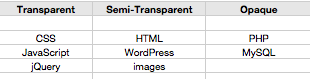
transparencyThe “transparent” technologies are available for anyone interested in looking. And that’s mostly good: Peeking beneath the hood is a great way to learn how a technology works. I often find myself opening the CSS for sites I like to see how they’re constructed. ((Keep in mind that you can learn bad habits this way.))

I’m classifying HTML as semi-transparent because so much of the HTML you see when you “View Source” for a site is generated by scripts running on the server, and it’s not automatically clear how or why. WordPress, for example, mixes in at least four parts (Header, Content, Footer and Sidebar) to make any given page. Someone familiar with WordPress might be able to deduce a basic structure, and figure out which parts were generated by The Loop. But in some cases it’s arbitrary. For example, the category links at the bottom of most pages on this site could be hard-coded or generated on the fly, and you wouldn’t be able to tell.

While you can find a lot of information about the images used on a site, including where they’re stored, you don’t necessarily know how they were generated. The chart above, for example, is a .png made from a snapshot of a Numbers document.

In the fully-opaque category are PHP and MySQL, who do most of the heavy lifting for the site but are completely insulated from the user.

Traditionally, programmers have been able to disappear behind the opacity of a compiler. Designers could hide behind the printing or manufacturing process. With the web, the process behind the product is much more visible.

(End of Geek Alert)

The same thing is happening to movies. Not too long ago, a movie came into existence in popular culture just shortly before its release, when the first ads and trailers started running. I didn’t know anything about Die Hard before I saw a trailer. I saw The Blair Witch Project without any idea who made it or how.

Now, long before the marketing begins — before production even begins — details of projects spill across the internet for consumption and criticism. Scripts leak. Photographers sneak pictures of the set, or the costumes. The omission of a giant squid becomes the focal point of conversation for a movie that doesn’t yet exist.

For movies and television, I’m not sure we’re better off “showing the work” in advance.

I appreciate reading American Cinematographer to see how Robert Elswit lights There Will Be Blood, but I don’t read those articles before seeing the movie, lest I get too distracted by those details when I watch it. Likewise, I wish I didn’t know what I know about Terminator: Salvation or Dollhouse. It’s not insider knowledge, but rather the media reporting on the media.

This isn’t transparency, an invitation to come look inside. It’s forced exposure. It’s uncomfortable, and by nature we try to avoid uncomfortable things.

Random Advice

March 9, 2009 Random Advice

Most of my posts offer advice about screenwriting. This week, I’m going to be running a few articles with advice about everything else.

Answer Finder

March 2, 2009 Geek Alert, Meta, QandA, Scrippets

I’ve had some version of this site up and running since 2003, when I became frustrated with how difficult it was to search through previous columns I’d written for IMDb. ((Remarkably, they’re still running these, even though it’s been years since I’ve written a new one.))

Unlike most blogs, ((I’m using “blog” in the 2009 sense of a series of short posts arranged chronologically, newest first. That is: a blog is a blog because of the way it’s formatted, not because of the content per se. It’s easy to forget that the term blog originally referred to weblogs, or online personal journals.)) many of the 1,000+ posts on this site are still highly relevant today. They’re answers to reader-submitted questions, and most of the questions haven’t changed. It’s often difficult to find these older entries, however, and the chronological blog format doesn’t help. I’ve struggled to find ways to make it easier to dig around.

The category archives at the bottom of (almost) every page are a start. Clicking on Education, for example, will take you to a listing of all the articles in that category, along with brand-new summaries — most of them written by Matt.

Another option is what I’m calling Answer Finder, which takes all the screenwriting-related entries and groups them together in a much more browsable interface. It’s an experiment, and your feedback is certainly appreciated. Two caveats:

  • There are known issues with Internet Explorer. In particular, the category box appears too far down the page. It’s a problem with IE’s box model, and if someone wants to grab the CSS and fix it, knock yourself out.
  • Some of the older entries have weird formatting, particularly with scrippets, because the specs have changed over the years. One by one, we’ll be going through old posts and fixing them. But if you see something wonky, feel free to note the URL in the comments to this post.

geek alertFor the truly curious, here’s how Answer Finder works. (You’re welcome to look at the source, of course.)

  1. Getting both categories and posts out of WordPress is more difficult than you’d think, which is why I’m happy to have found the plugin WP Categories and Posts.
  • I hacked the plugin to make it generate DIVs for each category. ((When I say “hack,” I really mean it. It works because it works, not because I really understand it. PHP makes baby Jesus cry.))

  • With a custom page template (an under-appreciated WordPress feature), I used jQuery to hide the DIVs, bind the category menu and place a session cookie to help you come back to the same place when navigating away. ((jQuery, by the way, is awesome. It lets a barely-programmer like me leverage a lot of CSS knowledge. And I have new respect for JavaScript, which is more Pythonic than I was anticipating. Given the speed boosts in the new Safari and Google Chrome, I’m looking forward to seeing what ambitious ideas will be coming down the pipe in 2009.))

  • Let me know how the new page is working, or not working, over the next week. You may see periodic downtime or wonkiness while things get sorted out.

    Authors’ Guild vs. Kindle

    February 26, 2009 Books, Follow Up, Rights and Copyright

    Cory Doctorow makes many of the points I would about the Authors’ Guild’s grumpiness over the Kindle’s text-to-speech function:

    Continuing to take Blount at his word, let’s assume that he’s right on the copyright question, namely, that:

    1) Converting text to speech infringes copyright

    2) Providing the software that is capable of committing copyright infringement makes you liable for copyright infringement, too

    1) is going to be sticky — the Author’s Guild is setting itself up to fight the World Blind Union, phone makers, free software authors, ebook makers, and a whole host of people engaged in teaching computers to talk.

    But 2 is really hairy. If Blount believes that making a device capable of infringing copyright is the same as infringing copyright (something refuted by the Supreme Court in Betamax in 1984, the decision that legalized VCRs), then email, web-browsers, computers, photocopiers, cameras, and typewriters are all illegal, too.

    That said, a colleague of mine made a good point: It’s sort of the Authors’ Guild’s job to stir the pot. They might be wrong — they might know they’re wrong — but it’s important to have a group trumpeting the issues of concern to their members.

    I think the potential win here will be for Amazon and authors/publishers to find well-priced ways to bundle the text and (real, professional) audiobook versions. I’ve never bought an audiobook, but would consider it if the premium weren’t too high.

    « Previous Page
    Next Page »

    Primary Sidebar

    Newsletter

    Inneresting Logo A Quote-Unquote Newsletter about Writing
    Read Now

    Explore

    Projects

    • Aladdin (1)
    • Arlo Finch (27)
    • Big Fish (88)
    • Birdigo (2)
    • Charlie (39)
    • Charlie's Angels (16)
    • Chosen (2)
    • Corpse Bride (9)
    • Dead Projects (18)
    • Frankenweenie (10)
    • Go (29)
    • Karateka (4)
    • Monsterpocalypse (3)
    • One Hit Kill (6)
    • Ops (6)
    • Preacher (2)
    • Prince of Persia (13)
    • Shazam (6)
    • Snake People (6)
    • Tarzan (5)
    • The Nines (118)
    • The Remnants (12)
    • The Variant (22)

    Apps

    • Bronson (14)
    • FDX Reader (11)
    • Fountain (32)
    • Highland (75)
    • Less IMDb (4)
    • Weekend Read (64)

    Recommended Reading

    • First Person (87)
    • Geek Alert (151)
    • WGA (162)
    • Workspace (19)

    Screenwriting Q&A

    • Adaptation (65)
    • Directors (90)
    • Education (49)
    • Film Industry (489)
    • Formatting (128)
    • Genres (89)
    • Glossary (6)
    • Pitches (29)
    • Producers (59)
    • Psych 101 (118)
    • Rights and Copyright (96)
    • So-Called Experts (47)
    • Story and Plot (170)
    • Television (165)
    • Treatments (21)
    • Words on the page (238)
    • Writing Process (177)

    More screenwriting Q&A at screenwriting.io

    © 2026 John August — All Rights Reserved.