• Skip to primary navigation
  • Skip to main content
  • Skip to primary sidebar

John August

  • Arlo Finch
  • Scriptnotes
  • Library
  • Store
  • About

flagged

On square miles

March 29, 2009 Words on the page

A correction in yesterday’s LA Times:

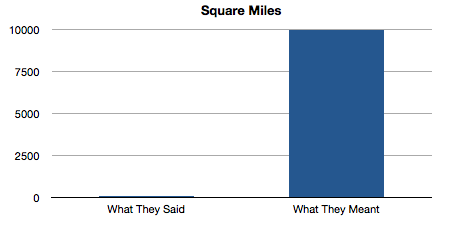
Solar power: A Friday editorial said that according to the U.S. Energy Department, enough sunlight hits a “100-square-mile” portion of the Nevada desert to power the entire country. It should have said “100-miles-square.”

Rearranging two words shouldn’t matter, should it?
square miles chart

Poor copy editing, sure. More than that, it’s bad language design: “square” and “miles” are alternately (and ambiguously) noun and modifier depending on word order. And the hyphens which transform it into an adjective only make it worse.

I’d argue that “square miles” and “square kilometers” really have no place in popular journalism, because we have little connection to what they mean.

square miles chartAs humans, we never travel a “square mile.” We travel a mile. Or ten miles. If we’re thinking about an area of land, we’re probably mentally walking along two of its edges — which is what the LA Times and the U.S. Department of Energy were doing.

A better version would offer something of a roughly equivalent scale:

“According to the U.S. Energy Department, enough sunlight hits a 100-miles-square portion of the Nevada desert (roughly the area of Vermont) to power the entire country.”

Let the right subtitles in

March 27, 2009 International, Video

I found this post about the uproar over the DVD/BR subtitles for Let The Right One In very interesting. Seemingly arbitrary changes really can impact the scene, and you wouldn’t know the difference unless you’d seen (that is, read) the theatrical version.

Warning: Some spoilers if you haven’t seen the movie. (Which you should. It’s terrific.)

Should I write a straight-to-DVD knockoff?

March 27, 2009 Film Industry, Genres, QandA

questionmarkI have a friend who is high up in a production company that specializes in straight-to-DVD low-budget versions of blockbuster movies. As a joke I pitched him a few ideas. Well, he loved them and asked me to write up the scripts.

On the one hand, this could be a great step in the right direction for my career in writing. It would mean getting some real credits to my name. On the other hand, I am afraid I would be labeled as a hack for writing this type of knock-off movie.

So my question is: Which is better? Getting my foot in the door with a bad movie, or hold on to my integrity and look the gift horse in the mouth? Could a bad movie credit hurt your chances in the future?

— Rob
Wilmington, Delaware

James Cameron directed Piranha Part Two: The Spawning. Everyone starts somewhere.

Yes, sure, it would be great if your first paid writing job was a quality movie at a reputable studio, complete with WGA coverage. But don’t turn up your nose at actual paid writing for a company that makes movies. You probably don’t want to make schlock for a living, but you can learn a lot even while making less-than-awesome movies.

Do it. Make it as good as possible for the genre. Then use it as a foothold to reach higher.

Why do LA people suck?

March 26, 2009 Film Industry, Los Angeles, Psych 101, QandA

questionmarkI’ve noticed no matter how close you are to someone in LA, they seem to stab you in the back. I feel like I give them my all, and never want to ask them for “help,” and they end up screwing you over.

I know some people in the industry… and the lifelong question of when to ask someone to read your work, or help you out comes to mind. I am very shy about when to ask, and never want them to think I am “using them.” But, it seems like if you don’t go out every night, and drink and party with them, they lose sight of who you are. Some pull the Kevin Williamson, and you will be introduced to them 100 times, and they still cannot remember your name…

How do you know when to ask for help, or a reference, or both, or even a foot in the door? If you don’t party with them every night is that going to hurt my chances in the long run? And when should you ask?

I don’t want to come off as a user, but it seems like everyone else is. Do I need to sink down to that level to succeed?

I know there is such thing as a missed opportunity….but..?

Thanks in advance,

— “Anonymous.”

What’s not clear from your question — if it really is a question, rather than an extended harrumph — is exactly how people are using you and/or stabbing you in the back. Let’s look at some scenarios.

  • Are you reading their scripts, offering helpful notes, while they can’t be bothered to do the same for you?
  • Are they repeating your ideas as their own?

  • Are they talking behind your back? Stealing your beer? Making love to your girlfriend?

  • Are you helping them move, without receiving reciprocal futon-hauling?

All of these are clear offenses. But my hunch is that nothing so egregious is actually occurring. You’re just finding it difficult to make headway personally or professionally. So you wonder: Is this indicative of the Hollywood culture, or specific to you?

It’s both.

Let’s divide it into more distinct questions.

Does the entertainment industry, and Los Angeles in general, tend to generate a lot of shallow friendships?

In my experience, yes. You end up knowing a lot of people, but not knowing them very well. The boundaries between “someone you know” and “friend” are indistinct. People flake out on you more, offering only half-hearted rsvps (“I’ll try to make it.”) or after-the-fact explanations-cum-apologies (“Traffic was insane.”) Keep in mind that you work in an industry in which people genuinely don’t know when they’ll be permitted to go home. An assistant working at a busy agent’s desk might be there until midnight.

Can you form real friendships in the industry? Absolutely. One of my best friends is the woman who was hired to replace me when I left my last assistant job. I got to know her through the hundred follow-up phone calls asking where a certain file was, or how to handle Crazy Person #32. But you don’t form real friendships when you approach people with the worry that they may stab you in the back.

Here’s the thing to remember: Friends are for your personal happiness. Colleagues are part of your career. You may go to drinks with both, but don’t confuse them.

When do you ask a colleague for help, or a reference, or both, or even a foot in the door?

At whatever moment you think there’s a pretty good chance they would help you. And a lot of that depends on your level of chutzpah. Some of the most successful people in the industry are the most shameless about asking people for things. Brett Ratner wrote to Spielberg, who sent him a check. Does Spielberg feel “used?” Pretty unlikely.

I was never that ballsy, but I did a good job keeping up with my peers, helping them whenever I could. When it came time to move to a larger agency, I asked their opinions and got them to call on my behalf. I’ll call a writer I’ve met once to ask about a project, or an executive, or director with a questionable reputation. That’s how it works.

And don’t assume you have nothing to offer someone who has more experience in the industry. When I have coffee with younger writers, I’m asking them as many questions as they ask me.

How do you ask for help?

By doing so directly, while giving the person an out.

  • “I’m applying for a reader job at New Regency. You said you know Ethan Someguy. Would you feel comfortable calling him on my behalf?”
  • “I wrote a short that I want to shoot next month, and I’d really like your feedback if you’d be willing to look at it.”

  • You then follow up nicely.

    • “Just wanted to check whether you were able to connect with Ethan Someguy.”
  • “I wanted to see if you’d had a chance to read my short.”

  • Is it just me?

    No, Anon, it’s not. At many points in my career I’ve wanted to throw someone through a wall. But the situation you’re describing seems at least partly attributable to your attitude.

    You’re not in the happiest place right now, which could be situational or could be a bigger deal. Disappointment is not depression. But if your overall mood is consistently needling downward, getting the advice of an actual psychology professional would seem to be in order. All the career advice in the world isn’t going to make you happy if larger obstacles stand in the way.

    « Previous Page
    Next Page »

    Primary Sidebar

    Newsletter

    Inneresting Logo A Quote-Unquote Newsletter about Writing
    Read Now

    Explore

    Projects

    • Aladdin (1)
    • Arlo Finch (27)
    • Big Fish (88)
    • Birdigo (2)
    • Charlie (39)
    • Charlie's Angels (16)
    • Chosen (2)
    • Corpse Bride (9)
    • Dead Projects (18)
    • Frankenweenie (10)
    • Go (29)
    • Karateka (4)
    • Monsterpocalypse (3)
    • One Hit Kill (6)
    • Ops (6)
    • Preacher (2)
    • Prince of Persia (13)
    • Shazam (6)
    • Snake People (6)
    • Tarzan (5)
    • The Nines (118)
    • The Remnants (12)
    • The Variant (22)

    Apps

    • Bronson (14)
    • FDX Reader (11)
    • Fountain (32)
    • Highland (75)
    • Less IMDb (4)
    • Weekend Read (64)

    Recommended Reading

    • First Person (87)
    • Geek Alert (151)
    • WGA (162)
    • Workspace (19)

    Screenwriting Q&A

    • Adaptation (65)
    • Directors (90)
    • Education (49)
    • Film Industry (489)
    • Formatting (128)
    • Genres (89)
    • Glossary (6)
    • Pitches (29)
    • Producers (59)
    • Psych 101 (118)
    • Rights and Copyright (96)
    • So-Called Experts (47)
    • Story and Plot (170)
    • Television (165)
    • Treatments (21)
    • Words on the page (238)
    • Writing Process (177)

    More screenwriting Q&A at screenwriting.io

    © 2026 John August — All Rights Reserved.