• Skip to primary navigation
  • Skip to main content
  • Skip to primary sidebar

John August

  • Arlo Finch
  • Scriptnotes
  • Library
  • Store
  • About

flagged

New Wiki for discussing better screenwriting software

April 21, 2004 Geek Alert

While I intend to continue the discussion on this site about how to make better screenwriting software, interested readers might want to check out a new wiki on the topic, which an interested reader forwarded to me yesterday.

For those who’d never used a wiki (and I hadn’t), it’s essentially a series of interlinked web pages which anybody can edit. It’s chaotic and not especially pretty, but it may be a good place to share ideas about what you’d like to see in your dream screenwriting software.

Update March 2011: Dead links. Article retained for historical interest only.
Writing on the Coast Starlight from Los Angeles to Seattle

April 20, 2004 Projects, Tarzan

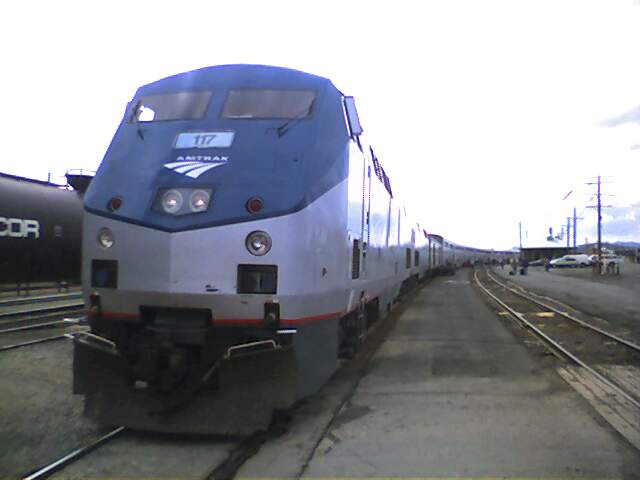
amtrakLast week, I took Amtrak’s Coast Starlight train from Los Angeles to Seattle, which meant 36 hours on the rails. That’s a very long time to spend in linear motion, but it was worth it.

My goal was to get some quality, uninterrupted writing time for the oft-delayed Tarzan, and I got it. I wrote long-hand, as I usually do on first drafts, and faxed the pages back to Los Angeles once I got to Seattle. Once everything was typed up, I had 41 more pages finished, which is good for three day’s work.

I’d recommend the train for any writer looking for some good alone time. Some caveats:

  1. American trains are much, much slower than their European counterparts. We averaged 35.6 miles per hour.
  2. My train was 2.5 hours late getting to Seattle, which is apparently the norm. So don’t expect to make it somewhere at a specific time.
  3. You absolutely need a sleeping car. I have no trouble flying coach, but beyond hour ten, you’ll be pulling your hair out if you don’t have a door you can shut.
  4. The dining car seats parties of four, so they’ll put you with strangers. Everyone I ate with was friendly and talkative.
  5. Bring a pillowcase. The Amtrak linens are scratchy.
  6. Cell phones work almost everywhere, except parts of Northern California.

I flew back from Seattle, which was always my plan. As much as I enjoyed my Amtrak time, I don’t know if I could have taken another 36 hours of train so soon.

David Dean Bottrell on How I Write

April 17, 2004 First Person, Writing Process

A few months ago, I asked several screenwriters to write a bit about their process for the First Person section. The first one to email me back with an answer was David Dean Bottrell. While I waited for the others answers to come in, I promptly misfiled his response.

This week, David emailed me to ask what the hell happened, and I could only cite my own idiocy. Fortunately, he’s a kind person who will forgive me for it.


first personWhen I have an idea I really like, I launch into a fairly detailed treatment of it. This is where I find out if my seemingly ingenious idea will really translate into a viable (and fun) story. I do this because once I start writing the actual screenplay, my focus will naturally shift to the characters and dialogue and I can easily lose track of the big picture. Writing a treatment gives me a clear perspective on the overall story that I’ll never have again. And since (as we all know) story makes or breaks a screenplay, attention paid to it now will save me a ton of time and grief later.

Once I start the screenplay, the task is to make sure my story is fully and truthfully lived out by the characters — and if they seem to want to do things a little differently than I had planned, I let them do it. I never try to write well on a first draft. I just hammer it out. I never edit while I’m writing (that comes after I’ve finished a draft). After about three passes on a script, I’ll show it to someone I trust. Usually they confirm my worst suspicions and then the repair work begins.

From this point on, other people are going to be involved and my job becomes about shaping and reshaping the script based on the feedback I’m getting. The greatest lesson I’ve learned from this part of the process is that (contrary to MY former beliefs) other people sometimes have terrific ideas that can significantly improve my script. Not always, but sometimes. Sometimes I agree to a change that I don’t initially like only to find that within a couple of days I love it and can’t wait to take full credit for the idea! In my experience, screenwriting (kinda like life!) is about choosing a path, then accepting the inevitability of change and learning to deal with it creatively.

I have yet to have a normal day at work. I write daily though I don’t keep specific office hours. I’m not one of those guys who can write in coffee shops – mostly because I live in L.A. and inevitably someone always comes up and asks what I’m writing and then wants to tell me about what he’s writing and then I somehow wind up agreeing to read his script.

Sometimes, my work day is dictated by deadlines so there are occasional late nights. Generally speaking, I protect my writing time by turning off phones and disconnecting from the internet – which can be a very tough thing to do since writing is at times a lonely process. I’ve found that not much good work happens if I am in a bad or cynical mood so I have lots of goofy (AKA “borderline idiotic”) tricks I play on myself in order to stay happy and interested in the work — And if you think I’m going to tell you what they are, you’re sorely mistaken, bub. Mostly, I try to respect and take pride in being a writer which helps me sit there and do it when I’d much rather go out and get drunk.


David Dean Bottrell co-wrote the screenplay for the Fox Searchlight feature, Kingdom Come. He has sold both spec scripts and pitches, rewritten scripts by other writers, adapted novels and written for feature animation.

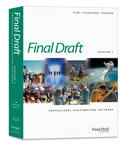
New Final Draft version 7.0 is…marginally better

April 8, 2004 Formatting, Geek Alert

finaldraftjpg
My screenwriting software of choice has long been Final Draft, which is 90% great, 10% maddening and significantly better than any of the other programs I’ve tried — and believe me, I’ve tried a bunch. This past month, Final Draft came out with version 7.0, which was the first major update in a while.

On the plus side, the new version is stable. It hasn’t quit on me, and it hasn’t had the same refusing-to-launch problem the last version had. It doesn’t choke on the previous version’s files, which is a problem I’ve encountered every previous integer-level upgrade.

One nice new feature is the ability to split a document window, so you can see two parts of the script at the same time. You can show one of the panels in scene-navigator view, or as index cards — which can now have two sides. On a big screen, keeping the left panel open to the scene navigator lets me click through to specific sections quickly.

Splitting the screen is helpful, but hardly revolutionary. Many Mac programs — including Microsoft Word — have had split windows for over a decade. Final Draft runs into familiar problems with this setup. If you make a selection in one panel that extends into the region shown in the other panel, the program freaks out. Caveat selector.

I never use Final Draft’s index cards. While in theory it would be great to reorganize your script just by moving some cards around, real life screenplays never work that way. Scenes aren’t Legos, and they can’t be flopped around willy-nilly. In my opinion, better choices for outlining are Omni Outliner and Pyramid. Each of these has free demo versions.

Final Draft 7 is apparently better at exporting .pdf files. That may be new for Windows, but if you’re using Mac OS X, I’d highly recommend using “Print…” and “Save to .pdf” instead. That way, you have all the options of the print dialog box, and you’re guaranteed to get just what the printer would.

There are other features I wish Final Draft had, such as XML export for the web, a clipping bin, and less-aggressive Smart Lists. But on the whole, the program works well for what I make my living doing. And for screenwriters lucky enough to have an honest-to-goodness movie on their hands, the production features alone are worth the price. Final Draft does a very solid job locking pages and tracking revisions, which makes sending out colored pages considerably easier than it has any right to be.

Should you buy Final Draft? Probably. Should you upgrade? That depends. If you’re happy with version 6, there’s really no pressing need. Version 7 isn’t bad, but it isn’t a huge improvement.

« Previous Page
Next Page »

Primary Sidebar

Newsletter

Inneresting Logo A Quote-Unquote Newsletter about Writing
Read Now

Explore

Projects

  • Aladdin (1)
  • Arlo Finch (27)
  • Big Fish (88)
  • Birdigo (2)
  • Charlie (39)
  • Charlie's Angels (16)
  • Chosen (2)
  • Corpse Bride (9)
  • Dead Projects (18)
  • Frankenweenie (10)
  • Go (29)
  • Karateka (4)
  • Monsterpocalypse (3)
  • One Hit Kill (6)
  • Ops (6)
  • Preacher (2)
  • Prince of Persia (13)
  • Shazam (6)
  • Snake People (6)
  • Tarzan (5)
  • The Nines (118)
  • The Remnants (12)
  • The Variant (22)

Apps

  • Bronson (14)
  • FDX Reader (11)
  • Fountain (32)
  • Highland (75)
  • Less IMDb (4)
  • Weekend Read (64)

Recommended Reading

  • First Person (87)
  • Geek Alert (151)
  • WGA (162)
  • Workspace (19)

Screenwriting Q&A

  • Adaptation (65)
  • Directors (90)
  • Education (49)
  • Film Industry (489)
  • Formatting (128)
  • Genres (89)
  • Glossary (6)
  • Pitches (29)
  • Producers (59)
  • Psych 101 (118)
  • Rights and Copyright (96)
  • So-Called Experts (47)
  • Story and Plot (170)
  • Television (165)
  • Treatments (21)
  • Words on the page (238)
  • Writing Process (177)

More screenwriting Q&A at screenwriting.io

© 2026 John August — All Rights Reserved.