• Skip to primary navigation
  • Skip to main content
  • Skip to primary sidebar

John August

  • Arlo Finch
  • Scriptnotes
  • Library
  • Store
  • About

flagged

Article about Rawson Thurber in the June issue of Premiere

May 11, 2004 News

dodgeballThe June issue of Premiere magazine — on newstands now! — has a nice article on Rawson Thurber, who longtime readers will recall was my faithful assistant from ’99 to ’02. He wrote and directed this summer’s DODGEBALL: A TRUE UNDERDOG STORY, which I’ve seen twice and highly recommend. If you watch television, you’ve already seen his work; Rawson created the Terry Tate: Office Linebacker series of ads for Reebok.

DODGEBALL, which unfortunately couldn’t keep its original-and-better title of UNDERDOGS, began as a spec script Rawson wrote while he was working for me. In stark contrast to all the advice I give on this site, he wrote it specifically for Ben Stiller and Vince Vaughn. Since he wanted to direct it himself, he had the foresight to create a funny and award-winning commercial campaign (Terry Tate), so that people would take him seriously as a director. He got an agent, got the script to Stiller’s production company, and within a year had a movie in production. It’s a helluva story.

This same issue of Premiere also features the annual Power List, which is always entertaining. So pick up a copy.

Big Fish sells 2 million DVDs in its first week

May 9, 2004 Big Fish, Projects

Big Fish DVD coverAccording to The Hollywood Reporter, Big Fish sold 2 million DVDs in its first week of release. Many thanks to all of those who bought a copy. Or three. And if you haven’t bought one yet, you can click the pretty picture to buy one through Amazon.

The screenwriter averages about five cents in residuals for every DVD sold, so that works out to $100,000. That’s a solid amount of money — enough to convince otherwise rational Americans to humiliate themselves on reality TV shows, for instance. So before I launch into an explanation about why DVD residuals are too low, understand that I’m not so jaded as to think a hundred g’s is a pittance. It’s a lot, and I’m grateful for it.

The issue of DVD residuals (and video-on-demand, the technology that will one day supplant it) is one of the primary topics of the current WGA negotiations. I won’t go into a long history here, but the formulas used for home video residuals are based on videotapes, which are relatively expensive to produce, and sell for a fairly low price. Technology changes. DVDs are cheaper to produce, and sell for a higher price. But the formula for paying residuals is still locked into the old paradigm. Studios make a hell of lot more on each DVD they sell, but the writer (and actor, and director) still get the same amount.

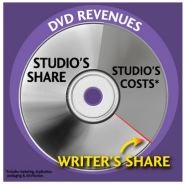
residualsA recent campaign by the WGA East does a graphical breakdown of the numbers, but let’s take Big Fish as an example. According to Video Business, its MSRP is $28.95, but most people will pay less than that. Let’s say $20, which is what you’d pay on Amazon. And Amazon is still pulling a 25% markup at that price; it buys the DVD wholesale at $16.

How much does it cost to manufacture, package, distribute and market each DVD? On average, $5.45. So the studio is making a profit of $10.55 on each DVD sold. For Big Fish, that means Columbia/TriStar has made $21.1 million profit in just one week. Of that, the writer gets the “point-one.”

I’m certainly not faulting the studios for having found a great business model. I love DVDs. But whenever writers, directors or actors ask for a greater chunk of residuals, the studios cry poverty, which is absurd. True, fewer movies are earning their investment back in their initial domestic run, but that’s largely because of inflated production and marketing costs. The box office is still incredibly strong, and distributors have never had a cash stream like DVD.

The other arena in which DVDs are crucial is television. TV writers used to make their real money in syndication. Increasingly, series are sold on DVD, which greatly cuts down on the syndication life of a show. After all, who wants to watch an old Smallville at 6:00 p.m. with commercials, when they have a pristine copy sitting on the shelf? Since DVD residuals for TV shows are much lower than syndication residuals, the writer loses.

So how much should the writer get for residuals? Per unit, one percent of the wholesale price. It’s a nice, easy-to-understand figure, which works out to 16 cents per copy. This will never happen. But it would be fair.

Screenwriting software survey results are in

May 8, 2004 Formatting, News

survey_iconTwo weeks ago, I set up a survey to gauge how screenwriters felt about the screenwriting software they used. This morning, I closed the survey, which capped out at 130 responses — most of them coming the first week. My thanks to all the writers who participated.

Is 130 responses a statistically valid sample? Probably not, but we’re not electing a president here. The goal was just to get a better sense of how screenwriters felt, and on that level, I think the results are pretty clear.

As I talk through some of my observations, I’ll focus on three different groups. “All Writers” refers to anyone who responded to the survey. “Professional Writers” means respondents who identified themselves as earning their living as a screenwriter. Since I have no way of knowing whether these people really make their living off the screen trade, I’ll also single out “Verified Writers.” These are screenwriters who I personally emailed, so I know they do it for a living.

Over the next week or so, I’ll post some further thoughts and conclusions. But for now, I just wanted to present some general observations:

1. Most screenwriters use Final Draft.
In all, 75.2% of respondents used some version of Final Draft. For verified writers, that number rises to 100% (13 of 13). For all writers, the number two program was Movie Magic Screenwriter, followed by Microsoft Word and Sophocles.

2. Most screenwriters are happy with their current program.
A whopping 87% of respondents rate their program Good or Excellent, and 83% fall in the Satisfied camp. Those numbers drop to 77% and 78% for verified writers, but are still quite good.

3. Real writers use Macs.
Granted, that’s a biased bullet point. But it’s worth noting that among verified writers, Mac users outnumber Windows users by more than two-to-one (69.2% vs. 30.8%). In the less strict professional writers category, the numbers are roughly even (50% Mac vs. 47.1% Windows). Windows comes out on top for total respondents, 59% to 38.5%.

4. There are a lot of features no one uses.
Among these: index cards, collaboration, character name generator, computer voice reading, and email from within the program. Split screens could be added to this list, but since that’s a new feature for Final Draft v. 7, it’s understandable why most people don’t use it.

5. People want features they don’t use.
The great thing about surveys is that they can reveal logic inconsistencies. For instance, 51% of all writers never use script compare, yet 67% consider it Crucial or Important.

6. Price is an issue, but people will pay for quality.
For starters, 81.7% of respondents report using a legitimate copy of the program. We can’t know if that’s really accurate, but I’m inclined to believe it. While 58% of writers feel the software they are using costs too much, 47% said they’d be willing to pay $200 for their ideal screenwriting software, and another 39% said $100. To my eyes, that doesn’t seem to be a case of just wanting things cheaper, but wanting a better program for the money.

7. Most people found the survey through my site.
Which makes me feel all warm-and-fuzzy.

I conducted the survey using SurveyMonkey, which is cheap and brilliant. One of the very best things about the service is that by clicking on this link, you can see all of the results for yourself. While you’re there, definitely try the “Edit Filter…” feature in order to see more specific sets of information. (Hint: Check the “Total” versus “Visible” figures to make sure you’re really looking at the data you want.)

As always, please post your comments. I have my opinions, but I’m very curious to know your thoughts about What It Really Means.

Survey up for screenwriting software

April 22, 2004 Formatting, News

The ongoing conversation about screenwriting software, prompted by the release of Final Draft 7.0, has gotten a lot of readers wondering why a better program isn’t out there. After all, compared with the complexity of editing video or managing a website, simply formatting a script should be cake. It’s just words, after all. And there’s no shortage of good ideas for what the ideal screenwriting software should do.

What’s missing from the discussion is any sense of the real numbers. How many writers use which programs and how satisfied are they? What features matter, and which could you live without? And most importantly, is there really a market for an innovative competitor? The only way to find out is to ask, which is why I set up a brand-new survey. (**Update: Survey was completed in 2004, and no longer online.)

It’s short — it should take five minutes, tops. Once we hit a critical mass of responses, I’ll post the results here for everyone to mull over. In the mean time, do your part.

« Previous Page
Next Page »

Primary Sidebar

Newsletter

Inneresting Logo A Quote-Unquote Newsletter about Writing
Read Now

Explore

Projects

  • Aladdin (1)
  • Arlo Finch (27)
  • Big Fish (88)
  • Birdigo (2)
  • Charlie (39)
  • Charlie's Angels (16)
  • Chosen (2)
  • Corpse Bride (9)
  • Dead Projects (18)
  • Frankenweenie (10)
  • Go (29)
  • Karateka (4)
  • Monsterpocalypse (3)
  • One Hit Kill (6)
  • Ops (6)
  • Preacher (2)
  • Prince of Persia (13)
  • Shazam (6)
  • Snake People (6)
  • Tarzan (5)
  • The Nines (118)
  • The Remnants (12)
  • The Variant (22)

Apps

  • Bronson (14)
  • FDX Reader (11)
  • Fountain (32)
  • Highland (75)
  • Less IMDb (4)
  • Weekend Read (64)

Recommended Reading

  • First Person (87)
  • Geek Alert (151)
  • WGA (162)
  • Workspace (19)

Screenwriting Q&A

  • Adaptation (65)
  • Directors (90)
  • Education (49)
  • Film Industry (489)
  • Formatting (128)
  • Genres (89)
  • Glossary (6)
  • Pitches (29)
  • Producers (59)
  • Psych 101 (118)
  • Rights and Copyright (96)
  • So-Called Experts (47)
  • Story and Plot (170)
  • Television (165)
  • Treatments (21)
  • Words on the page (238)
  • Writing Process (177)

More screenwriting Q&A at screenwriting.io

© 2026 John August — All Rights Reserved.