• Skip to primary navigation
  • Skip to main content
  • Skip to primary sidebar

John August

  • Arlo Finch
  • Scriptnotes
  • Library
  • Store
  • About

fixed

New Final Draft version 7.0 is…marginally better

April 8, 2004 Formatting, Geek Alert

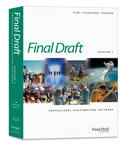
finaldraftjpg
My screenwriting software of choice has long been Final Draft, which is 90% great, 10% maddening and significantly better than any of the other programs I’ve tried — and believe me, I’ve tried a bunch. This past month, Final Draft came out with version 7.0, which was the first major update in a while.

On the plus side, the new version is stable. It hasn’t quit on me, and it hasn’t had the same refusing-to-launch problem the last version had. It doesn’t choke on the previous version’s files, which is a problem I’ve encountered every previous integer-level upgrade.

One nice new feature is the ability to split a document window, so you can see two parts of the script at the same time. You can show one of the panels in scene-navigator view, or as index cards — which can now have two sides. On a big screen, keeping the left panel open to the scene navigator lets me click through to specific sections quickly.

Splitting the screen is helpful, but hardly revolutionary. Many Mac programs — including Microsoft Word — have had split windows for over a decade. Final Draft runs into familiar problems with this setup. If you make a selection in one panel that extends into the region shown in the other panel, the program freaks out. Caveat selector.

I never use Final Draft’s index cards. While in theory it would be great to reorganize your script just by moving some cards around, real life screenplays never work that way. Scenes aren’t Legos, and they can’t be flopped around willy-nilly. In my opinion, better choices for outlining are Omni Outliner and Pyramid. Each of these has free demo versions.

Final Draft 7 is apparently better at exporting .pdf files. That may be new for Windows, but if you’re using Mac OS X, I’d highly recommend using “Print…” and “Save to .pdf” instead. That way, you have all the options of the print dialog box, and you’re guaranteed to get just what the printer would.

There are other features I wish Final Draft had, such as XML export for the web, a clipping bin, and less-aggressive Smart Lists. But on the whole, the program works well for what I make my living doing. And for screenwriters lucky enough to have an honest-to-goodness movie on their hands, the production features alone are worth the price. Final Draft does a very solid job locking pages and tracking revisions, which makes sending out colored pages considerably easier than it has any right to be.

Should you buy Final Draft? Probably. Should you upgrade? That depends. If you’re happy with version 6, there’s really no pressing need. Version 7 isn’t bad, but it isn’t a huge improvement.

AICN Charlie and the Chocolate Factory faux-review noted

March 23, 2004 Charlie, Projects

This morning, the good folks at Ain’t It Cool News put a correction up, stating that yesterday’s review of my CHARLIE AND THE CHOCOLATE FACTORY script was in fact bogus. I want to thank them, and especially Mr. Beaks, for taking care of it.

Getting help as a deaf screenwriter

March 12, 2004 QandA, So-Called Experts

questionmarkHi my name is Sami and I am deaf. I don’t write good in English, although I can write screenplay and know its format.

Suppose if I complete the screenplay and I want to be sure that this screenplay is complete accurate and perfect…how do I make sure it is? Do I send it to some script doctor and have them check the format, grammar, and etc? If so then do they have right to share the credit?

–Sami

answer iconOne of your instincts is right: you do need someone to look over your writing, since your English isn’t terrific. I’m guessing you grew up using American Sign Language, which many non-deaf people assume is a direct adaptation of English. It isn’t. Not only does the language omit a lot of our needless filler words (such as articles), but it can structure sentences and phrases in much different ways than a spoken language might. This is why, over time, it has become very sophisticated and robust. Unfortunately, fluency in signing doesn’t always lend itself to the written word.

Which is where you could use some help.

A “script doctor” isn’t really the right term for what you need. That term generally applies to a highly paid screenwriting pro who does specific, short-term work on a screenplay to fix some perceived problem. What you’re looking for is really just an editor, someone with stronger grammar skills who can help with spelling, word choice and punctuation. Think of it this way: if you were hired to write a magazine article in French, you wouldn’t think twice about having a native speaker look over your work. That’s what you need.

Obviously, you should write about whatever subject interests you, but I’d encourage you to seek out the work of other deaf filmmakers. There are at least three deaf film festivals running, and other entries can be found in many of the better programs around the country. There is also the opportunity for cross-over with deaf theater companies, such as the renowned Deaf West Theater in Los Angeles.

Even if your work ends up having nothing to do with deaf issues, you’d benefit from meeting other writers and artists to see how they handle the challenges and opportunities the medium presents.

Tyger Williams on How I Write

March 8, 2004 First Person, Writing Process

first personThe process of finding my way into a story is different each time. It depends on the subject matter, how innate the material is to me and my sensibilities, or just depending on where I am in my own headspace at the time. I usually try to find my way into the character, or whatever cool set pieces or beats are going to make me really excited and make it fun to write. Some projects require more research, some less. But all of them require a great deal of procrastination.

I generally start with a beat sheet, which I develop into a short outline. It’s all very sketchy at the start. I use a program that allows me to lay my entire story out in blocks (sort of like index cards) so that I can see what it looks like from beginning to end. It also allows me to color the blocks separately so that I can track the protagonist beats, action beats, sub-plot beats, etc. Once I have the outline I make a list of the scenes that I want to write each day. (sort of like a director’s shot list) Sometimes I write in sequence, sometimes not. Often I’ll do dialogue on a tape recorder, just to hear how it sounds and then rewrite it later.

A typical day at he office varies for me depending on whether I’m developing ideas or writing a draft of a script. When I’m drafting I approach it pretty systematically. I budget out my days. Six pages a day, five days a week. Four weeks to a first draft. I usually get in the office around 10:00 a.m. and will write until 1:00 p.m., or at least until I have four pages done before lunch. Then I’ll write again from 2:00 to 6:00. During this time I will write another two pages and loosely revise the day’s work, in addition to returning the necessary phone calls. Now this is all ideally speaking. There are times when I spend the whole day in the office trying to figure out what I’m supposed to write and won’t get it done until I get home and the family’s asleep. Either way, I try to make the day’s pages or I know I’ll have to play catch up later. I only put myself through these paces in order to get a first draft done, and the rewriting/editing phase is considerably more flexible.


Tyger Williams, a product of southern California, attended the University of Utah and Long Beach State University, where he studied Film, Television, and Marketing. After interning as a story analyst, he tried his hand at screenwriting. The immediate results were an unintended comedy, the semi-autobiographical film everyone writes, and his first produced film, MENACE II SOCIETY. Williams has most recently worked on NIGHT TRAIN: THE SONNY LISTON STORY, as well as a remake of the 1970′s blaxploitation film FOXY BROWN, and GRIDIRON GIRLS, a dramedy about life in the world of women’s professional football. He has also developed various television pilots and is currently adapting the Marvel comic character Brother Voodoo into a series for the Sci-Fi channel.

« Previous Page
Next Page »

Primary Sidebar

Newsletter

Inneresting Logo A Quote-Unquote Newsletter about Writing
Read Now

Explore

Projects

  • Aladdin (1)
  • Arlo Finch (27)
  • Big Fish (88)
  • Birdigo (2)
  • Charlie (39)
  • Charlie's Angels (16)
  • Chosen (2)
  • Corpse Bride (9)
  • Dead Projects (18)
  • Frankenweenie (10)
  • Go (29)
  • Karateka (4)
  • Monsterpocalypse (3)
  • One Hit Kill (6)
  • Ops (6)
  • Preacher (2)
  • Prince of Persia (13)
  • Shazam (6)
  • Snake People (6)
  • Tarzan (5)
  • The Nines (118)
  • The Remnants (12)
  • The Variant (22)

Apps

  • Bronson (14)
  • FDX Reader (11)
  • Fountain (32)
  • Highland (75)
  • Less IMDb (4)
  • Weekend Read (64)

Recommended Reading

  • First Person (87)
  • Geek Alert (151)
  • WGA (162)
  • Workspace (19)

Screenwriting Q&A

  • Adaptation (65)
  • Directors (90)
  • Education (49)
  • Film Industry (489)
  • Formatting (128)
  • Genres (89)
  • Glossary (6)
  • Pitches (29)
  • Producers (59)
  • Psych 101 (118)
  • Rights and Copyright (96)
  • So-Called Experts (47)
  • Story and Plot (170)
  • Television (165)
  • Treatments (21)
  • Words on the page (238)
  • Writing Process (177)

More screenwriting Q&A at screenwriting.io

© 2026 John August — All Rights Reserved.