
• Skip to primary navigation
  • Skip to main content
  • Skip to primary sidebar

John August

  • Arlo Finch
  • Scriptnotes
  • Library
  • Store
  • About

fixed

Big Fish sells 2 million DVDs in its first week

May 9, 2004 Big Fish, Projects

Big Fish DVD coverAccording to The Hollywood Reporter, Big Fish sold 2 million DVDs in its first week of release. Many thanks to all of those who bought a copy. Or three. And if you haven’t bought one yet, you can click the pretty picture to buy one through Amazon.

The screenwriter averages about five cents in residuals for every DVD sold, so that works out to $100,000. That’s a solid amount of money — enough to convince otherwise rational Americans to humiliate themselves on reality TV shows, for instance. So before I launch into an explanation about why DVD residuals are too low, understand that I’m not so jaded as to think a hundred g’s is a pittance. It’s a lot, and I’m grateful for it.

The issue of DVD residuals (and video-on-demand, the technology that will one day supplant it) is one of the primary topics of the current WGA negotiations. I won’t go into a long history here, but the formulas used for home video residuals are based on videotapes, which are relatively expensive to produce, and sell for a fairly low price. Technology changes. DVDs are cheaper to produce, and sell for a higher price. But the formula for paying residuals is still locked into the old paradigm. Studios make a hell of lot more on each DVD they sell, but the writer (and actor, and director) still get the same amount.
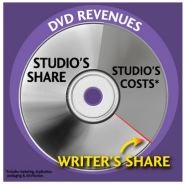
residualsA recent campaign by the WGA East does a graphical breakdown of the numbers, but let’s take Big Fish as an example. According to Video Business, its MSRP is $28.95, but most people will pay less than that. Let’s say $20, which is what you’d pay on Amazon. And Amazon is still pulling a 25% markup at that price; it buys the DVD wholesale at $16.

How much does it cost to manufacture, package, distribute and market each DVD? On average, $5.45. So the studio is making a profit of $10.55 on each DVD sold. For Big Fish, that means Columbia/TriStar has made $21.1 million profit in just one week. Of that, the writer gets the “point-one.”

I’m certainly not faulting the studios for having found a great business model. I love DVDs. But whenever writers, directors or actors ask for a greater chunk of residuals, the studios cry poverty, which is absurd. True, fewer movies are earning their investment back in their initial domestic run, but that’s largely because of inflated production and marketing costs. The box office is still incredibly strong, and distributors have never had a cash stream like DVD.

The other arena in which DVDs are crucial is television. TV writers used to make their real money in syndication. Increasingly, series are sold on DVD, which greatly cuts down on the syndication life of a show. After all, who wants to watch an old Smallville at 6:00 p.m. with commercials, when they have a pristine copy sitting on the shelf? Since DVD residuals for TV shows are much lower than syndication residuals, the writer loses.

So how much should the writer get for residuals? Per unit, one percent of the wholesale price. It’s a nice, easy-to-understand figure, which works out to 16 cents per copy. This will never happen. But it would be fair.
Survey up for screenwriting software

April 22, 2004 Formatting, News

The ongoing conversation about screenwriting software, prompted by the release of Final Draft 7.0, has gotten a lot of readers wondering why a better program isn’t out there. After all, compared with the complexity of editing video or managing a website, simply formatting a script should be cake. It’s just words, after all. And there’s no shortage of good ideas for what the ideal screenwriting software should do.

What’s missing from the discussion is any sense of the real numbers. How many writers use which programs and how satisfied are they? What features matter, and which could you live without? And most importantly, is there really a market for an innovative competitor? The only way to find out is to ask, which is why I set up a brand-new survey. (**Update: Survey was completed in 2004, and no longer online.)

It’s short — it should take five minutes, tops. Once we hit a critical mass of responses, I’ll post the results here for everyone to mull over. In the mean time, do your part.

New Wiki for discussing better screenwriting software

April 21, 2004 Geek Alert

While I intend to continue the discussion on this site about how to make better screenwriting software, interested readers might want to check out a new wiki on the topic, which an interested reader forwarded to me yesterday.

For those who’d never used a wiki (and I hadn’t), it’s essentially a series of interlinked web pages which anybody can edit. It’s chaotic and not especially pretty, but it may be a good place to share ideas about what you’d like to see in your dream screenwriting software.

Update March 2011: Dead links. Article retained for historical interest only.

Writing on the Coast Starlight from Los Angeles to Seattle

April 20, 2004 Projects, Tarzan

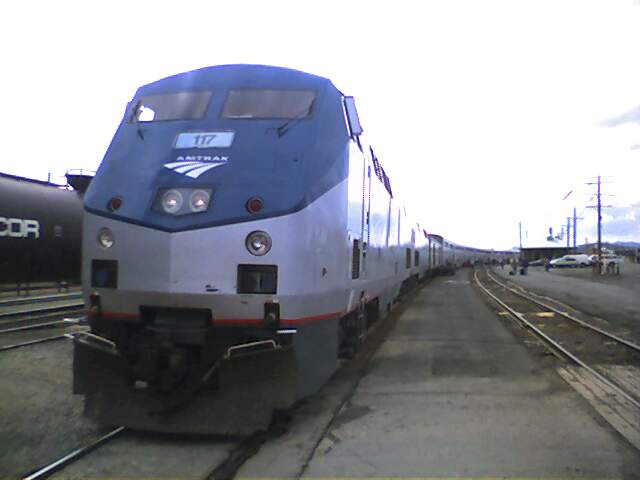
amtrakLast week, I took Amtrak’s Coast Starlight train from Los Angeles to Seattle, which meant 36 hours on the rails. That’s a very long time to spend in linear motion, but it was worth it.

My goal was to get some quality, uninterrupted writing time for the oft-delayed Tarzan, and I got it. I wrote long-hand, as I usually do on first drafts, and faxed the pages back to Los Angeles once I got to Seattle. Once everything was typed up, I had 41 more pages finished, which is good for three day’s work.

I’d recommend the train for any writer looking for some good alone time. Some caveats:

  1. American trains are much, much slower than their European counterparts. We averaged 35.6 miles per hour.
  2. My train was 2.5 hours late getting to Seattle, which is apparently the norm. So don’t expect to make it somewhere at a specific time.
  3. You absolutely need a sleeping car. I have no trouble flying coach, but beyond hour ten, you’ll be pulling your hair out if you don’t have a door you can shut.
  4. The dining car seats parties of four, so they’ll put you with strangers. Everyone I ate with was friendly and talkative.
  5. Bring a pillowcase. The Amtrak linens are scratchy.
  6. Cell phones work almost everywhere, except parts of Northern California.

I flew back from Seattle, which was always my plan. As much as I enjoyed my Amtrak time, I don’t know if I could have taken another 36 hours of train so soon.

« Previous Page
Next Page »

Primary Sidebar

Newsletter

Inneresting Logo A Quote-Unquote Newsletter about Writing
Read Now

Explore

Projects

  • Aladdin (1)
  • Arlo Finch (27)
  • Big Fish (88)
  • Birdigo (2)
  • Charlie (39)
  • Charlie's Angels (16)
  • Chosen (2)
  • Corpse Bride (9)
  • Dead Projects (18)
  • Frankenweenie (10)
  • Go (29)
  • Karateka (4)
  • Monsterpocalypse (3)
  • One Hit Kill (6)
  • Ops (6)
  • Preacher (2)
  • Prince of Persia (13)
  • Shazam (6)
  • Snake People (6)
  • Tarzan (5)
  • The Nines (118)
  • The Remnants (12)
  • The Variant (22)

Apps

  • Bronson (14)
  • FDX Reader (11)
  • Fountain (32)
  • Highland (75)
  • Less IMDb (4)
  • Weekend Read (64)

Recommended Reading

  • First Person (87)
  • Geek Alert (151)
  • WGA (162)
  • Workspace (19)

Screenwriting Q&A

  • Adaptation (65)
  • Directors (90)
  • Education (49)
  • Film Industry (489)
  • Formatting (128)
  • Genres (89)
  • Glossary (6)
  • Pitches (29)
  • Producers (59)
  • Psych 101 (118)
  • Rights and Copyright (96)
  • So-Called Experts (47)
  • Story and Plot (170)
  • Television (165)
  • Treatments (21)
  • Words on the page (238)
  • Writing Process (177)

More screenwriting Q&A at screenwriting.io

© 2026 John August — All Rights Reserved.