• Skip to primary navigation
  • Skip to main content
  • Skip to primary sidebar

John August

  • Arlo Finch
  • Scriptnotes
  • Library
  • Store
  • About

fixed

As it turns out, I could care less

October 13, 2006 Directors, First Person, The Nines

I fired an eight-year old girl.

It was the third day of production on The Movie, which had already endured freak rains, poison oak, rattlesnakes, bee swarms and a mountain lion. None of which could compare to this little girl.

The soon-to-be-fired pre-teen was a stand-in for our eight-year old actress. As a stand-in, her entire job was simply to reflect light and not be annoying. She failed.

She was über-annoying: a cross between Pippi Longstocking and Nellie Olsen. Whichever way I looked, she was there. While I was discussing wardrobe with an actress during lunch, Demon Girl pushed her way into the actress’s trailer, just for a look.

I promptly told the first A.D. that I wanted the brat gone. When she somehow showed up on the set after lunch, I clarified my earlier statement: I never wanted to see that little girl again, beginning immediately. A white production van arrived to whisk her off to whatever circle of Hell or Reseda had spawned her.

Was it really this little girl’s fault? Perhaps not. She was, after all, eight. Her parent-slash-guardian was alarmingly lax, considering the aforementioned rattlesnakes. And there’s a compelling argument that children should not be stand-ins at all. I had asked about using an adult little person for a stand-in. Apparently, it’s not uncommon, but we couldn’t swing it in time.

But that’s not the point.

I offer this story of juvenile termination to illustrate the single most important skill I developed while making The Movie: I learned to care less.

It seems anti-social — anti-human — to argue for less compassion. But in order to direct the film, I consciously decided to harden my heart a little. And by ZeusIn appreciation of Richard Dawkin’s The God Delusion, I’ve decided to stop referring to the Abrahamic God and start spreading the wealth to other mythical deities., it helped.

In ordinary life, I’m nice, to the point of obliging. I tend to treat people in my life like guests at a never-ending dinner party I got roped into hosting. I want everyone to be comfortable, yet at the same time, I secretly want them to leave.

I find myself apologizing for things completely out of my control, like the weather, or the incompetent baggage clerk at Newark.

A friend of mine, who is one of the more emotionally-intelligent people I’ve met, labels this behavior “over-functioning.” I take responsibility for things that I should better leave alone, and reverse-delegate tasks out of a skewed sense of fairness.

This is a questionable strategy for life. But it’s a flat-out awful strategy for directing a movie. A director’s first and only concern needs to be getting the story into the camera — damn the cost, fatigue, frustration and hurt feelings.

So I changed.

I decided that while I was on set, my only responsibility was to the movie, and my ability to direct it. With this philosophy in hand, many decisions became easier.

It didn’t matter why the little girl was annoying. It wasn’t my job to figure out what her malfunction was, or why her parent-slash-guardian wasn’t keeping tabs on her. The little girl was getting in the way, and thus, she had to go.

When the the focus puller tripped during a complicated Steadicam shot, Ordinary John would have insisted that he get checked by the medic. Director John didn’t. Mr. Focus said he was okay, so we kept shooting. I could see he was hurt, but that wasn’t my responsibility. He was a grown-up, and it was his decision. He could take care of himself.

The real test of this new philosophy came while we were shooting at my house. Normally, the presence of any stranger in my home sends me into full host mode. If I haven’t offered you something to drink within the first minute of your arrival, either I’m off my game, or I’d rather you leave. But when it came to The Movie, I let it go. The house was just a location; the crew was just the crew; it wasn’t my responsibility to find more toilet paper.

The real surprise of my Month of Caring Less was that I found myself caring much more deeply about the things that actually mattered.

Without the background noise of a thousand little niceties, I could focus much more clearly on what I wanted to happen in front of and behind the camera. I could talk to actors about motivation in very precise terms, because all I cared about was their moment, not the long-simmering feud between the gaffers and the camera department.

To be clear, I didn’t become an asshole. I think.I guess technically, I shouldn’t care if I did become an asshole. I only yelled three times, which is three more times than I would normally yell in a year, but well within guild standards. After the little girl, I fired three other crew members, not because they were bad people, but because they weren’t doing what I needed them to do for the movie. Which was all that mattered.

And now that we’ve wrapped? I’m probably a little less obliging, a little less eager-to-please. I expect more out of people, and am quicker to express my displeasure when someone isn’t performing.

Still, there’s no doubt I’ve gotten softer. As I recently wrote to that better-adjusted friend:

I’m worried that the theoretical actors and crew of my theoretical movie might feel exploited by a decision I don’t need to make for months if ever. This keeps me awake at night. Not North Korea. This. Bah.

Which, in a way, is fine.

I think part of being a writer, or an actor, is letting yourself feel things without judgment. A director leads an army into battle; a screenwriter leads characters into danger. They’re vastly different jobs, which require different temperaments.

But I’ll definitely keep part of the experience with me. After you’ve cared less, you recognize a certain dishonesty in a lot of what passes for sociability, and the opportunity cost of too much pleasantry.

For example, the first day of shooting, there was one crew member I was certain wouldn’t work out. He was uncomfortably weird and grumpy. Yet as I watched him work, I realized he was just really into his job. Essentially, he was doing what I was doing, putting the movie first and everything else later. He was too focused to be friendly. But he ended up being a lifesaver, solving problems in seconds that could have taken minutes.

So what did I learn in making The Movie? It turned out, I could care less. And both the film and I were better for it.


Austin Film Festival schedule

October 5, 2006 News

In case any readers want to see how much less articulate I am in person, I’ll be speaking on three panels at the upcoming Austin Film Festival. Here are the descriptions the organizers sent out:

The Art of the Pitch
SFA Hotel, Assembly Room
Oct. 19th, 2:45 p.m. – 4 p.m.

Pitching yourself is as important as pitching your script, and it often happens at parties, in elevators, and, of course, at festivals and conferences. Come learn how to hard pitch in a meeting and soft pitch in a casual setting and make sure your pitch leaves people wanting to get their hands on your script.

  • John August
  • Jessica Bendinger
  • Maggie Biggar
  • Alex Smith – moderator

Getting a Writing Job
Driskill Hotel, Maximilian Room
Oct. 20th, 10:45 a.m. – 12 p.m.

Inspired by John August’s Web site, this is the panel formerly known as Breaking Into the Business. Why did we change the name? Because what most writers really want to know is, “How can I get paid for my writing? How do I become a professional writer?” It’s important to know there isn’t just one path to success.

  • John August
  • Brendan McDonald
  • Gregg Rounds
  • Greg Beal – moderator

Tell Your Story
Driskill Hotel, Chisolm Trail Room
Oct. 20th, 3:15 p.m. – 4:30 p.m.

Come and meet John August, writer of Charlie and the Chocolate Factory, Corpse Bride, Big Fish, Charlie’s Angels, Go, and others, in a relaxed and intimate setting. Get here early and join the casual conversation on the couch.

Macworld review of Montage

October 2, 2006 Software

Macworld has a review of Mariner Software’s Montage, which is pretty much right on the money. They give it two out of five mice, admiring its interface while pointing out that it doesn’t do nearly as much as it should: page locking, scene numbering and many other standard features are still on the drawing board. Which is fine for a beta, but not a shipping product.

I like the Montage folks, and have been in e-mail contact with them about an even more fundamental issue for me — the way it handles dialogue across page breaks. They’ve been responsive, and seem to genuinely want to make a great application. Version 2 — or even 1.5 — might be terrific. Right now, Montage is a program that looks finished but isn’t.

I’ve moved beyond hoping for a Final Draft killer — the next version of Screenwriter should do that, assuming it ever ships. But competition breeds innovation, so I’ll always be watching Montage, Celtx and the other upstarts. One of them might just change the game.

ControllerMate and automatic fingers

September 5, 2006 Geek Alert

geek alertI recently upgraded to a Mac Pro, which I justified to myself thusly:
  1. I’m doing effects for The Movie, and Motion runs much faster on it. (In truth, I only did one effect in the final cut.)
  2. My G5 was actually slower than my laptop.
  3. As a writer, I needed a quieter computer.
  4. I deserve to throw some of my Hollywood money around.

The new computer is great, and almost all of my software works perfectly on it. Unfortunately, I’ve had some hiccups with my input devices.

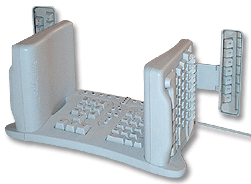
keyboardAs I’ve blogged about, I have a strange keyboard. It looks impossible to use, but I’m actually much faster typing on it than a traditional keyboard, with the added bonus that my arms don’t go numb in the middle of the night.

The Mac Pro isn’t thrilled with my keyboard, which connects through a serial-to-ADB dongle. On restarts, the computer asks me to confirm the keyboard layout, suspicious that I’ve swapped in a Klingon model. Nevertheless, it produces the correct letters every time.

While my odd keyboard is great for typing, it’s singularly awful for key commands, like Copy, Paste and Undo. While one’s fingers can always find the right keys to form words, there’s something different about multi-key combinations. It just doesn’t happen consistently.

nostromo keypadThat’s why I’ve been using a little gaming keypad, the Nostromo N52 by Belkin. Using the software that came with it, I set up keys for Copy, Paste and all the useful shortcuts one is likely to use. With my right hand on the mouse, and my left on the Nostromo, I’m an editing machine.

But the software for the Nostromo refuses to work with the Mac Pro.

At first, I wondered if I could live without it. I thought my fingers would stop reaching for the non-functioning keypad, but they wouldn’t. Thinking I was copying something, I’d be left with a single lower-case g, which is how the computer decided to interpret the chatter from the orphaned device.

Belkin hasn’t upgraded the drivers in years, so I’m not holding my breath that there will suddenly be a new version for Intel Macs like mine. One guy has taken it upon himself to create his own drivers, but it looks like even he’s given up.

Fortunately, there’s a program called ControllerMate which can handle the Nostromo. For $15, it’s almost as good as free, and can do a lot of things that the Belkin software couldn’t. Like confound the hell out of me.

ControllerMate has an elaborate flow-chart-style programming language which looks great but is almost impenetrable. How do you assign a keystroke to a button? It’s as easy as…

  1. Pick the controller from the list.
  2. Double-click it to open the available controller buttons.
  3. Press the actual button on the device to indicate which virtual button it corresponds to.
  4. Drag the virtual button to the programming area.
  5. But first, you might want to make a new programming page. Or a group. Why? You won’t know until you need it.
  6. Now, pull down the menu to outputs, and select “Keystroke” or “Single Key.” What’s the difference? I couldn’t tell you, except that Single Key seems to work and Keystroke locked up my machine in a beeping loop.
  7. Open the virtual keyboard palette and drag the desired key to the well, then add any modifier keys.
  8. Then drag the whole thing to the programming area, and attach it to the virtual button.
  9. Test to see if it works.

Repeat for all of the other keys. Uggh.

To be fair, there’s a benefit to all this abstraction. You can create some pretty elaborate logic by nesting groups and pages, so that hitting one key while another key is pressed performs a special function. But it’s a lot of work to get to Copy and Paste.

My fingers are just happy to be back on autopilot. Just in the course of writing and posting this blog, they’ll have reached for the Nostromo fifteen times. Which is fifteen times less I’ve had to curse under my breath.

« Previous Page
Next Page »

Primary Sidebar

Newsletter

Inneresting Logo A Quote-Unquote Newsletter about Writing
Read Now

Explore

Projects

  • Aladdin (1)
  • Arlo Finch (27)
  • Big Fish (88)
  • Birdigo (2)
  • Charlie (39)
  • Charlie's Angels (16)
  • Chosen (2)
  • Corpse Bride (9)
  • Dead Projects (18)
  • Frankenweenie (10)
  • Go (29)
  • Karateka (4)
  • Monsterpocalypse (3)
  • One Hit Kill (6)
  • Ops (6)
  • Preacher (2)
  • Prince of Persia (13)
  • Shazam (6)
  • Snake People (6)
  • Tarzan (5)
  • The Nines (118)
  • The Remnants (12)
  • The Variant (22)

Apps

  • Bronson (14)
  • FDX Reader (11)
  • Fountain (32)
  • Highland (75)
  • Less IMDb (4)
  • Weekend Read (64)

Recommended Reading

  • First Person (87)
  • Geek Alert (151)
  • WGA (162)
  • Workspace (19)

Screenwriting Q&A

  • Adaptation (65)
  • Directors (90)
  • Education (49)
  • Film Industry (489)
  • Formatting (128)
  • Genres (89)
  • Glossary (6)
  • Pitches (29)
  • Producers (59)
  • Psych 101 (118)
  • Rights and Copyright (96)
  • So-Called Experts (47)
  • Story and Plot (170)
  • Television (165)
  • Treatments (21)
  • Words on the page (238)
  • Writing Process (177)

More screenwriting Q&A at screenwriting.io

© 2026 John August — All Rights Reserved.