• Skip to primary navigation
  • Skip to main content
  • Skip to primary sidebar

John August

  • Arlo Finch
  • Scriptnotes
  • Library
  • Store
  • About

QandA

Good advice from agents

May 28, 2005 Film Industry, First Person

first person
Reader and fellow screenwriter-blogger David Anaxagoras is taking a class from the estimable Mike Werb, who recently brought in David Lubliner and Ken Friemann of the William Morris Agency to talk about agents, managers, and the business of representation.

Mr. Anaxagoras was generous enough to share his notes from class. Since “How Do I Get an Agent” is my number-one most avoided question to answer on this site, I thought I’d take this chance to comment upon some generally excellent advice:

Ken stressed that you should get as many pair of eyes to look at your script as you can, and that the eyes you want are in LA — so move out to LA. Search out managers, lawyers, assistants, creative execs, young directors — anyone who might have a connection and can pass your script along.

Two good points rolled into one. First, never be afraid of showing your work. Put it in the hands of everyone you meet, no matter what their job in the industry. Even these readers aren’t in a position to help you at the moment, one day they will be. Or they’ll know somebody who knows somebody.

Second, move to L.A. Yes, technically it’s possible to become a working screenwriter while living in Boise, but it isn’t likely. L.A. is film what Nashville is to country-western music. You just can’t avoid that.

Often, a good script will not sell. That’s the norm. New writers will get meetings off their script, and should look at it as an opportunity to open doors and build relationships.

I’d amend that to say “most good scripts will not sell.” Don’t look at screenwriting as a lottery ticket. You’re trying to build a career that will last decades. Building relationships with people who love your writing is much more important than a six-figure sale.

New screenwriters should expect to sign up with junior agents. In fact, Ken says it is imperative to sign up with a junior agent. Find someone who is passionate about you and your work and who has a vested interest in advancing your career — and thus their own. An established agent with high-powered clients has little at stake in your ultimate success or failure. Find someone you can grow with.

Yes. You want to grow up with an agent. An agent in his mid-40’s with top-tier clients isn’t going to hustle for you the same way a junior agent in her early 20’s will. More importantly, that agent won’t be having drinks with all the junior execs around town — the guys who oughta be reading your script.

Writers are often asked “what else do you have” in meetings. Ken recommends writers stick to the same genre or something similar until they are established. It’s just too much for Hollywood people to wrap their head around a romantic comedy, a period drama, and a horror pitch all in a short space of time. Remain relatable and help the agent to help you. Earn the right to write different.

Don’t worry about being pigeon-holed until you actually have a career. My first two paid jobs were adapting kids’ books, so I got sent a lot of other kids’ books. It was annoying. But I was working, which is a lot.

Ken let us know that a screenplay has a short window of opportunity once it goes out, and that if it doesn’t sell, writers need to learn to let go and move on. They can’t live off the hope of that one script forever. Instead, they need to keep producing new material. Keep writing — don’t sit around and wait for the sale or the next assignment.

Amen. This is very hard advice to take, because you’ve no doubt poured your heart and soul into those 120 unsold pages. Hopefully, you’ll get great meetings off that script. But don’t expect that one day someone will say, “Hey, we should really buy this old script that’s been sitting on the shelf.” From experience, I can tell you that it doesn’t happen.

You can read David’s whole recap in part one and part two.

Tom Smith on How I Got My Agent
David Steinberg on How I Got My Agent
Michelle Pfeiffer, Supervolcanoes and the Yellowstone Fallacy

May 27, 2005 Los Angeles, Television

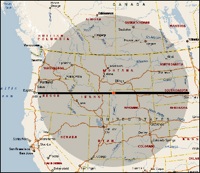
ash falloutI recently watched the Discovery Channel’s Supervolcano, a docu-drama about what would happen if the massive caldera underneath Yellowstone National Park were to erupt.

The program had been sitting on my TiVo for a while, because it’s hard for me to commit to an hour of Alias, much less a three-hour made-for-cable movie. But I knew I’d eventually watch it, because from the moment I first heard about the Yellowstone supervolcano, it was one of those nagging, back-of-my-mind fears. So much so, that I actually included a lengthy monologue about it for a script I was writing. (That scene got cut, so feel free to write your own.)

For those who don’t know, Yellowstone National Park, home of the Old Faithful geyser, is actually the caldera of a massive volcano. And not just a “theoretical” volcano: it’s erupted at least three times before: 2.1 million years ago, 1.3 million years ago and 640,000 years ago. Which, if you do the quick math, suggests that it erupts every 800,000 to 660,000 years. Which means it’s due to erupt now.

timeline

Which is very, very bad.

When Yellowstone erupts, it will be big-summer-disaster-movie apocalyptic. Think Armageddon x The Day After Tomorrow. Twenty feet of jagged volcanic ash strewn across the Midwest, tapering down to a centimeter on the East Coast. Global temperatures will fall. The monsoon will fail. Drought, famine, starvation lasting for years. As Discovery says on the website:

A modern full-force Yellowstone eruption could kill millions, directly and indirectly, and would make every volcano in recorded human history look minor by comparison.

Suddenly, moving to Australia looks a lot more enticing. Yes, there’s the global famine, but at least you don’t have ash falling on your head.

But here’s the thing: Yellowstone is not actually “due” to erupt. That’s a logical fallacy. And the celebrity spokesperson who proved it to me is Michelle Pfeiffer.

Let me provide context.

michelle pfeifferIn 1994, my friend Elizabeth and I went to see The Madness of King George at a movie theatre on the Third Street Promenade in Santa Monica. The movie theatre was pretty full, so we ended up sitting next to a man and woman — who turned out to be Michelle Pfeiffer and her husband David E. Kelly. Being good Los Angelenos, we pretended we didn’t know they were beautiful and famous. We just ate our popcorn, watched the movie, and gossiped after they left.

[Read more…] about Michelle Pfeiffer, Supervolcanoes and the Yellowstone Fallacy

Glossary: Manuscript and Tentpole

May 25, 2005 Film Industry

At readers’ request, I’ve added two new terms to the Glossary:

MANUSCRIPT
The typed (as opposed to type-set) version of a novel, as originally submitted to the publisher by an author. Much of the editing and revision of a book takes place at the manuscript stage.

TENTPOLE
A major motion picture, generally released in the summer or Christmas season, which is the primary focus of a studio’s marketing attention. The term comes from this analogy: if the tentpole fails, everything will collapse around it.

From FD to MMS

May 24, 2005 Formatting, Rant, Software

Craig Mazin of Artful Writer has had enough headaches (and heartaches) with Final Draft. He’s switched over to Movie Magic Screenwriter. You can read about his reasons why here, followed by a lot of opinions from fellow screenwriters.

Me, I’m still using Final Draft, though as often as I complain about it, I should probably give MMS another look.

« Previous Page
Next Page »

Primary Sidebar

Newsletter

Inneresting Logo A Quote-Unquote Newsletter about Writing
Read Now

Explore

Projects

  • Aladdin (1)
  • Arlo Finch (27)
  • Big Fish (88)
  • Birdigo (2)
  • Charlie (39)
  • Charlie's Angels (16)
  • Chosen (2)
  • Corpse Bride (9)
  • Dead Projects (18)
  • Frankenweenie (10)
  • Go (29)
  • Karateka (4)
  • Monsterpocalypse (3)
  • One Hit Kill (6)
  • Ops (6)
  • Preacher (2)
  • Prince of Persia (13)
  • Shazam (6)
  • Snake People (6)
  • Tarzan (5)
  • The Nines (118)
  • The Remnants (12)
  • The Variant (22)

Apps

  • Bronson (14)
  • FDX Reader (11)
  • Fountain (32)
  • Highland (75)
  • Less IMDb (4)
  • Weekend Read (64)

Recommended Reading

  • First Person (87)
  • Geek Alert (151)
  • WGA (162)
  • Workspace (19)

Screenwriting Q&A

  • Adaptation (65)
  • Directors (90)
  • Education (49)
  • Film Industry (489)
  • Formatting (128)
  • Genres (89)
  • Glossary (6)
  • Pitches (29)
  • Producers (59)
  • Psych 101 (118)
  • Rights and Copyright (96)
  • So-Called Experts (47)
  • Story and Plot (170)
  • Television (165)
  • Treatments (21)
  • Words on the page (238)
  • Writing Process (177)

More screenwriting Q&A at screenwriting.io

© 2026 John August — All Rights Reserved.