The original post for this episode can be found here.
John August: Hello. My name is John August.
Craig Mazin: My name is Craig Mazin.
John: And this is Scriptnotes, a podcast about screenwriting and things that are interesting to screenwriters. How are you today, Craig?
Craig: — Caught me mid-sip again. I’m doing fine today. Doing fine. How about yourself?
John: I’m doing really well.
Now Craig, whenever I bring up a television show, your standard response is that you have not seen it because you don’t watch any television shows. So I thought today I would ask what was the last movie you saw in the theater?
Craig: The Help.
John: The Help. Did you enjoy The Help?
Craig: I did enjoy The Help, I have to say. I thought that it was very well directed. Viola Davis, who I mention frequently, is a spectacularly good actor, and I like watching her in pretty much everything. I wasn’t familiar with her until I saw Doubt, and she’s only in Doubt for two scenes really.
But she has this one scene with Meryl Streep that is just unreal, I mean just spectacular, and a great example of a scene where the director just got completely out of the way and just covered it over a two-shot and just let the actors do what they do.
John: Yeah. The director’s name is Tate Taylor and actually a person I’ve known for a very long time. He’s part of the same crew with Melissa McCarthy and Octavia Spencer, so it’s been great to see him have such a success.
Craig: Yes. Tate Taylor did not direct Doubt. He directed The Help.
John: No, no, no. The Help. So The Help was also a tremendous success. That was one of the breakout movies that did not cost a lot of money, made a tremendous amount of money at the box office, and should therefore be completely profitable. Isn’t that correct?
Craig: Yeah. Well, [laughs] yes and no. It depends. Define “profit,” John.
John: Well, I think that’s exactly what we’re going to try to do today. I thought of this actually this weekend. I went to go see Puss in Boots, the animated Puss in Boots, which was actually really good. But I hadn’t seen the Shrek movies for a long time, so this was the first time getting back into that world. It was really nicely done.
But as I was buying my ticket, I started to think about like, “Wow. How much of this ticket is actually going to go back to the movie versus the everything else of it all?” So this is going to be an upper-level discussion I think because it’s not talking just about the words on the page but just how the film industry works and how money in the film industry works. So let’s put on our big brains and talk through the whole thing.
Craig: Yeah, that’s worse than big-boy pants today. Well, it’s a good thing we’re talking about it because it actually is very relevant for what we do. Screenwriters are in a constant state of employment-seeking. We write movies. Movies are expensive to make, still, no matter what anybody tells you, and even more expensive to market.
So we are relying on people to pay us and to support the films that we want to write. If we’re going to do that, if we’re going to dance that dance, it’s probably a good idea for us to understand how the business works from their end, because it directly impacts us.
John: Yeah. Well, one of the most fundamental things I think we have to understand about how film economics works is that every movie is considered its own company. It’s considered its own venture. So The Hangover 2, it was set up as its own company to produce a movie called The Hangover 2. All the accounting for The Hangover 2 exists within this bubble for this one movie.
So they will charge any possible expense against this movie for The Hangover 2, and the money that comes in will eventually get a portion to it. The same for The Help. The same for every different movie. On independent films, like The Nines, there’s a little bit more transparency because you’re seeing exactly what money is spent and what money is coming in.
On bigger movies it becomes more complicated, because there’s just so much money coming in and going out. But ultimately they’re set up the same way, which is that each film is its own venture and has its own accounting for profit and loss. Almost no movie is going to show a profit because of the things we’re going to talk about today.
Craig: Yeah, they’re certainly not going to show a net profit as defined by the studios. Look. It’s all tautological, and a net profit is what they define net profit as. There are certain facts that don’t change, and the facts are some things cost money and some things make money. Obviously, movies tend to make money. That’s why these businesses continue.
These studios, regardless of the fact that the ownership has changed hands over the years, most of them have been around for decades and decades. They are among the older businesses in the country. So obviously, movies make money. How they define making money, the rest of it, that’s the accounting stuff. So there are two ways we can approach this, which is, “How do movies actually make money?” And then, “Why do they keep saying they don’t?”
John: Yeah. So let’s break it into two different categories. There’s the money that you spend and the money that comes in. So first let’s talk through all the stuff that’s about the money that you’re spending in order to make a movie and market a movie. After we’ve made the movie, then we’ll start talking about the money coming back in from people buying tickets and buying DVDs.
So let’s first just talk about the money that we’re spending. The first thing if you’re going to approach making a movie is you have to buy the rights to something.
Craig: Oop! You’re already too late in the timeline. There’s something before that. The very first thing that will eventually be considered an expense of your movie are the salaries of the people at the studio.
John: The overhead.
Craig: Yup, overhead. Just business. Cost of business.
John: Generally, a 10 percent overhead is charged against a movie, although it can change based on the terms in people’s contracts.
Craig: Right.
John: So yes, there are preexisting costs called “overhead,” which are going to be a percentage of the total budget of the movie. As you start to approach making this one individual movie, the first thing you’re going to do is get the rights to something, or you’re going to buy a script that will become the underlying source for something.
So if you are making The Help, for example, you are going to buy the rights to Kathryn Stockett’s book I think. I hope I get her name right. So you have to buy the rights to her book. You need to hire a writer to adapt the book, which in this case is Tate Taylor.
Those are your first line out of expenses that you’re talking about for your movie. So however many, if it’s $100,000 you bought her book for, if it’s $100,000 you paid for the script, those are your first expenses that you’re running down.
Shortly after that, you have a director who you’re hiring on to direct this movie. You have the producers who are going to be producing this movie. A whole other podcast can be about producers and what good producers do and what terrible producers do, and why people get producer credits who probably shouldn’t get producer credits. But there will be producers, and those people are accounted for at this point, too.
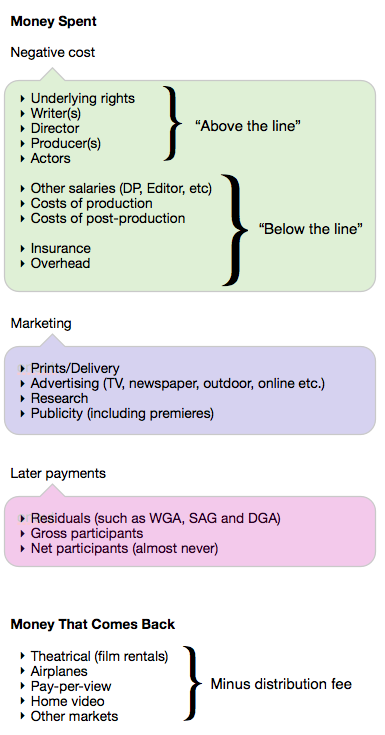
You have actors. You have talented actors like Viola Davis and Octavia Spencer and everyone else who’s in that movie. Those are additional salaries that you’re paying for in this initial part of the process. Everyone whose salaries I’ve mentioned so far, those are considered above the line. So studio budgets for movies have what’s called “above the line” and “below the line.”
Above the line is the rights to the material, the writer, the director, producers, the actors. Is there anything else that usually gets counted above the line?
Craig: No, that is the above the line. The phrase comes from the fact that there’s an actual line, because the notion is “above the line” is the material and the “talent.” Then “below the line” is the crew and the physical expense of making a movie.
John: Yeah, and so really talented people are below the line. So you’ve got costume designers below the line. Your cinematographers are below the line. Your editors are below the line. But they’re not considered that above the line talent. Where it could become helpful to discuss the difference between above the line and below the line is certain kinds of movies will be very expensive above the line and very inexpensive below the line.
For example, when they were making those really high-concept Jim Carrey comedies, those were a classic example of “You’re paying Jim Carrey $20 million, but your whole budget in the movie is maybe $40 million.”
Craig: That’s exactly right.
John: It’s a huge chunk of the budget. Increasingly, I would say that I don’t see that split quite as much because it tends to be like you’re paying somebody a ton of money and then you’re also making an incredibly expensive movie beyond that.
Craig: Yeah, or in the case of a movie where it’s a smaller film but you want a big star, they get creative with paying the star out of the real profits of the movie as opposed to guaranteeing them a massive payment up front.
John: Exactly, but above the line is all those billboard names plus all the actors, the writer, director, producers. Below the line, everybody who’s physically responsible for making the movie, so their salaries plus the actual expenses of shooting the movie, taking the movie through post, color correction. Everything that leads up to “Here is the finished movie that we can deliver and show to the world.”
So when you add together the above the line and the below the line, you have what’s called the “negative cost,” which is confusing because it sounds like it’s a minus number. It’s not. Negative cost literally refers to the cost to get you to the film negative that you are going from there be able to generate all the prints that you’re sending out to the world and releasing theatrically.
So when you see in a Variety story, like “this movie had an estimated negative cost of $80 million,” they’re referring to that’s how much they spent to get the movie finished.
One weird thing that didn’t occur to me until I started really getting profit statements on movies that I’ve worked on is you think the negative cost is just done at a certain point. Like “Okay, we delivered the movie. So the negative cost won’t go any higher than that.” But it still does, because they still find new things to charge against the movie years down the road.
Craig: That’s right; that’s right. Yeah, the accounting becomes amazing. Truly amazing.
John: So after buying the rights to material, hiring writers, hiring a director, hiring actors, hiring a crew, you went and shot the movie. You took the movie through post. You’ve delivered the movie to a studio. Now is the time to spend the money to market the movie and to create the actual physical prints that will go out to the world. So that’s called P & A, or prints and advertising.
Back when I was in the Stark Program, they would have us budget $2,000 per print for releasing theatrically. So literally it’s a 35-millimeter print that you are having Technicolor or Deluxe make and then ship to the theater and stick in the projector and show to the world. I don’t really know what the correct accounting is for a print now, especially if it’s digital, but there still can be a fee charged for every print to every theater.
Craig: There’s a cost. Yeah, there’s a cost involved in just making the prints, and they still make a ton of physical prints for movies. I think probably most movies are still physically projected. That part of the process also includes, I believe, dubbing and subtitling for foreign territories.
John: Yeah, and it seems like a weird thing, “Oh, well, $2,000.” Like $2,000 isn’t really that much compared to the budgets of these movies. But if you’re releasing on 3,000 screens simultaneously, that’s $6 million you just spent to make the physical prints.
Craig: Yeah. No, it’s definitely real money for sure.
John: It’s real money.
Craig: The “A” in P & A is the killer though. [laughs]
John: Yeah, so “A” is all the advertising. When you think about advertising, your first instinct is naturally going to TV, which I’m sure is still the bulk of what people are spending for…
Craig: For sure, yeah.
John: …marketing. So it’s every 30-second spot, every Super Bowl spot you’re buying for $1 million for that one launch thing. So that’s the easy money to think about for P & A. For independent films, you may never have a TV commercial, but you’re still spending on advertising because it gets down to the little banner ads you buy on websites.
You’re paying co-op money to the theater owners for the little listing in the newspaper that says, “Now playing at this…” and “Here are the show times.” You have to pay for every one of those little things. You’d assume that, “Oh, well, that expense would just go to the theater owners.” It doesn’t. You actually are paying for those newspaper ads in the free weekly newspaper.
Craig: Yeah. Theater owners don’t spend anything to advertise any particular movie. That is entirely on the studio. So every television ad, every bus side, every billboard, every radio spot, every promotional contest, stuff online, events, the premier. [laughs]
Everything, even the cost of sending the stars to New York to be on Letterman or wherever they go, all of that stuff ultimately comes under publicity and advertising. It’s all folded in as part of this massive expense. Increasingly, that number is starting to rival the budgets of some movies and in some cases actually more than budget.
John: Oh, yes. In some cases it’s far exceeding the actual budget of the movie.
Craig: Yeah, and that’s the thing that changed the most. I started in marketing in the early nineties, and that’s the biggest change to me in this business if I can look at one thing. It’s not so much that they’re making fewer movies. I actually think they’re making fewer movies because of this thing. This thing is that it costs so much more now to attract people to a movie because our attention is so divided now.
It’s not that we don’t like going to movies. It’s that we have less time in the day to notice what movies are coming out, so they have to bombard us and blanket and publicize movies in a way that they did not have to do before. That is enormously expensive.
Because of that expense, they then have to ask in a way they used to ask, but now it’s become almost an essential question, “Should we even make this movie?” If the movie costs $40 million, but it costs $60 million to sell it, what is the more important question? “Is this movie good?” Or, “Can we sell it?” Obviously the answer is, by $20 million to them, “Can we sell it?”
John: Yeah. So, it’s important to understand that there is a budget for the advertising and for what all the marketing is going to be for the movie. That is not part of the same budget for the movie itself.
So the line producer isn’t looking at the marketing budget for the movie. The line producer is looking at how much money he has to get this movie physically shot and delivered. The marketing budget is handled by completely different people. A good producer has his or her hands on both the production budget and the marketing budget and has a strong say in both of those. But it is beyond even the director’s control how much money is there and how it’s going to be spent.
Craig: Yeah, and the marketing budget is also elastic to a point. The budget for a movie is negotiated between the filmmakers, the producer, and the studio, based on the script and based on the cast and based on the expectations of what this movie could eventually bring back in income.
But the marketing budget expands and contracts based on the end result. They can look at a movie and say, “This is a dog. We’re dumping it. We’re not going to spend that much.” Or they can say, “This is great. We are tripling your marketing budget.”
I know that on the first Hangover, I think they saw the initial cut of the movie and went, “Alright, let’s spend way more than we spent on the movie to sell this, because it’s a hit.”
John: Yeah, that’s going to be the case. Another good example would be the Saw movies or any of the low-budget horror movies. They look at one of those and it’s like, “Oh, there actually is great potential here.” So they’re going to spend ten times their shooting budget on advertising because they feel like they can make their money back out of it.
Craig: For sure.
John: Other things that get included in the overall cost of making the movie: We have the negative cost. Negative cost would also fold in interest. So basically, in order to have the money to make something, you are taking out a loan. Now usually, you’re actually taking out a loan from the studio itself, but they are charging you interest. So, in a way, it is the studio paying itself, is how it goes.
Craig: And insurance.
John: And insurance, overhead. Insurance is both the policy for in case a stuntman dies, but it’s also insurance to make sure that the film can get completed if there are other catastrophes. Because the last thing you want to have happen is you get 80% done with the movie, and then you can’t actually finish the movie. A movie that can’t be finished or can’t be delivered is… It’s a horrible situation, because you have burned all this money and you have no way of getting the money back out.
So you buy insurance and a bond, a completion bond, to make sure that you will be able to finish shooting the movie. In some cases it does kick in. A star dies. When River Phoenix died during that Dark Water or whatever that movie was —
Craig: Right.
John: — That became an insurance claim because you have to figure out what you’re going to do with that movie.
Craig: Every movie, at some point or another, has an insurance claim. I went down Monday when I was directing, because I had bronchitis. The doctor literally pulled the plug on me and sent me home. That is an insurance day. Every day costs money. People showed up. They cooked food. They built props. They were waiting around. That’s money.
John: Yeah. On Go, we had an insurance claim for a camera malfunction – basically had negative flashing and we had to go back and reshoot. So that was two days of reshooting, where we had to really press our case for, “We have to reshoot these things. There is no technical solution for this. We actually have to go back and reshoot.” That does happen on a lot of shows.
While it is not an expense that you have while you are shooting the movie, what is ultimately charged against the overall cost of making the movie will be things you’re paying out to first dollar gross players and residuals. Those are going to be costs that will be charged against the movie ultimately.
There are other things that are siphoning money off from the film, which, for screenwriters, is good, because residuals are a very good thing. Residuals will kick in even though the movie will never, itself, become profitable.
Craig: Right. Residuals are based on gross receipts. The other major expense that every movie incurs, and this is the fun one, is the distribution fee. A studio does not distribute. The studio that makes a movie does not distribute the movie. They own a company that distributes the movie.
So every Disney film is not distributed by Disney. It is distributed by the Buena Vista Pictures Distribution Company. What is a distribution company? It’s a bunch of people in the same building, employed by the same people, who work with the theaters to place movies.
Distribution is an incredibly important thing because big studios tend to be able to get any movie into a theater, into lots of screens if they so desire, because they trade on the movies that the theater owners know are going to be big hits.
So, “I have Pirates of the Caribbean coming down the line for Christmas. You need to take this movie now and put it in your theater or I’m not going to give you Pirates of the Caribbean.” “Okay, I’ll take it.” So there is a real value to the distribution company. They obviously do a lot of work.
But, in the end, here is the deal: This is one of the areas where the studios pull a fast one on us. They basically say, “It costs $30 million. Our distribution company charged us $30 million to distribute this film.” Well, what that means is that they moved $30 million from their left pocket into their right pocket. It’s the same company. They’re charging themselves money and then telling you that it is an expense.
John: Yeah, there are exceptions to that. When George Lucas hires 20th Century Fox to release the new Star Wars movies, it really is a separate company kind of releasing it. But in most cases it is exactly the same people who made the movie that are the people who release the movie.
Craig: That’s right.
John: It would be useful to step back and take a look at the three big players of how movies are made and released. You have the production company, the people who basically make movies. You have the distribution company, who take movies that have been shot and distribute them to the people who can show them. You have the exhibitors, who are the people who actually are physically showing them, who are the theater owners.
Craig: Right.
John: Once upon a time, those were all the same people. That was vertical integration. So, 20th Century Fox would make a movie, distribute a movie and show it in its own theaters. I forget the name of the classic lawsuit that broke up that model.
Craig: I can’t remember it either.
John: It’s like Taft-Hartley. But it’s not Taft-Hartley.
Craig: Yeah.
John: We’ll put that in the show notes, but the studios are not allowed to own movie theaters anymore. So Pacific Theaters or AMC Theaters have to be their own separate companies. The distributors, which are really the studios, negotiate with the different theater owners to figure out who is going to play what movie and how that is all going to work.
Craig: Right. The theater owners basically – the way the studios make money off of movies is the theater owners pay them a rental charge, because they are renting the print from the studio. Obviously, they don’t own it. So they pay them a flat rental fee. Then, of course, they give them a percentage of the box office receipts.
John: Yeah. Let’s — I’m going to just put a boldface header here. This is the second section of what we’re talking about. So we’ve talked about all the money that goes out. Now, we’re starting to talk about the money that comes back in.
Craig: Right.
John: This is how people make money on making movies. It’s by showing them in theaters and showing them on TV and everything else. So with theaters, we are negotiating with AMC or Loews or one of these places. We are agreeing to basically split the box office with the theater owners.
Craig: Well, to some extent.
John: Yeah, to some extent. Generally, in negotiating with theater owners about which theater we are going to show them in and which screens we are going to have, it’s an ongoing conversation. But you are trying to get into the right houses at the right size.
You say, “Okay, opening weekend we will make a 90/10 split and we’ll pay you a certain amount per theater.” There’s like a – each theater has a house nut. So, “This is how much we are going to pay you for the right to show our movie in your theater.” Does that make sense?
Craig: Yeah.
John: I’m putting that kind of poorly.
Craig: Basically, here is the deal. It’s all a negotiation. If I’ve got a movie — let’s use Harry Potter. Everybody wants Harry Potter. It’s a guaranteed hit. There’s no chance it bombs.
So Warner Brothers says to a theater, and typically a theater chain, a very large chain, “We will give you Harry Potter at this level, but that’s a favor from us to you, because we could give it to your competitor across the street. We’re giving it to you in return for the first weekend,” which is where the big bulk of money is made.
Often times, a third of the entire box office run is made that first weekend. “We’ll make sure that you don’t lose money showing it, and maybe we will give you a little piece of the box office, but the bulk of it comes to us.”
As weekends progress, that split trends more towards a 50/50 kind of thing. And it’s because every movie is different, it’s hard to say ultimately, “What do theaters keep from box office?” because everybody says – they look at box office reports and they say, “Wow, Harry Potter made $400 million in the U.S. That means Warner Brothers made $400 million.” No. The theaters keep a lot of that. Someone once told me it’s sort of like a 60/40 thing.
John: Yeah. If you average out all the weekends and how it all flows.
Craig: Yeah, 60 is to the studios, and 40 is to the theaters.
John: But another truism you will see cited is that the theaters make more money off of concession sales than they do off of ticket sales, which doesn’t seem to make sense at all. Because if you buy a ticket for $11, not everyone is spending $11 on candy and popcorn.
Whether that statistic is true or not, the thinking behind that is that the theater owners keep all the concession money for themselves. They are not splitting any of that money back with the studios who are making the movies.
Craig: Exactly. Yeah. The theater owners are constantly… there is a war going on. I don’t know if people understand this. There is an endless struggle between exhibitors and studios. Obviously, they need each other, but they have cross purposes.
Theaters, obviously, want to make as much as they can. The studios want to make as much as they can. So the studios tend to win the whole box office battle. The theaters, in order to make their money back and to be profitable, obviously, they want to constantly raise ticket prices, which the studios constantly fight against them doing, because studios want more people showing up.
The theater owners obviously keep increasing prices on concessions. The big one that the studios hate is the theater owners run advertising, which pisses audience members off. Then, in return, what the theater owners hate is that the studios, in order to generate more money for themselves, want to shrink the time between the time that the movie is in the theater and the time that you can buy it on DVD.
As piracy spreads, studios are panicked that no one is going to go to the theater or, if they go, they won’t buy the DVD because they can get it that night on Bit Torrent or something. The theater owners hate that, because it means that the theater experience is being cheapened and isn’t as special. It’s this endless war.
Then, one last thing: Another big war is technology. Studios want theaters to have excellent projection. They want them to have 3D. They want them to have better sound, digital delivery. The theater owners are saying, “Great, but that’s entirely our burden. That’s a capital expense on our end and it costs you nothing, so help us.”
John: And, to some degree, studios are hamstrung to directly invest in the theaters, because they’re not supposed to be owning theaters.
Craig: Right.
John: Yeah. So it would behoove everyone if everyone had better projectors. It would be best for people who are going to see movies. It would be best for distributors, because that way they don’t have to make as many prints and they can digitally deliver prints and they love that.
It’s better for the theater owners ultimately, because there is less physical stuff for them to have to handle and they can get by with fewer projectionists. There are reasons why it is good for everybody. It’s just that switching over to a new projection system is really expensive.
Craig: Right.
John: So that’s why when they build new theaters, they tend to have nicer projectors and everything is more digital. In the older theaters, it’s hard to justify converting them.
Craig: Yeah.
John: But it comes down to even things that seem really cheap. There was a fight recently over 3D glasses and who should be responsible for providing 3D glasses. Should it be the theater owners or should it be the people who are producing the movie? It can be a very low margin business, so the cost of those $0.50 glasses can add up.
Craig: Yeah, for sure. No, it’s an interesting study in forced partnership. I mean, it’s economic. I’m sure they teach it in some sort of class.
John: The only statistics that you are likely to be able to find out about how a movie is doing is by box office. So we talk about domestic box office or worldwide box office, and so it’s important to remember that box office is really a function of how many tickets were sold and at what prices.
That’s the public figure that’s actually ever disclosed for a given movie. Privately, that’s not what really matters to studios. Studios are looking at what is called film rentals, which is, “How much of the money from the theaters is coming back to their pockets?”
Craig: Right.
John: That’s what is letting them know which movies are successful for them or not successful for them. Those film rentals that are coming back to 20th Century Fox or to Warner Brothers. That’s where they take off their distribution fee. I think 35 percent is the standard distribution fee now?
Craig: Yeah. Yeah.
John: So 35 percent of whatever is coming back to Fox, they are saying, “35 percent of that is going to the 20th Century Fox distribution arm,” and is not counted towards the actual, individual movie.
Craig: Which is, sort of, on its face, kind of dumb. The fact that it’s even a percentage is counter-logical.
John: Exactly. If it really was a cost, then add up the cost and charge that cost to the whole movie, rather than making it a percentage.
Craig: Yeah. No, it’s a scam. [laughs] It’s a total scam.
John: Yeah. So, agreed there are issues that you can take with studio accounting, its complexity, its…
Craig: Its scamminess.
John: Its scamminess.
Craig: Yeah.
John: The distribution fee is certainly one of the biggest ones. I would say distribution fee, interest and overhead are all easy targets for it and that when you really dig in, if you have to go through an audit on a given movie, you find that there are a ton of expenses that are thrown against a movie that may not really be legitimate expenses.
Craig: Correct. Correct.
John: Yeah. For example, if you are lucky enough to have a movie that is considered for an Academy Award campaign, every possible expense that they could think about to throw – in terms of trying to win you an Oscar — will get thrown against the movie. So every party, every screening, every possible thing will get charged to your movie. That’s going to be a tremendous amount of money.
Craig: By the way, those are actual expenses. I don’t mind those. [laughs] It’s the ghost expenses that make me nuts, but what are you going to do?
John: Yeah, but when you say, “Where do the expenses stop?” Should you be charging the studio executive’s hairstylist against the Oscar campaign?
Craig: Well, it depends on the hair.
John: Yeah, if it’s great hair.
Craig: Right.
John: If it wins the Oscar, then it’s worth every penny.
Craig: Right. Exactly.
John: Right now we have been talking about the theatrical experience, which is clearly the first step for most of these movies. But, a lot of movies are going to be making more of their money on home videos. That used to be videotapes. Then it was DVDs. Now, it’s iTunes and all of the other places that people can get movies legitimately and see them on their flat screens of some kind. Pay cable. Free cable. Broadcast television.
And an important thing to understand about when you start making television deals for things is that a lot of times ABC is not buying your movie. They’re actually buying a package of movies. They’re buying five different movies from Sony for $40 million and they’re buying the rights to show those movies several times.
Where that becomes troubling is, if Charlie’s Angels is one of those movies — there are five movies let’s say — so Charlie’s Angels is one of those movies and the other four movies are four movies you’ve never heard of, and you would never, ever want to see, they will try to account for those equally. They will just divide the $40 million among those movies and Charlie’s Angels will not show the profit that you think it should show.
Craig: Shenanigans. More shenanigans.
John: Yeah, just shenanigans. So when you start to have audit fights or have issues, that’s the kind of thing that comes up often, how they are apportioning things.
Craig: That’s what they do. Also, airlines are a big source of revenue for the companies. Hotel rooms — Lodge Net and all that stuff. There is a ton of money in that ancillary market, the afterlife. What is interesting about the aftermarket is, unlike the expense of releasing a movie theatrically, where you are making those expensive prints and delivering them and pouring a ton of marketing in, the ancillary stuff is really profit magic for the companies, or has traditionally been.
The movie is done. It’s got awareness. Hopefully, it was a hit. If so, you are literally just, in the case of iTunes, pressing a button and getting paid and doing nothing else. Someone who ran the studio one said to me that the best way to make money in the movie business is to own a library of movies and to not make movies.
Libraries kick off money every year, every title, without fail, with very little expense, very little cost associated with that. So as the VHS and DVD market boomed, you could see the movie business expanding to just chuck as many movies out there, because there was just this pot of gold at the end of almost every rainbow.
Even if the movie was a disaster, theatrically, somehow it always seemed to make money overseas and here through DVD and home video. Less and less the case now. That is another reason why the movie business has contracted a bit.
John: When you see studios freaking out about piracy, this is why they are freaking out about piracy. A tremendous amount of their income was coming from those things down the road. So that guy who was videotaping the movie in the theater is costing them, in their perception, sales of DVDs or iTunes sales or legitimate sales down the road, and they can’t ever possibly make those back.
It’s also crucial for screenwriters who are hoping to make more movies. We only get residuals on those things down the road. We don’t get any residuals on the first theatrical run of a film. Residuals are things that get paid to us from all of those other little bits, the airplane runs and the DVDs.
Craig: Not airplanes, actually.
John: Airplanes is first, isn’t it?
Craig: They count airplane as part of the theatrical release. I don’t know why. But you’re right, everything else in the release of it is where our residual base comes. Frankly, that’s where the profit in the movie business is. If you were to say today, that by fiat, the movie business could only make money by showing movies in theaters, I think, honestly, that every studio would just shut down.
John: Pack up and go home.
Craig: Yeah, because they cannot make the economics work. Making movies has become extraordinarily expensive. It’s a little counter-intuitive, because you think, “These cameras are getting cheaper and it’s so much easier to deliver content.”
But the other truism is that we have come to expect a certain level of spectacle with movies that is enormously expensive to achieve. Even when you find interesting filmmakers out there doing it on the cheap, it’s still, overall the rule of thumb is that, if you’re going to deliver a big, huge action movie, you need to spend money or it’s just not going to look like a big, huge action movie.
At least, that’s the studio calculation. So they need DVDs and video. They also need DVDs and video tapes to pay for the bombs because there are bombs. When you make a movie for $40 million and it loses $20 million, that is a big hit.
John: Yeah, they want to create a portfolio of movies, so that the hits will even out with the misses. Obviously, whenever somebody new comes to Hollywood, whenever new money comes to Hollywood, they, very smartly, say, “We’re only going to make the successful movies and we’re not going to make the bombs.”
The truth is that you don’t know which movies are going to be successes and bombs. So you try to plan carefully for what those will be. The challenge, I think, in our current situation is that the movies that are successful tend to be the incredibly, incredibly expensive movies. So we’re only making those incredibly expensive movies and we’re not making more of these mid-range things. We’re not making very many of The Help, and The Help is a godsend if that is your movie.
Craig: It’s very profitable. Then you look at movies, comedies in particular, I think, are extraordinarily profitable. Obviously, The Hangover, Bridesmaids, Horrible Bosses are movies that don’t cost a ton. That’s why comedy, I think, will always be a staple.
It’s not because people like them. Obviously, they do, but they like lots of movies. Horror movies and comedies tend to not require a ton of cash to make, but they can be just as successful or popular as action films are.
John: Yeah, because they don’t have to be home runs. You can hit doubles and triples and make a tremendous amount of money. I should back up and say, when I say, “Oh, they’re tremendously profitable,” again, we’re not talking that on the accounting of each individual film that they’re profitable, because they won’t be.
Craig: None of them are.
John: None of the movies, I think, that we have talked about today are going to show a profit on their actual, individual statements. But they are profitable for the people who made them, because they got to charge that 35 percent distribution fee. They charged their overhead against them. They charged everything they possibly could against them and they have a nice chunk of change because of that.
Craig: Yeah. Look, they run these models. That’s a word you hear all the time now. They model the budget based on what they think the movie will do theatrically and what that, then, implies the movie will do on video and OnDemand and iTunes.
They know before they roll a foot of film what they think the movie is going to make. Usually, they are right. They usually have a pretty good sense of it. But — I lost my train of thought.
John: It’s okay, because a bus just showed up.
Craig: Oh, a bus showed up.
John: People who are listening on good headphones may notice that Craig works at a bus stop.
Craig: Yeah.
John: You have to have more than one line of work if you are a screenwriter these days. You have to have many irons in the fire.
Craig: Got to stay in touch with the people. Do you know what I mean, John?
John: Yeah. So, he gets his best stories working as a shoe shiner. I think it’s good that you are keeping your working-class roots going there.
Craig: Yeah. Really, you can smell the urine in the air. I love this bus stop.
John: [laughs] Craig, thank you so much for a good and lengthy discussion on how the film economics work. I hope we all learned something today.
Craig: God, I hope we have. I sure do.
John: One of the things that I actually thought about this as the intro to how we were going to talk about this today, is, as I mentioned before, I am working on Big Fish, the musical. Broadway has a whole different economic model behind it in how it all works.
I am just now starting to learn it and it’s just bizarre. So we are at the stage now where we invite really, really rich people in to listen to the show and they write big checks to invest in the show, hoping that it is a huge success.
But, I honestly can’t say I understand exactly how they would get paid out in success, or God willing success, or why it’s a good idea for them to do that. Obviously, hopefully they want to support great art. But there is actually a profit and a business model and I can’t say I fully understand it yet.
Craig: This is one of the ways that I am a creative person. I don’t mind money. I like money, but I don’t understand it, to be honest with you. I don’t understand the ins and outs of it. Frankly, it doesn’t inspire me to talk about finance. I don’t really get it.
So, the people who do get it, I think, they do just much better than we do, because they really understand how it works. To me, it’s just a check. I don’t know.
John: One last thing we should slip in here is merchandising. There’s not going to be a perfect answer for this. But if you are making a movie that has toys — let’s say you made a little movie called Star Wars — toys are going to be an incredibly important part of how you are making a tremendous amount of money.
Some of the money from merchandising will be counted towards your movie and some of it won’t — which is a way of saying that those little, small things in your contract that seem like you’ll figure that out whenever they kick in, can become very, very important. So the degree to which all the ancillary toys and such become part of the accounting of your movie is really dependent on how good your lawyers were.
Craig: Yeah. You know guys, the deal is if a movie fails it doesn’t really matter what was in your contract. But in success, you and the people that owe you money will go hand-to-hand combat for a while. You see it in TV. When TV shows get syndicated and 20th Century Television sells the show to FX and it’s all the same, it gets so complicated. An industry of lawyers and people deal with it.
For those of us who write, I think the most important thing is to just be cognizant of how these guys make their decisions. So when it comes time to write your script, just know if you write a period piece that is a very adult drama, the studio is going to look at it and go, “Well, I see a whole bunch of budget costs that wouldn’t be in a horror movie.” Just be aware that it’s a little bit of an uphill battle. Just know how they think.
John: Yeah. So Craig, they’ve already come back to you. Hangover 3 is going to be PG-13 and there are going to be a lot of toys. Is that correct?
Craig: Hangover 3 will be rated R. [laughs] But there may be toys.
John: Toys are great. We love toys.
Craig: Love toys.
John: And we love talking about movies. So, thank you again, Craig, for another great podcast.
Craig: Thank you, John.
John: We’ll talk soon.
Craig: Bye.
The followup post to this episode can be found here