• Skip to primary navigation
  • Skip to main content
  • Skip to primary sidebar

John August

  • Arlo Finch
  • Scriptnotes
  • Library
  • Store
  • About

Drew Marquardt

How residuals work

Episode - 14

Go to Archive

November 29, 2011 Scriptnotes, Transcribed, WGA

Craig and John take a look at awards-season screeners before diving deep into a discussion of how residuals work and why they’re so important to screenwriters.

Plus, a visit from Craig’s cleaning lady, who thinks he’s insane.

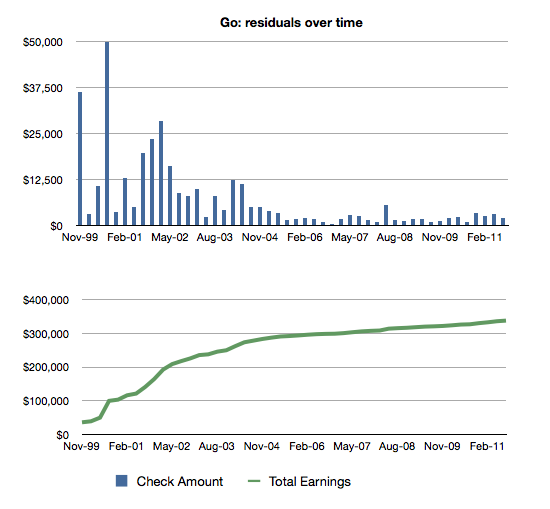
Near the end of our discussion on residuals, I give some actual numbers on an actual movie. Percentages are abstract; money is money.

I chose Go because I had the most data on it, going back to 1999. It’s also useful because the movie was only moderately successful at the box office.

As you can see in the charts below, residuals taper off over the years — but that long tail still adds up:
go residuals

Keep in mind, there’s a possibility that residuals could spike if another home video medium takes off — digital downloads or rentals, for example.

I went into the podcast thinking I could easily reverse the math to figure out how much the studio has made off the movie, but as Craig points out, it’s more complicated than it appears at first. Most home video is calculated as 1.5% of 20% of gross earnings, so in order to get an accurate number I would need to sort out how much of Go’s residuals are coming from home video (and not television licensing).

But we can still get a sense of minimums: Go brought in at least $30 million in the aftermarket, and likely much, much more.

LINKS:

  • Downton Abbey, Season One on Netflix
  • Father Ted on Netflix
  • Security theater as defined on Wikipedia
  • The WGA’s Residuals Survival Guide
  • Intro: Tree Top Apple Juice commercial
  • Outro: Country Lane by Telekinesis

You can download the episode here: AAC.

UPDATE 11-30-11: The transcript of this episode can be found here.

Scriptnotes, Ep. 13: Undervalued simplicity, and WGA coverage for videogames — Transcript

November 27, 2011 Scriptnotes Transcript

The original post for this episode can be found here.

John August: Hello, and welcome. My name is John August.

Craig Mazin: My name is Craig Mazin.

John: You are listening to Scriptnotes, a podcast about screenwriting and things that are interesting to screenwriters.

Craig, you are sick aren’t you?

Craig: I am sick. I have got the late November virus.

John: Is it a cold? How would you describe your illness?

Craig: Yeah, it’s definitely a cold. I am one of those… [clears throat] people. I am going to do this throughout the podcast, please forgive me.

John: Yeah, I am going to have Stuart go through and cut out every cough. It would seem like —

Craig: [coughs]

He’s not going to cut out that one, is he? [laughs]

Sorry. I am one of those people that rolls their eyes whenever someone says “Oh, I have the flu.” You don’t have the flu. You have a regular virus. You just have an upper respiratory infection, 99 times out of a 100. I think we have covered this before.

John: Yeah. I had a bit of a cold situation two nights ago, where it was one of those things where you can feel your body starting to… like my skin, I could just feel something strange about it. I will always know if I have a cold because if I try to take a shower, the water just feels really weird on my skin.

Craig: That is weird.

John: So I had that happen. I am not crazy. You have had the same thing, right?

Craig: I have not had that, I must admit. Not even in the worst illness have I ever experienced any kind of… I don’t know what you would call that.

John: Oh, whenever I get a cold I can always tell like the cold is coming on because like my skin just feels a little bit different. It’s not the surface of my skin, it’s like a few millimeters underneath my skin feels wrong and different.

Craig: Wow.

John: So anyway, I had that. The cure for that cold, just in case anyone is curious, is Maker’s Mark. Maker’s Mark bourbon whiskey is how you fix that. So I broke out the bottle and had a little Maker’s Mark and now I am fine.

Craig: That is essentially what Nyquil is. It’s just Maker’s Mark with a decongestant.

John: It’s cherry flavored Maker’s Mark.

Craig: Exactly.

John: So other than being sick, have you had an okay day?

Craig: Yeah, pretty good. I have got a script due out in a few weeks, so I have been cranking pretty hard. On Friday, by the time you get to Friday if you have been doing a good steady five page clip a day, you kind of start feeling a little bit like a melted chunk of ice or a puddle of disintegrated brain goo. So I am excited that it’s Friday.

John: You get that candy-bar-in-the-car quality.

Craig: Yeah, kind of soft, damaged.

John: I did no writing at all today. So here’s my day, since we were talking about people’s workflows. I started today with a meeting with Todd Strauss-Schulson, who is a director who did the Harold and Kumar movie, which I loved.

Craig: The most recent one?

John: Yeah, the most recent one.

Craig: Alright.

John: It was great. So I had followed his short films that he made before this and this was a chance to sit down and have coffee with him. So when people talk about like “Oh, what is a general meeting?” That is a general meeting. We weren’t talking about any specific project down the pipe, just like “Hey, who are you” and “Let’s get to know each other a little bit.”

So I had that coffee. I had a meeting at the WGA to talk about… Every year, or every two years, they try to do a survey of working screenwriters to figure out what the big issues are. So this was a test run on the survey for what this next survey is going to be so that they can ask all of the feature screenwriters what the issues are about late payments and sweepstakes pitching.

This writer, Craig Mazin, was originally supposed to be there but he didn’t make it.

Craig: Yeah, he didn’t show up because he was writing and coughing.

John: He was a candy bar melting in the car.

Craig: Yeah.

John: So it’s always encouraging to be sitting down and looking at the issues ahead. Also nice to be able to think about the issues ahead without having to think about how to fix them because so many of those creative issues are really intractable. We are not going to wave a magic wand and suddenly fix sweepstakes pitching.

Craig: Yeah, unfortunately, most of the things that they ask about and get responses on are sort of evergreen problems. So we keep asking what are the problems and screenwriters keep saying “This, this and this.”

John: Yeah.

Craig: [laughs] It’s a little frustrating. At some point the survey itself almost becomes this weirdly mocking thing.

John: Yes, this is self-fulfilling prophecy.

Craig: Yeah.

John: What’s potentially interesting about getting the data on this is that you can maybe start to recognize what studios and what mini-majors are the worst at some of these things and possibly you can effect some change based on the report card aspect of that.

So if studio X is notorious for bringing in 20 writers on a project that they don’t ever end up even making, then maybe that could be more publicly disseminated and people will know to not go in for every one of those crazy sweepstakes pitching situations.

Craig: Well, that would be nice. Unfortunately, I think the way that the business is right now and the economy and the level of development that is going on, writers will go in on those sweepstakes pitches. I wish they wouldn’t, but I can’t tell them not to. I certainly can’t judge anybody who needs a job who is trying to get a job. They are not illegal.

John: No.

Craig: They are just obnoxious. I would argue counterproductive. To me, the way to get studios off of that is to just make a compelling argument that the scripts will be worse because of them. I could make that argument, I just don’t know if they agree or care.

John: Yeah, because you are never going to be able to show that the script was worse because of it because you can’t fork the universe and show the two different development paths you took, one of which you brought in like eight writers to try to beat something out and one which you just hired the best writer who showed up.

Craig: That’s right. You can’t actually prove it. But the primary argument that I make about these things is when you force writers to jump through that many hoops in that kind of gladiator-style audition for work, you can be assured that when you do choose a writer and that person sits down to work, they are spending half their time working on your script and the other half doing the exact same thing they had to do for you for someone else to get the next job.

John: Exactly. You create a culture in which writers are only giving partial attention to the project in front of them because they have to keep looking for that next job, because the process has been drawn out for so long.

Craig: Exactly. I get why they do what they do. But the truth is between that factor of bifurcating the attention of the writer, the other factor is frankly, there is really no demonstrable connection in my mind between who does the best song and dance in the room and who is going to actually write the best script.

If you find somebody that you trust who has a good track record and you believe in them and they have a basically good take on it, that should be enough. But hey, I don’t run a studio.

John: One day, but not now.

Craig: One day. [laughs] God forbid.

John: So the rest of my day, jumping ahead, was spent working on, we suddenly have a Macintosh app that we are going to be releasing fairly soon. We were working on a different app which we will get to eventually. But along the way, there’s something I actually did for the Big Fish musical that I said “Hey Nima, we should be able to do this, right? I am not crazy. This is actually a pretty easily solvable problem.” Of course two days later he had it figured out.

Craig: That guy is a genius.

John: It’s because Nima’s a genius. Nima Yousefi, he is a listener and a friend of the show. So Nima worked on this thing and it looks like, “Hey, it’s actually really great and useful, and actually a much more useful app for many people than what we were originally working on.” Which brings me to a larger issue that came up a couple of times since last two weeks, is that this most recent project was actually really easy. It kind of feels like too easy. It feels like you are cheating because it’s just actually too simple.

In a weird way I think we undervalue things that come to us really easily because we have been through so many times where it’s been a struggle and conversely we overvalue those things. A better example might be for the Big Fish musical, we have been working on it for years and years and years. So there is maybe 20 songs. Not all of them are singing songs, but there’s 20 pieces of music. Some of them we have gone through like 14 different versions and drafts of them, like classically the “I Want” song, where the character sings about what he or she really wants. That’s the one we keep going to again and again. Or the opening number will be something we go to again and again.

There is one number that everyone loves in the show. But literally Andrew and I — it was late in an afternoon and we just banged it out three years ago. It kind of feels like cheating because we know we have worked so hard on every one else — on every other number — but that one just clicked and it was right and it was simple.

Craig: Yeah, it’s a frustrating thing, frankly, that your success as a creative person isn’t as simple as work in, quality out. It just doesn’t work that way. You are right. It kind of violates our weirdly Calvinistic work a day ethic.

I frankly am guilty of… You know there are days when you sit down, and suddenly you have this great run. Five pages pour out of you and they are really good and you feel great about it. Then you think “Well, I am not going to work the rest of the day.” You feel guilty. Whereas I feel curiously proud of myself if I beat my brain into a mush to get three pages out over the course of the day because they were really hard.

John: Yeah.

Craig: It’s kind of dumb, frankly. I should stop doing that.

John: Yeah, you should stop doing that because one of the other dangers, I think, is that those pages that were really hard to write, you are overvaluing how good they are because you know how hard they were to write. If they are only even kind of okay, you are more reluctant to change them because you know how hard they were to write. Sometimes you are willing to throw a perfectly good scene under the bus because you just dashed it off. But you are not really aware of the actual quality of the scene. You are so keyed into how much work you put into it.

Craig: Yeah, that is right. I think directors get that better than anybody because you could go out and direct a scene for three days at night in the cold and it’s dangerous work and it was brutal to even get it up on its feet and you argued to get the money for it. You could pile on an enormous amount of circumstances. Then if you watch the movie and it needs to be cut, you cut it out. That is a good lesson. You are right, just because you poured in a ton of effort doesn’t mean it’s valuable.

John: There’s a few of my movies, Corpse Bride was a pretty quick work but Charlie and the Chocolate Factory was sort of famously, was really three and a half weeks to get to my first draft. It was like “Oh, that wasn’t enough work.” I felt kind of guilty turning it in, but it was done. It was ready and they needed to shoot the movie. Most of the scenes I never went back and touched again. So you compare that situation and that movie was really successful to other movies that I have killed myself on that were either never shot or they were shot and they were a difficult process the whole time through.

You don’t know. I think you should probably just celebrate the times that they have worked out great rather than killing yourself on the times where it was a slog.

Craig: I totally agree. Let’s give ourselves a break.

John: Yup. Let’s also answer some questions because I…

Craig: Yes. I have got my question list right here.

John: I was in New York for two weeks and was away from the actual question bag. So a lot of stuff stacked up here.

So let me get to the first one here. Shannon, in Tucson asks, “I am a man with the name Shannon.”

Craig: Ha-ha. [laughs]

John: “As you may imagine, this has caused me some difficulties and embarrassing moments. I have come to think that choosing a different first name, I am thinking Andrew, would solve the problem. Is this a good reason to choose a pseudonym, or am I overreacting about my name?”

Craig: [laughs] Well, Shannon, it’s a personal thing. If it’s uncomfortable for you and awkward, then yeah why not change your name. It’s your name. It’s who you are. I had a friend in high school named Kevin Zeidenberg. Kevin’s mom was Filipino and his dad was Jewish. Kevin looked pretty Filipino. So he would get that look, the “you are not what I expected when I heard the name Kevin Zeidenberg.” I think some people sort of relish that slightly Ricky Gervais-style awkward moment and some people don’t. It’s your name; it’s your career. If you want to change it, do it.

John: Yeah, I agree. Pick a new first name, use your initials, whatever you want to do. It’s absolutely fine. As people who would look me up on Wikipedia would know, August is not my original last name. You knew that, right?

Craig: I did. Your original last name was… [laughs] sorry, I was going to make a joke that would get us kicked off of iTunes.

John: Yeah, that would not be good. It was a Germanic last name and really tough to pronounce and simple to look at, like “Oh, I could say that.” Then you actually try to say it like “Oh, wait. I don’t know what my vowel sounds are in this name.” So I recognized as I came through, having this name my entire life up through college that the first 15 seconds of any new conversation with somebody would always be about correcting how they mispronounced my name.

So I was doing myself a favor and everybody I would meet in the future a favor if I would just pick a simpler last name. So I just picked my dad’s middle name and it’s been cake since then. I legally changed it.

You don’t have to legally change your first name to use a pseudonym, but it just became easier for me to do that before I moved out to Los Angeles and started a new life. It’s made running from the police much simpler.

Craig: So much simpler.

John: Yeah.

Craig: Yeah, good point.

I have a question for you.

John: Alright.

Craig: This is coming from… do we say their names?

John: Yeah, we do.

Craig: Yeah like Shannon, we can talk about Shannons, we can say this because this is Mike Amass.

Question: “To flip the coin on the helpful Movie Money episode of our podcast, would you like to air your thoughts on the current state of self-distribution. John, I know you watch the team behind One too Many Mornings, and might still be entertaining the notion of self-distribution for future personal projects. Could you shed any light on how filmmakers like Kevin Smith and Edward Burns are enjoying total freedom, total freedom, John, to create and maybe, just maybe, might be making some decent money at it?”

John: Yeah, I have seen this question, I racked my brain to think of who is actually doing this now. So Kevin Smith, clearly with Red State, which is a movie he made, I think, basically on his own money. Then he famously took it to Sundance, and then obviously wasn’t going to really sell it, he was going to self-distribute it.

Edward Burns, we were on a panel with Edward Burns, weren’t we?

Craig: In Austin, two years ago.

John: I had to sit next to Edward Burns, and he’s a handsome man. You don’t feel uglier then when you are sitting next to Edward Burns.

Craig: He is dreamy.

John: He is dreamy. See, objectively dreamy, and a really nice guy. He made a movie called Nice Guy Johnny, which I saw, which was good and really, really small. It has the stakes of a postage stamp, but really charming, and sort of the way he made it at a really small budget, and made exactly the movie he wanted to make.

Then the Polish Brothers, who I was on a panel with many years ago, and they have done many and bigger movies, but they did a tiny movie called For Lovers Only, which was sort of a fantasy of the kind of movies they do. They just traveled around France and shot in black and white with this beautiful actress. It looked good. I saw the trailer, I haven’t seen the movie yet.

There are some directors who are doing this, and hopefully some of them are making money. You are sort of vertically integrating yourself, so rather than going to someone to give you money, you are raising the money yourself. Rather than going to a distributor and signing over most of your future income on something, you are doing all that work yourself.

It’s a tremendous amount of work, so a movie like The Nines, I guess we could have self-distributed it, but then you have to become a master of all these things you don’t really want to have to know about, like how you book theaters, and how you collect money from theaters, which is really hard.

Because how are you going to get the money back out of the theater? You are just counting on their goodwill to report honestly and give you the money that you are owed? The advantage a distributor has is they have the next movie. If you are not paying them for the previous one, they are not going to give you the next one. You have nothing else to pull that money out down the road.

I think iTunes is one of the better ways to think about doing it. With The Remnants, which was a web series pilot that I shot a few years ago, we got the rights back to it, and we had some discussion about doing it as a teeny, tiny feature. Who knows, at some point we might still do it. I discussed with the people at iTunes what that business model is, and what cut we get, and how we could make that all work out. Also, had a conversation with Hulu about it.

There is probably ways it could work, it’s a little bit easier if you have some name and reputation, like Kevin Smith, Edward Burns, the Polish Brothers, so you could have a little bit of leverage with the distributors, the online distributors, and that you can actually generate press. That is one of the challenges you always have with an independent film, is like how are you going to get mainstream media to pay enough attention that people are actually going to find your movie?

I would have enough of that now that I could probably do it, so it’s something I am really thinking about doing. It’s just it ends up being a tremendous amount of time and effort that may not have the best payoff and reward. You may not be able to put it in front of as many people’s eyeballs as you really hope.

Craig: Absolutely correct, a big, uphill battle there. I should also add, I think that when Mike suggests that Kevin Smith and Edward Burns are enjoying total freedom to create. I would argue that they have less creative freedom than Gore Verbinski had on the last Pirates movie, because the biggest restriction on creative freedom is money. When you are stuck with a micro-budget, you really are squeezed. Sometimes wonderful movies come out of that because it requires tremendous discipline. But it’s a mistake to think that there’s more creative freedom with less money. It’s just a different set of problems.

John: I will push back a little bit on that. I think creative freedom doesn’t mean that you get to do anything you possibly ever want. Creative freedom isn’t anything you can possibly imagine you can make. To me, creative freedom is no one is going to tell you no. With a smaller budget, even on The Nines, which wasn’t as small a budget as some of these things were, I did have a lot of creative freedom, because we were fewer people around to tell me no on things.

Craig: I get that.

John: When something wasn’t possible because we didn’t have the money, it was always, “Then how is the movie changing to accommodate our actual limitations?” I didn’t have to change anything to meet someone else’s taste.

Craig: You chose to make a movie that would fit within the preexisting constraints of your budget.

John: Absolutely.

Craig: That’s why, Mike uses the phrase “total freedom to create.” Really, I am just quibbling with the word total, and nothing else.

John: Yeah. I see your point now. Total freedom to create versus total creative freedom, slightly different things.

Let’s move on to Daniel from Oakland. He asks, “My brother claims that studios don’t like to see a film do better overseas, because they see less of a cut overall than if a film does better locally, in the US. Is there any truth to this?”

Craig: I don’t think so, unless a studio is splitting the domestic and foreign distribution with another entity. I don’t see why they would be particularly concerned. There are quite a few movies that do better overseas than here. In fact, this year, the best example I can think of is Kung Fu Panda 2, which underperformed at the domestic box office, but was an absolute blockbuster overseas.

Another great example is in fact the aforementioned Pirates of the Caribbean 4, which also underperformed here, but was even bigger overseas, it was unreal overseas. I think in the case of Pirates, Disney has a domestic distribution arm, and an international distribution arm, in Buena Vista Pictures International, sees a huge cut of that money. I don’t know, maybe I am wrong.

John: I would imagine in the past, probably, that could have been more of a case, where they had a harder time pulling the money back in from overseas markets. That is possibly like, once upon a time that was actually true, but now it’s actually not as true, because given that the bulk of big movies’ money comes from overseas, I am sure they have gotten much, much better at pulling that money back in.

I will say that psychologically, I think the executive at whatever studio in Culver City, would kind of prefer that the movie making a ton of money here, just because people pay attention to that. Feeling like you have a big hit is better than having a movie that underperforms.

Craig: Yeah, that’s absolutely true. There is kind of a weird stigma about a movie that is soft here, but plays big overseas. It’s got almost an underlying xenophobia, like, “Your movie was for people that don’t even speak English.” [laughs] People that didn’t get the prior intent of the movie because it’s all color and noise, or something like that.

Look, there are other examples of movies that do extreme splits, pro-domestic and anti-overseas, and that’s also damaging. Talladega Nights comes to mind. I think it made $100 million here, and literally something like $12 million in the rest of the world.

John: Yeah, the thing was that it doesn’t translate, or it doesn’t travel. That can also be the case, and it was the knock against African-American actors for a long time, until Will Smith came along and broke all those barriers too, is that the Eddie Murphy comedies would do really well here, but overseas, people wouldn’t go see them. That seems to be something of the past now.

Craig: Seems like it, yeah. Here is a question for you from Tom. “A number of movies have made it to Broadway, and I understand Big Fish will as well. As the writer of a screenplay, what do you ask for to keep you in the mix should your script move on to the stage?”

John: Here’s the messed up thing about writing a Broadway show that is based on a movie, is the screenwriter of the movie has zero claim or stake to anything in his or her script. Just nothing, because the studio is considered the author of the screenplay, and that is one of those separated rights that we are not holding on to in the ways you might hope that we could hold on to. Separated rights, actually holds the story, that’s part of the whole mess.

The truth of Big Fish is that if Sony had wanted to make a musical of Big Fish, they could have gone to any other writer they wanted to, that writer could have taken any words from my script, and put them into the Broadway musical, and used them without paying me a cent, and without my name being anywhere on it, it is kind of messed up. With Big Fish, it was honestly me grabbing hold, and saying, “I really want to make this musical,” and having to get the rights back from Sony, and having to get Daniel Wallace’s book reattached, so that we could do it.

As the screenwriter, you have very little hold on the Broadway musical version of your movie, unless it’s an original screenplay that you have the retained story credit.

Craig: Yeah if it’s an original screenplay where you retain story credit, or if it’s an adaptation where the story of the movie was unique, to the extent that they awarded you Screen Story by.

John: In retrospect, I should have tried to get screen story credit on Big Fish, because if you actually compare the book to the movie, they are so different in so many ways that I suspect I probably could have gotten it.

Craig: Right, it sounds like you did a workaround anyway, so that’s good.

John: Yeah, next question. Adam asks, “As someone who wants to write/pitch comedies, what value do you place on being funny during meetings? I am not referring to acting out hilarious scenes/characters, but perhaps an anecdotal story or joke interspersed to help build rapport. In other words, how do you try to sell your own comedic brand with the expected level of professionalism?”

Craig: I don’t like this question very much. Look, here’s the thing. If you are funny, you are funny, and if you are not, you are not. This question, forgive me Adam, it sounds like the kind of question a not funny person asks, because you shouldn’t be trying or calculating any of that.

The idea of a pitch meeting is there’s two parts. There is the meet, where you are actually pitching the movie, and you are correct to suggesting that acting out “hilarious scenes” and characters is a tricky thing to do. The other part is just you, talking to the people who will employ you, and giving them a sense of the kind of person you are, and what it will be like to work with you, and what you think funny is, and the quality of your wit, or lack thereof.

You can’t calculate that, you shouldn’t even be thinking about calculating it. Just be yourself, and if you are a funny person, let that come through. If you are not, probably shouldn’t be working in comedy. Sorry, I hate to be a bummer.

John: [laughs] I can understand his concern, it’s that when you go in to pitch a story, and you are trying to tell a story that you think is funny, you really want to have laughter come back, but studio executives don’t laugh a lot. They are not hysterically entertained people. You will hear stories of like, “Oh my God, there was this hysterical pitch, and everyone was laughing. People were crying, they were laughing so hard.” That is more the exception than the rule. You want people at least nodding and smiling, and acknowledging, “Oh, I see why that would be funny.”

Craig: Yeah, the thing is I like being funny just in the regular I am myself, and let’s just chit chat and be funny. That’s great. When it comes to actually pitching a movie, typically what they will say is, “Look, we know that you are a funny writer, we have read your scripts. What we are interested in is what’s the story, what are the characters, what is the theme, what are the ideas behind it?” In that regard, it’s a little bit like pitching a drama.

You are not required to do vaudeville or standup for them, because like you said, they are frankly not that interested. It’s like you are talking to somebody who represents standup comedians. They have heard it, they get it. [laughs] Just act like you have been there.

John: Yeah. Good advice.

Craig: Thank you.

John: Craig, in the lead up to the show you had said that something you wanted to talk about was videogames, because you are kind of a connoisseur of videogames, especially now, it feels like everything came out at the same time.

Craig: It is that season. It’s the holiday season, and they dropped the big, the big, big, big ones. We had two huge ones come out within a week of each other.

John: You are talking about Scribblenauts for iPad, right?

Craig: [laughs] I am talking about Scribblenauts for iPad, which has moved $14 billion worth of app money. No, I am not talking about Scribblenauts. I am talking about Call of Duty: Modern Warfare 3, and the Elder Scrolls V: Skyrim, both of which pulled in nearly Avatar-sized grosses within a week of their initial release. They are absolute monsters out there right now.

John: Here’s where I am aware that I don’t watch all that much real television, because I have seen enough Modern Warfare commercials and billboards and stuff that I have some sense of what it is. Now, correct me if I am wrong, but you get to play Jonah Hill. So, can I play Jonah Hill and can I pull a grenade and just like sit on it?

Craig: I, I don’t…

John: Watching the commercials, that’s what I am getting is I get to be actually Jonah Hill and I could run into a line of fire if I chose to?

Craig: You can absolutely, yes, sit on a grenade if you want. You can sacrifice yourself. I mean…

John: But, can I be Jonah Hill while we are doing it?

Craig: You mean, actually be Jonah Hill?

John: I want to see Jonah.

[laughter]

John: Can I have Jonah Hill die frequently in front of me? That’s really my goal.

Craig: No. [laughs]

John: That’s what I feel like I have been promised in your commercials is…

Craig: You can’t.

John: …I can be like the guy from Avatar or I can be Jonah Hill.

Craig: You cannot be Jonah Hill. There’s only one Jonah Hill.

John: Because I don’t play any of the sports games but like Madden Football, you get to play like a famous athlete, right?

Craig: That’s right. The idea there, yes, in Modern Warfare you are playing some grizzled secret Black Ops dude.

John: Yes.

Craig: Yes. In Skyrim you are an elf.

John: And in Skyrim you are an elf. So, you said you wanted to talk about that. I heard the name but it’s just like I thought it was like the new James Bond movie. I didn’t know what is Skyrim. I thought it was bizarre so I finally found the trailer. It looks great.

Craig: It is great. It’s pretty cool, and this is something that I have been kind of on about. I am getting a little wonky guilt here for the end of the podcast. This is something I have been talking about for literally five years. Our union…let me back up for a second and talk about what it means to be a militant. There’s this understanding that militants are the people that go out there and fight the companies hard to win gains and moderate are the people that just sort of talk and, maybe, get the crumbs off the table.

John: So, the moderates are the Scribblenauts and the militants are the Modern Warfare.

Craig: Correct, exactly. I have often been viewed as a Scribblenaut. [laughs] The truth of the matter is I think that I am, in fact, a real moderate…I am sorry, a real militant. I am a militant in the sense that if I see an opening where I think fighting will work, I want to fight. I think that the people we call militants in the union, sort of the Patrick Verone wing, are not actually militants, they are really suicide bombers because they just throw themselves at stuff that we can’t win at all.

They talk about sort of the glory of incinerating themselves for the cause. But as you and I both know, suicide bombers don’t ever achieve anything other than spraying themselves over a street.

John: Yes.

Craig: So, here is where we have been a suicide bomber. In organizing, we have gone after such impenetrable suicide bombing targets like American Idol or feature animation. Why are those impenetrable? Because American Idol, one can make an argument that there is writing going on, but one can also make an argument that there isn’t writing going on.

It’s basically Ryan Seacrest chatting with judges and then people sing. Somebody, producers are nudging it towards narrative but it’s a fuzzy case. In animation, obviously, animation is written but there’s another union that already has jurisdiction over it. That’s IATSE, I-A-T-S-E, and the Animation Guild 839.

So, these are suicide bomb targets, pointless. What is not a suicide bomb target are videogames, particularly videogames that are made here in the United States.

There are some huge videogame companies that are not U.S. companies and we can’t really get jurisdiction over people that aren’t working here in the U.S. It’s just a federal labor law. So, Enix I think and Squaresoft and Ubisoft, these are all big overseas companies. But, ZeniMax and Bethesda, the companies that make Skyrim, that is an American company.

They are in Maryland, in fact, and Skyrim and the Elder scrolls before it, Oblivion, are the most obviously written videogames ever because they are based on quests. You meet characters. They have storylines that they present to you with dialog. Let me go one step further. The videogame contains hundreds of readable books that the videogame writers wrote. It’s so obviously written, and I have been talking about this for a while. I just feel like…

Okay, here’s what kills me: Skyrim just made, it just grossed in one week, I believe, $700 million worldwide. That’s in a week.

John: Yes, a lot of money.

Craig: A ton of money. The writers of the game have no credit protection. They have no residuals or income from reuse. I don’t know if they get healthcare. I don’t know if they get pension. Most importantly, I just don’t know who they are. I feel like that is a great target for the guild to try and organize, same thing with Infinity Ward which makes the Call of Duty series, same deal.

John: Yes. I can tell that, particularly the videogames, to me that feel like they are actually movies. You look at the Sony one I never forget, the Naughty Dog, one they also just released, the one that will actually play this Christmas because I have a break, Uncharted.

Craig: Uncharted, that is a very narrative videogame, yes.

John: Yes. I mean, it deliberately feels exactly like a movie. There are movie people who are writing that. So, it feels like that is the kind of situation where you should be able to get some people protected. Yes.

Craig: Frankly, what does it cost? We go to Bethesda. By the way, I believe Les Moonves sits on the board of ZeniMax. It’s not like we don’t have these sort of pre-existing relationships. We go to them and say, “Listen, we want to organize your shop. As is our right by federal law, we want to be able to talk to the employees and let them know about the union and have them take a vote.”

John: Yes.

Craig: I mean, in the end what’s it going to cost that company? Are they really going to get a huge chunk removed from their $700 million of gross proceeds in the first week? Hell no, hell no. But, you don’t see us trying, and you don’t see us trying because we are repeatedly distracted by nonsense and suicide bomb targets. I really wish we would stop.

John: I am here with you.

Craig: We rant. I love it.

John: We rant. So, what is the next step? So, the next step is to find…

Craig: The next step would be for the guild to open its sleepy eye and say, “Okay, we are actually going to assign an organizing effort to this.” We would have to talk to the Writers Guild East and do it jointly with them, I suspect. Then the next step would be to actually reach out to those writers, visit the company, sit down, see if we can’t come to an agreement ahead of time if the writers are so interested, and help to find that process and to find some credits for them and get a contract in place.

Rather than doing it sort of game by game, Bethesda and ZeniMax and Infinity Ward are shops. They make a lot of games. They make incredibly successful games that are clearly written. So, let’s organize those shops.

John: Do you go in with, “This is the contract we would like to see” or do you go in with like, “We will figure this out but this is…” Basically, do you already figure out what exactly you want these people to be getting?

Craig: No. First, what you have to do is get the employees to essentially agree to allow the Writers Guild to become their collective bargaining agent. Once you have gotten to that point, essentially, it becomes a union shop. Then, the next step is to negotiate a contract.

John: How do you distinguish out between people who are doing writing work and people who are doing producing work?

Craig: Well, in the case of what we do, it’s very simple. The test is we create literary material. I would argue that it should be the exact same thing for these videogames. Are you putting words down on paper?

John: Okay.

Craig: If you are putting words down on paper that are being used to make moving images on a screen in the case of these videogames, we clearly have the capacity to cover you and define your work. Nobody else is. It should be us.

John: I am for it, I am for it. Done.

Craig: Good.

John: Resolved.

Craig: Resolved. [laughs]

John: [laughs] Mostly this podcast we are just talking about stuff. But, here, like clearly we fixed this whole system and we paid money for the guild. We paid health and pension for videogame people who wouldn’t otherwise have it.

Craig: Yes. I mean, I feel really good about myself right now.

John: You absolutely should. So, Craig, I am not going to be able to play all these videogames. So, which videogame should I play?

Craig: Because I know you, I am going to tell you, you should play Skyrim and you should be aware that I have just given you a small little piece of crack for free. If you like it, come back and get more.

John: Because you know I had a World of Warcraft problem that actually I had to like stop cold turkey.

Craig: Here is the thing: This has everything that World of Warcraft has in terms of…the stuff you liked about World of Warcraft is here. But, it’s not endless. Really what it is is probably 200 or 300 quest lines that crop up and interact, some of which are very involved, some of which are one offs.

So you get pulled through this thing because, essentially, it’s combining your love of videogames and, maybe, your love of fantasy with a writer’s need to know how the narrative ends. So, right now, I have, I don’t know, maybe, 15 active quests or more. It’s killing me because I wonder how they all end but I can only do one at a time.

John: Yes. See, I was banking my fantasy videogame jones for Diablo III which is going to be coming eventually from Blizzard.

Craig: Yes.

John: It’s in beta testing now. But, I would say the advantage of Skyrim…are we playing on X-Box or PS3 or what is it?

Craig: I am playing on the X-Box but it’s available for PC or PS3 as well.

John: Okay. So, the advantage to these games is that it wouldn’t be on the main computer, so therefore, I would know that I am not writing because I would know that I am not sitting on my chair at that computer.

Craig: Oh, yes, no question. We have a little out building on my property where it’s like a little rec roomy kind of thing that’s sort of standing.

John: It’s where you keep the Gimp, right?

Craig: It’s where I keep the Gimp, occasionally, when, yes, [laughs] when a little fly wonders into my web. I take the Gimp out and we have a party. But, it’s also where I play videogames. I told my wife and my kids, after 10:00 daddy goes away. Daddy goes to Skyrim. But my son, Jack, who is 10, it’s a great bonding experience for us. He just sits next to me and just watches and exhorts me to kill everyone. [laughs] It’s great. Sometimes I have to explain, “You know, daddy can’t kill this person. I need this person alive.”

John: Yes.

Craig: He looks at me just in disgust, the way that Patrick Verone looks at me, like a Scribblenaut. [laughs]

John: Years from now when your son turns to horrific violence, they will try to know why. It’s like, “I sat beside my father and watched him kill and kill and kill.”

Craig: Kill and kill and kill. Yes. Actually, there is one of the quest lines is there is something in Skyrim called the dark brotherhood where you join this group of assassins and your job is to go out and kill people. There’s, maybe, 20 quests just for that alone. I just did one with him where I had to go to a wedding. [laughs]

I had to kill the bride while she was addressing her guests. It had to be while she was addressing them. I don’t know why and I did it, and he was so delighted and he kept sort of playacting it over and over. Like, “She was standing there and she was like, ‘Oh, thank you for coming to my wedding …’ and then ah” [makes sound] . It was great, great father-son moment.

John: I am sure as he related the story back to your wife she was charmed and delighted.

Craig: He probably understands already that she wouldn’t care. So, I don’t think he talks about Skyrim to her. I have no doubt that the other kids in his class are getting an earful. I will likely be called into the principal’s office.

John: Yes. But, a small price to pay for the enjoyable saving or destroying of some fantasy kingdom.

Craig: Yes, I get to play videogames and my son loves me, win-win.

John: Totally.

Craig: Yes.

John: Win-win on the podcast. You did that, Craig.

Craig: Good podcast.

John: All right, and we will talk to you soon.

Craig: Thanks a lot.

John: Take care.

Craig: Bye.

Undervalued simplicity, and WGA coverage for videogames

November 22, 2011 Scriptnotes, Transcribed, Videogames, WGA

John and Craig tackle reader questions about self distribution, pseudonyms, separated rights, and studios’ feelings about international versus domestic box office.

They also explain the fallacy of equating effort in with value out, discuss why the WGA should address sweepstake pitches and coverage for videogame writers, and offer a Kentucky-born 21+ cure for the common cold.

This and more on the thirteenth Scriptnotes.

LINKS:

  • Director Todd Strauss-Schulson
  • Sweepstakes Pitching on screenwriting.io
  • Michael Mohan’s One Too Many Mornings
  • Kevin Smith’s Red State
  • Edward Burns’s Nice Guy Johnny
  • The Polish Brothers’ For Lovers Only
  • The Remnants on Vimeo
  • The domestic/international box office split for Talladega Nights
  • Scribblenauts for iOS
  • Elder Scrolls V: Skyrim on Amazon
  • Call of Duty: Modern Warfare 3 on Amazon
  • Uncharted 3 on Amazon
  • Intro: Pac-Man: The Animated Series
  • Outro: The Elder Scrolls V: SKYRIM Official Trailer

You can download the episode here: AAC.

UPDATE 11-27-11: The transcript of this episode can be found here.

Scriptnotes, Ep. 12: Follies, Kindles and Second-Act Malaise — Transcript

November 18, 2011 Scriptnotes Transcript

The original post for this episode can be found here.

John August: Hello. My name is John August.

Craig Mazin: My name is Craig Mazin.

John: This is Scriptnotes, a podcast about screenwriting and things that are interesting to screenwriters. How are you, Craig?

Craig: A little tired. A little overworked right now.

John: I’m sorry to hear that.

Craig: Well, worse than underworked.

— I’m sorry, I said it’s worse than underworked. It’s better than underworked.

John: Yes. You wouldn’t want to be unemployed.

Craig: No, no. No.

John: No, no. At the worst of our jobs we’re not digging ditches.

Craig: Right, precisely.

John: We’re indoors most of the day. We have comfortable chairs. — If we’re smart we have comfortable chairs.

Craig: Yes. I’ve got the Aeron.

John: I’ve got the thing that’s not the Aeron. I’m going to stand up and look at the back of my chair so I can tell you what it is. Hold on one sec.

Craig: Exciting.

John: Exciting. I will post a link to whatever it is in the show notes. It’s the one that’s not the Aeron but it’s like the Aeron. It’s supposed to be they can rip it apart and recycle it better. It’s the next thing. Do you remember what that was called?

Craig: I think my wife has one of those. I’m one of the many beneficiaries of the dot com bust. Hundreds of start-ups bought thousands of Aeron chairs in a display of remarkable optimism and they all went belly up, so they sell these things on eBay or whatever.

John: A good chair is very crucial. I found that Aeron didn’t give me quite enough support and that’s why I was happy to switch to this one which has worked better for me.

Craig: I have a little guy here who pushes up on the bottom of the chair for me.

John: That’s crucial, having that small person in your employment who can provide lumbar support like that.

Craig: He’s actually not small. He’s six foot two but he takes pride in his work.

John: Pride in your work is really the crucial thing.

Craig: It’s key.

John: Hey, Craig, I have a question for you. As you’re working with a director — let’s just say you’re working with Todd Philips — and Todd Phillips says, “€œHey, you really need to see this one Orson Wells movie that you hadn’t seen before.”€ As you know, Orson Wells is a master of comedy and you really can’t make Hangover 3 without Orson Wells€ knowledge.

Todd said, “€œHey, you need to check out this Orson Wells movie.”€ What would you do?

Craig: I would watch the movie.

John: How would you watch the movie?

Craig: I guess I would try and iTunes it or Netflix it. Barring that, I guess I would go to a brick and mortar and rent it.

John: Isn’t it remarkable that you can find pretty much any Orson Wells movie that has probably ever been made? You can be able to find that movie.

Craig: Pretty much.

John: I bring this up because, as I’ve talked about before on the show, I’m working on €œBig Fish€ the Broadway Musical, so I’ve needed to see a ton of Broadway musicals so I’m up to speed and so I can talk somewhat intelligently about other Broadway musicals, and I’m finding it’s a very different situation.

If I want to see any movie that’s ever been made, I can go and find it either on Netflix or digitally or somehow I can find that movie. With a Broadway show, it’s much more difficult. You can find a cast album for a lot of things. You can sometimes find a recording. Lincoln Center has recordings of some Broadway shows that were staged in the last 10 years or before that.

Sometimes there’s a movie version of it so sometimes you can see — like — the movie version of West Side Story,€ which is great, but a lot of shows you can’t actually see because they’re not staged that often.

Craig: So you have to actually go and see shows?

John: Yeah. It’s like being a filmmaker or screenwriter in the 1970s, for example, where you actually had to see a print of the show, and if there wasn’t a print handy you couldn’t see it, but even more difficult because you actually have to physically be in a space where people have come together to put on a show.

I guess my point is it’s harder to get caught up with all of the history in musical theater than it is to get caught up to cinema.

Craig: Yeah. I’m a musical theater fan but almost all of my fandom is based on the music. I listen to music and I listen to albums. I’ve seen almost no shows, so that’s something I guess I’ll have to rectify somewhere down the line.

John: In some ways you’re familiar with these musicals the same way if someone had only seen the action sequences in €œRaiders of the Lost Ark.€ You’re only getting the big highlights, but you’re not seeing how it all fits together in the bigger structure.

Craig: That’s right. On the other hand, though, I don’t have to sit through those really boring, bad songs.

John: Well, as the book writer who has to write all that really boring stuff I’ve needed to see a lot of those things. Luckily in a big city like LA we have Reprise!, which puts on a lot of the lesser staged Broadway shows. I think it’s Jason Alexander who is one of the big people behind Reprise!.

Several times a year over at UCLA they’ll put on a show that isn’t staged very often. I got to see €œHow to Succeed in Business Without Really Trying a couple years ago before this most recent incarnation, and I could see, “Oh, that’s what that show is really about and that song that I recognized needs to be in that show and that’s a good thing.”

This is all a very lengthy introduction to the point of I finally saw Follies for the first time two weeks ago in New York. It was really strange to see Follies. I’m guessing you’ve not seen €œFollies?

Craig: I haven’t seen Follies. I’ve heard quite a bit of the music of it, in consistent with my report from a few seconds ago, but €œFollies,€ by all accounts, was viewed as a very strange show from the start so you’re not alone in thinking that.

John: One of my frustrations, I should also add, when you’re trying to catch up on the history of musical theater is people inevitably say, “You should have seen the original.” That’s helpful because the original was in 1971 so unless you provide a time machine for me I really can’t go back and see the original staging of €œFollies.

The best I can do is a see a current staging of €œFollies, which is playing right now at the Marquee Theater in Broadway with Bernadette Peters and a lot of other talented people. Follies is this weird one, because I knew going into it that it has this weird place in the pantheon of Broadway musicals because it’s like a shibboleth.

You can’t say anything bad about €œFollies in a way because then you’re a godless heathen, but if you talk about it without acknowledging it’s generally perceived flaws you’re an idiot. It’s one of those things in describing it here and knowing that whatever I’m saying is going to be recorded for future people to listen to I have to be careful about talking about Follies.

Craig: But you’ve already blown it by saying that you have to be careful about talking about it. [laughs]

John: It’s like €œFight Club.€ You have to be careful about Fight Club. It’s such a strange, strange show. Do you know what it’s about? You’ve listened to the cast album.

Craig: It’s about these women who used to be burlesque-y stars and they all gather together for a reunion? Is that right?

John: That’s correct mostly. It’s not just women, it’s women and men. More women than men. It’s based on the €œZigfield Follies. This generation of it was between the two big wars so it’s the late ‘€œ40s, early ’50s I’m guessing. The show is staged with these older performers coming back to this theater that’s about to be destroyed for one last reunion.

A reunion setup is a very natural way of starting a story. What’s unusual about Follies is not only do you have all the older versions of these people, you have their younger versions as well, so the cast is huge because basically you have a younger version for each older person in the show so the cast gets giant.

The younger versions don’t interact directly with the older versions, but a lot of times they’re echoing what they’re doing or you’re seeing an earlier moment that they’re talking about in the present back in the past.

Also troubling, not troubling but problematic, is that the present day of it is the 1970s so you’re watching this in 2011 watching a show set in the 1970s and in the 1940s and your frames of references are off.

The younger incarnations of these people I take it in the original staging were much more explicitly handled in ghosts. In this most recent one I wouldn’t really necessarily call them ghosts. They’re more like a CBS show, like a Cold Case. It’s like they’re half flashing back to earlier times.

The show, the soundtrack album that you’ve listened to, the only reason that people still talk about it as much as they do is there’s amazing songs in that show. €œI’m Still Here,€ €œBroadway Baby.

Craig: Broadway Baby is a classic. Elaine Stritch has an awesome version of Broadway Baby.€ It’s funny because I don’t know quite where. It’s a live version. It must have been a tribute concert. The thing about Sondheim is every — I would say — 14 hours there’s a tribute concert to Steven Sondheim where everybody gets together and sings his songs.

There’s a great Elaine Stritch that is really funny and then there’s this heartbreaking version of I’m Still Here€ by Dorothy Loudon that is my particular favorite.

John: Those two songs are classics. Too Many Mornings Could I Leave You. Losing My Mind which is a great, great song. They’re all written by Steven Sondheim, who’s, again, considered a deity. The book was written by James Goldman, who is a screenwriter who did a lot of different things, is the brother of William Goldman. There’s a tradition of screenwriters working in the theater.

The other song that I’d heard from it that I didn’t know was from the show was œWaiting for the Girls Upstairs.

Craig: Yes, that is from that show.

John: That is from that show. That is very literally the suitors waiting for the girl performers that are getting changed upstairs and taking too long to change upstairs. I’d heard that song many different times but I really had no context for it. I always assumed it was like the girls upstairs were in an apartment upstairs.

I kept envisioning the cast of €œFriends€ for that song and it’s not even remotely that way.

Craig: That’s my struggle with all these songs. I don’t know what €œI’m Still Here is about other than a woman who used to be a popular singer or performer of some kind now well on in her years and she struggled through tough times and lost of fame. I don’t know what the context is beyond that.

John: Hearing that song wouldn’t you assume that it’s one of the main characters who sings that song?

Craig: I would, although I happen to know it’s not.

John: No, it’s a really side character. The same with that and Broadway Baby. Naturally as screenwriters you can’t turn off that screenwriter brain of, “Okay, this isn’t really all working right and so how do you fix this?” The only reason the fix it instinct kicks in is that you recognize that the parts are working much better than the whole.

The parts being these really, really great numbers, these great songs, but the framework around them isn’t maybe all you would hope it could be. Those two songs, they’re not your lead characters singing them. They do help set up this whole sense of this generation has passed and some of the people are still performers and most of the people have gone on to other kinds of lives so it works on that level.

The real meat of the show are these two married couples and essentially the one girl really wanted the other guy and both of them are in unhappy marriages because of choices made decades ago. €œCould I Leave You is could the one wife leave the husband, and it’s a really good, funny song, but it plays strangely in what’s meant to be a deserted theater.

It feels like you want to see her in her house singing this song rather than in some theater. Losing My Mind,€ which is a great song, but you hear that song and it feels like a more recent love. It feels more like I’ve been in love with you for a year and you told me once that you loved me and were you just being kind?

It feels more like a recent romantic obsession rather than something that dates back 30 years.

Craig: Yeah. Well, maybe I’m kind of the beneficiary, then, of sort of hearing these songs out of context. For instance, Broadway Baby€ is hysterical when Elaine Stritch sings it. It’s a very funny performance. Maybe it’s really tragic and sad in the musical but I sort of enjoy it on its own.

Actually, it’s funny, with Sondheim. Maybe because I’m just not quite… I am not a musical theatre nut. I’m just a casual fan.

John: Yeah.

Craig: So I’ve never seen, for instance, €œSunday in the Park. I’ve never seen it. But I do love It’s Hot in Here and I do love €œPutting it Together. I feel like that’s okay. I enjoy those songs for what they are. I can figure out that It’s Hot in Here is… or It’s Hot up Here?

John: Yeah.

Craig: I can’t remember which one. But it’s the people in his famous painting that are singing about being stuck there. And that’s all I need to know. I’m good.

John: Yeah. Yeah.

Craig: By the way, a little trivia question. Who’s the actress who originated the role that sings I’m Still Here€ in The Follies?

John: I don’t know.

Craig: Yvonne De Carlo who was famous for playing…

John: Ah-hah. Batwoman.

Craig: No.

John: Catgirl.

Craig: No. Was she Catgirl?

John: Wasn’t she?

Craig: No. Well, maybe she was but I know her, most famously, as Lilly Munster.

John: Aaah.

Craig: Lilly Munster.

John: I’m looking at Yvonne De Carlo right now.

Craig: Yvonne De Carlo.

John: Just because that’s a crucial thing.

Craig: Yeah, it’s crucial.

John: Yeah, I’m not seeing it here but she was in €œThe Girl from U.N.C.L.E.€ So that’s important.

Craig: Yes.

John: Yeah.

Craig: All right. Trivia time… Done.

John: So, my other screenwriter brain. And this is, again, dangerous to criticize a show that is beloved by many people. But this is also useful for people, screenwriters, who are listening to this podcast.

In the clever idea of like, “Oh, you have the old version and the young version,”€ you end up dividing the audiences loyalties because it’s like, “€œWait. Am I supposed to be caring more about the older version or the younger version?”

Craig: Yeah.

John: Which is, certainly, a challenge we had in the movie version of Big Fish, too. It’s that you’re splitting the roles between the young Edward Bloom and the older Edward Bloom. So, which one is the real Edward Bloom?

Craig: That’s a great way of putting it because in every movie where an individual is split, through time travel or just the framing of the movie, you never really believe they’re the same person. In your mind you can’t track it that way.

John: Yeah.

Craig: So, you’re always… I mean, you try.

John: Yeah.

Craig: As writers, we try and do the best we can. But, inevitably, the brain won’t allow it.

John: Yeah. The other issue I found… and it’s not unique to this musical but when you have people in unhappy marriages, the idea that their marriage is going to fall apart on this one night… or, actually, more specifically, that their marriage would have lasted up until this one night… can be a real challenge. It’s like, if you hate each other so much then how did you possibly get in the car to come here tonight?

Craig: [laughs] Right.

John: That’s a challenge.

Craig: It’s like the dilemma of drama. When marriages break up they usually break up slowly and miserably. It’s like dying. No-one ever dies by grabbing someone’s hand and whispering those last great words and then eyes roll back. It’s like two months in the hospital, bedpans, and machines that go “ping.”

John: Ping. Oh, I’m going to steal a line from Andrew Lippa, who is the composer on €œBig Fish.€ His father gave him an amazing deathbed line. His father was coherent enough so Andrew said, “€œDad, are you comfortable?”€ and his father opened his eyes and said, “€œI make a living.”

Craig: [laughs] Was he consciously joking, right there at the end? Or was he just confused?

John: Oh, he was consciously joking.

Craig: That guy is awesome.

John: That’s pretty amazing. Isn’t it?

Craig: That’s pretty awesome to be Vaudeville at the very end.

John: Yeah, Vaudeville to the end.

Craig: Yeah.

John: So, by bigger framing around this whole Follies end, having to physically see musicals and see them staged, and having to really track down like… There are many musicals that I would rush out to see. Even a version that I know isn’t supposed to be the best possible version because otherwise I just couldn’t see it.

Another big difference with movies is movies have a fixed, finished form. €œRaiders of the Lost Arc€ is basically always going to be the same €œRaiders of the Lost Arc.

Craig: Yes.

John: Which is why, when there are new releases where they change things, I think people get so pissed off. There’s this assumption with movies that once you’re done, you’re done. And you’re not going to change the movie anymore.

Craig: Right. In fact, this goes to the heart of a question that every screenwriter asks sooner or later. Typically, when they’re starting out and they’re dealing with a lot of the humiliations, the everyday humiliations of being a professional screenwriter.

They say, “Why? Why are playwrights treated so much differently? Why does everybody respect the playwright and never change a word? Not the directors. Not the actors. But, screenwriters are treated completely differently.”

The answer is very simple. Playwrights write a play and that’s done and then the play is performed. Performances are not intellectual property. They’re performances. They are not even works of art, in the legal sense. They’re performances of a work of art whereas screenplays are not.

Screenplays are intended to be transformed into a movie which is fixed, as you put it, and done and is, in fact, a work of art and intellectual property that is never changed.

The fact that the playwright writes something that is performed over and over and over in a million different ways requires consistency in the words. It must have it. Otherwise, what play are you seeing? Are you seeing Fiddler on the Roof or somebody else’s €œFiddler on the Roof?

That is why we are in a jam, as screenwriters.

John: Yeah.

Craig: Our work isn’t performed.

John: Our work is transformed into something else that is the finished thing.

Craig: Correct.

John: It’s a little sorbet, before we get to our next big topic. Are you reading a lot these days? Are you getting a chance to read for fun?

Craig: Not for fun. No.

John: No.

Craig: I mean, I got the Jobs autobiography. I have not even cracked it open. Mostly, I’ve just been reading stuff for jobs. I mean, for writing.

John: I’m sorry.

Craig: Yeah, I know. Bummer. What are you reading?

John: I’ve read two things this last week. So, first off, I got the new Kindle. Not the Kindle Fire but the really cheap $79 Kindle, which is great, by the way.

I got the one with ads and the ads are a little bit annoying. They don’t interrupt your reading experience but if it’s just sitting there then suddenly it will turn into a hair care product ad. It’s like I don’t really want to see that.

Craig: Totally inapplicable to you.

John: Yeah. Not useful for me.

Craig: No.

John: But it’s great and it’s small and it fits perfectly in my coat pocket, for when I’m in New York. I can be on the subway, I can pull out my Kindle and read for a bit on the subway and it’s great. So I find myself reading a lot more.

Or, and hopefully, if I’m in a restaurant and it’s too dark for me to use my real Kindle then I can just pull out my phone and read the same book on my phone.

Craig: Right.

John: So, a useful advantage of living in 2011.

Craig: Yes.

John: So, I’m reading two things. I read Mindy Kaling’s book.

Craig: Oh yeah. I heard that was great.

John: Yeah. Mindy Kaling is the producer and actress and director on The Office. It’s good. People want to compare it directly to the Tina Fey book and the Tina Fey book is meteor. There’s just more to it.

But what I found really interesting in Mindy Kaling’s book was her back story, in terms of how she got started. I’d know she’d written this play called Matt and Ben which is about Ben Affleck and Matt Damon.

But her whole back story about how that got set up and started was really fascinating and very much proves the thing that we say here a lot, “You don’t know what is going to be the one thing that is going to push you over the edge and get you noticed and get you started.”

This was just something that she found funny and fascinating and she pursued with full vigor. And people liked it. That’s the thing that sort of got her put in a spotlight and she used that spotlight very well.

Craig: Yeah. Mary notes how funny talent plus unique perspective tends to stand out.

John: Yes.

Craig: Yeah.

John: Yeah. So, she’s great. I’m reading Thinking, Fast and Slow. I forget the author’s name, but I will put it in the show notes. It is a really good brain book. I have to read a good brain book, every year or two, about the mental processes. His basic argument is that you have two systems that process thought for you.

You have system one which does things automatically and subconsciously and can do most of the functions of making the simple decisions about things and noticing when something is wrong and that you have to pay attention to it. And system two which does your more difficult… What we really think of as thinking.

It does your complicated math and stuff like that. A lot of our decisions that we assume we’re consciously aware of are really being made in system one before we’re thinking about it.

Craig: Yeah, absolutely. There’s a really interesting book I recommend. Actually, I took a class with this guy when I was in college. His name is Julian Jaynes.

John: Oh, I know Julian Jaynes.

Craig: Yes.

John: Bicameral or the breakdown of the…

Craig: Yes, €œThe Origin of Consciousness and the Breakdown of the Bicameral Mind.€ I said that really fast but you’ll put up a note, I’m sure. It’s a really interesting book. He essentially argues that the root of consciousness is language and it’s why we are conscious, in the way we understand it to be, and animals are not. At least that’s his theory.

One of the things he talks about first is what consciousness isn’t. A knee-jerk response to the question, “€œWhat is consciousness?” is awareness. But he points out… We’ve all had that experience of driving in a car and then suddenly realizing, “I haven’t really actually been paying attention. How did I even get this far? I’ve been thinking about something else while I’m driving.”

But while you were thinking about something else you were staying in your lane, slowing down when cars in front of you slowed down, making right turns and left turns, and taking exits.

It’s remarkable how much your brain can do without you actually paying attention.

John: Yeah. It raises the question of what is the you. It’s like, without you paying attention… well, part of you is paying attention. It’s just not that part that we think about as being consciousness.

Craig: Right.

John: It’s not that part that sort of self reports and carries your awareness of your inner monologue. So, Jaynes’s book is fascinating. I’ve seen it a lot. I read it ten years ago, maybe. I’ve seen a lot of criticism about it since then.

Craig: Yeah.

John: But I think it’s fascinating in terms of its ideas.

Craig: It’s essentially groundless but, as a groundless theory, it’s fun to read. His essential argument is that once we developed a capacity for language and came up with the word “I” and with metaphors, to be able to describe ourselves through language, that’s how we essentially began to become conscious.

There was one thing that I remember after I read the book. I went to bed and I had a dream. It was a normal dream…. I remember in the dream someone said something that surprised me. That happens all the time in dreams. People say things and you go, “€œOh, okay,” and then you respond. Just like a regular conversation.

When I woke up, it occurred to me those aren’t other people. They’re just me. I mean, obviously, my brain is writing and playing all the roles in a dream. But you don’t know what they’re going to say. So, somehow your brain is capable of splitting off and creating multiple consciousnesses that can interact with each other in a dream.

Well, that happens most efficiently when we’re dreaming. Certainly, that’s a big part of what we do when we’re screenwriting. We do it with awareness, but part of the tool of the screenwriter is to somehow become schizophrenic and have people inside of your head think differently than you and surprise you.

John: I don’t remember if this is Jaynes’s book specifically, but I recall one of these books was talking about when we read the really classic Greek literature and there’s all the talk about the gods talking to people, that may have actually been the experience of what it was like to be alive at that time.

Well, our assumption that, “Oh, people back then were exactly the way that people are now,” that may not be entirely true and that people may have actually heard voices the way we consider a schizophrenic hears voices much more commonly because of just the way the brain was organized and the way that language had shaped how we’re thinking about things.

So people in the classic times or the pre-classic times may have literally been hearing voices a lot, and so their experience of who they were and who the outside world was could have been very different.

Craig: Yeah, that was Jaynes. He was arguing that the two hemispheres of the brain are connected by this big huge bundle of fibers called the corpus callosum, which is much larger in women by the way than men. Men are more split brain on the average than women, which by the way accounts for some of these very persistent cognitive differences so they think that we see over and over in men and women.

But his suggestion was that in the old days there was even less of a connection between the two hemispheres, and what we tend to think of as our own mind talking to us, people then either literally heard as an auditory hallucination or just interpreted it as somebody else speaking to us. It accounts in some small part for why people back then were so much more religious.

People are religious now, but not in the way they were then. I mean people then truly did hear gods telling them what to do, and it was quite commonplace. Interestingly, no one ever said, “€œOh, that guy who says God is talking to him, he’s crazy.”€ Quite the opposite. Those people were prophets. Now, of course, if you say that God is talking to you, it’s time for some chlorpromazine.

John: Yeah, I don’t want gods talking to me. I’m happy to have a sense of the universe being sane and rational and ordered and me being a player within it.

Craig: I beg to differ. I want to be in charge. Yeah. I prefer the solipsistic vision where you’re all here for my benefit. It’s just a big play, and…

[laughter]

Craig: …When I close my eyes you all die. When I open my eyes, you wake up again. [laughs]

John: Having made The Nines,€ which was essentially that whole premise, it’s not really quite how I view the universe. But it is fascinating and telling.

Craig: Tempting, isn’t it?

John: Tempting, yes.

Craig: [laughs]

John: One other thing I want to talk about is what I described in our setup email is second act malaise. I should say second act, not in the sense of theatre second act because theatre has two acts. It has a first act and then an intermission and a second act. Second act malaise in terms of screenwriting, which is you have your first act which sets everything up. You have your last act which wraps everything up.

The second act is this vast stretch in the middle of writing, which can both be challenging narratively but also challenging really hard just in work because I find that when I’m deep in the second act like I am on this one project, you’re excited about all the stuff you’ve written. You’re excited about the stuff that’s coming up, but where you’re at right there in the middle can just be a slog.

Craig: It can. In fact, I am right there right now on a script, right in the middle, and because I knew we were going to be talking about this, I started thinking about why. Because look, the first act is actually the hardest thing to write I think. You have to invent all the voices, the characters, the appearances, the situations, the premises, and so forth.

The third act is a little easier because theoretically it is what must occur. The second act shouldn’t be so much harder than the first. So I started asking myself is this psychological? Is it just, “Okay, the excitement of the new is gone?” The excitement of “I’m almost finished” is gone?€ So is that the cause of the fatigue? But I came upon a possible different solution, so I’m curious to see what you think.

I think that when we write, we naturally identify with our protagonist. Even if they’re very different than us, their experience is something that we have to feel emotionally or we don’t write them very well.

In the middle of the movie our characters tend to be lost. [laughs] They tend to be unmoored from their comforting surroundings. They’re in the middle of their journey. It is the hard part of their journey.

There is no resolution around the corner. In fact, sometimes they don’t even know what they’re supposed to do next. I actually feel like when we’re writing, it’s not surprising that we get tired and a little overwhelmed and fatigued in the middle because that’s how our characters are.

John: Yeah, that’s a nice way of thinking about it. I like that.

Craig: Thank you.

John: I would push back and say I find the first act to be the easiest part to write.

Craig: Interesting.

John: I find starting a script to be very difficult. Much like our friend, who describes her of having to climb into the water very gently and splash water on her toes, I have a hard time literally starting the work.

But the first act is fascinating and exciting for me because I am setting up the rules of the world. So anything is possible in the first act because what could happen in this movie? Well, whatever I want to have happen in this movie. I’m setting up the rules and the boundaries of what this movie is.

The second act for me partly is challenging because I already have established those boundaries, so I know that I can only go this far to this far, this far, this far. You’re on a path, and you have to stay on that path. You’ve decided we’re going to drive to Wichita, so you have to find a way to make that drive to Wichita as interesting as possible.

You’re not allowed to introduce a lot of new characters. You’re not supposed to be introducing brand new ideas in terms of what characters should want.

Sometimes you are revisiting things from earlier on in the story, so they’re not new. One of the projects I’m working on right now, the director has an interesting mandate, which has been challenging to carry out but also fascinating to carry out is that she doesn’t want to see the same set twice, which is…

Craig: Really?

John: Really. Which is really a great goal. I don’t know necessarily that it was achievable. But her point worth discussing is anytime you come back to a set, you have a sense that the story is not moving forward because you’ve literally returned to someplace that you’ve been to before.

So even if some other things have changed or the characters in a different place now, you are going back someplace and you want to always go forward.

Craig: Well, there goes €œCasablanca€ and quite a few other movies. [laughs]

John: Absolutely.

Craig: Go on.

John: But some of my favorite movies, that is actually I think really true. €œRaiders of the Lost Ark€ is never going back to the same set twice.

Craig: That’s a really good question. Does it ever go back to the same set twice?

John: And Star Wars might but only in things like the Millennium Falcon or in the vehicles that are physically going someplace new.

Craig: Yeah. Well, he goes back home and sees the skeletons of his aunt and uncle.

John: Aha! So that’s why I would add an addendum. It’s like you can go back to a place but only if it is destroyed…

Craig: Right.

John: Or significantly transformed.

Craig: I think that that’s true actually. In thinking about the script I’m writing right now, I don’t think there are any returns. It’s a weird thing. I never thought of it that way, but yeah. It’s a good point.

John: Maybe part of the reason why I also am fascinated about second act malaise or maybe because I experience second act malaise so deeply and it frustrates me so much, a lot of my movies don’t have second acts in a classic sense. Like €œGo€ just restarts itself twice. The Nines restarts itself twice, and so The Nines is essentially three first acts. There’s something really exciting about that that you’re burning everything behind you.

Craig: Well, I’m a fan of a good, well-crafted traditional second act, but a lot of what I think about when I’m in the middle of it is making sure that…

I always like to think of these things in terms of the relationship between the character or the protagonist and the theme of the story, and making sure that as we go through the second act that they are encountering glimpses of this new way of living and this new truth and resisting it and fighting it.

So I feel like I never fear second acts. I don’t know — maybe all it really boils down to is the second act is that also the part of the process where you realize, “I’ve been doing this for a while.” And when you do anything for a while, it gets a little boring. It’s exciting to finish — god, it’s exciting to finish — and it’s exciting to start. But what’s exciting about page 40 through 80?

John: No, not that much.

Craig: Not that much.

John: This last weekend in New York I was lucky to be able to see my friend Quinn run the New York Marathon, and writing a script is very much a marathon. I suspect it’s a similar experience to a marathon runner. Those first four miles, that’s going to feel great. “Hey, you’re running a marathon!”€ Those last couple miles, like, “€œGreat, I’m almost done with my marathon!”

If I were running the marathon I would suspect miles 8 through 20 would get annoying because there’s nothing new about them. It’s just more fatigue and keeping it interesting for yourself.

John: Well, that’s what sets marathon runners apart from we mortals, and I would suggest that that’s what sets we professional screenwriters apart from the people who start 12 scripts and never finish them. If you can’t find the joy in that middle slog, some sick perverted joy, maybe this isn’t for you.

Bummer!

Craig: Bummer.

John: Gunshot.

[laughter]

John: That feels like the perfect note to end our podcast here.

One thing I should say and I meant to bring this up earlier is we talk about the show notes or the links. If you’re listening to this podcast or through iTunes or through wherever else, the links for every show are always on johnaugust.com. So just johnaugust.com, Scriptnotes, and all the shows are there.

Links that we’re talking about for anything that we bring up in the show will always be there.

Anything more, Craig?

Craig: No, I’m tapped.

John: Yeah, I’m tapped, too.

Craig: I’m exhausted.

John: But thank you, sir.

Craig: Thank you. That was good. That was fun. I really enjoyed the Musical Theatre Monday. That was fun.

[laughter]

John: Very good. All right. We’ll talk soon

Craig: Thanks.

John: Bye.

Craig: Bye.

« Previous Page
Next Page »

Primary Sidebar

Newsletter

Inneresting Logo A Quote-Unquote Newsletter about Writing
Read Now

Explore

Projects

  • Aladdin (1)
  • Arlo Finch (27)
  • Big Fish (88)
  • Birdigo (2)
  • Charlie (39)
  • Charlie's Angels (16)
  • Chosen (2)
  • Corpse Bride (9)
  • Dead Projects (18)
  • Frankenweenie (10)
  • Go (29)
  • Karateka (4)
  • Monsterpocalypse (3)
  • One Hit Kill (6)
  • Ops (6)
  • Preacher (2)
  • Prince of Persia (13)
  • Shazam (6)
  • Snake People (6)
  • Tarzan (5)
  • The Nines (118)
  • The Remnants (12)
  • The Variant (22)

Apps

  • Bronson (14)
  • FDX Reader (11)
  • Fountain (32)
  • Highland (75)
  • Less IMDb (4)
  • Weekend Read (64)

Recommended Reading

  • First Person (87)
  • Geek Alert (151)
  • WGA (162)
  • Workspace (19)

Screenwriting Q&A

  • Adaptation (65)
  • Directors (90)
  • Education (49)
  • Film Industry (489)
  • Formatting (128)
  • Genres (89)
  • Glossary (6)
  • Pitches (29)
  • Producers (59)
  • Psych 101 (118)
  • Rights and Copyright (96)
  • So-Called Experts (47)
  • Story and Plot (170)
  • Television (165)
  • Treatments (21)
  • Words on the page (238)
  • Writing Process (177)

More screenwriting Q&A at screenwriting.io

© 2026 John August — All Rights Reserved.