• Skip to primary navigation
  • Skip to main content
  • Skip to primary sidebar

John August

  • Arlo Finch
  • Scriptnotes
  • Library
  • Store
  • About

Drew Marquardt

Scriptnotes, Ep 206: Everything but the dialogue — Transcript

July 17, 2015 Scriptnotes Transcript

The original post for this episode can be found here.

John August: Hello and welcome. My name is John August.

Craig Mazin: My name is Craig Mazin.

John: And this is Episode 206 of Scriptnotes, a podcast about screenwriting and things that are interesting to screenwriters.

Craig, it’s great to be back on the air with you. Last week was a strange episode because it was the first time in the Scriptnotes history where I had not actually listened to the episode before it was aired. So the interview with Alec Berg, I had heard none of it, and suddenly it’s there in my ears as I’m on the treadmill. And I thought it was delightful.

Craig: Well thank you. I was a little worried just because we were winging it technologically. I mean, we were just basically sitting around my laptop because I had stupidly forgotten the microphone and all that other stuff. But, you know, it’s proof that content is king. It doesn’t really matter what it sounds like as long as what people are saying are interesting. And Alec, as always, was fascinating.

John: He’s a great guy. And so thank you for doing that interview. We are back at our real microphones on Skype. We are on different coasts, but it’s more like a normal show this week. This week on the show we’re going to be talking about revenue sharing. We’re going to talk about scene description. And we’re going to talk about reshoots. These are three kind of cool topics. So, I’m eager to get into it.

But first, follow up. On last week’s episode of the show I talked about the USB drives that have all 200 episodes of Scriptnotes on them. I said that you could use the special promo code — what was the promo code, Craig?

Craig: Singularity.

John: I said you could use that promo code and save 20%. I was wrong. It’s 10%, which is $2. I just got math — math is hard for me in my head as I speak. So many people used the code Singularity that we’re almost sold out. So, it may be moot by the time you’re hearing this podcast. We may be sold out of those USB drives. But thank you to everyone who purchased one of those.

Craig: That’s great. I’m glad that people are picking those up. You know, it is our contention that if you don’t have the money to go to film school, but you do have — how much does this thing cost?

John: $20.

Craig: $20, minus ten percent.

John: Yes.

Craig: $18, plus tax, not a bad option. It’s certainly cheaper than the cheapest film school is per day.

John: Yes.

Craig: So, give it a shot.

John: Give it a shot. This week we want to talk about revenue sharing. And this was a topic that got sent into us by a friend on Twitter. I’m sorry, I didn’t look up who actually sent us the link to the article, but I thought it was really interesting because I had not heard about this kind of plan before. So, what’s happening is Paramount Pictures, AMC Theaters, and Cineplex Entertainment are cutting this new deal for two movies that they’re going to be releasing.

First is Paranormal Activity: The Ghost Dimension, and then there’s also Scout’s Guide to the Zombie Apocalypse. And when they release them into theaters, very shortly after being released in the theaters they will be coming out on home video. Now, we’ve seen other movies before that have done sort of day and date, a lot of indie films will do the same weekend they’re out in theaters they’ll be available on iTunes. But this is sort of a special case where it’s going to be wide releases of these movies and then at whatever point it drops below 300 screens it goes out on home video very shortly thereafter.

Craig, what did you make of this?

Craig: Well, it was very interesting. It’s smart, but I want to get into why it’s a very specific targeted strategy. Let’s walk back for a second to the history of this situation. There’s a natural push and pull between the studios and the exhibitors. The studios understand that they make most of their money from the first couple of weeks in exhibition, and then following that they get less and less coming back to them.

The theaters continue to take a pretty healthy piece of the ticket sales, but of course a bucket of popcorn costs just as much on week five of a movie as it does on week one. What concerns the movie theaters is, look, if you give us a movie and then you turn around four weeks later and put it out on digital, people just aren’t going to come to the theater. They’re just going to wait the four weeks because it’s maybe easier than driving to the theater. They’ll just wait and they’ll see it at home. They won’t feel like they’re missing out on an experience. They won’t feel like, you know, oh my god, everyone around me has seen this movie except for me and I’m waiting the three months before it’s available on video.

So, the studios naturally want to shrink the window between theatrical release and digital release. And the exhibitors want it to be as long as possible. So, here’s what Paramount does. They say, look, on these two films what we’re saying to you guys is let us release this thing on digital way earlier than we normally would. We’re going to really shrink that window. But to compensate you for this we’ll give you a piece of what we make on the digital following three months after the initial theatrical release. So we put it out in theaters, 17 days go by, and now it’s still running in your theaters, but you can also watch it digitally at home.

For those people who watch it digitally at home, from that — up until 90 days from the start of the theatrical release — we’ll kick back a little piece of it to you guys. And when I say a little piece, it could be a big piece. We don’t know what the actual percentage is.

And it’s fascinating because, of course, the exhibitors, the theater owners, they have nothing to do with you at home buying the movie. It’s basically the studio buying the right from the theaters to run the movie in the theater and then allow them to sell it to home video. Of course, look at the movies that they’re doing it with, and there’s where it gets —

John: Yeah. So, the two films are Paranormal Activity: The Ghost Dimension and Scout’s Guide to the Zombie Apocalypse. And those are genre movies and there’s a really telling quote from one of the theater owners. Ellis Jacobs says, “Some films generate 99% of their gross in the first four to six weeks of release, followed by a two-month window where they’re completely unavailable to the legitimate marketplace.” And that term “the legitimate marketplace” is really what’s underlying all of this discussion.

When movies are released in the theaters, people go see them in the theaters because that’s the only place to see them, until they show up on torrents. Until everyone is just illegally downloading them. And so there’s always been that period of time where people could download those movies and watch them at home. It just wasn’t legal.

And the studios are saying, listen, we want to actually capture some of that money and be able to make money off of these movies during this time when people are just streaming them, or illegally downloading them.

Craig: That’s right. So, the studios want to shrink the window in part because they want to make more money, and in part because they want to defeat piracy. On these two movies, the exhibitors understand that when they say — I think the quote you said, “99% is within the first four to six weeks of release.” He’s being really generous with that number. My guess is that on a movie like a Paranormal Activity title, 99% of the theatrical gross is within the first three weeks.

Because it’s such an opening night business. It’s very teenage driven. It’s also — they have a high Latino turnout. They have a high African American turnout. We know that Latinos and African Americans are big drivers of early movie-going, like first week of movie-going. They are right on those releases.

So, on a movie like a Paranormal Activity, everybody, Paramount and the theaters, they know that, meh, after 17 days of a theatrical run, a lot of that juice has been squeezed out of the orange anyway. So, this way the theaters are kind of saying, well, we probably weren’t going to make that much money off these movies anyway after 17 days. And since you guys are willing to kick back to us some of that sweet digital money for another 73 days, why not? What you won’t see are any arrangements like this with movies that theoretically play in a more traditional way.

John: Agreed. I think it’s important to understand that the relationship between studios and exhibitors, exhibitors being the theater chains, they are contractual, but there’s also some governmental influence underneath this. Because once upon on a time these used to be vertically integrated companies. And so Paramount used to own its theaters. And if we still were setup that same way, Paramount would have done this a long time ago. Paramount would have recognized that like, listen, why bother with a window. Just get it out there, get a big push, and like next week we should put it on digital.

But they have to have this complicated relationship with their exhibitors now because they’re not allowed to own them, so they have to have a negotiation. And that negotiation has been sometimes favored towards the studios, sometimes favored for their exhibitors, but they need each other, because they’re not allowed to own each other.

And so exhibitors quite reasonably are worried that if the average theater goer understands that a movie is going to be available two weeks after it’s on the big screen, they’re just going to wait and see it at home. And that is really their worry and that’s why they don’t want most films to go this way.

Craig: Yeah. I mean, the theaters and the studios do this interesting dance. It’s a dance of negotiation where the exhibitors desperately want the big movies. The studios want them to take all of their movies, right? So, there’s that whole negotiation. Yeah, you can have The Avengers if you also take this. Right?

Okay, so there’s that part. Then the theater owners obviously want as much time as possible in the theaters exclusively, because that’s why people go to the movie theaters. The companies, of course, want to make money however they can, as fast as they can. Then, the studios really want the exhibitors to make movie theaters as awesome as they can. The studios want movie theaters to be all digital, and have great seats, and to be clean.

They don’t want movie theaters to charge too much for tickets to drive people away, unless it’s a really great movie, then they would love that. If the movie theaters had their druthers, popcorn would be free, because they don’t make any money off of it. And they know that movie goers are annoyed by the high prices of concessions. All these interesting things are going on here. So, far so good — both businesses seem to be okay. It’s a weird thing.

I’ve always felt that the nature of the exhibition arrangement is one of the reasons why you see this remarkable permanency in Hollywood studio corporate history. You have these big five studios and they’ve always been the big five studios and they pretty much always will be because they’re the ones that have the libraries and the negotiation clout with the exhibitors.

John: Yeah. It’s one of those kind of weird oligopoly/olinopsony, what is the equivalent of the oligopoly for the buyer side? There’s a very limited number of buyers. There’s a very limited number of sellers. In this case you have two of the buyers, if you want to call them buyers, the exhibitors, dealing — cutting a deal with one of the big sellers. And it’s an experiment that I think everyone is going to be watching because a lot of studios are making movies that are in this window. A lot of Lions Gate movies feel like they’re kind of in this window.

Craig: I agree. And if it works out mutually to everyone’s success, now, of course, it creates a whole other channel of negotiations because if this works then the next thing that happens is the studios say, well, we’ll do it again, but we’re not going to give you quite as much of the digital. You know, this will always be the way that corporations deal with each other. It is fascinating.

I think from a screenwriter point of view, this is a good deal. Because all of our residuals are for what we call ancillary markets. So the primary or what they call secondary exhibition. Primary exhibition covers theatrical release and curiously enough releases on airplanes.

John: Yup.

Craig: So, we don’t get any money from the run in the theater. We only get money from sale to television, downloads, rentals, etc. This is good for the writers of Paranormal Activity: Ghost Dimension, and the writers of Scout’s Guide to the Zombie Apocalypse because they should get a nice boost on the digital sales. So, from a writing point of view, all of us should be very much in favor of this.

John: Fast forward to the next negotiation and how much do you want to bet the studios want to put a clause in there that defines ancillary markets as being markets that are encountered within like a 90-day window after theatrical. I just feel like there’s going to be some way that they’re going to claim that, well, this is still part of the theatrical release because we’re still sharing the proceeds back with the exhibitors.

Craig: I think they may ask. I mean, the obvious response is —

John: No.

Craig: You can share with anybody whatever you want. But we get a piece of your grosses, period, the end. That’s it. You can give it all to charity. We don’t care what you do with your end.

John: Mm-hmm. But I would not be surprised if this becomes — if this is successful and other studios try to emulate this model — I would not be surprised if we see this kind of hybrid approach being a factor in upcoming negotiations.

Craig: It may very well be. We’ll see. We’ll see. I hope not. Because to me it feels like kind of a big strike issue, unless we can show that this is a minor, minor deal. Like, okay, if you’re giving away 1% and you want to take away 1% of our residuals during that 67 days, I suppose there’s a negotiation there. Maybe. Because it’s minor. But, you know, but — ah…eh…

John: I don’t want us to put a dark cloud over what I think is overall an interesting idea and an interesting experiment because everyone who goes to see these kinds of movies recognizes that there’s something really weird and broken about sort of how long that window is between these kind of movies and when you can find them legally online.

Craig: Yeah.

John: And honestly, all screenwriters want — we’re not getting paid any residuals on those stolen movies, so —

Craig: That’s right.

John: We want those to be converted to legitimate sources.

Craig: That’s one of my beefs with the Writers Guild is that they — we should be as aligned as possible with anti-piracy efforts. Sometimes I feel like we’re not quite there the way that the DGA is. But, yeah, no question. The system is old in a new era. And these sorts of creative solutions will happen more and more, but I do think that they will happen in this way, in a very a la carte way. Because this is not a model that applies to most movies I would even argue. It just applies to some.

John: Yeah. So far we’ve only seen this applied to these kind of special genre movies and as we’ve talked about in previous episodes the day and date releases, home video, and theatrical for indie films, sort of like the Sundance movie —

Craig: Right. Because those movies tend to only be running theatrically in a few cities anyway.

John: Exactly. Cool. Our next topic is something we’ve never actually done before, which is, you know, we’ve done Three Page Challenges where we’ve looked at three pages that listeners have sent in and gone through them. We end up talking a lot about the scene description, but we’ve never really talked about scene description just by itself. And so I thought this week we would go through and take a look at seven examples of produced screenplays, movies you’ve seen, and what those looked like on the page.

And so if you want to read along home with us, there are little snippets that are available. You can follow the links in the show notes at johnaugust.com. And they’re just little graphics that take a screenshot of a piece of the page so that we can talk about what those words were on the page that became the scenes that you saw. So, the six movies that we’re going to look at are Aliens, Erin Brockovich, Ocean’s 11, Unforgiven, Wall-E, Wanted, and Whip It.

So, these are just a random sample I picked this morning of different movies, some of them are what we consider action movies, others are just dramas or comedies. But just a sense of what those words are like on the page and by scene description let’s just talk about our terms here. I’m really referring to everything that’s not the character’s talking.

So, it’s everything that would be on the page to help describe what the movie actually is, but isn’t a character talking. And so those are the action lines, those are how you are moving across the page. What punctuation you’re using. What nouns you’re choosing. What verbs you’re choosing to sort of show how things look.

Craig: Mm-hmm.

John: So, let’s take a look at Aliens. Aliens is really one of those movies that screenwriters of my generation sort of go back to, because it’s one of the first scripts we just read and loved and kind of tried to copy James Cameron’s style.

This is an example from the start of Aliens. This is him describing the Narcissus. I won’t go through all of this, but I’m just going to give you a sense of what it feels like on the page.

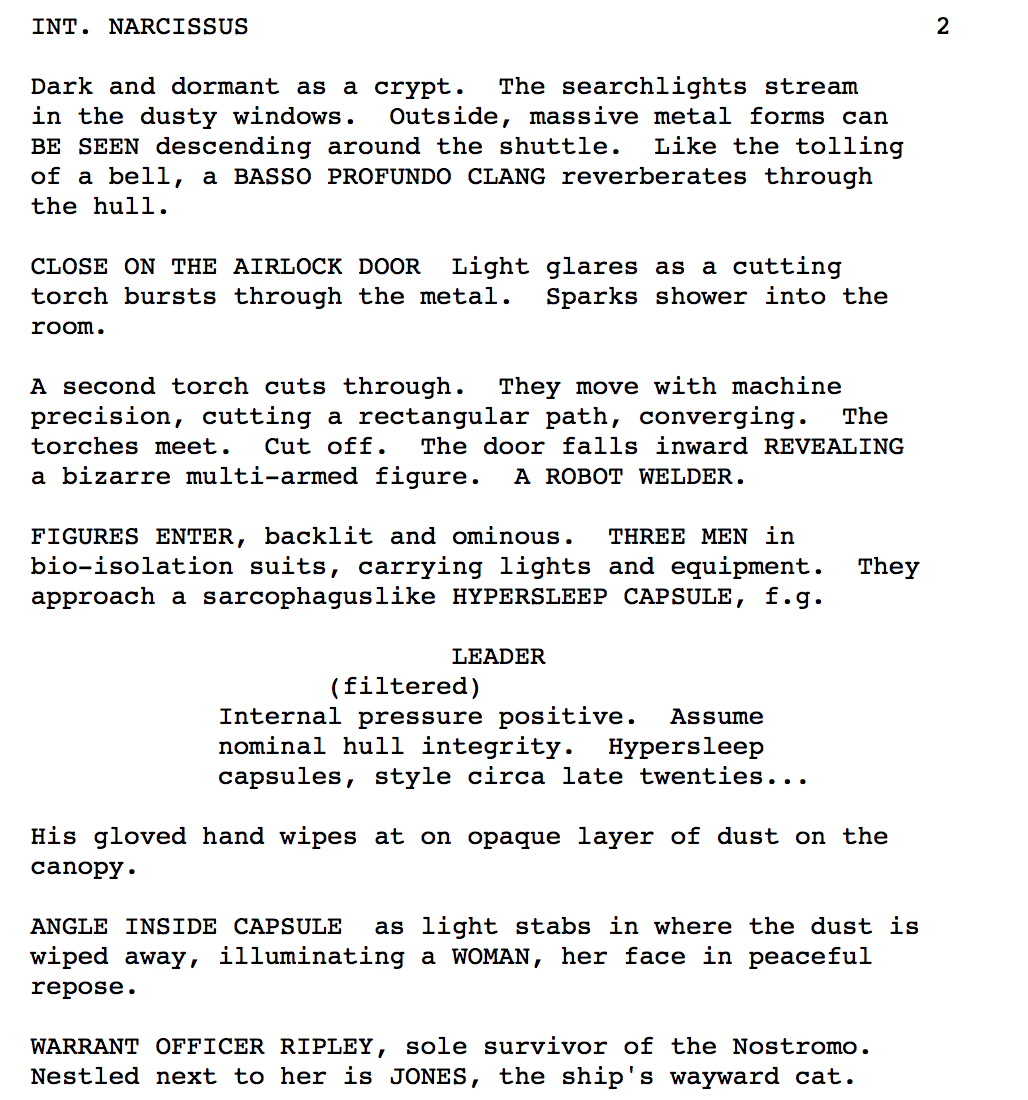
INT. NARCISSUS. There’s no day or night. Just INT. NARCISSUS.

Dark and dormant as a crypt. The searchlights stream in the dusty windows. Outside, massive metal forms can BE SEEN descending around the shuttle. Like the tolling of a bell, a BASSO PROFUNDO CLANG reverberates through the hull.

CLOSE ON THE AIRLOCK DOOR. Light glares as a cutting torch bursts through the metal. Sparks shower into the room.

A second torch cuts through. They move with machine precision, cutting a rectangular path, conversion as the torches meet. Cut off. The door falls inward revealing a bizarre multi-armed figure. A ROBOT WELDER.

So, that’s the very start of Aliens. This is coming to find Ripley in her spaceship. And I remember what that looks like when I saw it in the movie, but this would have given me a very good sense of what this movie felt like. Craig, how do you react to this?

Craig: Well, this to me, I think of this, and I’m not sure if it’s because the script was so influential, or if it’s simply within a tradition that’s longer, this feels like a very typical way of doing things. And I don’t mean to say boring at all. I mean to say this is sort of how you do it. Like when I think of like a good classic way of writing description, it is a little bit prosy, right? He doesn’t shy completely away from prose. “Dark and dormant as a crypt” is evocative.

But he’s using — he’s not writing full, complete sentences. He’s doing a lot of little bursts. Like, “Sparks shower into the room” is a technical sentence, but it’s not like a full, or like the words “Cut off” is a sentence. That obviously is a little bit of a fragment.

So, he kind of goes fragmented at times. Mostly the action description is focusing you on the visuals and on the audio, which is important. So, to me, this is a very classic way of doing things. There’s not a lot of stuff in here — there’s nothing cute. There’s nothing clever or referential to the reader. There’s nothing that you wouldn’t know if you weren’t watching or listening to the movie.

This, frankly, is pretty much the way I like to approach things. Also interesting is his use of capitalization which is very much the way I use it. And it’s when I feel like it.

John: Yeah.

Craig: So, you know, sometimes he’ll say, like he’s using it in a typical way when a new character enters. ROBOT WELDER. THREE MEN. Sometimes he uses it to call out a specific prop. HYPER SLEEP CAPSULE. Sometimes he uses it for a sound, or even an action. Like he says, “Outside, massive metal forms can BE SEEN.” And it’s there just to help you. It’s almost like you can see the camera swinging to it, you know what I mean?

John: Mm-hmm.

Craig: So, this is very classic. I think you could not go wrong if you adopt this as your style.

John: Absolutely. Let’s talk about the literary techniques he’s using. So you have metaphor and simile in here. So, “Dark and dormant as a crypt.” “Like the tolling of a bell.” So, obviously you can’t see metaphor and simile up on a screen, but that’s how you’re trying to create the image in the reader’s head, or create the sound in the reader’s head.

He’s not afraid of referencing the camera. So, it does say, “ANGLE INSIDE CAPSULE,” “f.g.” for foreground, which is not common, but you totally get what’s happening there. This feels like a script that was both written to be shot, and written to be read. He actually has a great appreciation for the person who is spending the time to read the script and is trying to create on the page as close to the experience as what he wants to create on the big screen down the road.

Craig: Right.

John: So, this is terrific on that level.

Craig: Yeah, I agree. And it’s one of the reasons I get so frustrated when so-called script whatevers say, “Don’t do…script…” because what he’s doing here isn’t so much writing a script like, oh, I’m just writing directorial notes for myself. What he’s doing is helping the reader watch a movie. Everything he writes in here, everything, is essentially him describing to you the movie that’s running in his head. So, “Dark and dormant as a crypt” is evocative and I can see it. And then I see, “Searchlights stream in the dusty windows.”

I see all of it, and it’s — even “Like the tolling of a bell, a BASSO PROFUNDO CLANG.” So, some people might not know what a Basso Profundo Clang is, but they know what the tolling of a bell is. So, we’re good.

John: Yeah.

Craig: “Light glares as a cutting torch bursts,” I can see it. It’s all about helping me see, and the angles help me see.

John: The next last paragraph, “ANGLE INSIDE CAPSULE as light stabs in where the dust is wiped away, illuminating a WOMAN, her face in peaceful repose.”

So, here we go. This is a long sentence for what this. So, “Inside the capsule, light stabs.” Great. I totally get what the stabbing is in that case. “As dust is wiped away.” So here it’s like we’ve moved to passive voice kind of here for a second. You know, dust is wiped away. But we’re inside and he’s using the whole sentence to sort of let us know this is a longer shot. We’re inside something. It’s meant to be mysterious and it’s meant to be a little bit more serene inside here. It’s just terrifically well done.

Craig: It’s so good. It’s so good. And it’s so purposeful. Like this is my favorite kind of description, frankly, because it is both creative and utilitarian. I’m a big fan of this sort of thing.

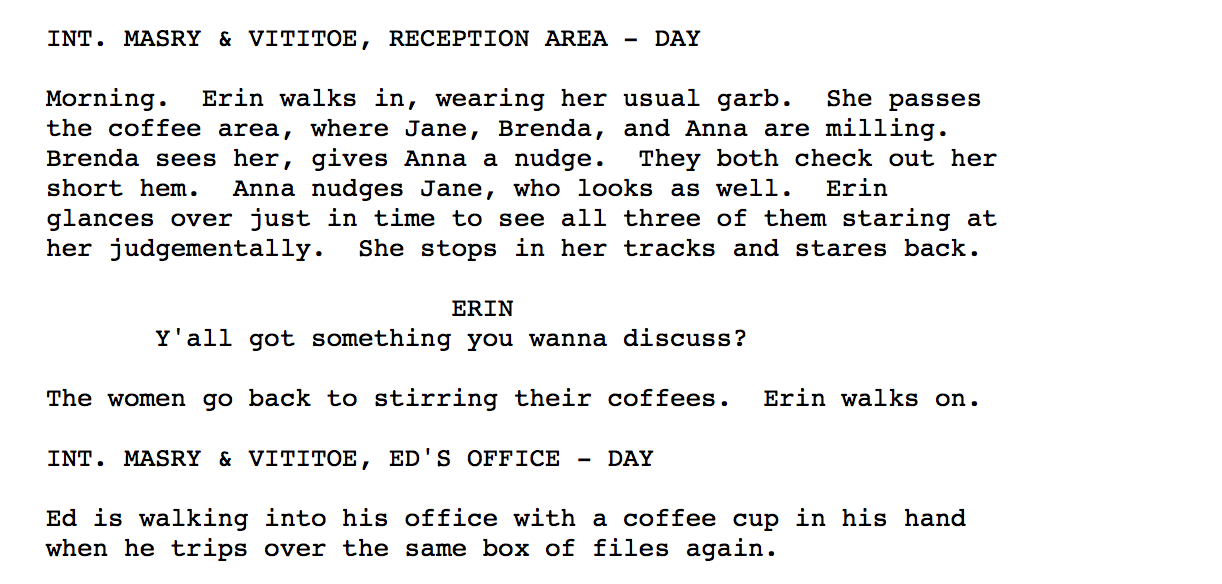
John: Great. Next up we have Erin Brockovich, and here’s a snippet of the script by Susannah Grant.

INT. MASRY & VITITOE — lord, I have no idea what the name is — RECEPTION AREA — DAY.

Morning. Erin walks in, wearing her usual garb. She passes the coffee area where Jane, Brenda, and Anna are milling. Brenda sees her, gives Anna a nudge. They both check out her short hem. Anna nudges Jane, who looks as well. Erin glances over just in time to see all three of them staring back at her judgmentally. She stops in her tracks and stares back.

Y’all got something you want to discuss?

The women go back to stirring their coffees. Erin walks on.

Next scene.

INT. ED’S OFFICE — DAY

Ed is walking over to his office with the coffee cup in his hand when he trips over the same box of files again.

So, a very different style here. This first paragraph, all the scene description before Erin talks is just one block. And yet it works really well for me because it gives me the feeling that this is a oner, that basically this is all happening in a single shot. This is all sort of one idea is them looking at her. And then we’re going to circle back around to what her reaction is to them looking at her.

Craig: Yeah. This is a very common way of describing scenes that are not about the camera. The camera should not be noticed here at all.

So, when we look at James Cameron’s opening, it’s incredibly visual because there is no dialogue and it’s entirely about telling the story of the mystery of a space that’s being illuminated and exciting things are going on.

This scene is about people and what’s going on in their heads. And about what looks mean and what looks don’t mean. And looking away and looking at. And in that case this is appropriate because I don’t need to know the angles on that, at all. The angles, frankly, will be incredibly boring and obvious.

It’s entirely about the performance, so in this case I like the fact that the action takes a back seat to the performance. And all of the action is now actually describing what’s happening inside people’s heads, so that when Erin says, “Y’all got something you want to discuss?” and then they go back to stirring their coffees, I know exactly what happened.

You could have done this in dialogue. You know, it could have been whispered. “You see what she’s wearing?” “Y’all got something to discuss?” “No, no, no.” Right?

And so I like that in this case you go, no, no, I don’t want to do that in dialogue. I want to do it in action. Well, this is how you do that in action.

John: Yup. I mean, if you didn’t understand English, you would still understand this scene. And you would understand that they are looking conspiratorially and reacting. And that she says something back that shuts them up. That’s all you really need to know. So, honestly the line of dialogue isn’t especially important for making the scene work.

Craig: Yeah. This is one area where — I don’t want people to think that just because I say you’re allowed to use camera angles means you should always use them. This would be a place where it would be very clunky to suddenly say, “Angle on Erin. She stops in her tracks and stares back.” You just don’t want that. Because it’s a boring shot.

John: Yeah. This makes it seem easy and sort of thrown off in a way that’s just right. I wanted to talk about that last line before we go to the next scene. “The women go back to stirring their coffees. Erin walks on.”

It’s a great example of just varying your sentence length to create a good rhythm on the page. So, those were some long sentences beforehand. It was a big long block. Here we just have two short sentences. “The women go back to stirring their coffees. Erin walks on.” A three-word sentence that lets us know that that scene is done and we’re on to the next thing.

You don’t need a Cut To when you have Erin walks on. That short sentence is your cut to.

Craig: That’s correct. And I would also say that let’s say your intention was that she would say, “Y’all got something you want to discuss?” and then you just for whatever reason wanted to cut away to something else, sometimes I’ll read in scripts where people end a scene on a dialogue line. It’s just a bad idea I think in general. Because you do want the line to land somehow.

Now, here you clearly need it to land, plus Erin is leaving. But I think in action it’s best to begin and end a scene with action.

John: Yeah. And of course you’re not making a blanket —

Craig: No.

John: Recommendation.

Craig: No, it’s just a good —

John: Yeah, so I’m sure you have scripts where you’ve deliberately ended on a line of dialogue and I’ve done it, too, but it’s a very sort of unique special case where you definitely want to leave the feeling that the camera is ending up on that person as they say this line, and you’re not supposed to be getting the reaction. That the next shot is the reaction to what they just said.

Craig: Yeah. I probably even in those circumstances, I’d probably pull a Cut To in there because I want some sense that I know what I’m doing. That it’s intentional.

John: Yeah. I think the Cut To is almost required for doing that technique.

Craig: Yeah. Ooh, I want to read this one.

John: You can read this one. This is Ocean’s 11 by Ted Griffin.

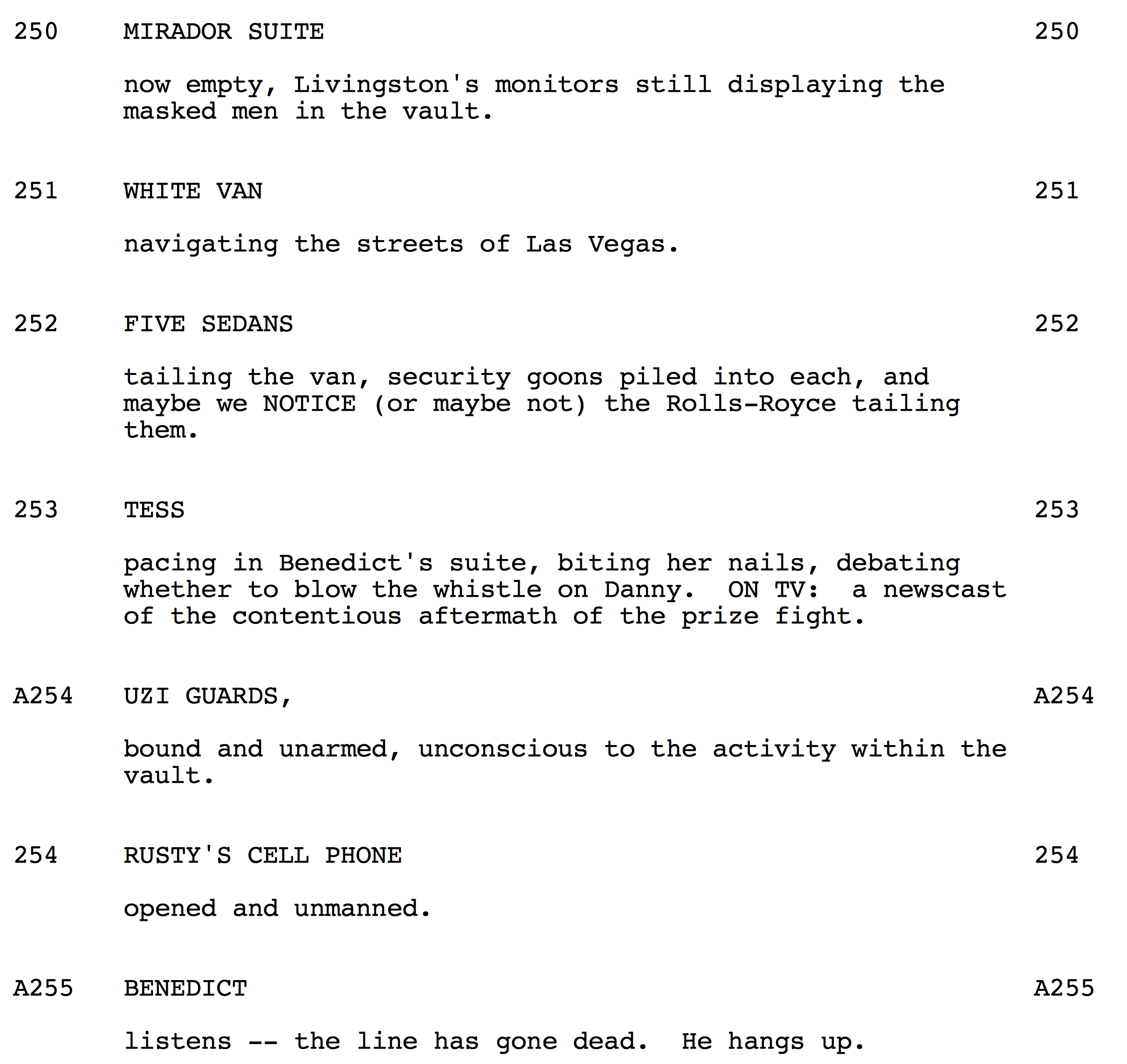
Craig: Right. And here in this little snippet you’ll see that these are all called out as individual scene numbers. So, this is from a production script where everything was numbered. So, I’ll sort of emphasize where things are capitalized.

MIRADOR SUITE. Now empty, Livingston’s monitors still displaying the masked men in the vault.

WHITE VAN. Navigating the streets of Las Vegas.

FIVE SEDANS. Tailing the van, security goons piled into each, and maybe we NOTICE (or maybe not) the Rolls-Royce tailing them.

TESS. Pacing in Benedict’s suite, biting her nails, debating whether to blow the whistle on Danny. ON TV: a newscast of the contentious aftermath of the prize fight.

UZI GUARDS, bound and unarmed, unconscious to the activity within the vault.

RUSTY’S CELL PHONE opened and unmanned.

BENEDICT listens — the line has gone dead. He hangs up.

Ooh, good job.

John: So good.

Craig: Good job, Ted.

John: Good job, Ted Griffin. I wanted to include this because so often you see like, well, the question is like well how do I do a montage, how do I format a montage and, you know, sometimes you do it with bullet points, sort of you quickly go through a list of shots. But this is more commonly what you’re really needing to do in a montage which is you’re moving between different people and different places and they all have to build up to sort of one greater sequence. And this is great example of how you actually do that.

So, you notice that the start of each one he’s in all caps in uppercase doing the where we’re at. So, MIRADOR SUITE, WHITE VAN, FIVE SEDANS, TESS. And then the description right after that is set up in a parallel structure, so it’s always navigating, tailing, pacing. He’s coming with an adjectival, participle phrase to sort of give you a sense of what the action is, but not really the verb. So, it could be, “White van navigates the streets of Las Vegas.” But instead it’s, “White van, navigating the streets of Las Vegas.”

It’s a continuous action that we’re just catching a glimpse of it while it’s going on.

Craig: Yeah. This is all about creating the sense of flow across things that otherwise would be considered fragmented. So, let’s just go right off the bat here. Ted gets rid of INTs and EXTs. Doesn’t need them. Doesn’t want to bother with them. And I don’t blame him at all, especially when you have so many of these in a row. It would be just like word salad to have all these INTs and EXTs, and we don’t need them. We know that the white van navigating the streets of Las Vegas is outside. And we know that Tess in Benedict’s suite is inside.

We’re getting all of that. So, he says, eh, screw all that formality. Don’t need it. I also love that the way it’s running here, there’s a rapidity to it. We can feel the pace of these scenes. We can see — there’s a motion going on to all of this.

And then there’s this interesting — this would fall — I would put this in the school of extreme utility. But, then there are these little twists. For instance, “FIVE SEDANS tailing the van, security goons piled into each, and maybe we NOTICE,” and in parenthesis, “(or maybe not) the Rolls-Royce tailing them,” which is great, because that’s different than what Cameron does. Cameron probably would never write that, because what do you mean, maybe not? Well either we do or we don’t, right?

But actually that is something. Like the instruction there is a careful viewer who is paying attention to that will see it, but otherwise they won’t. We’re not making a deal of it.

John: In the script I just turned in, there’s some scene description of an apartment that we go to the first time. And I call out that there’s some memorabilia from an earlier scene in the set decoration, but it’s not crucial. It’s like it’s a useful thing that’s there that helps sort of connect it to an earlier thing, but it’s not an urgent thing that the viewer doesn’t see it that the world comes crashing to an end.

And so that “or maybe not” is a useful thing. It’s not saying like throwing up your hands like you don’t care. It’s saying that it’s like it’s there and it’s interesting, but it’s not essential.

Craig: Right. Similarly, there’s a thing that probably I don’t think Cameron would do in his description, but I like that Ted does it here. On Tess, “Debating whether to blow the whistle on Danny.” Well, can you film that? Yes, you can.

As long as the screenplay has made it clear that she’s in a position where she would be debating that, what you’re saying there is act like you’re debating that. And I’ll see it. I should be able to see — that’s something that an actor can act. So, I like that that’s there. And then you see that on TV there’s this prize fight going on. So there’s all these layers of stuff.

I love that Rusty’s cell phone is his own scene. It’s just great. Because that — here’s the other thing. Once you start down the road of a pattern for a montage, you’re in that pattern.

John: Yup.

Craig: So, you can’t just suddenly go, okay, now here’s a bunch of things all together in one scene. No. Uzi guards and now Rusty’s cell phone is his own scene, just sitting there, all good, and then you go back to Benedict. “The line has gone dead.” Great. Great. Great.

Just a really good way to move you through this moment. It’s fun. You can feel — like you can almost feel the music through this which is great.

John: Absolutely. Probably a good sign for almost any montage is that you should be able to sense the underlying audio, which is generally music, that’s going to be the bed that’s going to tie all these things together.

And each of these shots feels about the same length, even though they consist of very different material in them.

Circling back to what you said about Tess, “Pacing in Benedict’s suite, biting her nails, debating whether to blow the whistle on Danny.” In all these examples, these are scenes that were already set up someplace else. And so if you’re coming back to something you don’t have to sort of do all the work again to establish who that person was, what they were doing. We had an earlier scene where we saw her. We saw or we knew what her situation was, so we don’t have to do the full recap here. It’s just like, you know, remind us like, oh, she’s debating what she’s going to do.

Craig: Right.

John: Great. We got it.

Craig: Yeah. And it’s really underscoring also how much work the screenplay has done well, because there’s a simplicity and a clarity. There’s no confusion at this point what her pacing is about. That means the screenplay has done its job. So, excellent work there. Ooh, can I read this one, too?

John: You can read this one, too.

Craig: Only because it’s like my favorite and I just feel like maybe I’ll get smarter for having read it. [laughs] So this is a little bit from Unforgiven by David Webb Peoples. Obviously one of the great, great screenplays ever.

BAH-WHOOM! Munny fires and smoke belches out…

Skinny is blown back against the wall and falls to the floor a bloody mess and…

Little Bill is reaching for the Spencer which is leaning against the bar near his leg but he freezes because…

Munny has turned the shotgun on him and Munny sees Ned’s Spencer there and his eyes show how feels about it.

For a moment while the smoke clears the bar is silent and there are nervous glances cast at the bloody body of Skinny but Little Bill keeps his eyes on Munny.

Little Bill says, “Well sir…You are a cowardly sonofabitch because you have just shot down an unarmed man.

Actually, I think in the movie they flipped that. Regardless.

Then….It has become a very formal moment and there are, figuratively speaking, only two people in the room, Munny and Little Bill…and WW Beauchamp is watching them, scared to death, but this is it, what all those Easterners dreamed about, the showdown in the saloon.

John: So much to love here. And so different than some of our other examples. And that’s why I thought we would include it.

Craig: Yeah.

John: So, let’s talk about dot-dot-dot and dash-dash. So, here David Webb Peoples is sort of continuing the continuity of the action by ending each line on a dot-dot-dot. So, and…, and…, because…. So, there’s a cause and effect to each time that we’re cutting.

You know, you don’t necessarily have to believe that each one of these paragraphs is its own shot, but it kind of feels that way.

We’re always in the present tense, and yet look at the choices he’s making about present tense. Skinny is blown against the wall. So, rather than saying the shot blows Skinny back, he is blown back, so we’re seeing the effect of that shot from a previous cut.

Little Bill is reaching for the Spencer which is leaning against the bar near his leg, so we are — so often in screenwriting books they’ll talk about like oh don’t use —

Craig: Get rid of I-N-G. Wah!

John: Yeah, exactly.

Craig: Blech.

John: But here twice in a row, because we’re establishing geography and location and sort of the continuity of a person’s action.

Craig: Right.

John: It’s so fascinating here, I think, where Munny has turned the shotgun on him. So rather than saying Munny turns the shotgun on him, like it has already happened, so we’re coming into a moment that has just happened, so we’re seeing the effect of what has just happened.

Craig: It’s so great. It’s so great. And, you know, this is where these, again, these screenwriting knucklehead gurus out there, I just want to put them all on a spaceship and send them into the sun, because they don’t even understand, ooh, here it comes, they don’t understand —

John: Yup. I knew it was coming.

Craig: They don’t understand the point of verbs. This is a — this is masterful. What peoples is doing here is masterful. And if you pay attention you can see the movie happening because of the verb tenses, right? Little Bill is reaching for the Spencer means when the camera cuts to Bill he’s already in motion. Not reaches for, which means he makes a decision to reach and then reaches. He’s already moving. The thing is already there. And then, but he freezes because Munny has turned the shotgun on him.

Munny has turned the shotgun on him means that Little Bill is discovering something that has happened off-screen that he didn’t realize happened, and that’s so impactful for the audience. Because it means that he’s going to see something first and we’re going to see in his eyes fear. And then we’re going to reveal what he’s scared of.

This is how verbs work, you enormous pile of [laughs] of exploitative —

John: You’re not talking to me. You’re talking to some strawman —

Craig: You exploitative mother-f’ers. “Don’t use I-N-G verbs.” You idiots. Right? So this is what it’s about.

And I love it!

John: Mm-hmm. This last paragraph is so fascinating to me, because “It has become a very formal moment and there are, figuratively speaking,” so it’s a huge long paragraph. This phrase, “it has become a very formal moment,” doesn’t that feel like a slow pullback to you?

Craig: Mm-hmm.

John: It’s like you’re just like you’re recognizing like, oh, we’ve been in these little moments and then suddenly we’re getting bigger and wider and we’re sort of seeing what exactly has happened here.

So, it’s like it’s taking stock of the last few moments and sort of like what the scene is like now. And you don’t have to do this, but in some ways to write to Unforgiven you have to do this, because that’s what the movie feels like.

Craig: Absolutely. And, by the way, I think wrong. I think that this is exactly the order that Little Bill said it in. It’s just maybe he fiddled with a couple of words. But, no, of course, it’s exactly right. So, here’s the deal, right, I love dot-dot-dots. I’m a huge fan of them because what dot-dot-dots do for me is they kind of imply you’re holding your breath. You know, like Walter Murch wrote this great book called In the Blink of an Eye where he talks how the audience will naturally blink where you kind of want to cut, you know.

And that’s just the way our brains work. And similarly, when things like this are happening, it’s common for people to say, “Oh my god, I finally breathed. Like I was holding my breath through that whole thing.” That’s what dot-dot-dot is doing. It’s saying hold your breath. Hold your breath. Hold your breath. And then Little Bill says this, and the way that David Peoples writes this last paragraph it implies you’re breathing now. In fact, we’re going to take our time to breathe and discover this tableau, that it’s now formal. Now, all the action is over and we have entered this new weird thing where two gods among men have dropped all the pretenses and are cutting to the truth.

And then I love this, “And WW Beauchamp is watching them, scared to death that this is, what all those Easterners dreamed about, the showdown in the saloon,” which is something that is acted beautifully in that moment. It’s just great. And there’s nothing wrong. It’s not too wordy, as far as I’m concerned. I feel like this is really bursty, like quick bursts, and exciting, and then when the movie becomes a little bit languid, the action becomes languid.

So this is poetry to me. The use of action is helping imply the pace of the scene itself.

John: Great. Our next example is from Wall-E, which has a similar sort of strange style to it, like sort of not conventional style. But completely suits the movie that Wall-E is. So, Wall-E, if you remember, so much of Wall-E takes place like a silent film. And if you read the script, it sort of feels that way.

So, I’ll describe this to you and if you look at the actual sample, these single sentences are all their own line. So there’s no paragraphs here. They’re all just given their own line. They’re blocked together in some ways to sort of imply a bit of more continuity of action, but they’re all single sentences.

EXT. TRUCK — NIGHT

Wally motors outside.
Turns over his Igloo cooler to clean it out.
Pauses to take in the night sky.
STARS struggle to be seen through the polluted haze.
Wally presses the “Play” button on his chest.
The newly sampled It Only Takes a Moment plays.

The wind picks up.
A WARNING LIGHT sounds on Wally’s chest.
He looks out into the night.
A RAGING SANDSTORM approaches off the bay…

Unfazed, Wally heads back in the truck.
It Only Takes a Moment still gently playing.

…The massive wave of sand roars closer…

Wally raises the door.
Pauses.
WHISTLES for his cockroach to come inside.
The door shuts just as the storm hits.
Obliterates everything in view.

Craig: Well, I love Wall-E. Love Wall-E. I would not recommend that people write traditional screenplays this way. I wouldn’t even recommend people write animated screenplays this way, because this document feels like a notes documents for people who are all working on a movie.

This document feels like it’s in support of reams and reams of storyboards and story art. And on its own is simply not going to do the job. Like, I read this and it doesn’t make me see the movie at all.

It feels like a support document. So, I think that this is a more technical way of doing things within a framework of a storyboarded process, but I don’t think that this would be advisable for a movie where somebody didn’t know your story at all and was going to read it.

John: I disagree with you. I think I could read this document and have a really good sense of what the movie felt like.

And it would take me a little while to get into this strange spare style, but honestly it does feel what certainly the first half of Wall-E feels like to me, which is a bunch of individual shots where he is a small figure against a large landscape or, you know, just he’s center frame and there’s just this giant emptiness around him.

I really dug it. And so even if you were to try to apply some of these lessons to a more conventionally written screenplay, I want to talk about trimming off subjects of sentences because you don’t need them a lot of times.

So, let’s imagine these first couple of sentences where in a more conventionally formatted script. “Wally motors outside. Turns over his Igloo cooler to clean it out. Pauses to take in the night sky.” You don’t need the He’s, you don’t need the It’s, you don’t need Wally’s, as long as you have parallel structure between those sentences, we get it.

And particularly if you’re writing action sequences, you’re very often going to trim off those subjects because we know who’s doing it, so just give us the verb and let’s keep going.

Craig: Yeah, I agree. I do that all the time, and I obviously write in a more traditional sense. Where this doesn’t work for me, if I weren’t familiar with Wall-E, if I didn’t see artwork, I hadn’t been looking at storyboards is things like, it says, “A raging sandstorm approaches off the bay…” but that’s it. It’s just a raging sandstorm. Okay.

And then it’s a “massive wave of sand.” And then it says, “The door shuts just as the storm hits.” It’s so flat and I’m not excited. And I want to be excited in things like that. He says, “Whistles for his cockroach to come inside.” I’m not sure if a cockroach does come inside there, or not. I don’t know. And it says “obliterates everything in view.” It’s all so flat and it feels very much like Wally himself, like Wally is writing this script. But I don’t want Wally to be writing the script. I want somebody like Pete Docter to be writing the script to make me feel for Wally, which is in fact what was going on.

I think it was Pete Docter who did this one, right?

John: Yeah. Pete Docter, Andrew Stanton.

Craig: Oh, Stanton.

John: Other credits were Jim Reardon, yeah.

Craig: I’m just fascinated by this. You know what I’m going to do? I’m going to ask our friend Emily Zulauf like what the deal is with this, because I can’t imagine that they would give this to somebody that didn’t know anything else and say what do you think of this movie we’re making. So, I’m in a different place than you are on this one.

John: Yeah. For sure you could imagine this document along with the artwork, or the sense of like each of these lines became one panel of a storyboard. And maybe that’s sort of how their internal process works. But I really do think this is a way you could write a script and have it be quite successful. So, all right, next is a much more conventional thing but also quite delightful thing from our friends Derek Haas and Michael Brandt. This is from the movie Wanted.

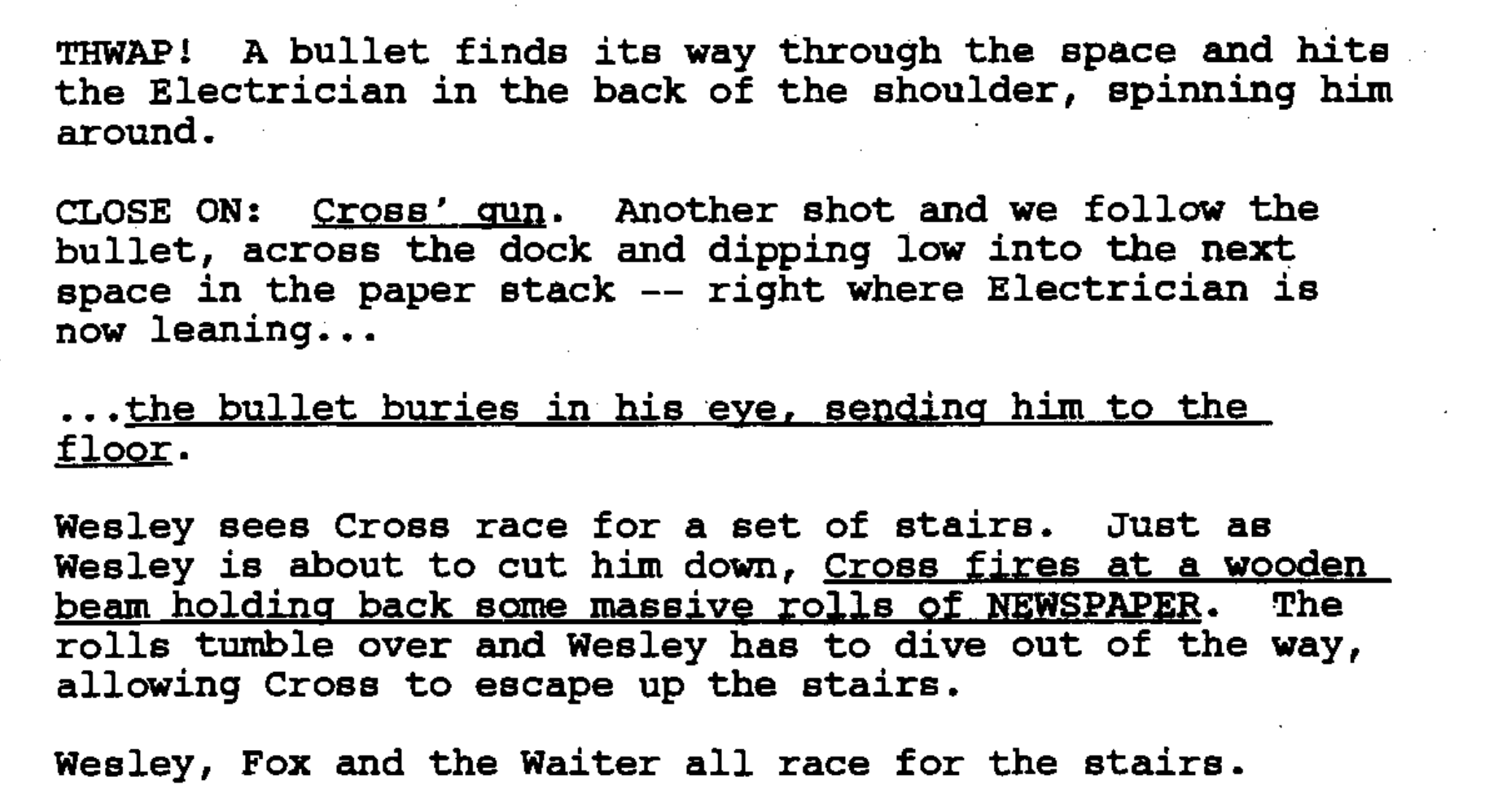
THWAP! A bullet finds its way through the space and hits the Electrician in the back of the shoulder, spinning him around.

CLOSE ON: Cross’s gun. Another shot and we follow the bullet, across the dock, and dipping low into the next space in the paper stack — right where Electrician is now leaning…

…the bullet buries in his eye, sending him to the floor.

Wesley sees Cross race for a set of stairs. Just as Wesley is about to cut him down, Cross fires at a wooden beam holding back some massive rolls of NEWSPAPER. The rolls tumble over and Wesley has to dive out of the way, allowing Cross to escape up the stairs.

Wesley, Fox, and the Waiter all race for the stairs.

Craig: Yeah. To me, this is, again, very traditional way of doing action. One thing that the guys do here is they’re not shying away from violence, right, so the action — when we write action, you can say like, “He’s shot, falls to the ground.” And the action is telling you this is a movie about the ballet of violence. When it’s “THWAP! A bullet finds its way through the space and hits the Electrician in the back of the shoulder, spinning him around,” we understand that we’re doing ballet now. First of all, we know that we’re actually following the bullet, which tells us, again, about pace.

When “the bullet buries in his eye, sending him to the floor,” it’s underlined. They’re like, hey, this is what we’re about here. This is a movie in which violence is supposed to be operatic.

And people running and dancing around, like I don’t know what these guys are thinking, and I don’t need to. I don’t know what their characters are in this moment. It’s not about that. So, contrast this with say like in Unforgiven we can see like, oh my god, he turns and then there’s this moment of dread. And then we reveal this. This is more pure action.

And this is a very typical way of writing pure action. High energy. And use the action to let us know exactly how lurid we’re going to be.

John: Yup. Also, the use of underlining is part of the reason why I chose this section of the script. Action scripts will tend to use underlining as like an extra form of punctuation. It’s like a way of sort of visually indicating what the key crucial beats are. And so you will underline the things that you want to make sure the reader doesn’t miss, but also it’s just going to give you a sense of this is already a very loud scene, so what are the loudest parts within this loud scene.

And sort of what do you need to make sure you’re focusing on. Even within the uppercase, like that NEWSPAPER still gets capitalized because — it’s not just because it’s a key prop, but because it’s a big thing you need to make sure you don’t miss. It’s a thing that’s going to be causing the action in the next section.

Craig: Right.

John: It’s essentially its own character for the rest of this paragraph.

Craig: Yeah. And so like if you don’t capitalize newspaper and so everything is just underlined there, you’ll notice it, but massive rolls of newspaper you’re like, well, okay, so massive rolls of newspaper. Newspaper doesn’t seem very massive to me. Massive rolls of all capitalized newspaper, I’m just already imagining lots of newspaper, like a massive amount of newspaper, which is what they want. So, they’re smart that way.

I thought this was done really, really well. And, by the way, just side note, love this movie. Love — so entertaining. I was so entertained by Wanted.

John: Yeah. Wanted is a movie that knows what it is in a way that so many movies don’t. It never shied away from being its own true self, and that’s what I really appreciated about it. It was nutso.

Craig: Yes, it was.

John: And wasn’t Chris Pratt in that? Chris Pratt plays like —

Craig: Yes, he plays like his jerk buddy at work who is screwing his girlfriend.

John: Like on a copy machine. There’s some crazy —

Craig: Yeah, exactly. He hits him in the face with the keyboard and the keyboard letters spell out F-U I think, or, I’m trying to keep it clean. But it was very cool. I don’t know, Timur is nuts, man. That guy — I love that movie.

John: Yeah. I love it, too. Whatever happened to Chris Pratt?

Craig: I don’t know. I don’t know. For a moment there, uh, you know, I think he’s just mostly doing that role, like he plays that guy, the jerk.

John: The jerk. Yeah.

Craig: Like the jerk who is in a movie for a scene to make the hero look good.

John: Yeah. Sometimes you get typecast because it’s really who you are.

Craig: Yeah, well he gained a ton of weight. He’s like 300 pounds now.

John: It’s rough. Our final example is from Whip It. And I wanted another example of a montage. And this is a movie that has a lot of montages because like most sports movies there’s time where you’re really trying to summarize down what a match feels like, what a game feels like, to sort of those key moments. So, here is one of the matches in Whip It.

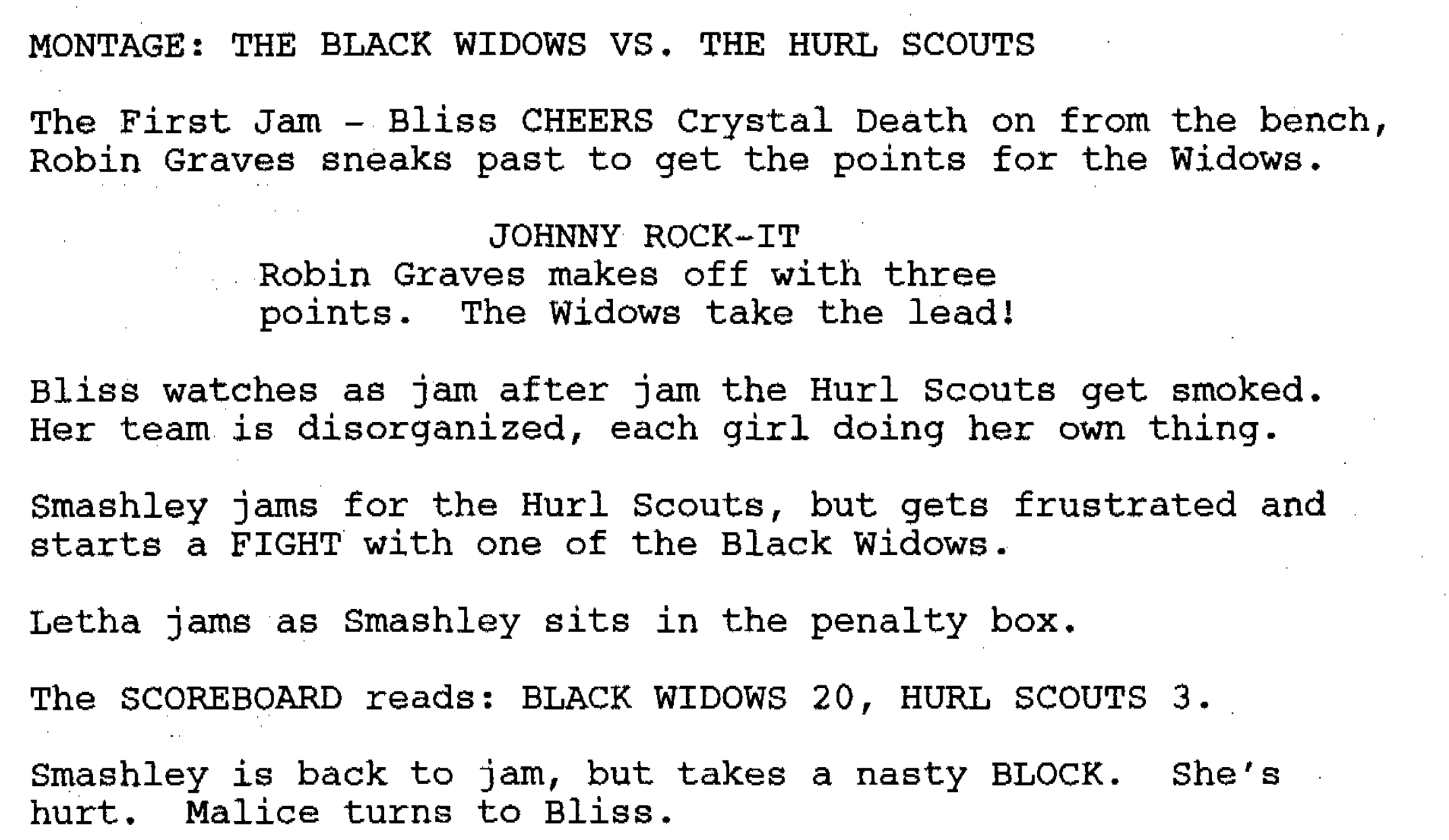
MONTAGE: THE BLACK WIDOWS VS. THE HURL SCOUTS.

The First Jam — Bliss CHEERS Crystal Death on from the bench, Robin Graves sneaks past to get the points for the Widows.

Johnny Rock-It says, “Robin Graves makes off with three points. The Widows take the lead!”

Bliss watches as jam after jam the Hurl Scouts get smoked. Her team is disorganized, each girl doing her own thing.

Smashley jams for the Hurl Scouts, but gets frustrated and starts a FIGHT with one of the Black Widows.

Letha jams as Smashley sits in the penalty box.

The SCOREBOARD reads: BLACK WIDOWS 20, HURL SCOUTS 3.

Smashley is back to jam, but takes a nasty BLOCK. She’s hurt. Malice turns to Bliss.

Craig: Yeah, I mean, it gets the job done.

John: Absolutely.

Craig: Yeah, this is pretty spare, actually. I mean, I’m kind of a little surprised, because I’ve seen the movie which is so much fun, and these things are such high energy. I mean, I guess I am being a little critical. Like I kind of want sound. I want sound. I want crunching. I want like, you know, like starts a fight, like how? Like punches her?

John: Punches her? You know, I feel like I actually got some of that sound and some of the feel just by the use of the verbs she did choose. So, “jam after jam they get smoked.” Picking the fights. Takes a nasty block. I think this scene comes from later on in the movie, so this may be after we’ve had quite a few examples of like what these matches feel like, so this may be one of the shorter matches in the movie overall.

Craig: Right. Okay, well that’s a good point. Because there is a real fatigue that can set in. It’s one thing to do the ballet of the bullet smashing into eyes, and people smashing into each other, but if this is the ninth or tenth of these at some point in the movie, then I guess short-handing makes sense, because one thing that does happen — and everybody knows this as you’re reading a script — is you read faster. It’s like faster, faster, faster because if the script has done its done its job right, you want to see what happens

John: Yup.

Craig: You want to see what happens. So, you start to go faster and faster. You don’t want quite as much really painstaking detail in here. And perhaps, you know, if Smashley has started a fight before, then — and it’s been spelled out really clearly, then starts a fight here, I kind of get how she’s doing it.

So, that makes sense to me.

John: Cool. I hope this was helpful for people. So, you can find all of the examples that we talked about here. There’s little images that you can download on the Internet. Just go to johnaugust.com/Scriptnotes and in the show notes for this week’s show you’ll see all of these images that you can read along with us. Thank you, Craig.

Craig: You know what? That was great. I feel like we’ve got a pretty big show here. Maybe we should push reshoots to next week?

John: I think we’re going to push reshoots to next week. So, in next week’s episode we will talk about what are reshoots, why do movies have them. How do writers get involved with reshoots? What happens if the original writer is not the writer on the reshoots? And we’ll talk through some of our own examples with our films that have gone through reshoots and what has worked well and what has not worked well.

But there is time for One Cool Things if Craig has a One Cool Thing.

Craig: Uh, my One Cool Thing is your One Cool Thing.

John: All right. My One Cool Thing is A World Without Work. It’s an article by Derek Thompson in The Atlantic. And I thought it was just a really good think piece overall about what is the future of America and other western economies going to be like as more and more of our work gets replaced by technology. And so to date we’ve seen like factory jobs being replaced, but as clerk jobs and transportation jobs and other things get replaced, there may just not be a place for some people to have jobs in the classic sense that we’ve had jobs.

And what does the world look like, not just in terms of how does the economy work, but psychologically how do we deal with a society where not everyone is going to be employed or needs to be employed. And so I thought it was interesting for everyone to sort of take a look at.

Also, the kind of work that you and I do, Craig, is sort of kind of weird luxury work. And we’re not kind of crucial or fundamental to any part of the economy. And we could easily, while we’re not going to be replaced by computers tomorrow, it just got me thinking about sort of what my life would be like and what my identity would be like if it weren’t the job that I had.

Craig: You know, artists have never been essential to society the way that people that grow food are, or doctors are, but we’ve always been in demand. I mean, well, not all of them, but a bunch of them.

So, the nice thing is I always feel like what we do at least, there’s always a place for it. People will always want to be entertained. It’s just innate to the human condition. So, yeah, I don’t think we will be replaced by computers.

I think I could be replaced by a computer. [laughs] That’s just me.

John: I think it does, and this article does lay out, is that it does allow for a greater number of people who have artistic ambitions to sort of fulfill those artistic ambitions because there’s no fundamental need for them to be working.

And so I think it may create a class of people who were never kind of looking for a job, or just decided to have sort of the minimal jobs and just become artists in whatever capacity they wanted to be because there’s no pressure to define yourself by making a certain amount of money.

Craig: All right.

John: We’ll see.

Craig: Yup.

John: Craig, thank you so much for another fun podcast. Our show, as always, is produced by Stuart Friedel. It is edited by Matthew Chilelli. I’m not sure who did the outro this week, but if you have an outro for our show, you can write into ask@dev.johnaugust.com. That’s also the place where you can send your questions, long questions are the place for that.

Short questions are great on Twitter. I’m @johnaugust. Craig is @clmazin.

If you would like to subscribe to our show, you should subscribe to it in iTunes. Just go to iTunes and search for Scriptnotes. Also in iTunes you can find the Scriptnotes App which lets you get access to all the back episodes of the show. There’s also one for Android.

If you would like a USB drive, there’s a small chance that there are still some left in the store. So you could go to store.johnaugust.com and get one of those. There’s a 10% discount if you use the code SINGULARITY.

And that’s our show this week. Craig, have a fun week.

Craig: You too, John.

John: Bye.

Craig: Bye.

Links:

  • Scriptnotes 200 Episode USB drives are available in the store while supplies last
  • Paramount, AMC and Cineplex try new revenue-sharing initiative on The Wrap
  • Excerpts from Aliens, Erin Brockovich, Oceans 11, Unforgiven, Wall-E, Wanted and Whip It
  • A World Without Work by Derek Thompson
  • Outro by Stuart Neville (send us yours!)
Everything but the dialogue

Episode - 206

Go to Archive

July 14, 2015 Follow Up, News, Scriptnotes, Transcribed, Words on the page

John and Craig take a deep dive into scene description, looking at how seven produced screenplays arranged the words on the page. With samples from Aliens, Erin Brockovich, Oceans 11, Unforgiven, Wall-E, Wanted and Whip It, we tackle verbs and metaphors, ellipses and underlining.

You can look at the show notes to see the exact scenes we’re discussing.

Also this week, Paramount has cut a deal with two exhibitors to greatly shorten the window between theatrical and home video on two upcoming releases. We look at why, and what this experiment means for writers in the near and long-term.

Links:

  • Scriptnotes 200 Episode USB drives are available in the store while supplies last
  • Paramount, AMC and Cineplex try new revenue-sharing initiative on The Wrap
  • Excerpts from Aliens, Erin Brockovich, Oceans 11, Unforgiven, Wall-E, Wanted and Whip It
  • A World Without Work by Derek Thompson
  • Outro by Stuart Neville (send us yours!)
You can download the episode here: AAC | mp3.

UPDATE 7-17-15: The transcript of this episode can be found here.

Scriptnotes, Ep 205: The One with Alec Berg — Transcript

July 9, 2015 Scriptnotes Transcript

The original post for this episode can be found here.

John August: Hello and welcome. My name is John August.

Craig Mazin: My name is Craig Mazin.

John: And this is Episode 205 of Scriptnotes, a podcast about screenwriting and things that are interesting to screenwriters.

Now like most weeks, I’m here in Los Angeles, but Craig is way off in the other side of the country. He has kidnapped a famous writer/director who we both like, Alec Berg, and he’s holding him hostage in a house. So this can be sort of a special episode because Craig is going to interrogate him and get all the information he can out of Alec Berg.

Craig: Yeah. The Bergs and the Mazins are on a little mini vacation together right now. All of the children are out of our hair, spectacular. And what we like to do when we go on vacation is record podcasts.

John: Yeah, absolutely.

Craig: So I’ve got him. And I’m going to be asking him all the questions that people want to know. You know, a lot of questions about Alec Berg that have gone unanswered over the years and they’re all going to be asked, and I will get answers. Oh, I will.

John: And I’m looking forward to it. So before you do that, let’s do just a tiny bit of follow up.

Craig: Yeah.

John: In the last episode, we described the new 200 episodes Scriptnotes USB drive that people can purchase. A bunch of people purchased them so we are not quite in danger of selling out of them but they will sell out relatively soon. So if you would like to get the entire back catalogue of Scriptnotes on a USB drive, you should go to store.johnaugust.com and probably not wait too long for those because they will go. But thank you for everyone who bought one of those.

And Craig, do you remember what the promo code was that you picked for these USB drives?

Craig: Yes, the promo code was SINGULARITY.

John: That is the promo code that will save you 20% which would almost cover the shipping cost of those in the U.S. So if you want one of those —

Craig: Huge savings.

John: Huge savings. Second, our final bit of follow up — I’m kind of sad about this, on Tess Gerritsen and her Gravity lawsuit. Craig, talk us through it.

Craig: Well, you know, we’ve been following Tess Gerritsen. She alleged that she was owed a whole bunch of money because the Warner Bros. film Gravity, at least in her point of view, was based on her book Gravity that she had sold the rights to New Line, and she’d been suing. And all along the way, we had been following this and saying, “We don’t think she has a case.” Well, neither did the judge, repeatedly. And now she’s saying, alas, she’s giving up.

But she’s saying she’s giving up in the weirdest way. And it’s kind of consistent with everything she’s done so far. I mean, her whole thing is — she would go on her blog and say, “This is why I have this amazing case and this is why it’s terrible and this is why Warner Bros. can’t get away with this.” This is an incredibly one sided thing that even then both you and I felt was flimsy and not substantive.

And her final goodbye here is similar. Rather than saying — so the title of the piece is Gravity Lawsuit: Why I’m Giving Up. The proper answer is because I have no case. That’s not the answer she gives. The answer she gives instead is because the court is nuts and didn’t allow us to prove our justice and so forth. But I disagree. I disagree.

She even cites — I don’t know if you noticed this John, she cites for the first time something, right? What she never gave us was anything from her book and then something from the movie for us all to look at and say, “Oh yeah, that’s very, very similar.” What she does instead now is she cites something from her contract and she believes that this is determinative, and it says, “Owner agrees that the company may assign this agreement blah, blah, blah, blah, blah.” May, she just doesn’t see the word may there. Interesting, very interesting.

John: Yeah. So this is the end of our Gravity saga and I guess I’ll kind of miss it. The good news/bad news is that people have been tweeting in with all sorts of other lawsuits that are similar, some of which are making it through the court system as we speak. So in a future episode, we will talk through some of these other ones that have percolated up.

My hunch is that we are seeing more of these but they’ve always been there. You and I have both been around long enough that we’ve seen a lot of these things happen, what’s interesting to me is I think more of these are actually going to trial rather being settled before they ever become publicly known. So we’ll talk through some of those. I expect our opinions on them will probably be similar to the Gravity lawsuit but we’ll look at them as they come up.

Craig: Yeah. I mean, a general rule of thumb is if it goes to trial, the studio is going to win. They don’t go to trial with losers in general, they just settle them. They never came close to settling on this one as far as I could tell. I think, you know, when I see something like this, I just keep thinking that at some point, somebody must have reached out from the plaintiff side to say, “Well, do you guys just want to make this go away or what?” And when the studio says, “No. Actually, we would love to go all the way with this.” That’s when you know, they just — that’s just not the way corporate lawyers behave when they don’t have something locked down.

John: Yeah. I doubt it’s a philosophical change where the corporate lawyer decided to just become much more aggressive and like, “Oh yeah, we’d love to go to trial.” I think there’s something that has shifted in terms of how they respond into these kind of complaints or just that they felt there were no grounds for the complaint.

Craig: I agree. I’ll tell you that I don’t blame Tess Gerritsen for anything she did. I am concerned with her lawyers who I think kind of sold her a bill of goods here, but that’s my opinion, my non-lawyerly opinion that her legal team may have led her down the primrose path.

John: Great. So for the rest of this podcast, you are going to be talking to Alec Berg and I will not be there in the room to defend Alec Berg as you beat him up. He’s tied to a chair. You’re going to slap the answers out of him, correct?

Craig: Oh, yeah. I’m going to slap a lot out of him.

John: But what I’d love to know is how he helped create such an amazing show called Silicon Valley and how he actually topped the work in the first season with the second season. And how he prepares for the crushing disappointment of the third season which cannot possibly live up to expectation.

Craig: You know, it’s funny, I was not aware that he was involved in a show called — what is it? Silicon what?

John: Silicon Valley.

Craig: No.

John: And so apparently it’s about the silicon mining industry, and also intercut with the plastic surgery industry. So it’s really a great, gripping drama that enfolds over, you know, this sort of nonlinear storytelling mode. So maybe while you’re on vacation with him, you could, you know, rent the DVDs and watch them.

Craig: Just to be clear, I’m here with a guy name Alex Berg, I don’t know — do you?

John: Oh man, the wrong person, sorry.

Craig: Yeah. But this is Alex Berg. He’s not — I mean he’s a writer of a kind-ish. [laughs]

John: Well, Craig, I’ll leave it to you to figure out who this man is and why he should be on our podcast.

Craig: All right, here we go. So at last, I’m here with Alec Berg.

Alec Berg: Indeed you are, sir.

Craig: Got rid of Alex Berg, turns out he was useless.

Alec: Alex Berg, a real guy, actor.

Craig: Oh?

Alec: Yes

Craig: Not useless.

Alec: No. There is an Alex Berg who is an actor, and there’s an Alec Berg who’s a musician, I believe, in Portland. And there’s an Alec Berg who is a tech writer, oddly enough. I think he’s in upstate New York and he tweets constantly. So if you go to Twitter, he’s Alec Berg and I had to be pretentiously real Alec Berg like he’s not real because I’m the real Alec Berg, but —

Craig: By the way, you’re not real —

Alec: No.

Craig: And he is probably real.

Alec: He’s much more real than I am.

Craig: He seems real than you are.

Alec: He certainly tweeted several hundred thousand times more than I have.

Craig: Oh, he’s doing — oh, and that means, therefore, real.

Alec: Yes.

Craig: As we all know, volume equals substance.

Alec: Well, sure.

Craig: Well, [laughs] so here I am with the real, real Alec Berg —

Alec: @realalecberg.

Craig: And we are on vacation together.

Alec: We are.

Craig: With our wives.

Alec: Not the way —

Craig: I don’t want to start any weird rumors or nothing, although we do have a free path to happiness across the country.

Alec: Craig, please, this is going out to the public.

Craig: That is true, that is true.

Alec: We will end at that part.

Craig: Yes, yes.

Alec: [laughs]

Craig: Let’s keep it in. So Alec, I’ve known you for many years but I’ve never interviewed you. So I’m going to start a little bit where most of the interviews start and then we’re going to wander off. Because what we like to do on our show is talk about things from the writing perspective as writers. It’s not the same old questions. Nonetheless, I’m going to start with the same old question. You began your Swedish life as a writer at Harvard, I believe. Were you writing even prior to college?

Alec: Yeah. I mean, I did a lot of like, you know, the usual creative writing classes and things like that. And those were always the classes that I was, you know, enjoying the most in junior high and high school. I went to high school with Ted Griffin who I don’t know if you’ve had on this podcast or not, but —

Craig: No. Ted is simply not important enough.

Alec: Yes.

Craig: No. We’ll get him on for sure.

Alec: Screenwriter of much repute —

Craig: Ocean’s Eleven

Alec: Ocean’s Eleven and Matchstick Men.

Craig: And Matchstick Men.

Alec: And he created a show on —

Craig: Terriers.

Alec: FX called Terriers which was amazing.

Craig: Yeah.

Alec: Anyway, Ted and I went to junior high and high school together and he was, you know, probably from birth, like just obsessed with the film business. It’s in his family. His grandfather was a director. So he was aggressively making short films. We were actually editing short films together where we would have to plug two VCRs into each other and you would have to play from one into the other.

Craig: Basically like the first EditDroid from Lucas.

Alec: Yes. Yeah, right, right.

Craig: But only with two instead of like twenty.

Alec: Yeah, right. But like I remember sitting in his apartment when I think I was in like ninth grade and he was in seventh grade and we were, you know, editing. And I grew up in Pasadena so it was close enough to the film business that I knew it was there. Like I wasn’t like a child of the film business but I definitely was very aware of it.

Craig: Did you look at the film business as kind of a trap for feckless dreamers?

Alec: I had no sense, really, of what it was. And I certainly had no pretension of like — I always assumed like even from that age like, “Oh, I’d like to do something peripherally pertaining to entertainment.” I was really obsessed with stand-ups. Like when I was eight years old, I could do two-and-half hours of Bill Cosby kind of word perfect.

Craig: Right.

Alec: And then Steve Martin became like the game changer for me, like those few first few albums.

Craig: It’s interesting. I went through the same thing. I remember Delirious, Eddie Murphy’s Delirious. It’s like you memorized it almost word for word.

Alec: Well, somebody just wrote an amazing piece. Somebody interviewed like a hundred comedians and said, “What was the thing that made you want to be a comedian?” And of those hundred comedians, I think like 80 of them referenced Eddie Murphy’s Delirious. Like that really was like the — that’s the Star Wars of stand-ups.

Craig: It kind of is. And I remember, yeah, you would sit with your friends and sort of compete to see who had the most word for word.

Alec: Yes. And it’s still amazing. If you watch it now, it’s like it’s not one of those things where you go, “Oh yeah. Well sure, 30 years ago.”

Craig: It’s still really funny stuff, yes.

Alec: It’s unbelievably edgy. It’s great stuff still. So I was kind of a comedy nerd and we did — Ted and I did — but I mean Ted, far more than I, like driven by show business, show business. So I came to be enamored with the entertainment business, but I always thought I’d be an executive or, you know, an attorney or something like that. Like I don’t really ever think — until I got to college and I started writing — I worked at the Harvard Lampoon and that was where all of a sudden I became aware of like, “Oh, there are people who graduated a few years ago who write for Letterman, who write for The Simpsons,” had just started. The Simpsons started when I think I was a sophomore in college.

Craig: Right.

Alec: And that was one of those things where it’s like, “Oh, this is a thing.” Like people actually, like they don’t get jobs, they don’t go to law school. But I don’t think I was really like, it’s become a very weird thing now where like, there are like sophomores at the Lampoon who are like writing spec scripts and, “Oh yeah, this is my sketch package.”

Craig: Weaponize their ambition, yeah. .

Alec: It’s like what? Like I didn’t even know what that was or like that’s how you got a job. But I did a bunch of filmmaking in college and then the part of it that I thought I was sort of best at and I was most interested in was writing.

Craig: Right. So you were in that — it’s interesting, I was — because we’re going to leap ahead to a question I was going to ask you later, but I want to ask you now because you kind of segued into it perfectly. When you and I — we both got into the business roughly around the same time, in the early mid-90s —

Alec: Yes, the good old days.

Craig: The good old days. And we came out of what does seem like a fairly naive place. I mean, I remember, when I first came to L.A. that I got this book, Ken Auletta I think was his name, he wrote a book called Three Blind Mice and it was the story of the networks. And I got it because I just didn’t understand what the difference was between a network and those stations that weren’t networks and who made shows. Wait, wait, networks don’t make shows and I had no idea how any of it worked.

Alec: Well, the nice thing is that nobody knows how that works still to the this day —

Craig: Still to this day, exactly.

Alec: And now more than ever.

Craig: But, you know, you were at the Lampoon going, “Oh wow, there’s people who write on those shows, maybe I could do that too.” And you’re right. Now it seems very formalized. Everybody seems to be aware of everything very early on. Do you think that — and I promise we’ll get back to you in a second, but do you think that whatever you call it, the farm system, the incubation of new writers, is that damaged beyond repair or is it just too self-aware right now?

Alec: You know, it’s funny, I have no sense — people always ask me like, people always like people ask me questions like all the time.

Craig: Like just this morning this guy asked you.

Alec: Yeah. I can’t go anywhere without people asking me. When I do get asked about like how do you break into the business, the answer I sort of come around to is I kind of look at it like breaking into a bank. Or it’s like, I can tell you how I robbed the bank.

Craig: Right.

Alec: I can tell you what I did to short the alarm system and to fool people into thinking I was the security guard —

Craig: They’ve closed that loop a lot, yeah.

Alec: That’s my thing. It’s like people are like, “How do I break into the business?” And my honest answer is, “I have no idea.”

Craig: Right.

Alec: Like I know what people were expecting of me back then, like you’d write a couple of spec scripts of existing shows. The rule then was, don’t write a spec pilot because people don’t want to read spec pilots, they want to read existing shows, they want to read —

Craig: Just the opposite of what it is now.

Alec: Right, right. And now it’s like when I read writer submissions, it’s like — nobody’s writing Modern Family. Like all I’m getting are pilots because that’s the thing people do now.

Craig: Do you think that the cohort — I mean, I’m asking to throw an entire generation under the bus, but you don’t have to. But do you think that the cohort of writers that you came up with is stronger at least in inception than say this one now?

Alec: I think it’s a generational thing. It’s always going to be, you always think that like because you prize your skills in a certain, you know, order, I think you value certain things that people of your era valued, right?

Craig: Right. Like quality.

Alec: Well, it’s like, you know, the whole point of like rock music was to piss of your parents. And if your parents like the music, it’s not working correctly. It feels like it’s the same thing where it’s like each generation — like personally, I feel like — especially in sketch, you feel the influence of UCB and that kind zany improv like, “Oh, the twist in the middle of the sketch is this thing goes completely sideways and it turns out we’re on an alien planet watching this on TV.” And to me, as a sort of traditionalist, that offends me, because when I think of sketches I think come up with a really solid premise.

Craig: Right.

Alec: And serve the premise. And this idea of like in the middle of the sketch you go zany sideways, and it’s — you turn the whole thing upside down. That feels like a quit to me. But people who grew up prizing those zany left-turns as like, “Oh, that’s the comedy gold,” I think that —

Craig: Oh, but you know —

Alec: That feels right to them. So I guess what I’m saying is, without even realizing it, I’ve become hacky and —

Craig: [laughs] At last I’ve led you to the truth.

Alec: It’s over. It’s over for me.

Craig: Halfway through this, you’re going to quit the business.

Alec: Yeah.

Craig: And at the end you’re going to shoot yourself.

Alec: Yeah.

Craig: This is going to be great, yeah.

Alec: People would just say, we always used to joke about this, like the hardest thing about show business really is like you never get pink slipped, right?

Craig: That’s right.

Alec: It not like somebody just calls you and goes, “Yeah, we appreciate your contributions. Here’s your severance package. Don’t come in tomorrow.”

Craig: Your last day looks just like all your other days.

Alec: Right. You keep going in and then all of a sudden you realize that you haven’t been on the payroll for weeks.

Craig: That’s right. And you don’t know any of these people.

Alec: No. But also, everyone else knows you’re not working there anymore but they haven’t said anything.

Craig: Correct.

Alec: And that’s the most brutal part. It’s just like it’s a very slow, quiet, there’s no definitive end moment.

Craig: That’s actually great news for us, I think. Because I plan on just drifting out of the business.

Alec: But the terrifying thing is that, we may be done.

Craig: Right.

Alec: Without even knowing it.

Craig: You said it’s terrifying and my heart is singing right now. I’m still happy. It means we can extend this vacation. Let’s just keep driving, man, like Thelma and Louise.

Alec: Wouldn’t that be amazing? You suddenly realize there’s just no compelling reason to go back.

Craig: Well, you know, a lot of people — no one really knows this except for you and for me, but we’ll share it with them that you and I have this fantasy —

Alec: Yeah.

Craig: We’ve been talking about it for years — quitting writing.

Alec: Dare to dream.

Craig: Dare to dream, quit writing, and the two of us just open some kind of — we’d become lawyers. And I honestly feel like we could get our law degrees — I’m not kidding — in months. I feel like if you and I tried really hard —

Alec: I think you can get a law degree. I don’t know if it would be reputable at all but it does seem like —

Craig: It would be a degree.

Alec: It would be a physical piece of paper that says we have —

Craig: Right. If you and I said, “Look, the bar is one year from now, let’s start studying now,” and we’ll take the bar a year from now, I think we could do it.

Alec: If our sole reason for studying was to pass the bar, as opposed to amassing actual useable legal knowledge —

Craig: Not interested in that.

Alec: [laughs] That’s applicable in some real world.

Craig: I already feel like I’m more of a lawyer than you are because of the way I’m approaching it —

Alec: Yeah. No, you’ve already — you adjudicated this entire thing.

Craig: Your scruples [laughs] —

Alec: Masterfully. Yeah. No. See, again, this is the problem, I’m out of that business also before I even got in.

Craig: I need a new partner. You and I become lawyers and then — and sort of, like, lawyers-managers-agents. We become like some sort of weird new thing. We take on all of our friends, we stop writing, and we just advise them on how to go through their careers. We probably would end up making more money. Now, we’re taking 10% of 20 or 30 A-list writers.

Alec: Yeah. And I don’t know that I would end up being more happy doing that, but I’ll bet you I would be less sad.

Craig: Well, and then there’s that. Let’s talk about that. Why —

Alec: Yeah.

Craig: So Alec, this is what I think a lot of people will never understand. So you and your occasional partners, and for many years you were really tied at the hip with Jeff Schaffer and David Mandel.

Alec: Yes.

Craig: So Berg, Schaffer, Mandel. Even when I started working, I remember people were like, well, there’s Berg, Schaffer, Mandel. That’s like a thing. They’re like a big comedy corporation. And you guys did everything — Seinfeld, Curb Your Enthusiasm, a ton of movies. You wrote and directed EuroTrip and then there was a lot of movies that you worked on that you didn’t get credit for —

Alec: Yeah.

Craig: But a ton of work there. Everything seems to be going great and yet, sad. And I talk about this all the time. And I think in a weird way, people, when they hear me say that I’m sad a lot, they I go, “Yeah, you should be.” [laughs] But I think people would be surprised to hear that you get glum about things. What is going on?

Alec: I’ve made peace of it. It’s the creative process. That’s just what it is. I think in any creative endeavor, I feel like if you’re not unhappy with where your product is, whatever it is, you’re not going to strive to do better. Like as soon as — I think complacency is just absolutely anathema to doing good work. Especially in comedy which — I mean, you know, this is a sidebar, but like comedy really is binary, right? Like it’s either funny or it’s not. It’s not like, “We’re going to get it to a certain level and then we’ll just make it a little funnier and a little funnier.” Like certain things are like, “That’s funny,” or, “That’s not funny.”

Craig: Right.

Alec: Right? So if it’s not working, it’s just white hot death. I think as soon as you start to feel smug or complacent or satisfied, you know, unfortunately, you stop trying desperately to make everything better. And I feel like everything I do creatively, I always approach from the standpoint of, “This is terrible. This is going to get out into the world, and people are going to laugh at me in a bad way.” Not like a “Ha-ha, this is hilarious” way, like in a “This is what passes for professional work? This is a joke. That guy stinks. He’s terrible. We’ve discovered his dirty secret. He’s talentless.”

Craig: Right. There’s a lot of that going around.

Alec: And that is the way I approach everything. And it’s like — it makes it difficult because even, you know, when I get an occasional Emmy nomination, for about 10 seconds, that’s awesome, and then it becomes, “Oh, my God. The fall is going to be even more precipitous and more ugly, and people are going to watch —

Craig: What do I do now?

Alec: The crap that I turned out next and go, ‘Somebody got nominated for an Emmy for this?'”

Craig: Right.

Alec: But ultimately, as awful as all that sounds, I’ve sort of made peace with it because it’s good for the work. It just is. It’s a professional hazard but it makes the work better because I don’t stop.

Craig: But do you think it’s possible to be happy and still also be committed to — for instance, Jerry Seinfeld, you worked with him for many years.

Alec: Yeah.

Craig: He strikes me as the guy that isn’t torturing himself. Am I wildly off-base there?

Alec: I think he is very hard on himself, but no. He definitely has figured out a way, I think, to feel positive and good about the good work that he’s doing and —

Craig: In a healthy way.

Alec: The pleasure he derives from his work seems not to have led him to a place of complacency and mediocrity.

Craig: Right.

Alec: But there’s a reason that you’re citing him as an example because he stands out.

Craig: Exception to the rule.

Alec: Right? Like, “Oh, there is somebody who can do that and he’s that guy.” Like the vast majority of people are, you know, when Larry David and Jerry Seinfeld worked together on Seinfeld, Jerry was always the positive one who’s like, “If we set our minds to this, we will do it and we will crush it and we will be great.”

Craig: And Larry —

Alec: And Larry’s whole thing is, “No, we can’t do this. This will never work.”

Craig: [laughs] Right.

Alec: “Let’s not even try, because what’s the point?”

Craig: And that was a pretty great combination.

Alec: And the yin and yang of that was really exceptional.

Craig: And that’s an interesting thing for you to bring up because for many years you did have this very — it was a unique partnership. You don’t see a three-man team or a three-person team almost ever.

Alec: Yeah.

Craig: In writing, at least. It’s every now and then, but you guys really are the only one of note that I can think of.

Alec: Well, Zucker, Abrahams, Zucker.

Craig: Well, yeah, those three guys were — there’s a slightly different division of labor there.

Alec: Yeah you’ve worked with those —

Craig: Yeah. I mean —

Alec: So you tell me.

Craig: Because in a weird way, there was almost four of them because Pat Proft was usually in the mix as well. One of them, often David, was directing more, you know. But you guys were like a traditional, like the three of you would write a script.

Alec: Yeah. And the three of us would direct when we directed. I mean, it really was — yeah, that is a —

Craig: Correct. It was extremely —

Alec: That is the interesting thing about that partnership because I do see a lot of partnerships where like one guy is the this guy and the other one is the that guy. All three of us did everything.

Craig: Right. All three of you did everything in a kind of an equal way. But now, you have sort of said, “Okay, just as Schaffer is off doing The League and Mandel is currently now running Veep.”

Alec: He just started running Veep, yes.

Craig: Right. And you are running Silicon Valley, and have been running it as the writer from the start.

Alec: Yes. I came on after the pilot.

Craig: Oh, came on after the pilot.

Alec: Yeah.

Craig: So, after everybody else had done the hardest part of it.

Alec: That’s right.

Craig: And cleared away all the possible mines that you certainly would have stepped on.

Alec: Yeah. No. I showed up for dessert.

Craig: You showed up after they loosened it and then just went wee, wee, wee, and out came gold.

Alec: That seems fair.

Craig: Right. So congrats.

Alec: Yeah.

Craig: Good.

Alec: Thank you.

Craig: Nice job. But that’s an interesting thing that you have wandered away from what I would imagine would be this comforting nest where you knew, okay, maybe, and each of you might have had this thought at some point. Maybe on our own, we’re only a third of a great person but together we’re one great person?

Alec: I think part of us thought that way. I don’t think we ever had one discussion about, like, how do we work and what is our — like, we just did the work. There wasn’t a lot of, like, you know, talk about process and who does what and who’s better at what and why and how can we, you know, make this process more efficient or hone it in any way. Like there was no —

Craig: The other two guys just agreed that you were the best of them.

Alec: Well, I always used to joke that Jeff and Dave argued and disagreed about almost everything. So functionally, I got to make every decision because that’s the way — it was majority rules.

Craig: [laughs] Right.

Alec: And that part of it —

Craig: You would just wait

Alec: Yes. So in a funny way, it was really like it was — they were helping me make decisions but really —

Craig: They should have just even stopped trying to make decisions.

Alec: Yeah. Which is not entirely true. I mean —

Craig: It’s entirely true.

Alec: All right.

Craig: It’s entirely true.

Alec: No. I mean, we just didn’t spend a lot of time analyzing how it worked. We just did it. And actually, I would say it’s funny. Like there are a lot of writing teams, particularly in comedy, of two people. And you’re right, not that many three-person teams. What’s weird is a three-person team actually makes it much easier. Because with two people you get into these deadlocks —

Craig: Right.

Alec: Where it’s like, “I think it should be black,” “I think it should be white.” And you fight about it. You fight about it, and all sorts of teams have all sorts of different ways of breaking the ties. Some alternate, some flip a coin.

Craig: Right.

Alec: With three people —

Craig: There is no question.

Alec: If two people really have an argument, they argue it out and the third person is almost literally watching it like a tennis match. Just listening to the argument meaning that in the end, well, a lot of times, me, but —

Craig: I could totally see it.

Alec: But really — but here’s — this was also the —

Craig: Here’s what’s going on. You have one Swedish guy, you, watching two Jews beating each other up, just waiting.

Alec: [laughs]

Craig: Just waiting for them to tire each other out with words.

Alec: Yeah.

Craig: And then you come in and in your flat affect way, just say, “We will do the following.”

Alec: Yeah. But what was interesting is, you know, I got outvoted a lot. And what was interesting about that is there just was a level of trust. Like, those guys are both really talented, skilled guys.

Craig: Right.

Alec: And you just get to a point where you go, “I think they are absolutely wrong. I don’t see what they’re agreeing about here. They’re just flat wrong.” But if both of those guys see something in going this other route —

Craig: There might be something —

Alec: There must be something.

Craig: There must be something.

Alec: There must be.

Craig: Yeah.

Alec: Like we just got to that level of trust where it’s like, “I think you’re wrong — ”

Craig: Right.

Alec: “But I also believe that because of past experience, if both of you see it, you’re right.”

Craig: Yeah. I always felt — when I was writing with Todd Philips and he would say, “No, no, no. This should be this way,” and I would think, “I don’t like that. I don’t think that’s true. But I know that if you see it, then you will at least know how to make it good.”

Alec: Yeah.

Craig: And when I say good, I mean, I may never love that one thing but I’ll know that it will work.

Alec: Yeah.

Craig: Because in your mind, if you say to me, “I know how to make this work,” I trust you, you know how to make it work. I would imagine that it was probably that way with those two guys.

Alec: Absolutely. No, 100%. That even the things that I was most like adamantly opposed to, in the end I would always come around to and I’d go, “Oh, okay. Now, I get it.”

Craig: All right. So the brief journey here, you graduated from Harvard, which is a second tier school, you end up in Los Angeles.

Alec: Yeah. It’s the Princeton of Cambridge.

Craig: [laughs] It is the Princeton. It’s the Princeton of — I don’t even think — I think it’s actually the Cornell of Cambridge, but fine.

Alec: [laughs]

Craig: So you end up out here back home, essentially.

Alec: Yes, yeah.

Craig: Where you’re from.

Alec: Well, my folks moved to Boston after I graduated from high school. So I finally —

Craig: To be near you?

Alec: No, my dad is a college professor, my mom is college professor. They got work on the East Coast.

Craig: Idiots.

Alec: Yeah, they went that way.

Craig: Got it.

Alec: So I finally, after graduating college, moved really away from them for the first time.

Craig: Yeah, I was going to say. Like you thought you were getting away from them?

Alec: Yeah.

Craig: And then when was that? Like freshman year? Surprise.

Alec: Yeah. Well, no. What was really funny is — no, they moved the summer before my freshman year.

Craig: Oh, my. You never even had a day?

Alec: So we sort of went to college together.

Craig: Oh.

Alec: But what was funny is, my brother went — my brother’s in college in Connecticut, he ended up seeing and talking to my parents much more than I did even though they were ten blocks away. Because psychologically I’m like, “I don’t have to call them, they’re right there.”

Craig: Right.

Alec: “I don’t have to go see them, they’re right there.” And so I would go months —

Craig: The distance —

Alec: Without talking to them or seeing them.

Craig: I’m really rethinking my strategy of moving halfway across the country, entirely across the country with my parents. I should be next door.

Alec: Yeah. No, I was — I didn’t have to call them, they’re right there.

Craig: Brilliant.

Alec: Why? What do I need to call them for?

Craig: Brilliant.

Alec: I could shout to them.

Craig: And so I won’t.

Alec: Yeah, so —

Craig: So, you came out here —

Alec: Yeah, I graduated. I spent about six months living at home, writing specs because I had a friend who was a couple years older who had moved out to L.A. and had worked in an agency.

Craig: Okay.

Alec: Chris Moore.

Craig: Oh, yes, Chris.

Alec: Who ended up producing the American Pie movies. And he worked at a little agency called InterTalent. And he basically said, “Look, I just got promoted. I have my own desk. I’m an agent now and I don’t really have a lot of clients. I can sort of represent you, but you’ve got to move to L.A.”

Craig: Right.

Alec: And he said, “When you get here, you need writing samples.” So I spent six months writing.

Jeff Schaffer graduated the same year I did. He basically lived in Cambridge for six months. And we didn’t work together-together, but everything I wrote, he read. Everything he wrote, I read. We would trade things back and forth. Yeah. We were, you know, we helped each other.

Craig: And somewhere out there was Mandel.

Alec: Mandel was a year younger.

Craig: Okay.

Alec: So we had worked with him on a bunch of Lampoon stuff but he was still in college when we were out. So Jeff and I moved — packed up his Toyota Camry and we moved to L.A. And our intention initially was to work.

Craig: He had a Camry?

Alec: He did.

Craig: Rich kid.

Alec: Yeah. Oh, yeah.

Craig: Rich kid. I had a Corolla.

Alec: It was something.

Craig: Yeah.

Alec: With the leather and the —

Craig: Leather?

Alec: Yeah. Oh, it had a CD player in it.

Craig: Chic.

Alex: Ooh, yeah, no, it was fancy.

Craig: God. CD player?

Alec: Yeah. I actually ended up crashing his car at one point.

Craig: Nice.

Alec: So I took him down a peg.

Craig: Nice.

Alec: So we moved to L.A. and we sat down with Chris Moore. And Chris Moore at that point was trying to get more into features. He represented a young Zak Penn and Adam Leff actually who had just sold the Last Action Hero.

Craig: I always put Leff first just to piss Zak off.

Alec: Yeah.

Craig: Leff and Penn. That team was —

Alec: And Zak is —

Craig: It was Adam Leff, and Adam Leff’s partner.

Alec: Yeah, that’s right. And a slight annex of Adam Leff.

Craig: That’s right.

Alec: So we moved out. Chris was going to represent us. He became a feature agent, so he put us in a room with two kind of fledgling TV agents, one of whom we ended up working with. The other of whom was a young kid named Ari Emanuel.

Craig: That kid’s name was Ari Emanuel.

Alec: Yeah.

Craig: And was it Ari Emanuel or just a different Israeli?

Alec: Who can tell, really? I’m Swedish, I can’t tell the difference.

Craig: Alec Berg, anti-Semite. I got my news story.

Alec: Edit this out.

Craig: No, editing it in.

Alec: The thing that happened immediately was these agents all said, “Look, you guys have the same background, you like the same shows, you want to work in the same places, you have very similar samples, you’ve worked together for several years in the Lampoon — ”

Craig: Right. Formalize it.

Alec: “Be a team.”

Craig: Yeah.

Alec: “We’re going to send you out against each other or we can send you out with each other,” and people feel like rightfully so they’re getting more for their money when they hire a team because you really are getting two — especially in a comedy room they’re —

Craig: Yeah, they’re getting more.

Alec: You’ve got two brains instead of one.

Craig: Let’s take a side trip and talk for a second to the — because, you know, we have a lot of people who listen to the show that are aspiring writers, many of whom have partners. How do you get screwed when you’re a — I mean, you guys got particularly screwed as a three-man team but what are the ways that writing teams get screwed?

Alec: Well, I mean, you know, there’s a big thing going on with the Writers Guild about paper teams, right? Where like TV shows will basically say, “I want to hire you and I want to hire you. You don’t work together, but if you become a team, I can hire both of you for one salary and you guys can both work at the show.” And people who aren’t actually teams —

Craig: Yes, they’re getting their salaries halved — they’re getting their residuals halved.

Alec: Team up and basically each take half.

Craig: Right. There’s also — for you guys, there’s — you know, we get money — when we get paid there’s a percentage on top of that that the studios kick in for our healthcare and our pension. And they don’t really double it exactly or like they don’t double the cap for teams. And tripling God only knows what it is.

Alec: You know far more about —

Craig: What I’m trying to tell you that you’ve been really damaged over the years.

Alec: Yeah, no, just —

Craig: Deeply damaged by this.

Alec: I was aware of that, I just don’t know the extent to which I’ve been damaged.

Craig: Let me take out a spreadsheet and then just take a look at these numbers.

Alec: I feel like knowing the extent to which I’ve been damaged is going to damage me that much further.

Craig: Yes. So as I said, at the end of the show, you’ll kill yourself. [laughs] I’m working towards the gunshot.

Alec: Yeah. You’re just going to show me a printout of my career stats and I’ll off myself.

Craig: Here’s your pension information. Here are some texts that I’ve had with your wife. Here’s — okay.

Alec: [laughs].

Craig: But now —

Alec: File all of these under “mistakes made.”

Craig: [laughs] Exactly. This is the conception of this thing that eventually turns into this amazing career in television. And I want to talk about this — what I think of as — because I’m catching up to Silicon Valley in a way. I’m going to, like, I’m speeding through Seinfeld and Curb Your Enthusiasm, getting to Silicon Valley in part because I feel like there’s something that unites them. And I always think of a certain kind of story as very Bergian. You prefer Bergian? Bergess?

Alec: I prefer neither.

Craig: Bergish? Yes.

Alec: Speaking [crosstalk].

Craig: So Bergian, we all know what Bergian means. Crap.

Alec: [laughs]

Craig: But also —

Alec: That’s what I’m thinking in my head. That’s Hollywood translation.

Craig: Yes, but also, “God, that’s Bergian.”

Alec: On the fly.

Craig: But also there is a certain kind of recursive self-referential plotting, a kind of a Rube Goldberg plotting that goes on, I see it Silicon Valley the way I would see it in Curb and Seinfeld, too, to maybe a lesser extent, but it’s there. And it’s this thing where these really funny jokes happen. And when you’re writing a comedy and there’re jokes that are connected to plot, they’re on plot, they’re on the specific character relationship that story is about. Then there are these little side jokes, they’re there for funsies. Those become important to the plot. You just don’t realize it’s happening.

Alec: Absolutely. No, there’s nothing better than something that plays purely as a joke that all of a sudden you realize it’s like a magic trick.

Craig: That’s right.

Alec: And it’s just like —

Craig: This is what I think of as Bergian.

Alec: Yeah.

Craig: I guess my craft question is how intentional is that? I mean, do you stop and go, “I know I need something that doesn’t seem like plot and seems like pure icing to turn into cake later.”

Alec: That’s a great question. The answer honestly is we cheat, which is that I would say way more often than not, that little joke early that becomes plot was written after the plot was written.

Craig: Got it. So you’re retrofitting.

Alec: That’s the big difference is that you watch a show in a linear fashion.

Craig: Right.

Alec: The show is never written in a linear fashion. And in fact, one of the great joys of Silicon Valley is because we only do 10 episodes, we can do the same trick from show to show where we’ll come up with something in show six as we’re writing it and we’ll go, “Wait a second, there was a moment in show two where we talked about a similar thing. Let’s go back — ”

Craig: Let’s go back and retrofit.

Alec: “Let’s put something in the show two script — ”

Craig: Right.

Alec: “That sets this up.” And there are things that we do all the time in the show where, you know, there’s a conversation in the first episode of the season where somebody says, “Watch out or this will happen, you got to be careful.”

Craig: Right.

Alec: And then in show nine or 10, that happens.

Craig: What’s the board, the — ?

Alec: We have a big grid on the wall in the office.

Craig: No. I mean, on the show itself, what’s —

Alec: Oh, the SWOT board?

Craig: The SWOT board, yeah. Like that was something that you could see like, “Okay, that was just funny. That was just a sad joke.”

Alec: Yeah.

Craig: And then it became like a runner. I mean, even like the condor, you know, the joke was —

Alec: That’s a great example.

Craig: It was like, “Okay, we’re making a joke about Schrodinger’s bird, Schrodinger’s egg.”

Alec: Yes.

Craig: And then that becomes — I always think of that as a very Bergian thing, the ferrets.

Alec: But that’s the rewriting process, right, is that you go, “Oh, we can reference that here, we can set that up here.” And you’re basically, yeah, you’ve got a chunk of something and you’re pulling little tendrils out of it and plugging them in in other places so that eventually everything is woven in, right? I mean, that I learned from — that’s Larry David. You know, Larry and Jerry kind of invented —

Craig: He invented that in a way.

Alec: I think so. I mean, I don’t know, there’s probably somebody who did something 10 years earlier who’s listening to this going, “Damn you. It was me.” But —

Craig: Well, sorry, sucker.

Alec: Yeah. I just made a joke about somebody listening to this.

Craig: [laughs]

Alec: No, but the honest answer, that’s where I learned it is the whole method of telling stories in Seinfeld is, first of all, there were no freestanding jokes in that show. And it’s what makes that show endure, I think, is when you tell somebody the plot of a Seinfeld episode, that’s the comedy, right?

Craig: Right.

Alec: It’s not like a traditional sitcom where it’s like, “Oh, he told somebody that he was he was going to do them a favor and then he didn’t want to do it and here of the funny jokes that happened during that.” The story of Seinfeld episodes, when you just say what happened, that’s the comedy of it.

Craig: Right. How far can we go without running out of gas?

Alec: Right, exactly. But those are the laughs, right?

Craig: Right.

Alec: Is the comedy and the story are the same and that is something that I kind of learned to do from Larry. And we did that in Curb also, that like, what’s the story? The story is the comedy, right? Like what’s a funny idea? Oh, that’s a comedy idea? That’s what happens.

Craig: Right. Jerry Zucker, I think — I don’t know, David will probably say that he said it first because that’s the way they are. But he said early on they said, “Make plot points jokes, and make jokes plot points,” which is very similar. But what’s different about what you do and I’m using you as the common thread even though obviously all you ever did was just rip off Larry David.

Alec: I hope this analysis doesn’t screw me up because I’ve never thought about what I do or how I do it, I just do it.

Craig: Let me reiterate again. At the end of the show, you will kill yourself. [laughs]

What you do specifically is you make non-plot jokes plot points. There are certain kinds of jokes that never feel like they’re meant to be plot. They just seem like minor, they seem like minor things that are just there because they’re amusing. And you take those out and really — and no one ever sees that coming because we’re trained, I think, now as just consumers of so much culture and a lot of comedy, we’re trained to see setups and payoffs. We know they’re coming.

Alec: Yeah, well it’s like the insert shot of something, right? Like if somebody puts their phone down, there’s a tight shot of the phone. It’s like, “Oh, okay. Here it comes.”

Craig: That means something. Right. We are trained for setups and payoffs. You know, we know when somebody says, “There is absolutely no way I’m going in there…” Right? And you’re really good at paying off setups that we didn’t think could ever be setups for anything anyway, like why would the ferret thing ever be relevant?

Alec: Right.

Craig: You know.

Alec: Well, the condor is an example of like where we wanted Jared’s idea of live streaming the condor egg to be just a dumb Jared suggestion.

Craig: Correct. But that’s exactly right. Like, I thought the joke was Jared is just being a sweet dork the way he is and these guys are torturing him by making him think that he’s going to kill the bird by calling, which is classic those guys, right? And so that felt great to me. And it turns out, yeah, and then in an Alec Berg way — so sorry for the suicide that’s coming — you say, “That’s what we should be paying off. Not, for instance, making a huge payoff about the guy and that the other company and their competing software,” which is what I think everybody else would do.

Alec: Yeah. But again, the way that’s actually constructed is a lot of times in reverse, right? Where we know that we’re doing this thing at the end where there’s this guy on a cliff and that’s the live stream and that catches on. And then we sort of back into all that other stuff.

Craig: Great.

Alec: And sometimes it’s the reverse. Sometimes you have a funny joke and then later in the show you’re like, “What are we going to do here?” And then somebody goes, “Well, what if that thing becomes this?” “Oh, great.” Boom.

Craig: Right.

Alec: But a lot of times, you back into it. You know, you go back and you go, “Oh, this should be the funny thing that we do there.”

Craig: Really, to me, I think what makes you special and different than a lot of writers is —

Alec: Aww.

Craig: It’s not good [laughs]. It’s just how incompetent you are —

Alec: Yeah. [laughs]

Craig: And yet you still get paid at such a high level.

Alec: Oh, shocking.

Craig: It’s that it’s what you choose. It’s when you go backwards, where do you go backwards to? And I find that that’s where you make interesting choices all the time. Because, I mean, you know, everybody, I think, plays the setup/payoff game. But where you go looking for those setups in the kind of retroactive fit ways is very clever and it’s always really funny.

Alec: Oh, thank you.

Craig: Now, so Silicon Valley, I suspect that you felt great going into the second season. You thought, “We’ve had a great first season, what could possibly go wrong in the second season?”

Alec: No, no. Precisely the opposite. I mean, actually in a weird way, the first season was very freeing because it was — “We’re doing this show.” “What is it?” “I don’t know. It could be this.” “What if this is the show?” “How about they — ” “Yeah, that could be the show,” “This could be the show,” “That could be the show.” And you’re just — you’re vamping. You’re just kind of like, you know, you’re really like kind of freeform —

Craig: Free.

Alec: And it’s like, “This could be the show.” And if it’s not the show, no one will see us fail because no one’s watching the show.

Craig: No one will see it. Exactly.

Alec: Right?

Craig: Yeah.

Alec: So it’s very freeing in a way because it’s really like you’re just backstage doing it for yourself. And then when it got out and it sort of worked, Season 2 was like the, “Okay, now prove this wasn’t a fluke.”

Craig: Well, first of all, you guys suffered a ridiculous tragedy in between those seasons. I mean —

Alec: Well, it was in the middle of Season 1 —

Craig: You were in the middle of Season 1, right.

Alec: Chris Evan Welch who played Peter Gregory, brilliant, brilliant actor, unbelievably great guy.

Craig: And potentially the reason — I mean, this is the thing, that when I heard the news about that, what killed me was that — and I think we all knew by the time the show started airing, correct?

Alec: He died when we were shooting shows five and six of the eight initial shows.

Craig: But he didn’t die after the first episode aired on HBO, did he?

Alec: No, no. He died while we were filming.

Craig: While you were filming.

Alec: Yeah.

Craig: So we all knew.

Alec: There were scenes that we had written for him in the last two episodes of the first season that — and toughest thing I’ve ever had to do as a writer is soon after learning of his death, it was like we got — this train is on the tracks and moving —

Craig: Right.

Alec: You know, the show must go on. I had to sit and delete him from these scripts —

Craig: Oh, my god.

Alec: I mean we loved him, we loved the character, we loved the scenes.

Craig: Right. You are part Swedish and, I don’t know, maybe you have a thousandth of the average human’s emotion.

Alec: Do I? I can’t find it. I defy you.

Craig: If I ever were on a show where the main character died in the middle and I had to do these tragic things like delete their name while I was in mourning and replace them, I would call you.

Alec: It was awful, it was really —

Craig: Yeah. Even you thought it was awful.

Alec: It was grim. No. I was like, I realized in that moment, I’m like, “Oh, this is what it’s like to feel.”

Craig: [laughs] At last.

Alec: Yeah. No. No wonder —

Craig: And then you said, “Ow.”

Alec: Yeah. No wonder my wife gets so down. Like if this is what it’s like, god.

Craig: She’s like this every day.

Alec: Yeah, man.

Craig: But he was potentially the reason to watch that show.

Alec: He was amazing. Amazing. He was the guy who every time you shot with him —

Craig: Something happened, right?

Alec: For the next day or two, everybody like, you know, at craft service was like mimicking his delivery and his lines and it was like —

Craig: It was a kind of an impossible creation because it doesn’t seem like you can do anything truly new in that space, in a performance space like that. All you can do is versions of things. I had never seen anything like that in my life.

Alec: He was brilliant. And what was amazing about it is it was completely farcical and insanely broad but at the same time 100% real.

Craig: Yeah.

Alec: Like you believed everything he did was a real human, a very strange —

Craig: Very strange but internally —

Alec: But very particular human being.

Craig: Yeah.

Alec: But everything was real. And that was his brilliance. Like there was not a phony beat to anything he did.

Craig: No. It was all consistent to his character. You know, when he called the hamburger buns breadings, I believed it 100%. And these breadings have sesame seeds, these breadings do not.

Alec: Yeah. And, you know, have you been to Burger King.

Craig: Yeah. Burger King.

Alec: Do people like it? Is it enjoyed?

Craig: [laughs] Is it enjoyed? And then there’s that thing he did that you made me notice. I mean, I think I would have noticed it anyway, when he has that chance encounter with —

Alec: Yeah. Belson, yeah.

Craig: With Gavin Belson and the rest —

Alec: I think my favorite scene to date that we’ve done on the show.

Craig: And instead of saying goodbye, he does like a weird hand —

Alec: His wave.

Craig: His wave.

Alec: It’s very strange, where he has his hand at his side and he kind of brings it up sort of across his chest and lowers it like he knows he’s supposed to wave because someone has told him that moving your hand in a certain way is a human way of communicating farewell. And he knows that he’s supposed to —

Craig: Incredible.

Alec: But it’s just a fascinating thing.

Craig: And the reason I also love —

Alec: And that was all him, by the way, like there was no like, “Hey, do a weird wave.” He just did it.

Craig: And we’re going to get into that question, too, in a second. But that character, what I also loved about him was I believed all of his behavior, all of his behavioral problems, but I also believed because of the way you guys portrayed him that he actually deserved every cent of his billions of dollars.

Alec: This is one of the things that we worked I think probably hardest on in Silicon Valley is that there’s a huge amount of protecting the characters. And we talk about that all the time. We can kick the crap out of Richard a lot —

Craig: But he has to be at least —

Alec: But you have to believe that he’s good at this because ultimately you want to root for him to succeed. And like when we first started, a lot of people, especially like tech journalists and people in the tech business were like, “Wait, is this just like — are you just like kicking the tar out of us? Like is this just a poison pen letter?”

And the answer was, no, of course not. Like, we’re going to take shots and we’re going to call out, you know, things that we see as ridiculous. But we’re not indicting the tech business because our characters are striving to succeed in that business. And if we’re saying that what they’re striving to do is nonsense, then we’re telling the audience not to root for them to succeed.

Craig: Not to root for them, not to care about our show.

Alec: Right. So ultimately, what we’re saying is there’s a right way and a wrong way to succeed in the business, you know. But we’re not saying that success in that business means that you’re a bad person or is a bad thing because then the audience is going to go, “Well, why am I rooting for somebody to get to something that I know is bad?”

Craig: It’s odd to me that the tech community missed the subtle cues of what you were presenting there. But nonetheless, I think you guys do a great job of that. And, you know, particularly good job with him because he did seem like if you pushed him even three or four more millimeters one way or the other that I would just stop believing that he had actually earned all that money. Whereas a guy like Gavin Belson, I think of as somebody who actually probably can’t do much but was a very aggressive businessman.

Alec: Of course. No, I mean look, we play with that a lot, too. Like, we can’t render Gavin as a complete buffoon because he needs to be formidable.

Craig: Right.

Alec: Right? We need a real enemy. We need a real heavy that Richard has to actually battle and those battles have to be real and hard. And if Gavin is just a buffoon —

Craig: Well, you look at him as this incredibly — he is like a Steve Ballmer kind of guy, like I don’t think of Steve Ballmer as a big tech head, but I think of him as a corporate bully.

Alec: Yeah, but oddly, most CEOs are not engineers.

Craig: That’s right, exactly. Gates was — Jobs really wasn’t —

Alec: Well, we did a joke in the pilot about that, right, where Richard sort of, you know, raises his nose at Jobs, right, because Jobs didn’t even write code, right?

Craig: Exactly.

Alec: And it is a funny like engineers versus management thing.

Craig: 100%.

Alec: It was like Jobs versus Woz. You know there is a yin and yang. Where engineers traditionally don’t make great CEOs because they’re so in their heads.

Craig: Exactly, and so that’s what’s interesting that that’s the story that you’ve set up now for Season 3.

Alec: Yes. But we have to have that conversation about protecting all of the characters. Like Gilfoyle and Dinesh giving Jared crap is something where it’s fun to watch, but we have to be very careful about making Gilfoyle and Dinesh too mean because it’s just like once they’re just slapping a baby, it’s like you hate them for that. And so it’s like you like them beating him up, but we have to be very careful about how far we go.

And it’s funny, we always talk about — Mike and I have kind of come up with this thing that we call the Price is Right school of comedy where it’s better to be significantly under the line than to be even one penny over the line.

Craig: One dollar over, exactly.

Alec: Right? Like you’d rather be $10 under than $0.01 over.

Craig: Well, because nobody really gives you credit for being slightly over the line. Either you are or you’re not.

Alec: It is damaging, and sometimes it just destroys everything. And so you’d rather miss under, under, under, under, under than ever miss over.

Craig: When you were evaluating this, I mean, because here’s what I think people probably — for people that are writing, they put so much pressure on themselves to get it right. When you’re writing especially this kind of comedy which is truly about generating laughs, you just acknowledge upfront you’re going to blow some things. You have to. There’s no way, you can’t hit home runs if you’re not occasionally whiffing. So there’s I assume this very painful and painstaking process in editing where it’s like, “No, that went too far.”

Alec: 100%. No, we do it in the writing process, we do it on the stage when we’re shooting, we pull people back, we, “Okay, go for it. Try it. And if it doesn’t work, you know, we’ll pull it back later.” And yeah, we do a tremendous amount of writing in the edit on the show where there’s a huge amount of lines on people’s backs that we do in ADR, and reconfiguring things.

And, you know, a lot of times if you’re on somebody’s close up and you want to build a pause into that, that pause is not they were pausing when they performed it, there was somebody else off-camera talking. And we take that line out so you build a pause in, like you play with rhythms and —

Craig: You know, when it comes to comedy, I wish that there could be some kind of program or something for up and coming comedy writers to watch comedy people edit comedy because that is where you see so much happening. The rescue missions that happen when you’re editing comedy and the tricks, the bag of tricks that are enormous, I mean, especially when you’re doing joke-based comedy and you and I both spend time doing a lot of jokes-based comedy. It’s all about the rhythm and finding, oh, my god, if I need him to just stare and then look briefly to the right, where is that? Find that.

Alec: Oh, the number of times like you’ll use a piece of like after you’ve cut —

Craig: After you’ve cut.

Alec: And somebody says like, “Hey can we do one more?” And the actor will kind of look up to hear who’s off-camera talking to them.

Craig: Gold.

Alec: You use that piece because it’s like we need something where he turns to his right so that we can cut to that guy and he looks like he’s looking.

Craig: Have you ever done one where you played it backwards?

Alec: We have. We did it. There was a scene in an episode in the first season where they hired a guy named The Carver and then we shot two scenes and we realized in the edit that those two scenes really should be one scene. And we glued them together. We had a shot of Kumail in the second scene standing up and leaving. And we used that shot played in reverse so that at the end of the first scene, we cut to a shot of Kumail sitting into his chair which was actually a shot of him standing up from the second scene.

Craig: This is the epitome —

Alec: And you put some footsteps in, so you hear him enter.

Craig: These are the tricks.

Alec: Right. So when you’re watching the show, you go, “Somebody’s walking into the room.”

Craig: Right.

Alec: And then you caught to Kumail sitting. You go, “Oh, that was Kumail who walked in.” And then the second scene starts.

Craig: Kumail does act ambidextrously. I mean, the reputation that he has is like —

Alec: You can’t tell.

Craig: You can’t tell. Even when he’s walking forward, if you play him backwards, it seems natural.

Alec: It’s his gift. He walks forward backwards.

Craig: He walks forward backwards. He’s incredible.

Alec: He’s a talent.

Craig: By the way, I mean like I’ve told you many, many times, if all the show were Gilfoyle and Dinesh talking, I would watch it. I would. I know I would.

Alec: But see, here’s all I will say. And those guys are brilliant, super, super funny. I respect the hell out of them. But —

Craig: Throw them under the bus.

Alec: But the fact is, this is an ensemble show. And the reason that you want to watch those guys all day every day —

Craig: Of course. You’re right.

Alec: Is that they’re part of a bigger machine that works.

Craig: You can’t eat dessert all day. I get it.

Alec: Right.

Craig: I get it. And it’s true. And —

Alec: But it’s great that people think that. Like people want the Erlich show, people want the Jared show, people want the Dinesh and Gilfoyle show.

Craig: That means you’re doing it right.

Alec: Right.

Craig: It’s interesting. I saw an interview with those guys and they said something that made me so happy because whenever actors are being interviewed for junkets and things, somebody inevitably, in comedy always, will say, “How much of this is improv?” And the actors will always give one answer and the writers will always give another. It’s just hysterical.

Alec: [laughs]

Craig: “Yes, you know, they let us kind of do, you know, obviously there’s the script and, you know, then they kind of — we find stuff in the moment.” And the writer answers always like, “Less than you think. Less than you think.”

Alec: [laughs]

Craig: [laughs] “Ever here and there.” And what I find fascinating about you guys is that you guys switched. In this interview, the actors are all like, “No, the scripts are really tightly put together, so we stick to them.” But when I talk to you, you’re like, you know, you’ll say like Zach Woods is an incredible improv artist and that Kumail and —

Alec: They’re all super nimble and yeah.

Craig: Yeah, and that they go on these incredible runs and that there is improv in the show. So is it just that you guys are all incredibly humble or is the answer sort of somewhere in the middle?

Alec: I think that we’ve just found a balance. And I’ve worked on shows where the writers are very sort of hostile about the cast and the cast are very hostile about the writers and there is a lot of like, “Oh, you want me to go out there and say this? I’m going to look like an idiot.” And that there’s this animosity and there really is this cliquishness where like the writers are mad that the actors are tanking their jokes. And the actors are mad that the writers are giving this garbage. It’s exactly the opposite on this show. I just think that it is a special show in that regard that I think the actors have tremendous respect for the writing and we all have tremendous respect for them as performers. And it’s just a good —

Craig: It’s a good mix.

Alec: It’s a good ecosystem. And I credit Mike Judge for that as well, like he’s just a super laid back guy. He was a musician and you can tell from the way he writes and the way he directs that it’s all done by ear. It’s not “I have rules and I’m going to, no, this is the way I shoot.”

Craig: He feels it.

Alec: “I have a style.” He just listens. And if it sounds right, it works. And if it doesn’t sound right, he wants to adjust.

Craig: And so, heading into Season 3, I assume now at last, right? So, okay, first season’s whatever.

Alec: Uh-huh.

Craig: Second season, very scary. I mean, what are we going to do?

Alec: Sure.

Craig: We lost a key cast member and I was so worried. But then we put together a really good season. So now you’re comfortable and happy and perfectly ready for Season 3 knowing that nothing can go wrong.

Alec: Of course.

Craig: And by the way, here’s the gun, here’s how it works.

Alec: Yes, right.

Craig: Now, answer the question. Yeah. [laughs]

Alec: I see what you’re doing. Yeah.

Craig: Yeah. So, what do you think?

Alec: You’re [crosstalk].

Craig: [laughs] Are you excited?

Alec: Look, I feel like, like I said, there was a freedom to Season 1 that, you know, I think in the moment, I was terrified because, “What is this? We have to make a show out of this. How do we do that?” Look, this applies to everything. I feel like I wish that I could figure out a way to enjoy anything that I’m doing in the moment.

Craig: Right.

Alec: I enjoy an enormous amount of what I do retroactively.

Craig: Like this for instance.

Alec: Right. Yes.

Craig: You will later look back at this.

Alec: Like, right now, this is awful. And at a certain point, I might look back after I realized that this led to the freedom of not having to work again where I’ll go, “Oh, that was good.”

Craig: This was the moment.

Alec: Yeah. That was pink slip moment. But, virtually, nothing that I do, like during any of it, during the writing process, during the directing, during the editing, if you said to me, “Are you having fun right now?” The answer, 100% of the time, is no.

Craig: Is no. So, you’re looking forward to more of that?

Alec: “But did you enjoy doing that?” I did. Tremendously. “Did you enjoy that thing?” I enjoyed having done things.

Craig: In the past. Right.

Alec: Yes, of course.

Craig: So, you appreciate the past.

Alec: Right.

Craig: The present is misery.

Alec: I wish I were better because there have been an enormous amount of things that I’ve done that I look back at and I go, “That was awesome that I got to do that. That was an amazing thing that I was allowed to do.”

Craig: “But while I was doing it, I hated it.”

Alec: “I wish, in the moment, I had been able to relax and have more fun doing it.”

Craig: I mean, let’s —

Alec: I can’t. I can’t.

Craig: Let’s end with this.

Alec: Pow!

Craig: [laughs] That was Alec Berg in his last interview.

Alec: Beep.

Craig: [laughs] Reporting live from the Sonoma County Coroner’s Office. Do you think it’s possible, when you say you can’t, if you at least intellectually acknowledge that you’ve worried in all of the moments, some of the results have been good and some have been bad.

Alec: Yeah.

Craig: Therefore, we can take that variable out. The worrying isn’t what makes the work good. Can you at least then say, “Well, why don’t I just stop worrying since it’s having no effect?”

Alec: But, see, I feel like you’ve made a spurious leap of logic there.

Craig: Okay.

Alec: Which is I believe, unfortunately, that the worrying is what makes the work good. That being so terrified of caulking it up —

Craig: Right.

Alec: Is what makes me reexamine and reexamine and shred and tear apart and rebuild and —

Craig: Okay. But let me —

Alec: And if I’m ever enjoying this machine that I’m building in the moment and going, “This works great,” then I’m not scrutinizing it to the point where I’m going to make it work as well as it can.

Craig: But I think you’re confounding joy with satisfaction. In other words, you can enjoy the process while saying, “Well, it’s not good enough but it will get better.”

Alec: Except that I believe that my motivation to really push and work hard —

Craig: Is dread.

Alec: I’m not a person who runs to something. I’m not running to quality. I’m running from failure.

Craig: Okay, running away. Well, it’s Woody Allen’s thing, you know, that his big goal when they asked him, “What are you always trying to achieve when you make a movie?” And he said, “To not embarrass myself.”

Alec: Yeah. And that’s it. That is the sole drive. And I know you would think having done this the way I’ve done it and having worked on the things I’ve worked on, that worked the way a lot of them worked, that at a certain point I would go, “At this point, having done this 20 plus years, I kind of know what I’m doing.” I don’t feel like that at all. I feel like I know less now about how to do it than I did when I started. What I know is I think I have a better idea of what doesn’t work.

Craig: Right.

Alec: So, I can look at something that 20 years ago I might have looked at something and I might have said, “Yeah, I think that’s pretty good.” Now, I’ll look at it and go, “This doesn’t work, and here are 50 reasons why. That’s no good. This is no good. That guy shouldn’t be this way, that guy shouldn’t be this way, she shouldn’t be talking like that.”

Craig: Suddenly, the channel for success becomes incredibly narrow.

Alec: Yes. But I don’t know any better now how to make things work.

Craig: Right.

Alec: I just am much better at identifying flaws.

Craig: You just see all the mines in the field.

Alec: Right.

Craig: Right.

Alec: So, it gets harder and harder as I do it. Not easier and easier.

Craig: Well, there is one way out, Alec.

Alec: Yeah. No, I think we’ve come to that.

Craig: Yeah. Here, let me show you how this works. [laughs] And take that. No, no, don’t touch that yet.

Alec: What’s this X here?

Craig: That, you want to push that down.

Alec: Orange dot. What do I do with that?

Craig: The orange dot you want to be looking at directly or taste it.

Alec: Oh, that’s right.

Craig: Well, Alec, a tremendously insightful conversation. I, like you, am soaking in misery all the time. I share this with our listeners constantly.

Alec: Yes. But that’s the job.

Craig: It’s kind of the gig. It’s part of what we do. I try as best I can now to find little bits of joy.

Alec: Yes. It’s funny, we always used to have this running joke that there’s not a funny comedian on earth with washboard abs. And the reason is, once you take the time to focus on yourself and take yourself seriously enough to sculpt your body like that —

Craig: Yeah.

Alec: You’re taking yourself seriously.

Craig: That’s right.

Alec: And you’re not kicking the tar out of yourself and you’re not going to be as funny as you can be. And I sort of have just embraced that.

Craig: Yes.

Alec: At a certain point, I’m sorry for all the misery that I caused my wife and every time I come home and I say, “This show is not good. You don’t understand,” I know I said it wasn’t good before, this time —

Craig: That you’ve been saying this to me, I mean, like, you were really worried about this season.

Alec: Yes.

Craig: Really worried.

Alec: Desperately worried. I was convinced that it was a colossal — like we had just driven it right into a cliff.

Craig: Right.

Alec: I swear to you, it’s not a —

Craig: It’s not false —

Alec: I need approbation, somebody telling me how good I am. It’s really not. I was genuinely 100% convinced that Season 2 was a disaster.

Craig: When you said that to me, it wasn’t like I thought to myself, “Oh, no, no. There’s something I can tell him that will make him feel good.” I thought, “He’s giving me something as he sees it as a fact.”

Alec: Yes.

Craig: I’m not going to tell him that his, you know, dead cat is really alive by shaking it in the air.

Alec: Yes.

Craig: And I understood, by the way, exactly where you were coming from. Exactly. Because it’s a very hard thing to do. I mean, it’s essentially a sequel. Every season is a sequel. And you’re always on the horns of, “I want to be different but I don’t want to be so different that it’s — ”

Alec: Both.

Craig: We have to kind of the same, we have —

Alec: It’s like releasing albums. I think like every band, you know, like, there are AC/DCs who just make the same album over and over and over again. And they’re great.

Craig: Right.

Alec: Right?

Craig: And that’s what their fans want.

Alec: Right. There’s Madonnas who, like, “Oh, now, she’s this woman. And now, she’s the Marilyn Monroe lookalike, and now she’s Vogueing,” and there are people who can reinvent themselves and each version is good.

Craig: Right.

Alec: Right? And then there are bands that, you know, they do an album or two and then they put something out and you go, well, I don’t want this. It’s over.”

Craig: [laughs] It’s over. You’re done. Here’s your gun, go ahead.

Alec: Yeah. Yeah, they are the one-hit wonders.

Craig: No, I got actually why you were so upset or concerned, really.

Alec: Yeah. Terrified.

Craig: But what I know about your show is that the characters are so strong. And I think that no matter what you do plot-wise — because here’s the truth, if you were to say to me, “Figure out the Season 3 plot line,” I think I could sit and come up with a plot line, sure. Would I care about it? I wouldn’t care about the plot line as much as I would care about the characters as they moved through it. To me, that’s the heart of television. The true heart of television is the characters.

Alec: Everything is so interdependent that I’d think you care about the characters because the characters care about executing certain things. And that’s the plot.

Craig: Yes. But I will tell you as just — this is my experience of the show. I was not worried that they were going to lose their company. And here’s why. Either they were going to lose their company and then I was excited to see what those characters would do, or they were going to get their company and I was excited to see what those characters would do. The dilemma and the building the case — by the way, the lawyer, I mean, just an amazing performance. It was a great, great performance.

Alec: Oh, Matt McCoy?

Craig: Matt McCoy.

Alec: Yeah.

Craig: Just crushed it.

Alec: Unbelievable.

Craig: That’s another great lesson, by the way, is those little characters have to be like your best characters you know. Just your best characters in their own quiet way.

Alec: Yeah. And he was so freakishly good. So great.

Craig: So good, so good. Anyway, I wasn’t worried. I’m not worried for Season 3 either, although you probably will fail this time.

Alec: Oh, we just started writing a couple of weeks ago and I’m already — I just go, “That’s it. It’s over.”

Craig: Actually, this time I believe you.

Alec: We had a good run.

Craig: Yeah — not even — two seasons is not a good run. [laughs]

Alec: Eighteen episodes, that’s a lot.

Craig: In Britain. [laughs] I mean, come on, man.

Alec: We had a good run.

Craig: No, this is going to be one of those like, “What happened?”

Alec: Yeah.

Craig: “Did you ever watch Silicon Valley?” “No. Should I?” “Well, only the first two seasons. Only the first two seasons. Don’t go after that.”

Alec: By the way, you’re channeling — this is my internal monologue.

Craig: Yeah. I wonder how I know what that sounds like.

Alec: [laughs]

Craig: Ladies and gentlemen, Alec Berg. Thank you very much for joining us.

Alec: Thank you for having me. This was fun.

Craig: And we’ll do it again. We’ll get you on live with John.

Alec: Would love to, yeah.

Craig: So you can face his withering questions.

Alec: Bring it on.

Craig: All right, that was Alec Berg and now back to the regular show.

John: So, Craig, that was your interview with Alec Berg which I did not hear a bit of, but I assume that you got all the answers out of him, that he’s not bleeding too hard, that there are not any marks that cannot be healed with time or with plastic surgery.

Craig: Not only that, but I fully expect a Pulitzer for — I mean, truly one of the great coops of journalism right there.

John: It was basically Frost/Nixon but in a podcast form.

Craig: It was. It was Frost/Nixon except important.

John: Yes. [laughs] Let’s talk about our One Cool Things. My One Cool Thing this week is a video that was sent around because the subway, the purple line of the Los Angeles subway is being constructed very, very close to my house. I will be near one of the new subway stops. And so they sent through all this information about the street closures and everything else they have to do to make this subway happen. It’ll be open in like in 2020, so it’s quite a ways off.

The coolest thing they sent was this video that describes and shows how the subway boring machine works, how they actually create the tunnels. And it is so different than you would think. I had a hard time believing that such a robot existed. It felt like something of Robert Zemeckis’ Contact, that we’re actually able to build this thing that can bore and also take all the ore and transport it back.

It was so amazing that I immediately want to set a movie inside a subway digging construction. So it’s a 15-minute video I’m going to send you from a German subway boring tunnel machine. And I think you will find it fascinating.

Craig: That is such a boring machine. You know who drives the boring machine? Arkham Knight. Are you playing Arkham Knight?

John: I’m not playing Arkham Knight. Is Arkham Knight great?

Craig: It’s the greatest and the Arkham Knight who is not Batman. That’s the whole question is, who is the Arkham Knight? I know. He drives a boring machine at one point.

John: I think that’s great. You know, the villain at the very end of the Incredibles is the Underminer. Perhaps he is the boring knight.

Craig: He is the boring knight.

John: Arkham Knight, is it a open sandbox or is it a strict sort of campaign storyline?

Craig: Yeah, if you’ve played the other Arkham games, it’s essentially the same thing. You’re in a general sandbox area but your missions are on rails. It’s Arkham. It’s very, very good. It’s very, very good. But that’s not my One Cool Thing this week.

My One Cool Thing this week is “Rex Parker Does the New York Times Crossword Puzzle”. And when I say One Cool Thing, I mean one kind of cool thing because the truth is, Rex is not cool at all. [laughs] He’s not cool. Rex Parker is a man named Michael Sharp. He is a professor I think at — I want to say SUNY Binghamton. I’m guessing on that one, I think.

But what’s interesting about Rex is that he runs a blog, “Rex Parker Does the New York Times Crossword Puzzle”. He does the New York Times Crossword Puzzle every single day. And then he puts the solution on his blog and then analyzes and critiques the puzzle.

And what’s fascinating is, because I do the puzzle every day, and it’s like, if there were no film critics in the world, if nobody reviewed movies at all, that wasn’t even a thing, except for one guy, one guy did it, that’s kind of what this is like. He’s the only crossword critic I think that exists.

And amazingly, even though he’s the only one, he is incredibly typical for critics. He’s just cranky as hell. He hates most of the puzzles that he does, so of course you’re left thinking, “Why do you do them every day?”

He hates about 90% of them. That’s just my unscientific tally from reading his reviews each day. He particularly hates bad fill. Fill is what they call in crosswords — you have your longer theme answers and then Fill are the shorter answers. So, you know, a lot of bad crossword words that people learn, he’s not a big fan of those.

But I do check him out every day after I do the puzzle and it makes me understand how people use movie reviews I think because the way I use his stuff is, I complete the puzzle and then I go over to Rex to see if I’m either angry at him because he’s wrong, or happy with him because he’s right. Either way, I get validation. I get the validation of anger at him because he’s stupid or pleasure with him because he’s smart. It has nothing to do with him. It has everything to do with me. And as it turns out, I agree with him about 50% of the time.

But if you are interested in getting started on the New York Times Crossword Puzzle, you could do worst. At least at his site, you can get the answers pretty quickly and you can see how he constructs his solutions. And to be fair to Michael Sharp who is cranky, cranky, cranky, he’s a very good solver. His solve times are fairly extraordinary. Well, as he says on his website, he is the 9th greatest crossword solver in the universe based on the 2015 Indie 500 Crossword Tournament.

John: He sounds like an amazing character, so even though I could not care less about crossword puzzles, I will check out his site just because that persona you’re describing sounds amazing.

Craig: It’s kind of great.

John: What do you think is his day job?

Craig: I know in the day he’s a professor, so I think that his deal is he is — I want to say a professor of English, possibly? Yeah, at SUNY Binghamton, I believe. So he’s an academic.

John: Cool. Very nice. I have one last plug. So every Friday this summer, we are going to be putting up some brand new scripts in Weekend Read. Weekend Read is the app that I make for iOS, for iPad and for iPhone.

And so the scripts are only up for the weekend. It’s truly only a weekend read. So if you’re listening to this on Tuesday, there are no scripts up there for you to read because they were only available from Friday until Sunday night. So you just missed out on Josh Freedman’s original script pilot for Terminator: The Sarah Connor Chronicles, you missed out on Lorene Scafaria’s Seeking a Friend for the End of the World, and a highly recommend Black List script.

So, every Friday, check out Weekend Read because there will be brand new stuff up there all summer long.

Craig: Great.

John: Our show is produced by Stuart Friedel who’s also on vacation on the West Coast. Matthew Chilelli edited our show and did the amazing outro of this week. Our thanks to Alec Berg, our wonderful guest. I hope his wounds heal. Craig, have a great week.

Craig: You too, John.

John: Bye.

Craig: Bye.

Links:

  • Scriptnotes 200 Episode USB drives are available now!
  • Tess Gerritsen on why she is giving up the Gravity lawsuit
  • Alec Berg on Wikipedia, IMDb and Twitter
  • The Harvard Lampoon, and on Wikipedia
  • Jeff Schaffer and David Mandel on Wikipedia
  • Silicon Valley on HBO.com and Wikipedia
  • Christopher Evan Welch
  • Crenshaw/LAX Tunnel Boring Machine
  • Batman: Arkham Knight
  • Rex Parker Does The NY Times Crossword Puzzle
  • Check out Featured Fridays on Weekend Read
  • Outro by Matthew Chilelli (send us yours!)

The One with Alec Berg

July 7, 2015 Film Industry, Follow Up, News, Scriptnotes, Story and Plot, Television, Transcribed

Craig sits down with Silicon Valley writer/director Alec Berg to talk about set ups and payoffs, editing comedy and how writing teams get screwed.

Also this week: Tess Gerritsen gives up, but that’s not the end of you-stole-my-idea lawsuits.

The 200-episode USB drives are in the store, but for how long? If you want one, don’t wait. (Note: In the podcast, I misspoke: the discount code give you 10% off, not 20%. You’ll save $2, which is about what shipping costs in the U.S.)

Links:

  • Scriptnotes 200 Episode USB drives are available now!
  • Tess Gerritsen on why she is giving up the Gravity lawsuit
  • Alec Berg on Wikipedia, IMDb and Twitter
  • The Harvard Lampoon, and on Wikipedia
  • Jeff Schaffer and David Mandel on Wikipedia
  • Silicon Valley on HBO.com and Wikipedia
  • Christopher Evan Welch
  • Crenshaw/LAX Tunnel Boring Machine
  • Batman: Arkham Knight
  • Rex Parker Does The NY Times Crossword Puzzle
  • Check out Featured Fridays on Weekend Read
  • Outro by Matthew Chilelli (send us yours!)

You can download the episode here: AAC | mp3.

UPDATE 7-9-15: The transcript of this episode can be found here.

« Previous Page
Next Page »

Primary Sidebar

Newsletter

Inneresting Logo A Quote-Unquote Newsletter about Writing
Read Now

Explore

Projects

  • Aladdin (1)
  • Arlo Finch (27)
  • Big Fish (88)
  • Birdigo (2)
  • Charlie (39)
  • Charlie's Angels (16)
  • Chosen (2)
  • Corpse Bride (9)
  • Dead Projects (18)
  • Frankenweenie (10)
  • Go (29)
  • Karateka (4)
  • Monsterpocalypse (3)
  • One Hit Kill (6)
  • Ops (6)
  • Preacher (2)
  • Prince of Persia (13)
  • Shazam (6)
  • Snake People (6)
  • Tarzan (5)
  • The Nines (118)
  • The Remnants (12)
  • The Variant (22)

Apps

  • Bronson (14)
  • FDX Reader (11)
  • Fountain (32)
  • Highland (75)
  • Less IMDb (4)
  • Weekend Read (64)

Recommended Reading

  • First Person (87)
  • Geek Alert (151)
  • WGA (162)
  • Workspace (19)

Screenwriting Q&A

  • Adaptation (65)
  • Directors (90)
  • Education (49)
  • Film Industry (489)
  • Formatting (128)
  • Genres (89)
  • Glossary (6)
  • Pitches (29)
  • Producers (59)
  • Psych 101 (118)
  • Rights and Copyright (96)
  • So-Called Experts (47)
  • Story and Plot (170)
  • Television (165)
  • Treatments (21)
  • Words on the page (238)
  • Writing Process (177)

More screenwriting Q&A at screenwriting.io

© 2026 John August — All Rights Reserved.