• Skip to primary navigation
  • Skip to main content
  • Skip to primary sidebar

John August

  • Arlo Finch
  • Scriptnotes
  • Library
  • Store
  • About

John

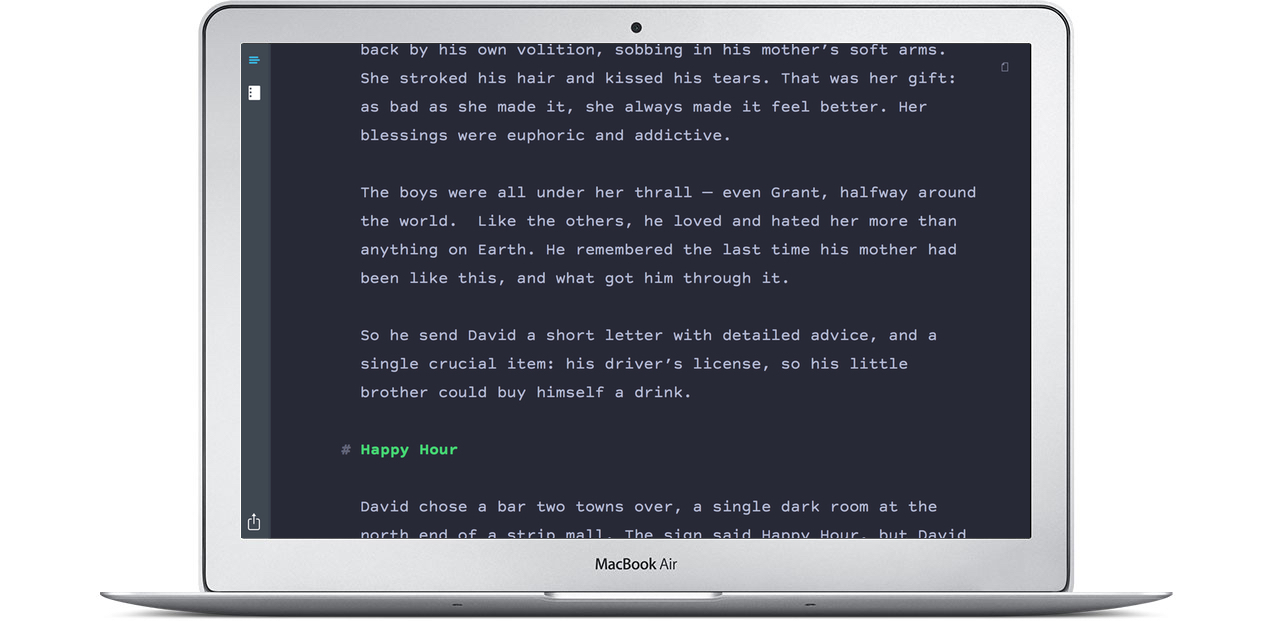
Highland is great for novels

October 28, 2014 Apps, Fountain, Highland, Writing Process

macbook with highland

In addition to being a swell time to grow a mustache, November is NaNoWriMo — National Novel Writing Month.

Over the next few weeks, aspiring Hemingways and Flynns will attempt to hit their target word counts so that by Thanksgiving they’re finishing a draft. Godspeed to them all.

While novels can be written in just about any word processor, more-sophisticated apps like Scrivener allow for notes and images and virtual corkboards. In my experience, the more bells and whistles an app has, the more time I spend playing with the bells and whistles, and the less time I spend actually writing. That’s partly why I made Highland, a writing app that lets you focus on the words, not the formatting.

Because I’m mostly a screenwriter, Highland is largely tailored towards screenplays. But I also write fiction, and I didn’t want to give up any of my Highland comforts.

Since version 1.4, Highland has included a manuscript mode that strikes a good balance between helpful and distracting. Choosing Format > Document Format > Manuscript adds a single line to your file…

Format: Manuscript

…and with it, makes Highland a surprisingly good choice for writing fiction. When you print or export, you’ll find Highland double-spaces text to common publisher standards, perfect for paper editing.

For an example, compare an original file to the pdf Highland creates.

Highland 1.8.2, new in the Mac App Store today, adds a few extra features novel writers can appreciate, such as on-the-fly word count. (Just click the page icon.)

Want to put a header on every page? Add it below the format line:

Format: Manuscript

Header: MOBY-DICK ORIGINS / Caswell Barthowly

Want to start a new chapter? Use a hashtag, such as

#Chapter Six: The Wailing Whaling

Highland will automatically insert the page break, and center the chapter heading on the next page. ((Fountain purists are likely scratching their heads at this choice. Truth is, this untitled manuscript format is actually more like Markdown than Fountain. It feels correct for section headers to be printed.))

Highland’s notes, synopses and omissions work the same as always. [[Text in double brackets]] won’t print. Same for a single line preceded by the equal sign =. And you can keep your scraps handy; select a range of text and choose Format > Omit. You’ll leave it in the file while hiding it from export.

In Preferences, you can adjust column width and line spacing, and set your favorite colors for Dark Mode.

If you’re tempted to give Highland a shot for writing your November novel, we have it marked half-off through November 7th. Give Manuscript mode a spin, and see whether its minimalism can maximize your page count.

As always, you can find Highland on the Mac App Store.
Writer Emergency Pack, now in pre-launch

October 22, 2014 Story and Plot, Writer Emergency, Writing Process

As I mentioned on the podcast yesterday, we’re getting close to launching a new project called Writer Emergency Pack.

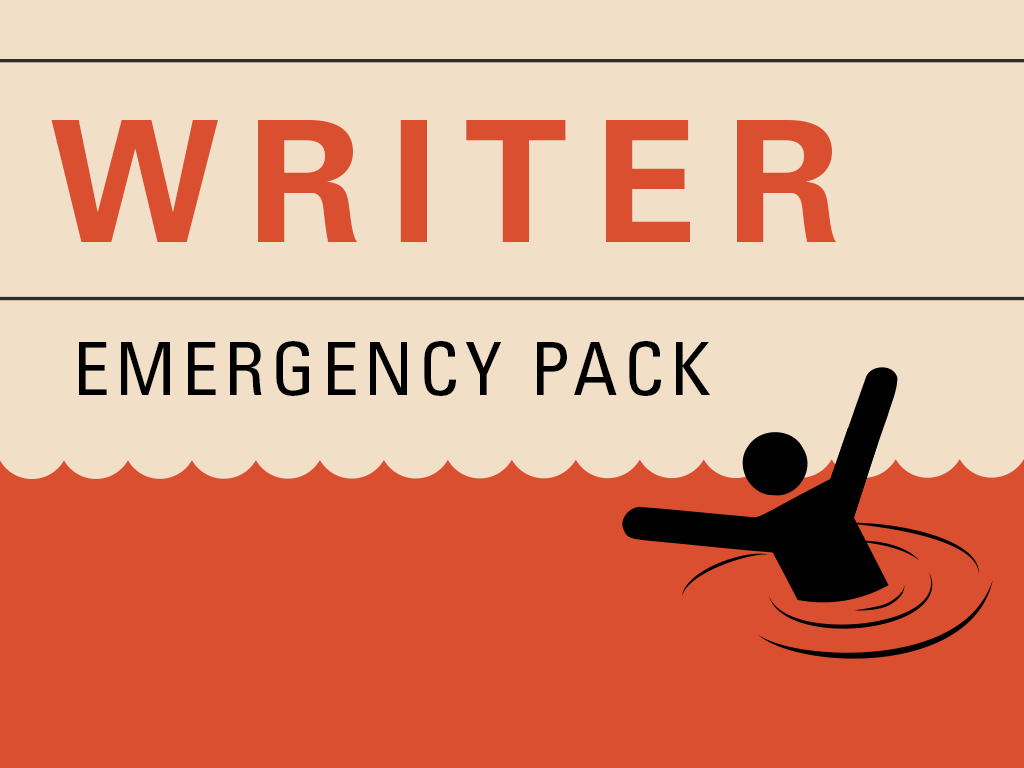
The cover looks like this:

header graphic

As the name suggests, it’s designed as a survival tool for writers. It’s not an app or a book. It’s more like a crowbar for getting unstuck. It’s for screenwriters, novelists, playwrights, students, writing teachers — anyone who deals with story.

We’ve actually been developing it on-and-off for four years, but it became real in the last six weeks. We’ve had a fun time showing prototypes to other writers and gathering feedback. It’s gonna be cool.

Because it’s a physical thing, we’ve had to plan and budget much more carefully than we do with our digital stuff. Atoms scale differently than bits. Make too few, and you run out. Make too many, and you’re sitting on boxes of inventory. Figuring out how to actually make and ship something like this is easily half the job.

When we launch — sometime after Halloween — there will be a short order window to get into the initial run. To make sure no one misses out, we’ve set up a mailing list to let writers know the moment it’s available.

If you’re at all curious, I’d advise you to sign up at Writer Emergency today.

You can also follow on Twitter, @writeremergency. (Tweet ‘Help’ for a teaser.)

Highland works great with Yosemite

October 20, 2014 Apps, Highland

We had quite a few inquiries from Highland’s support page this weekend, including:

Is Highland compatible with Mac OS 10.10 Yosemite? Of all the apps I’m running on my Macs, Highland is probably the most important. I won’t upgrade until you give the all clear signal.

Green light. The version of Highland in the Mac App Store runs fine under Yosemite.

In fact, we’ve been running Highland with the Yosemite betas for months, so the past few builds all run fine. Except for a few small UI changes (such as using the green dot to go full-screen), you won’t notice any significant differences.

We update Highland quite frequently. Version 1.8.2, now in review, addresses bugs that users helped us identify under both old and new OS versions. Highland keeps improving because we have seriously committed users.

If it’s been a while since you’ve looked at Highland, you may have missed out on its new line spacing options. You can now choose Tight, Normal or Loose line spacing in the editor view. This ability to customize the editor for maximum readability is one of the clear advantages to Highland’s just-the-words philosophy.

You can download Highland in the Mac App Store.

On Being Somebody

September 17, 2014 Follow Up, Los Angeles, Psych 101

Reading Notch’s letter about how the burden of public scrutiny led him to sell Minecraft, I’ve been thinking back to an essay I wrote in 2006 entitled Are You Somebody?

As I’ve done more publicity, and talking-head interviews on various DVDs, I’ve found that random people are recognizing me and saying hello with increasing frequency. It’s once a month or so — nothing alarming — but it always comes when I least it expect it: shopping for strollers, in line at the movies, at breakfast with the woman carrying my baby.

The hand-shakers are invariably polite, so I can always genuinely say, “It’s nice to meet you.” But what’s fascinating is how everyone around us reacts. Remember: as a screenwriter, I’m not actually famous. Yet suddenly someone is treating me like I am. I love watching that double-take as bystanders try to figure out who I could possibly be.

Once a nearby woman actually asked me, “Are you somebody?”

Almost apologetically, I said I was a screenwriter. Her face showed a combination of confusion and disappointment that would have been devastating at another point in my life.

That was 2006. Eight years later, I’m still not famous the way movie stars are famous.

Back then, I wrote:

Here’s an example of someone who is actually famous: Drew Barrymore. A few years ago, paparazzi took pictures of us having lunch. In the caption, I was the “unidentified companion.”

This happened again last year in New York. This time I was carrying Drew’s kid, and I didn’t even merit an “unidentified companion.” So when I say I’m not famous, I have proof.

But over the last eight years, I’ve become more widely known within a subset of people, most of them writers and tech folks. Because of Scriptnotes, my voice is actually recognized as often as my face. Because of Twitter, I end up interacting with strangers much more often. And because of both outlets, people who recognize me know a lot more about me — at least, a version of me who hosts a popular podcast about screenwriting.

That “version of me” aspect can be challenging. Jason Kottke writes about his experience:

I realized fairly early on that me and the Jason Kottke who published online were actually two separate people…or to use Danskin’s formulation, they were a person and a concept. (When you try to explain this to people, BTW, they think you’re a fucking narcissistic crazy person for talking about yourself in the third person. But you’re not actually talking about yourself…you’re talking about a concept the audience has created. Those who think of you as a concept particularly hate this sort of behavior.)

Because I can’t hide behind my writing, I’m probably more “myself” on the podcast than I am in blog posts like this. I rewrote this sentence five times; on the show, I can’t ponder and perfect.

But the podcast is on some level a performance. It’s me with the dial turned up. It’s not who I am when I’m making dinner or struggling to make a scene work.

Kottke references Ian Danskin, whose video This is Phil Fish deftly explores how we treat “famous” people more as concepts than as individuals. Even if notoriety hasn’t changed someone’s behavior at all, perception has:

The dynamic between these two people is viewed completely differently as soon as one of them becomes famous.

If there’s a takeaway from this — and there needs to be, because John August is professorial — it’s that the time to think about how you’d behave if you got famous is right now.

That fuck-you tweet to @RandomCelebrity may seem like no big deal — hell, they’re rich and famous. But if that rich-and-famous celebrity tweeted the same thing, you’d think, “Wow, what an asshole.”

Here’s the mind-blowing truth: The person who sends the fuck-you tweet is an asshole, regardless of her pre-existing level of fame.

Tweet people — even famous people — the way you’d want to be tweeted. Yes, this is basic Golden Rule stuff, but we always forget it in the world of internet fame.

Beyond that, be careful of internet pile-ons. People do stupid stuff, and it’s often appropriate to call them out on it. But it’s almost never a good idea to take a random person who said something stupid and hoist them up as a symbol. You’re forcing fame — infamy, really — on someone who is likely no worse a person than you.

Internet fame has a multiplier effect that’s hard to anticipate. You can hurt people far more easily than you realize. And long after you’ve forgotten your outrage, the focus of the blast is left picking up the pieces.

« Previous Page
Next Page »

Primary Sidebar

Newsletter

Inneresting Logo A Quote-Unquote Newsletter about Writing
Read Now

Explore

Projects

  • Aladdin (1)
  • Arlo Finch (27)
  • Big Fish (88)
  • Birdigo (2)
  • Charlie (39)
  • Charlie's Angels (16)
  • Chosen (2)
  • Corpse Bride (9)
  • Dead Projects (18)
  • Frankenweenie (10)
  • Go (29)
  • Karateka (4)
  • Monsterpocalypse (3)
  • One Hit Kill (6)
  • Ops (6)
  • Preacher (2)
  • Prince of Persia (13)
  • Shazam (6)
  • Snake People (6)
  • Tarzan (5)
  • The Nines (118)
  • The Remnants (12)
  • The Variant (22)

Apps

  • Bronson (14)
  • FDX Reader (11)
  • Fountain (32)
  • Highland (75)
  • Less IMDb (4)
  • Weekend Read (64)

Recommended Reading

  • First Person (87)
  • Geek Alert (151)
  • WGA (162)
  • Workspace (19)

Screenwriting Q&A

  • Adaptation (65)
  • Directors (90)
  • Education (49)
  • Film Industry (489)
  • Formatting (128)
  • Genres (89)
  • Glossary (6)
  • Pitches (29)
  • Producers (59)
  • Psych 101 (118)
  • Rights and Copyright (96)
  • So-Called Experts (47)
  • Story and Plot (170)
  • Television (165)
  • Treatments (21)
  • Words on the page (238)
  • Writing Process (177)

More screenwriting Q&A at screenwriting.io

© 2026 John August — All Rights Reserved.