• Skip to primary navigation
  • Skip to main content
  • Skip to primary sidebar

John August

  • Arlo Finch
  • Scriptnotes
  • Library
  • Store
  • About

John

Introducing AlphaBirds

March 27, 2018 Geek Alert, Projects, Store

In addition to making apps like Highland and Weekend Read, my little company makes physical stuff, including Writer Emergency Pack and One Hit Kill.

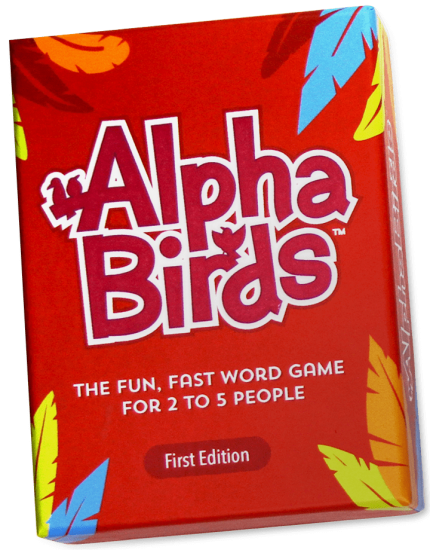
Today, we’re releasing a new game called AlphaBirds. It’s a word game like Scrabble® or Boggle®, but faster and more fun. ((As a fan of both Scrabble and Boggle, I stand by this statement. AlphaBirds is more fun than either of these games.))

AlphaBirds is ridiculously simple to learn.

  1. On your turn, draw two cards.
  2. Play one card in front of you, and one in front of any other player.
  3. Make words if you can. Longer words are worth more points.

Yes: there are more rules. But that’s the gist. Most players pick it up in 30 seconds or less.

We’ve been playing AlphaBirds in the office every Friday afternoon for more than a year. It’s the perfect game for lunchtime or beer o’clock. You can carry on a conversation while playing, and don’t have to keep things in your hand. You draw; you play; you’re finished until it’s your turn again. Most games last about 10 minutes.

AlphaBirds isn’t a Kickstarter. It’s available today. It’s $19 + shipping.

For now, AlphaBirds is only available through our own store. If you like word games, I think you’ll dig it.

Arlo Finch in the Bookstores of America (and Canada)

February 6, 2018 Arlo Finch, Books, Projects

My first novel, Arlo Finch in the Valley of Fire, comes out today in stores throughout North America.

I’d love you to, well, buy it. People buying books makes future books possible.

It’s available at massive online stores, national chains and your local indie bookstore.

Arlo Finch is middle-grade fantasy fiction. That’s the broad category that includes Harry Potter, Stranger Things and Star Wars. If that’s not your speed, you may have a son or daughter or nephew who would dig it.

How old does a kid need to be for Arlo? All kids are different, but eight seems a good general guideline. The audiobook might be a good option for younger sorts.

But if you’d like to help me out, there are a few other things you can do.

  1. Review it on Goodreads and Amazon.
  2. Recommend it to parents, teachers and librarians. They’re the ones who put books into kids’ hands.
  3. Post about on Twitter, Instagram and Facebook.

And if you’re in a bookstore in the next few weeks, find it on the shelf and take a peek inside. During my visit to the printing plant, I put special stickers in five books. I’m eager to learn where they turn up, so if you find one, let me know!

If you’re not listening to the Launch podcast, the first four episodes are now up. Today’s is my favorite so far.

I hope you dig the book. I’m really proud of it, and hope to be able to make more of them. Your help can make that dream possible. Thanks!

I made another podcast

January 23, 2018 Launch

Today, I’m launching a new podcast series about the journey of making a book, from initial idea to bookstore shelves.

There’s a teaser for it in the new Scriptnotes that’s up this morning. But if you’re not a regular listener, I didn’t want you to miss the news.

The backstory: Two years ago, I decided to write my own novel. It turns out, I didn’t know much about how books are actually made. So I began recording interviews with everyone involved in the process.

The result is Launch.

Behind-the-scenes of making a book

Over the course of six episodes, we’ll be following how my first novel, Arlo Finch in the Valley of Fire, was written, sold, edited and printed. We’ll visit Colorado forests and Virginia printing plants, talking to the people responsible for every decision along the way: editors, agents, artists and booksellers.

Plus a ton of great authors, without whom I would be very lost.

As I’m writing this blog post, I know how it all started, but how will it end? You’ll find out when I do. That’s part of what’s exciting about this podcast. There’s no way to know how this will all turn out.

Please take a listen and subscribe. The first two episodes are available today on Apple Podcasts and everywhere you like to listen.

And if you like the show, a rating and review would help a lot.

I’ll be answering questions in a later episode, so if you have one, just use the normal email: ask@dev.johnaugust.com.

In February, I’ll be traveling on a two-week book tour, with live events in Los Angeles, San Francisco, Denver, New York and Chicago. If you’d like to say hi, you can find the full schedule here.

And don’t worry. Launch isn’t replacing Scriptnotes. Craig and I will keep doing the show every Tuesday like always.

But really: Please subscribe. I think you’ll like it.

Don’t search with your eyes

December 11, 2017 Arlo Finch, Books, Highland, How-To, Projects

This week, I’m editing the manuscript for the second Arlo Finch. I do most of my edits on paper because I find I catch a lot of mistakes I’d otherwise miss just scrolling on the screen.

One of the frustrations with this process can be trying to match up the errors you’ve found on paper with what’s in the file. You’re constantly scrolling, looking for the trouble spot. Highland 2 has a sidebar navigator and inline page numbers, both of which can help. But I’ve found the fastest solution is to stop scrolling altogether and use the built-in search function.

Let’s say you’re fixing a typo, like a missing ‘d’ on the door had been force open. It’s halfway down on page 183, but that doesn’t matter.

Hit Command-F and type had been force then return.

Boom. You’re right there. Fix the mistake and keep going.

Note that you want to search for a string of words, not just the one with the typo. You may have used force a dozen times, but you’re almost certain to have typed had been force just once.

In Highland 2 — and most Mac writing apps — the Find command starts searching from wherever your cursor is, so if you’re working through edits in order, you rarely have to be particularly narrow in your search query. Even if you use its claws scraped more than once in your book, it will always give you the next one first. That’s likely to be the one you want.

This technique probably saved me half an hour today, and a lot of eye fatigue. So try it out next time.

« Previous Page
Next Page »

Primary Sidebar

Newsletter

Inneresting Logo A Quote-Unquote Newsletter about Writing
Read Now

Explore

Projects

  • Aladdin (1)
  • Arlo Finch (27)
  • Big Fish (88)
  • Birdigo (2)
  • Charlie (39)
  • Charlie's Angels (16)
  • Chosen (2)
  • Corpse Bride (9)
  • Dead Projects (18)
  • Frankenweenie (10)
  • Go (29)
  • Karateka (4)
  • Monsterpocalypse (3)
  • One Hit Kill (6)
  • Ops (6)
  • Preacher (2)
  • Prince of Persia (13)
  • Shazam (6)
  • Snake People (6)
  • Tarzan (5)
  • The Nines (118)
  • The Remnants (12)
  • The Variant (22)

Apps

  • Bronson (14)
  • FDX Reader (11)
  • Fountain (32)
  • Highland (75)
  • Less IMDb (4)
  • Weekend Read (64)

Recommended Reading

  • First Person (87)
  • Geek Alert (151)
  • WGA (162)
  • Workspace (19)

Screenwriting Q&A

  • Adaptation (65)
  • Directors (90)
  • Education (49)
  • Film Industry (489)
  • Formatting (128)
  • Genres (89)
  • Glossary (6)
  • Pitches (29)
  • Producers (59)
  • Psych 101 (118)
  • Rights and Copyright (96)
  • So-Called Experts (47)
  • Story and Plot (170)
  • Television (165)
  • Treatments (21)
  • Words on the page (238)
  • Writing Process (177)

More screenwriting Q&A at screenwriting.io

© 2026 John August — All Rights Reserved.