• Skip to primary navigation
  • Skip to main content
  • Skip to primary sidebar

John August

  • Arlo Finch
  • Scriptnotes
  • Library
  • Store
  • About

John

Missing Movies

August 15, 2018 Directors, Film Industry, WGA

Last week, I tweeted about my surprise that I couldn’t find 1984’s The Flamingo Kid available to stream, rent or purchase online.

My experience mirrored that of Kate Hagen, who had previously blogged about her frustration trying to find a way to watch 1988’s Fresh Horses.

These aren’t obscure art films from the 1950s. Both of these movies definitely exist on DVD, which is why it’s surprising that they aren’t available to download from iTunes, Amazon or one of the many streaming services. (JustWatch is a great way to look up where a movie is available.)

Readers on Twitter chimed in with even bigger titles that are surprisingly unavailable digitally, including Cocoon, Willow, True Lies and Apocalypto.

This raised three questions:

  1. Why are these movies missing?
  2. How could someone fix this?
  3. How many other movies from the home video era (1980 onward) are unavailable to legally watch online?

I tackled the third question first.

Let’s make a list

I started by crowdsourcing a list of missing movies using a simple form. From that came a spreadsheet that’s currently up to 394 entries. ((You’ll see duplicate titles and other garbage data on the list, which is one of the drawbacks of letting anyone add to it.))

A few patterns quickly become clear.

Very few movies of the past ten years are unavailable. That makes sense; they arrived in the era of iTunes and other digital services. For these titles, home video meant online, not just DVD or tape.

While a crowdsourced list can single out individual titles, I put out the call for a more systematic approach. Stephen Follows took up the challenge, which resulted in a blog post that tracks the availability of the 200 top-grossing movies for each year going back to 1999.

He finds that overall availability was pretty good:

Across all 4,000 movies, just under half are available to stream via subscription, 92% can be rented digitally and 95% can be bought digitally. The availability is slightly better for the highest grossing 50 movies, as opposed to the top 50 as judged by audiences and film critics.

For this cohort of 4,000 titles, just 120 movies can’t be streamed, rented or purchased digitally. That’s no consolation if you’re looking for Apocalypto or Basic Instinct 2, but it’s pretty good.

I asked Stephen to expand his search back to early decades. My hunch was that availability fell off a cliff starting sometime in the mid-90s. The results bore this out.

When looking at the 100 top-grossing movies from 1970 to 2017, you see the growing mountain of missing movies.
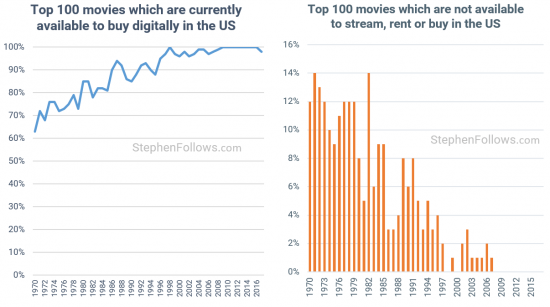
chart showing digital availability

The chart on the left shows films you can buy digitally on sites like iTunes, Amazon and Google Play. ((The digital rental chart is nearly identical, except that very recent movies tend to only be available for purchase.)) While there are peaks and valleys, the trend line is clear: with each decade, availability falls by double digits.

The chart on the right shows it even more starkly. As you head back in time from 1997, the number of missing movies skyrockets. When I looked at the list itself, I didn’t recognize many of the titles from 1970s. But some jumped out, including Sleeper, All That Jazz and Sleuth.

In all, Stephen identified 335 films that are unavailable. Is that list exhaustive and conclusive? No.

Particularly for streaming, films can fall in and out of license. And by design, this study is only looking at US availability for the top 100 films. That’s a tiny fraction of global film history. It’s like trying to define “books” by the New York Times bestseller list.

Still, it’s a useful place to start. These are movies that one would reasonably expect to find online, yet they’re missing.

Next steps

Now that there’s a list of unavailable movies, can anything be done?

I have a few ideas.

I’m a member of the Academy, so I’ve been talking with folks there about whether this is something that might fall under the Academy’s purview. It’s a form of film preservation, after all. If no one can watch a given movie, it’s functionally lost.

A more immediate way of getting some action would be to talk to some of the directors with films on the list and encourage them to get their movies released digitally. Ron Howard and James Cameron are obvious candidates.

Some of these movies from the 1970s may have never been released on home video. Getting them digitized and placed online is going to be a lot of work, and I honestly don’t know who’s going to take that challenge.

For films that do exist on DVD, my suspicion is that what’s keeping them off of iTunes and streaming is mostly murky rights issues. Some of these distributors have been bought and sold multiple times, so determining who controls the rights to a given movie can be complicated.

But sorting it out is doable. The same way chemists and colorists can save old film prints, I suspect lawyers and paralegals can save some of these missing movies. They’ll just need a framework for doing it, which is something I think the Academy might be able to provide.

But what about physical media?

A thing I’ve been hearing a lot over the past week is some version of, That’s why I still buy DVDs. Or That’s why we have videostores/libraries/Netflix-by-mail.

Physical media is one solution for making sure these movies aren’t lost to time. But a DVD sitting on someone’s shelf doesn’t solve the problem of me wanting to watch The Flamingo Kid tonight.

You can argue that we’re spoiled in the internet age. We expect everything to be available on demand at all times.

Well, yeah.

I don’t think we need to apologize for that. If I can watch Taken, why not Ransom? I don’t think we have a “right” to see any movie at any time, but in 2018 we have a reasonable expectation that mainstream movies are a few clicks away.

Plus, there’s a real economic incentive for figuring this out. Digital rental, download and streaming generates money for distributors, along with residuals for writers, directors and actors. ((And other guilds as well, through funding their pension and health plans.)) If a film is only available on used DVD, it’s stopped earning income for its creators.

In no way am I arguing for the end of physical media, or video stores or libraries. We need all of them, plus a renewed focus on making sure movies are available in legal digital forms. Because of course, many of these films are available online through torrent sites.

Piracy isn’t an answer to the problem. But what we can learn from pirate sites is that there’s always an audience for a movie.

In the days of DVD, a distributor needed to sell a certain number of copies in order for the print run to be profitable. For online digital, that number is nearly zero. Once a film is online, it can keep generating money nearly indefinitely.

So let’s get The Flamingo Kid, Fresh Horses and 1995’s Circle of Friends online. It’ll be worth it for everyone.
My abortion story

August 7, 2018 Citizenship, First Person

Last week, Slate ran a feature in which six women talked about their abortions:

We might better understand what abortion is, and what that right means, if we talked about it more. And so we asked the people who write and podcast for Slate if any of them have abortion stories they’d be comfortable sharing.

It’s a great piece. You should read it, listen to it, and share it widely.

Like every other cisgendered man on Earth, I’ve never had an abortion. I believe it’s not my place to tell a woman what to do with her body.

And as a gay guy, I never expected abortion to play any role in my life. But it did.

So in the spirit of talking openly about the subject, I’ve decided to share my experience of an unplanned pregnancy, and how it demonstrated why restricting abortion may constitute a moral crime.


My abortion story starts ten years ago in the suburbs of San Diego, where a young woman finds herself pregnant.

Katie is 17, living at home, about to graduate high school. Her grades are good but not exceptional. She plans to go to community college while keeping her job at the mall. ((I’ve changed Katie’s name, but none of the other details.))

It takes Katie a while to realize she might be pregnant, and longer still to tell anyone. She’s scared and in denial.

Part of the problem is the guy. He’s a classmate. They’d hooked up after a party, but were never dating. She doesn’t know how she feels about him.

Part of the problem is her parents. She is their only child, the light of their life. She knows they’ll be disappointed in her.

So she doesn’t say anything for months, even as the pregnancy becomes harder and harder to ignore. She finally tells a friend at work. They sit in her car discussing all the options.

You probably think you know what happens next.

You’re wrong.

Katie tells her parents. As she predicted, they are upset, and scared, but also supportive.

They talk it over, and together decide to contact an adoption agency.

After a phone interview, Katie gets a folder of “Dear Birth Mother” letters from families looking to adopt a child. Here’s how it works: After reading through the letters, she can choose a family to meet and decide if they are the right home for her kid. It’s all up to her.

Suddenly this pregnancy, which had seemed like a curse, feels like an opportunity. She can give a family what they want most. The dread has been lifted from her, replaced with a sense of hope and responsibility.

After sorting the letters into piles, weighing pros and cons of each family, she makes a choice.

She chooses us.

That’s how I enter this story.

At this point, we already have one kid: a daughter who is nearly three. This is one reason Katie picks us; Katie had always wanted a big sister. Her child will have one.

Plus, we live close enough that Katie can visit. She isn’t sure how much she wants to be part of the kid’s life — it is hard to think that far ahead — but she is excited to have the option.

Before we drive down to meet Katie, the agency schedules an ultrasound to check on the progress of the pregnancy. It’s her first checkup.

That’s when the story takes a second turn.

The ultrasound reveals feet and hands and a heart, but no brain. It’s missing. At top of the spine is a shape like a deflated basketball.

These types of neural tube defects are rare, but not as rare as you’d think. They happen in roughly 1 out of 1,000 pregnancies. They show up in an ultrasound. The back of the head doesn’t form properly, leaving the stem exposed.

There isn’t going to be a baby to adopt, because what is growing can’t survive. It will likely be stillborn, but even if it is isn’t, it will never be conscious.

Katie is devastated. She has just come to accept she is going to have a baby, and now she isn’t.

Her decision is straightforward. She terminates the pregnancy. That’s what the vast majority of women do when receiving this diagnosis.

We never end up meeting Katie. We send our condolences, and wish her and her family the best. She goes back to her life, and we go back to ours.

Very few of our friends know there was even the possibility of a second kid. Neither do our parents. It never comes up. But recently, I’ve been thinking about it a lot.

This could have been much, much worse

The procedure Katie had is an abortion.

It would be illegal under many of the laws proposed across the country — laws waiting to be enacted if Roe vs. Wade is weakened or overturned.

The most far-reaching of these bans are called “heartbeat bills” because they prohibit abortion beginning at the moment a fetal heartbeat can be detected, roughly six weeks.

Other abortion bans start at 20 weeks. Ohio’s Republican governor John Kasich signed one of these bills, calling it the “best, most legally sound and sustainable approach to protecting the sanctity of human life.”

But not if you’re Katie.

Katie had passed 20 weeks when she discovered what was growing inside her was certain to die. Doctors couldn’t tell her when. It could happen at any moment, or during birth, or immediately afterwards.

Under Ohio’s law, Katie couldn’t terminate the pregnancy. Like most of these laws, Ohio’s doesn’t make exceptions for fetal anomalies.

To be sure, some women in Katie’s situation do continue their pregnancies, bracing themselves for the grim outcome. If you Google their stories, you’ll see phrases like —

I had two options…
We prayed on it and ultimately decided…
For us, the choice was clear.

According to the Ohio legislature, these women shouldn’t have a choice. They shouldn’t pray over it. They should wait until they spontaneously miscarry, or until their due date arrives at which point labor can be induced. (Odd science fact: Natural labor is triggered by hormones in babies’ brains. No brain, no hormones.)

The end result will be a dead body without a brain, the same as if the abortion had taken place months earlier.

To me, forcing a woman to continue a doomed pregnancy is a moral crime.

It means forcing a woman to go through months of emotional and physical distress, along with potentially serious medical complications. It means forcing a woman to suspend her plans for no one’s benefit. It means her life is worth less than a collection of cells that will never be conscious.

I suspect that most legislators are not thinking about neural tube defects when they pass these bills. Nor do I believe that governors intend to inflict suffering when they sign them.

I don’t think these people are evil. But laws passed without careful consideration can do real evil.

It’s the responsibility of our courts, elected officials and citizens to tell them that. That’s why I’m sharing this story now. That’s why I encourage more people to talk about their experience with abortion, either publicly or with friends and family.

And as new abortion restrictions are proposed, I’d urge you to be skeptical of anyone proffering “reasonable compromises.”

They’ll say 20 weeks is the threshold of viability. But it’s not. Katie’s pregnancy was never going to be viable, if you define viability in any sensible way.

They’ll say that the woman needs to wait a few days, or see the ultrasound, or hear the heartbeat. But she’s not the one who needs to stop and look and listen.

Ultimately, the heartbeat that needs attention is the woman’s. She’s the one who is unambiguously alive. She has a past, a future and a family.


Katie will be 27 now. We haven’t had any contact with her. Wherever she is, I hope she’s well and happy.

I have to imagine this was a terrible experience for her. But I’m thankful it wasn’t worse. She didn’t have to spend months answering questions about her doomed pregnancy, knowing that at any moment she could miscarry. She didn’t have to go through the pain of delivery to give birth to a dead child.

Because abortion was legal, a young woman’s suffering was lessened. That’s something worth defending.

You can download the audio here.

I’m on the App Store

August 1, 2018 Apps, Bronson, Highland, News, Weekend Read

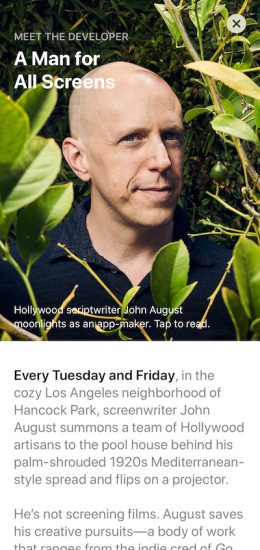
app store article with photoThis morning, Apple posted a profile of me and my software company, Quote-Unquote Apps. If you’re on an iPhone or iPad, you can read the piece here.

Or just open the App Store app and I’m on the front page.

Yes, it’s a little frustrating that the article is accessible only through the App Store app. I get why they do it — they want exclusive content about apps available right where you get them, just like airlines have their own in-flight magazines. But it feels weird to have a link that only some readers can open.

When you agree to a profile like this, you don’t get a lot of control. I didn’t see the story or the photos until it posted. But I’m happy they emphasized the team that makes it possible. Nima Yousefi is our master coder. Dustin Bocks designs everything to pixel precision. Megana Rao keeps on top of support issues and finds new scripts each week for Weekend Read.

While this profile mostly focuses on Weekend Read, in reality it’s Highland 2 that occupies most of our time. Since it debuted in May, Highland 2 has become our biggest hit by far. It’s also the most important app for me as a writer, since I use it nonstop for scripts, books and blog posts like this one.

If you still haven’t checked out Highland 2, today’s the day.

And if you’re a screenwriter nervous about making the jump, definitely check out our new PDF on Switching from Final Draft to Highland 2.

Billionaires-to-be

July 31, 2018 Citizenship, Follow Up

This quote, often misattributed to Steinbeck, is a pithy summary of what I wrote earlier this morning:

Socialism never took root in America because the poor see themselves not as an exploited proletariat but as temporarily embarrassed millionaires.

Thank you to Twitter folks who mentioned it.

“Socialism” and “proletariat” are loaded words, so the simpler 2018 version might read: Americans never think of themselves as poor, but rather billionaires-to-be.

« Previous Page
Next Page »

Primary Sidebar

Newsletter

Inneresting Logo A Quote-Unquote Newsletter about Writing
Read Now

Explore

Projects

  • Aladdin (1)
  • Arlo Finch (27)
  • Big Fish (88)
  • Birdigo (2)
  • Charlie (39)
  • Charlie's Angels (16)
  • Chosen (2)
  • Corpse Bride (9)
  • Dead Projects (18)
  • Frankenweenie (10)
  • Go (29)
  • Karateka (4)
  • Monsterpocalypse (3)
  • One Hit Kill (6)
  • Ops (6)
  • Preacher (2)
  • Prince of Persia (13)
  • Shazam (6)
  • Snake People (6)
  • Tarzan (5)
  • The Nines (118)
  • The Remnants (12)
  • The Variant (22)

Apps

  • Bronson (14)
  • FDX Reader (11)
  • Fountain (32)
  • Highland (75)
  • Less IMDb (4)
  • Weekend Read (64)

Recommended Reading

  • First Person (87)
  • Geek Alert (151)
  • WGA (162)
  • Workspace (19)

Screenwriting Q&A

  • Adaptation (65)
  • Directors (90)
  • Education (49)
  • Film Industry (489)
  • Formatting (128)
  • Genres (89)
  • Glossary (6)
  • Pitches (29)
  • Producers (59)
  • Psych 101 (118)
  • Rights and Copyright (96)
  • So-Called Experts (47)
  • Story and Plot (170)
  • Television (165)
  • Treatments (21)
  • Words on the page (238)
  • Writing Process (177)

More screenwriting Q&A at screenwriting.io

© 2026 John August — All Rights Reserved.