• Skip to primary navigation
  • Skip to main content
  • Skip to primary sidebar

John August

  • Arlo Finch
  • Scriptnotes
  • Library
  • Store
  • About

John

Professionalism in the Age of the Influencer

November 20, 2019 Film Industry, Follow Up, General, International, Random Advice

On October 24, 2019, I presented the Hawley Foundation Lecture at Drake University. It was an update and reexamination of a 2006 speech on professionalism I originally gave at Trinity University, and later that year at Drake.

What follows is a pretty close approximation of my speech, but hardly a transcript. It’s long, around 14,000 words. My presentation originally had slides. I’ve included many of them, and swapped out others for links or embedded posts.

If you’re familiar with the earlier speech and want to jump to the new stuff, you can click here.


Back in 2006, I gave a speech here at Drake entitled “Professional Writing and the Rise of the Amateur.” In it, I presented my observations and arguments about how the emergence of the internet had made the old distinctions between amateurs and professionals largely irrelevant. Tonight I want to revisit that speech and look at what still makes sense in 2019, and more importantly, what I got wrong.

To do that, we need to start with a bit of time travel so we can all remember what 2006 looked like.

Here’s Facebook:
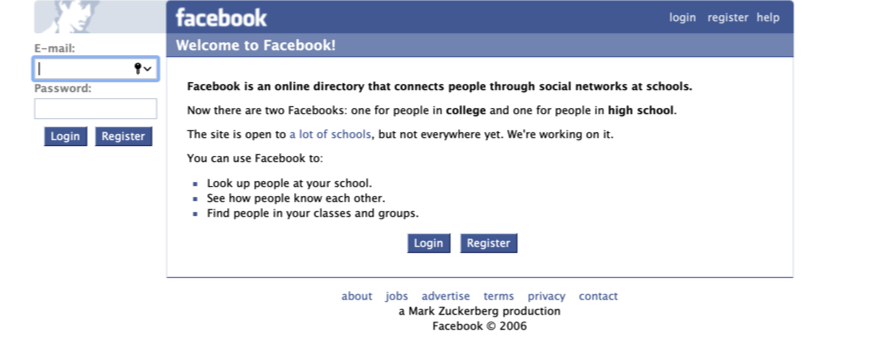
facebook 2006

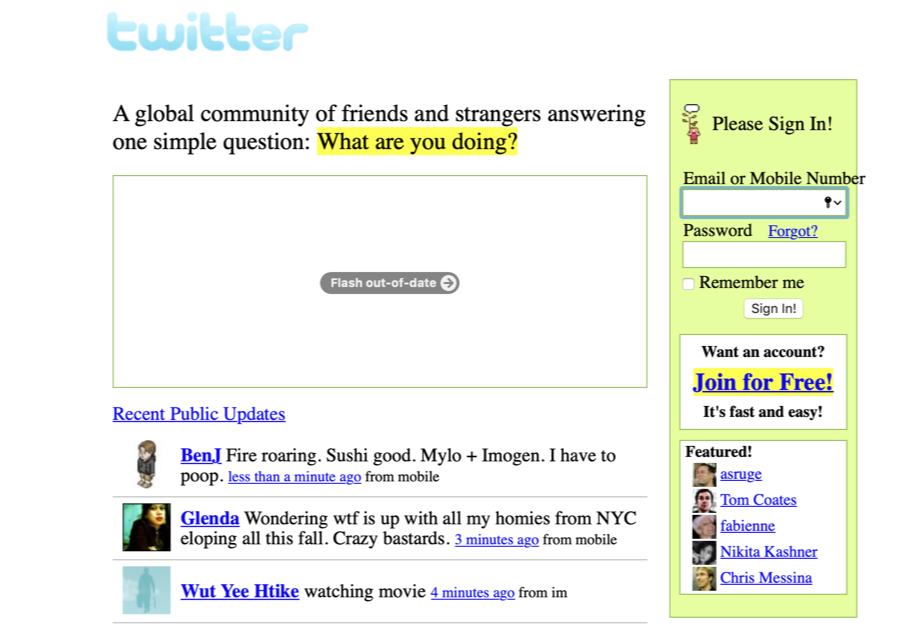
Here’s Twitter:

twitter 2006

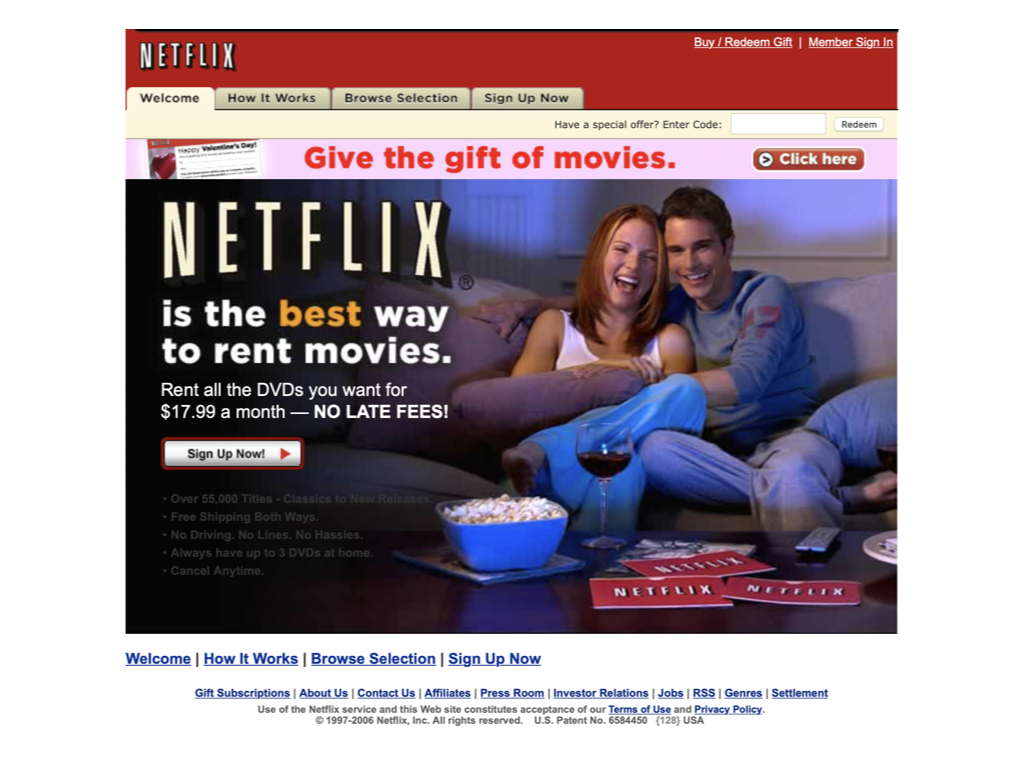
Here’s Netflix:

netflix home screen 2006

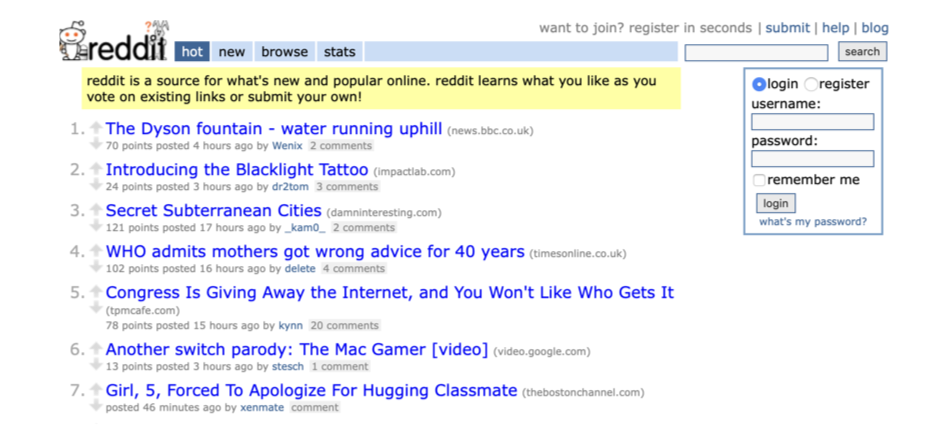
Here’s Reddit:

reddit 2006

Here’s Instagram:

instagram debuted in 2010

Oh, 2006 was a simpler time. The internet existed, but it wasn’t as all-consuming as it is now. We had blogs. We had MySpace. But we didn’t have the internet on our iPhones. Because iPhones wouldn’t come out for another year.

However, even in this innocent age, issues would arise that would feel very familiar today. We had fake news and trolls and pile-ons.

For example, back in 2006, I started my speech with this anecdote:

On March 21, 2004, at about nine in the morning, I got an email from my friend James, saying, “Hey, congrats on the great review of Charlie and the Chocolate Factory on Ain’t It Cool News!”

Let’s start by answering, What is Ain’t It Cool News? It was a movie website started by a guy named Harry Knowles. It looked like this:
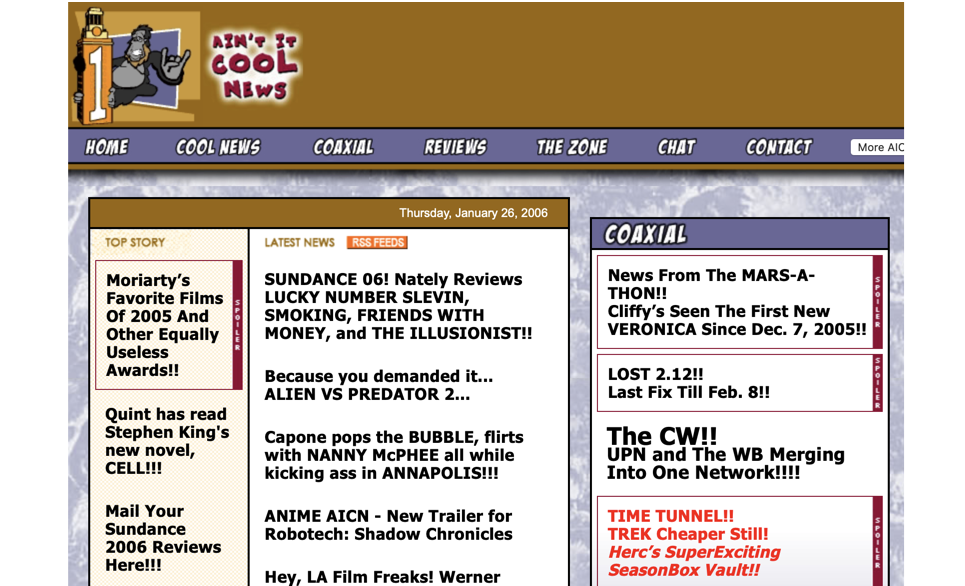
aicn 2006

Ain’t It Cool News billed itself as a fan site. I’d argue that it was an incredibly significant step towards today’s fan-centered nerd culture, for better and for worse. Online fandom has brought forth the Avengers and fixed Sonic the Hedgehog’s teeth, but it’s also unleashed digital mobs upon actors and journalists, women in particular.

Back in 2006, the nexus of movie fandom was Ain’t It Cool News. It wasn’t just a barometer of what a certain class of movie fan would like; it could set expectations and buzz. Studio publicity departments checked it constantly.

So, back to my email from James. He’d written:

“Hey, congrats on the great review of Charlie and the Chocolate Factory on Ain’t It Cool News!”

This was troubling for a couple of reasons.

First off, the movie hadn’t been shot yet. We weren’t in production. So the review was actually a review of the script. Studios and filmmakers really, really don’t like it when scripts leak out and get reviewed on the internet, because it starts this cycle of conjecture and fuss about things that may or may not ever be shot. So I knew that no matter what, I was going to get panicked phone calls from Warner Bros.

I click through to Ain’t It Cool and read this “review.” And it’s immediately clear that it’s a complete work of fiction.
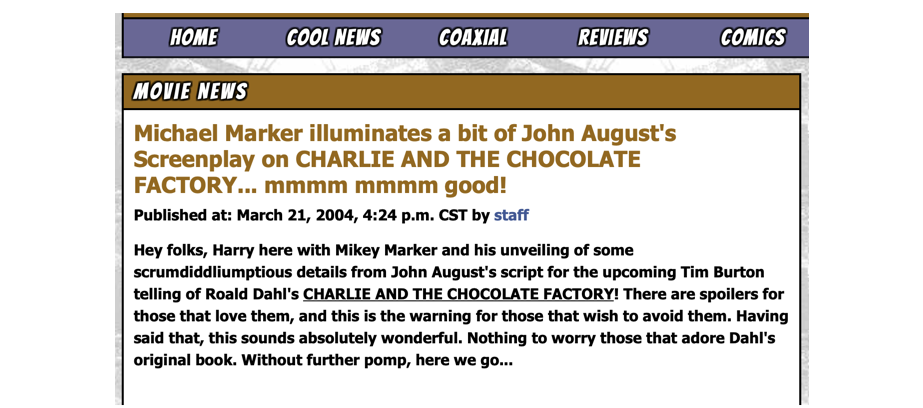
aicn article 2006

The author of the article, “Michael Marker,” claims to have read the script, but he definitely hasn’t. He’s just making it up. It is literally fake news.

Fortunately, back in 2004, I knew exactly one person at Ain’t It Cool News. His name was Jeremy, but he went by the handle “Mr. Beaks.” So I emailed him, and say, hey, that review of the Charlie script is bullshit.

Actually, I don’t say that. I say, “That guy is bullshitting you.” It’s not that I’m wronged, no. It’s that that guy, Michael Marker, is besmirching the good name of Ain’t It Cool News by trying to pass off his deluded ramblings as truth. How dare he!

And it works. Mr. Beaks talks to Harry Knowles, and Harry posts a new article saying that the review was bogus.
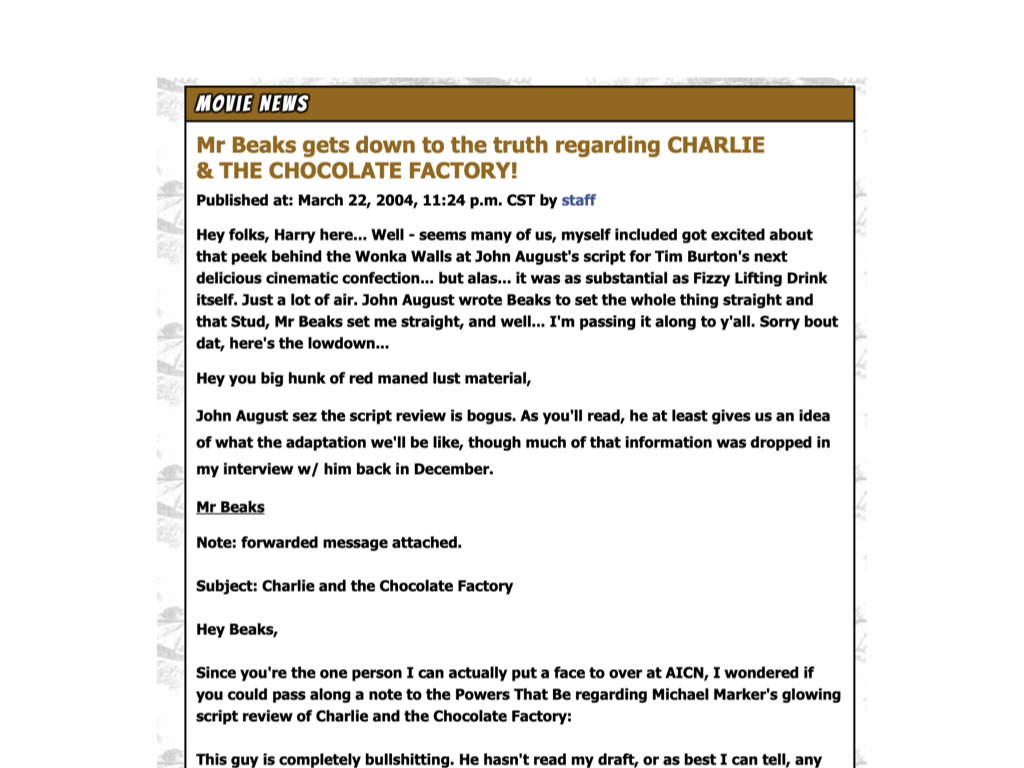
aicn article screenshot

They don’t pull the original article, but oh well. It’s basically resolved.

I can’t help but think — this article was wrong, but it was really, really positive. What if it had been negative? Would Mr. Beaks or Harry Knowles have believed me? Probably not. They would have said, “Oh, sour grapes.” My complaining would have made the readers believe the bogus review even more.

It might have led to the Streisand effect, where complaining about something just brings more attention to it.

Back in 2006, if you tried to really go after any of these film-related sites, criticizing them for say, running a review of a test screening or just outright making shit up, you’d get one standard response:

Hey, we’re not professional journalists. We’re just a bunch of guys who really love movies.

Their defense is that they’re amateurs, so they can’t be held to the same standards of the New York Times or NBC.

That became the topic of my speech in 2006: the eroding distinction between professionals and amateurs.

The classic, easy distinction is that the professional gets paid for it, while the amateur doesn’t. For a lot of things, that works. You have a professional boxer versus an amateur. You have a professional astronomer versus an amateur — some guy with a telescope in his back yard.

[Read more…] about Professionalism in the Age of the Influencer

Early progress on assistant pay

November 4, 2019 Assistants

We continue to get email about assistant pay, including a few like this one that show some potential for change:

As I was giving my boss a ride home tonight, she brought up the #payuphollywood movement (unprompted!). She asked me what I thought it might actually accomplish, and I mentioned that fair pay would be a nice starting point, and I brought up the fact that payroll wasn’t likely to approve my weekend overtime. She told me that if they give me any trouble, she will step in and take care of it. She also told me to start keeping track of mileage because she would like to reimburse me out of her own pocket (since the studio doesn’t).

I know this doesn’t get to the root of the issue, but it definitely turned a crappy day into a bit of a happy ending.

Doing right by assistants

October 30, 2019 Assistants, Follow Up

This letter by a writers room PA who had to pay out of pocket for others’ lunches struck a nerve. Scriptnotes producer Megana Rao has been reading many similar horror stories from assistants, but she’s also come across a few emails that demonstrate writers stepping up for their assistants.

Jordan writes:

Back in 2016 I was working as a writers PA on a Fox show and it was a great experience. Even though I was just a PA, they allowed me to sit in the writers room while they worked and join them in the edit bay while they watched early cuts of episodes. I was even able to pitch, and a few of my jokes managed to make the final cut.

I was paid minimum wage with no benefits and no box rental, but once my position wrapped, the writing staff pulled their money together to give me an envelope with $500 cash. They also did the same for the showrunner’s assistant and script coordinator. A few of the EPs also gifted us bottles of whiskey and custom t-shirts.

It was a wonderful work experience, probably the best I’ll have in this industry, and I was very sad when Fox cancelled the show. I’m still friends with many of those on the writing staff and they’ve helped me since we parted ways.

Circumstances made this a fairly stressful show for the EPs, but they never took it out on those of us at the bottom of the totem pole.

Showrunner Michael Green has a formula for calculating how much a writers room should gift the assistant(s) at the holidays. (Most assistants don’t get paid for the two-week break.)

A frequent issue we’ve heard is that the hourly rate isn’t everything; for many assistants overtime is what makes the job survivable.

Violet writes:

I started a job as a showrunner’s assistant on a network show in May of 2017. I made $15.14 an hour with a 60 hour a week guarantee.

When the show was cancelled in the fall of 2018, I decided to stay with my (amazing and talented) boss under his studio overall deal. My hourly rate went up. HOWEVER, I was only allowed to work 40 hours a week. Yes, allowed. No overtime, period. Luckily, my boss helped mitigate some of the loss by paying me out of his own pocket. Even with my boss’s extra help, my salary still went down that year by $12,000!

Recently, my boss’s show was picked up to series, and I was promoted to writers’ assistant. But the studio policy is to pay their writers’ assistants LESS than showrunners’ assistants, despite the fact that it is a promotion and a much more time-consuming job. My boss was able to fight for me to get a raise, but it was a fight. This is not exclusive to this particular studio, in fact, I’ve heard that my studio pays better than the other studios and streamers.

The studios will also do a move on pilots where one assistant does multiple assistant jobs but only gets paid for one. For instance, I was the showrunner’s assistant on the pilot but also acted as script coordinator. During this time period, because the show was not picked up yet, I was still paid NO OVERTIME, despite the fact that I was working far more than 60 hours a week and doing two jobs.

I LOVE my job. I had the most awesome time during that year of development, and I learned a ton. But if I did not have some help from my parents, I wouldn’t have survived the year of May 2018-May 2019. I DO have privilege, and it was still a very frugal year. It isn’t livable for someone without my privilege, period end of story. Not on its own.

Many assistants without parental help end up taking on second jobs like script reading or even bartending. But they burn out. And they’re completely unable to write on the weekends. How can we expect those people to do their jobs well, much less move up the ladder and become staff writers?

Several listeners noted that they’ve found success when the assistant and showrunner are on the same page before business affairs gets involved.

Mia writes:

Before taking this job, I nervously asked about the pay, ready to walk away.However, from the start this showrunner had demanded a guaranteed 60 hours of pay for the assistant position with the previous assistant and demanded that they keep the same rate for me. The previous assistant also assured me that I would rarely be expected to work more than 40 hours–the bosses were happy to sign off knowing that this was the work around that allowed an assistant to make enough to live.Those extra 10 hours of OT, combined with getting free lunch every day, made enough of a difference to take the job. But I still wasn’t making as much as I had working for a partner at a big agency, so things were tight.

A year in, the Big Boss decided to take the company independent even though doing so meant that all of the operational costs of running the company would now be his sole responsibility. Still, as part of the new arrangement he upped my pay to a weekly salary of $1000 ($25 per hour for a 40 hour week) and paid for my health insurance.

There were a ton of other small things that both of my bosses did to take care of me and the others who worked under them. This showrunner is known for promoting heavily from within. He set the tone that continued when he stepped away from showrunning to develop more. WAs, SAs, and WPAs all have consistently gotten to write episodes of the show.

Perhaps these examples aren’t as much advocating on an assistants’ behalf as they are taking personal initiative to make sure assistants are taken care of. But in thinking about it, I never could have taken the job in the first place if it didn’t come with that 60 hour guarantee.From the start he used his pull when he first landed his overall to make sure the starting salary for the assistant role was significantly more than the studio was offering. It was a really great job, and I know from experience, they often aren’t.

Sarah writes:

Been an assistant for many years now and have gotten over my shyness about asking for a living wage (plus, you tend to be offered the minimum to start, and as an experienced assistant, I feel I can and should ask for more). In general, I’ve found most people respect politeness, and I always negotiate knowing that the studio is a business and is advocating for themselves; it’s not a personal thing. Usually, it’s all sorted out within a few emails.

But after being hired on a new show with a boss I’d never worked for before, Business Affairs simply wasn’t coming up from their number… at all. Someone from the department eventually called me to say my requests were “outrageous.” I explained that I was simply looking to match my quote from my prior show, and I was happy to loop in the showrunner, whom I’d told my previous rate to before I was hired, if that helped.

The person on the phone told me I could do that if I wanted, but offered me some “free advice” — I could tell my boss I wanted more money, but I should ask myself what that said about me. “Why was I taking the job. Was I looking to learn… or looking to get paid?” I was so stunned, I simply said I’d reach out to the showrunner and be in touch once I’d heard back.

Showrunner agreed to my rate immediately. I took the position, but I always wished I’d said something to that Business Affairs person on the phone. You can say no to my rate anytime you’d like, but it’s shameful to imply that asking for fair compensation for a job I am performing for your company in any way means that I am ungrateful for the opportunity.

Assistants are nervous to push for the money they deserve because they really want the job. Not any job — this job. Many Hollywood assistants have resumes that could be earning them six figures in other industries, but they want to work in film and television.

These jobs are worth a lot, but so are these assistants. The industry needs to pay a fair wage.

Writers PA left to pick up the tab

October 25, 2019 Assistants, Television

Our mailbox keeps overflowing with new tales of assistant-dom. Producer Megana Rao reads every one and sorts them for future episodes. She also forwards a handful to me. This one, from a writers room production assistant (WPA), felt like one that should be read in its entirety, so I got the author’s permission to publish it here.


I was in my early 30’s when I finally landed a Writers PA gig on a comedy. We had a toddler so just to take the job, I had to work weekends waiting tables to pay for the childcare during the week. (Which is another issue entirely.)

The WPA job destroyed my soul. I was invisible to the writers except when they needed something or when I wasn’t at their immediate disposal for an errand. They would leave the room at the end of the day with their plates and cups and half-eaten meals on the table for me to clean up after them. One writer even told me when I asked if she would please throw out her food that “it was my job to clean things.”

I took it in all in stride. Lunch was brutal. (ed: Most TV writers rooms order in lunch. It’s a big part of a WPA’s job.) They were incredulous about the studio-imposed dollar limit, and at me for trying to enforce it. If they went over, some paid, others refused. It’s only a few bucks — who would notice – be creative with the numbers they’d say. They would become so enraged when I’d let them know they went over that I simply stopped asking to be paid back.

A few writers sent me on special snack runs and told me to charge it through. When accounting told me I had to get reimbursed by the writers, these writers would instruct me to tell accounting where they could shove it. Accounting would get angry and respond in kind. This would go back and forth and the whole time, the lunch overages and snack-run tab grew and grew. Eventually [the show] got cancelled and everybody split. Accounting told me I would be blacklisted if I didn’t pay the tab. So… I paid. It was almost $500. And I never told anyone.

If you’re wondering why I paid or why I I didn’t stand up for myself, then you don’t understand what it’s like to be a writer trying to break in. How working writers see you — writers who might be in a position to hire you one day — is critical. And I know this because one time I did stand up for myself and it came back to bite me.

Towards the end of our run, one writer who would often tell me how he had “paid his dues the hard way and that’s just how it is when you’re an assistant,” told me to go on a bakery run and charge it through. I told him that accounting had reprimanded me that morning for the millionth time regarding yet another sketchy charge for the writing staff and I simply couldn’t do it.

This was a mid-level writer who I could tell was on his way up…but I’d had enough and said no. I was respectful. Later that day after an all-writing-staff meeting, the higher ups left and this writer turned to me and very publicly kicked me out of the room making it clear I was no longer welcome when it wasn’t food-related.

When you’re support staff and you speak up, regardless of the reason or how polite you are, there are consequences.

I could have told the showrunner about this. I could have told him about the $500 tab. He would have paid. He would have brought me back in the room to be a fly in the wall —- but he was a kind and sweet person who was in over his head running his first show and I wanted to get staffed one day.

I’m no longer a PA or an assistant and I’d never do it again. I believe that forgiveness, of others and yourself, along with letting things go. It’s an essential part of being a healthy person. But for some reason, these experiences still upset me to this day.

I deeply appreciate you shining a light in this issue. It means a lot to all of us.

« Previous Page
Next Page »

Primary Sidebar

Newsletter

Inneresting Logo A Quote-Unquote Newsletter about Writing
Read Now

Explore

Projects

  • Aladdin (1)
  • Arlo Finch (27)
  • Big Fish (88)
  • Birdigo (2)
  • Charlie (39)
  • Charlie's Angels (16)
  • Chosen (2)
  • Corpse Bride (9)
  • Dead Projects (18)
  • Frankenweenie (10)
  • Go (29)
  • Karateka (4)
  • Monsterpocalypse (3)
  • One Hit Kill (6)
  • Ops (6)
  • Preacher (2)
  • Prince of Persia (13)
  • Shazam (6)
  • Snake People (6)
  • Tarzan (5)
  • The Nines (118)
  • The Remnants (12)
  • The Variant (22)

Apps

  • Bronson (14)
  • FDX Reader (11)
  • Fountain (32)
  • Highland (75)
  • Less IMDb (4)
  • Weekend Read (64)

Recommended Reading

  • First Person (87)
  • Geek Alert (151)
  • WGA (162)
  • Workspace (19)

Screenwriting Q&A

  • Adaptation (65)
  • Directors (90)
  • Education (49)
  • Film Industry (489)
  • Formatting (128)
  • Genres (89)
  • Glossary (6)
  • Pitches (29)
  • Producers (59)
  • Psych 101 (118)
  • Rights and Copyright (96)
  • So-Called Experts (47)
  • Story and Plot (170)
  • Television (165)
  • Treatments (21)
  • Words on the page (238)
  • Writing Process (177)

More screenwriting Q&A at screenwriting.io

© 2026 John August — All Rights Reserved.