• Skip to primary navigation
  • Skip to main content
  • Skip to primary sidebar

John August

  • Arlo Finch
  • Scriptnotes
  • Library
  • Store
  • About

John

How accurate is the page-per-minute rule?

March 9, 2020 Film Industry, Follow Up, Formatting, QandA, Rant

Back in 2006, I answered a reader question about page counts:

Every screenwriting book I’ve read, class I took, and basically the first rule I learned says:

ONE PAGE OF A PROPERLY FORMATTED SCRIPT = APPROX. A MINUTE OF SCREEN TIME.

I know one page of say a battle can last five minutes whereas one page of quick dialogue my last ten seconds if the actors talk fast. So my question is, is this rule true?

I replied that the page-per-minute rule of thumb didn’t hold up to much scrutiny, and offered examples from my own work.

Then a few weeks ago, I started thinking about this question again, and realized there was an opportunity to reframe the question in a more concrete way:

For screenplays, what is the correlation between screenplay length and running time?

I asked data scientist Stephen Follows if he’d be up for tackling this question. He jumped into action, gathering 761 feature screenplays and comparing them to the running times of their finished films. Today, he published his findings.

The results largely match what I expected, and what I wrote in 2006:

The one-page-per-minute rule of thumb doesn’t hold up to much scrutiny. True, most screenplays are about 120 pages, and true, most movies are around two hours. But the conversion rate between paper and celluloid is rarely one-to-one. ((Celluloid! It truly was a different age in 2006.))

While Follows finds there is some obvious correlation between page count and running time, the rule of thumb barely works in aggregate but isn’t very predictive for any given project.

Why does it matter? Because too many folks in the film and television industry have internalized one-page-per-minute as an axiomatic truth rather than a crude estimate. Any script that is longer than 120 pages is perceived as being too long. Indeed, some studios’ contracts specify that the writer may not deliver a script longer than 120 pages. ((On a recent project, my contract limited delivery to 130 pages. Such decadence!))

In order to bring their scripts under this artificial limit, screenwriters waste time making tiny edits with the goal of moving page breaks. It’s pointless busy work.

Worse, the page-per-minute rule of thumb puts too much focus on arbitrary sheets of never-printed paper rather than the words they contain. If we’re worried about the length of anything, it should be scenes and sequences. But in 2020 we continue to treat screenplays as if they’re hand-typed on dead trees, forgoing digital tools that would allow for better security, collaboration and version control.

As an industry, we’re afraid to move to new formats for screenplays because we’re worried it’ll break the page-per-minute standard. But we don’t need to worry, because the rule of thumb was never really true.

Doing what makes sense

Is it appropriate to try to estimate a project’s running time based on the script? Absolutely.

Before a project goes into production, the script supervisor — an experienced professional who works beside the director on set — generally performs a “script timing” by estimating the time for each scene. It’s not perfect, but it better reflects reality. If a script times out to three hours, better to know it before production, so you’re not shooting scenes that won’t make it into the film.

Is there an opportunity for computer-generated running time estimates? Probably.

With machine learning, I can imagine systems that better predict how words on the page will reflect minutes on screen. But I wonder if it’s a false goal. Ultimately, running time is a factor of film editing. Scenes get dropped in post, and it’s very hard to anticipate these changes when looking at a script in preproduction.

This analysis was done on feature films, but every TV show faces similar issues. However, long-running shows have the advantage of knowing how their specific show works. My hunch is that every NCIS script falls in a narrow range of scenes and pages because they know what they need.

Big thanks to Stephen Follows for accepting this challenge and myth-busting this rule of thumb. Be sure to read, share and comment on his post.
Highland 2 Student Edition

February 21, 2020 Apps, Highland

Article Update February 2026: Highland 2 has officially been updated to Highland Pro. Students and educators can access information about free student and educator licenses at this link!


We offer a free full version of Highland 2 for students enrolled in university writing programs, including film schools. Over the past few months, we’ve signed up programs at the Ivy Leagues, big state schools and tiny London colleges.

Here’s how the process works:

  1. The writing professor or instructor emails us at brand@dev.johnaugust.com.
  2. We send back instructions for signing up their students. Important: We can only sign up students with their official school email addresses (such as .edu).
  3. Once they’re in our system, we send each student an email confirmation.
  4. Confirmed students use their school email address to unlock Highland 2.

The student edition of Highland 2 is time-limited to the duration of studies. After that, it reverts to Highland 2 Basic, which has most of the same features but includes a watermark when printing or exporting to PDF.

If you’re an instructor who wants your students to have access to Highland 2, send us an email to brand@dev.johnaugust.com. If you’re a student in a university writing program who wants to use Highland 2, send your instructor a link to this post.

Uncredited writing by a script coordinator

January 9, 2020 Assistants, Television

On Scriptnotes episode 432, a listener asked what could be done when a writers room assistant or script coordinator was doing actual writing but not getting writing credit. This morning, another listener wrote in with their own tales of uncredited work and how they pushed back.

As this listener makes clear, writing credit and low assistant pay are related issues. I believe there’s an ethical way to help assistants and script coordinators gain experience without having them do unpaid writing. This letter shows why it’s so important we address this issue.


I interviewed for a position as a script coordinator on a comedy. From the start, there were many red flags:

  • The current script coordinator was leaving before production,
  • There were severe miscommunication issues, and
  • People were already telling me about their own mistreatment

But I was coming off a five-month hiatus and needed a job. So I took it.

Before I started, I was told that most of the episodes were already written. When I got there, only three episodes were done, all of which would end up being heavily re-written and there were only five writers to break and write the rest of the season.

I was encouraged to pitch, as was the writers’ assistant. I was happy for the opportunity, but as we began shooting, I stepped up even more. Our showrunner was busy, so I’d get sent to rehearsals with directors and would be trusted to implement the rehearsal rewrites with little to no supervision. When it was clear that I was capable of writing in the voice of the show, I found myself re-writing chunks of episodes and full scenes in different corners of the stage, or at 1am, as well as implementing new scenes throughout multiple scripts.

Not all of the episodes had been assigned, so I thought that my hard work would be noticed. It was not.

Eventually, I realized I’d have to ask for a credit. But before I could, we found out that the showrunner had given an episode to a writer that was not on the show, had never been on the show and was not in the room when we broke the episode. And, in the end, the episode had to be completely rewritten.

By this point, I was exhausted. I was doing the work of a script coordinator, a staff writer, and navigating the manipulative and abusive work environment that was designed to keep people in lesser positions of power from speaking out because of fear of retaliation.

When the job ended, a weight was lifted. I came home and got a new job. The showrunner asked me to go onto the next show with them as a script coordinator, but I declined.

When the WGA reached out to confirm what other writers had told them about the showrunner’s behavior and the writing credits, I gave them the information they were looking for but declined to take anything further. I regret this now. I should have asked for credit; I should have spoken up for myself afterward and I should have never let it get as bad as it did.

But this industry is a dumpster fire that feeds off the lowest on the totem pole and tricks you into thinking that you deserve nothing. It’s a lie. I deserved to get credit for my contributions.

The show I’m currently on is a better environment, yet the same thing almost happened. The only difference this time was that I was annoyingly persistent and several writers had my back. It took weeks of convincing the showrunner to give me credit for an episode that I pitched to a room full of writers who all agreed that it was mine.

What it really comes down to is if you, as a showrunner, don’t want to give someone credit for their work, don’t let them contribute and certainly don’t take their ideas.

Yes, we’re apprentices, but apprentices work with the intention of moving up. It’s so hard to go from script coordinator or writers’ assistant to writer because the system feeds off free labor.

A showrunner once said to me that an assistant’s need for credit is purely driven by their want of compensation. Yes, money is important. But we’re trying to be writers. To be staffed. To turn this into a career.

That’s not going to happen if our work is never credited and we’re never seen as anything more than free labor. And, clearly, if we’re good enough to have you use our jokes and our ideas, we’re good enough to be staff writers. The problem is that we’re cheaper and taught to keep our mouths shut for fear of losing our job.

Fuck that. Ask for the credit. And don’t delete your emails.

Introducing the new Scriptnotes Premium

December 16, 2019 News

Scriptnotes is a free weekly podcast about screenwriting and things that are interesting to screenwriters. It’s hosted by me and Craig Mazin. Around 80,000 people listen to it each week.

From the start, Scriptnotes has been ad-free. In order to pay for our producer, editor and transcriber, we offer a paid premium version that gives access to the entire back catalogue of 430+ episodes.

For the past few years, we’ve been using a service that channels the premium feed through a custom app on iOS and Android. ((Frustratingly, the buggy Scriptnotes app is released through our company (Quote-Unquote), but we don’t have any control over its design or function. It’s all handled by the provider.)) It’s been frustrating. Listeners have been experiencing an increasing number bugs in the app, which is a major reason we’ve decided to switch to a new service starting this week.

premium scriptnotes logo

The new Scriptnotes Premium costs $4.99/month. In addition to helping support the folks who make the show, premium members get the following benefits:

  • Access to the entire back catalogue
  • Bonus segments on all new episodes
  • Exclusive member-only episodes
  • Early access to episodes, generally Monday evening
  • Advance notice about live events

Even better, the new Scriptnotes Premium works in normal podcast apps, including Apple Podcasts, Overcast, Castro and most Android players. ((Scriptnotes Premium doesn’t currently work on “walled garden” services like Stitcher, Spotify, Google Podcasts, or NPR One.))

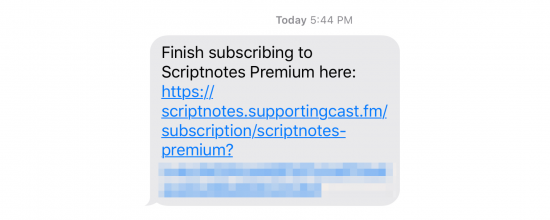
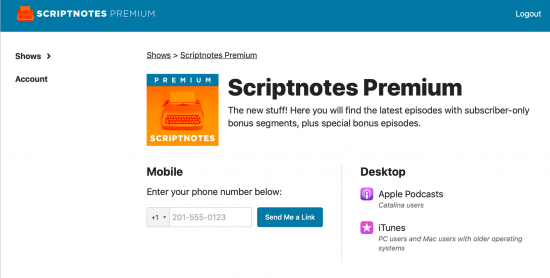
To sign up, all you need is your email address and credit card. There are no user names or passwords. You can do it quickly on mobile — or if you’re registering on desktop, have it send you a text message with a link to subscribe.

premium screenshot

text message: subscribe with link

Our first exclusive premium episode will be a deep dive look at Die Hard. It comes out December 25th.

We’ll also have additional bonus content this week: a discussion with Sam Mendes and Krysty Wilson-Cairns about 1917.

Thank you to all the listeners who’ve supported the show over the past eight years. ((We’ll be turning off the lights on the old service after February, but once you’ve subscribed to the new Scriptnotes Premium, you can safely cancel the old one. Follow these instructions.)) We’re excited to keep going, both with the classic free Scriptnotes and the premium version.

You can sign up for Scriptnotes Premium at scriptnotes.net.

« Previous Page
Next Page »

Primary Sidebar

Newsletter

Inneresting Logo A Quote-Unquote Newsletter about Writing
Read Now

Explore

Projects

  • Aladdin (1)
  • Arlo Finch (27)
  • Big Fish (88)
  • Birdigo (2)
  • Charlie (39)
  • Charlie's Angels (16)
  • Chosen (2)
  • Corpse Bride (9)
  • Dead Projects (18)
  • Frankenweenie (10)
  • Go (29)
  • Karateka (4)
  • Monsterpocalypse (3)
  • One Hit Kill (6)
  • Ops (6)
  • Preacher (2)
  • Prince of Persia (13)
  • Shazam (6)
  • Snake People (6)
  • Tarzan (5)
  • The Nines (118)
  • The Remnants (12)
  • The Variant (22)

Apps

  • Bronson (14)
  • FDX Reader (11)
  • Fountain (32)
  • Highland (75)
  • Less IMDb (4)
  • Weekend Read (64)

Recommended Reading

  • First Person (87)
  • Geek Alert (151)
  • WGA (162)
  • Workspace (19)

Screenwriting Q&A

  • Adaptation (65)
  • Directors (90)
  • Education (49)
  • Film Industry (489)
  • Formatting (128)
  • Genres (89)
  • Glossary (6)
  • Pitches (29)
  • Producers (59)
  • Psych 101 (118)
  • Rights and Copyright (96)
  • So-Called Experts (47)
  • Story and Plot (170)
  • Television (165)
  • Treatments (21)
  • Words on the page (238)
  • Writing Process (177)

More screenwriting Q&A at screenwriting.io

© 2026 John August — All Rights Reserved.