• Skip to primary navigation
  • Skip to main content
  • Skip to primary sidebar

John August

  • Arlo Finch
  • Scriptnotes
  • Library
  • Store
  • About

John

Writing with an invisible illness

January 14, 2022 First Person

Annie Hayes is a longtime friend of Scriptnotes, who first helped me out at the Austin Film Festival.


first personI’m currently a staff writer on the CW’s In the Dark. I previously had several different assistant jobs in the industry. I also have a genetic disease called cystic fibrosis.

As an assistant in Hollywood, you’re often told that this is the time for you to pay your dues, to work long hours and run yourself ragged for the pocket change they throw at you every week. You’re young, you can handle it.

Before I moved to LA, a producer I met at a CF research conference told me I would be crazy to try to get one of those jobs with my condition. I should stay home, write, and live off my mother for as long as I could get away with. I didn’t take his advice, but his words got in my head. No one really talks about what it’s like to navigate such a demanding industry with a chronic illness. I’ve learned it is possible, but I wish more people had been having this conversation a long time ago.

In Scriptnotes episode 530, Jack Thorne mentions his complicated feelings about the word disability. I share them. I don’t feel “disabled” applies to me, but neither does the word healthy. We don’t really have commonly understood terms to describe the people who fall somewhere in the middle.

Our society still has a long way to go in terms of employers making workplaces accessible for the physically disabled. Accommodations for people with invisible illnesses are barely on the radar. I in no way mean to imply that I have it harder than someone who is blind or uses a wheelchair — working with disabled writers on a show about a disabled character, I am acutely aware that I do not. But it can be a very thorny path to navigate.

Over the past several years, I’ve come to realize that I greatly prefer being open and vocal about my illness. To anyone else with the same situation, I would say it’s important to present the people you’re working for with the solution rather than the problem. You may need to work a little differently or have a different schedule, but if you’ve figured out what that looks like and all they have to do is go along with your plan, it will be so much easier to get them on board.

For me, that once meant having to do my brand new script coordinator job from a hospital bed for a week. But nothing fell through the cracks, so in the end, no one gave it a second thought.

For aspiring writers, there’s also the question of trying to find the time and energy to write your own stuff on the side. I certainly know what it’s like to be so wiped out from the cumulative stressors of work and health that you have nothing left to give your own writing at the end of the day.

I just had to learn to forgive myself. You’re not being lazy, and you can’t judge yourself by other people’s standards. I’ve seen plenty of very healthy people struggle to get any writing done at all, so you’re not falling as far behind as you might think.

Cystic fibrosis is a progressive condition, so I have a lot of uncertainty about what my health will look like down the road. The silver lining of working in an industry this precarious is that our jobs rarely last more than a year, giving me built-in opportunities to continually re-evaluate what I’m capable of.

That’s changed over time; frankly, right now I probably couldn’t do the agency assistant job I loved five years ago. But I’m at peace with that. I never take a job with responsibilities beyond what I know I can currently handle. And if that were to change suddenly, I would just have to be honest with my boss. Granted, that’s easier as a writer, but I managed it as an assistant, too.

Ultimately, I wish I had known when I came to LA in 2016 that I would be able to handle it. That even though my health would get worse, it wouldn’t affect my career. To anyone else out there who may be having the same doubts, I say give it a shot.
Is a class in script coverage worth it?

December 11, 2021 Film Industry, QandA, So-Called Experts

Ethan in Northridge writes:

Recently I was searching online on how to write script coverage and become a script reader as I felt I didn’t have a full understanding of those topics. In my search I found a website offering a free class that would “share the details of what it takes to become a reader.”

Since the class was free I decided to attend. It started out fine. The instructor was nice and eased us into talking about script coverage and their own background.

Then about halfway through the class, when the instructor promised to get more into the details about becoming a reader, the class clearly turned into an advertisement for their paid courses. The remainder of the class was largely them listing off how different parts of their courses have a $400, $2,000, or $11,000 value.

Most people in the class chat were praising this and saying it was a great deal, but I personally just felt uneasy about the whole thing.

Do you think I am correct in feeling uneasy about this? Or am I being judgmental and unfair to a legitimate business?


Something can both be a legitimate business and make you feel uneasy. For example, pawns shops are legitimate businesses. So are gun ranges, drug paraphernalia stores and strip mall psychics. That doesn’t mean you need to give them any of your money.

Don’t get hung up whether something is legit or a scam. If a business doesn’t feel right for you, trust your gut and move on.

Let’s talk a little about script coverage, and whether it’s ever worth paying to study it.

I first learned how to write script coverage while in graduate school at USC, in a class taught by uber-producer Laura Ziskin. She showed us examples of good coverage and then told us to write some. For several weeks, we’d take home a script from her library and write up coverage on it. (You can read some of this early coverage in my 1996 site, although I can’t find any with proper top sheets intact.) Laura or one of her execs would mark it up and offer feedback.

How much did I pay to learn coverage in Ziskin’s class? And how much was it worth?

Since that was only a small part of the class, it’s hard to break it out to exact dollars. But I’d guess it was less than $500. As part of a class designed to teach us to think critically about script development, the section on coverage was definitely worth it. In fact, a few months later I started working as a paid freelance reader at TriStar.

Do you, Ethan, want to work as a reader? If so, a short, structured program focused on writing coverage might be worth it, assuming it’s taught by someone who does it for a living. You’d want something like what I had with Laura Ziskin: a look at what executives want to see in coverage, and then a few cracks at writing it, with good feedback on what you wrote.

But that’s if you want to be a reader. It’s much more likely you want to work as a screenwriter.

In that case, your time is better spent reading as many scripts as possible and writing just your reaction to the scripts. What worked for you? What didn’t — and why didn’t it work? Most importantly, what did you learn?

If you can find a group of peers to regularly discuss the scripts you’re reading, all the better. But I don’t think you need to do it as part of a class.

Why I changed my mind on end credits

October 7, 2021 Film Industry, News, WGA

This week, the WGA announced an upcoming referendum on a proposal to create an “Additional Literary Material” end credit for feature films.

I was part of the committee that drafted the proposal, and took the lead in writing up the exhaustive explainer and FAQ. ((I beg you, please read the explainer. We really tried to answer every question you might ask.))

Outside of my role on the committee, I want to talk through how and why my thinking about end credits has evolved over my 20+ years as a screenwriter, and why I think members should vote yes on the proposal.

The way it’s always been

Going back decades, the WGA has had a process for determining who gets credit for writing on a movie. These are the familiar “by” credits: written by, screenplay by, story by, etc.

These credits denote authorship. Whether a film uses opening titles or end titles, the writing credit always comes right next to the director. They answer the question, “Who wrote that?”

But they don’t tell the whole story. In many cases, other writers worked on the project. If they didn’t meet the threshold for receiving this “by” credit, all record of their employment is erased.

That’s unique to the film industry. In television, members of a writing staff receive an employment credit (e.g. staff writer, story editor) in addition to a writing credit on episodes they write.

The idea of listing every writer who worked on a movie is not new. It’s always seemed absurd that a catering truck driver who worked one day on a film has their name in the credits, while a screenwriter who spent a year on the project and wrote major scenes goes uncredited.

And yet! Screenwriters are not drivers. Our work is fundamentally different. Authorship means something, both for the individual project and for the status of screenwriters as a profession. That’s why in the case of projects with multiple writers, the Guild has an arbitration process to determine the official writer(s) of the script.

But what about listing the other writers in the end credits, away from the “by” credits?

For at least 20 years, I’ve been able to argue both sides of the end credits question. Pro: Listing all the writers better reflects the reality of who worked on a movie. Con: Listing all the writers undercuts the purpose of the WGA determining credits in the first place. Like a high school debater, I knew the arguments and was ready to engage on either side of the debate.

I didn’t want to pick a side — but of course, I was picking a side. When the status quo is no end credits, doing nothing means perpetuating the current system.

During my year working on the committee, a few things got me to change my mind.

Recognizing survivorship bias

I’ve received credit on films I wrote, and lost credits I thought I deserved. On the whole, it’s worked out. My resume looks pretty full, particularly in those crucial early years of my career (Go, Charlie’s Angels, Big Fish).

Even on movies where I didn’t get credit, “the town” knew I did the work. I kept getting hired and increasing my quote.

Talking with many of my screenwriting peers — writers in their 40s and 50s — that’s largely been their experience as well. It’s not surprising given the phenomenon of survivorship bias. If you’re only looking at the screenwriters who made it, you’re going to assume the system is working well.

But what about the screenwriters who aren’t getting credit? What’s happening to them?

Talking with members currently at the early stages of their screenwriting careers, they describe a very different universe than I experienced, one with month-long writers rooms, simultaneous drafts and cultural sensitivity passes. Their missing credits are not because of bad luck, but rather because of an environment that makes it much less likely they could ever receive credit.

That sense that “the town” knows who really wrote something? There is no town anymore. Instead of six studios, there are countless production entities, many of them not based in LA. Netflix is so giant that one team has no idea what another team is making.

In 2021, when a screenwriter receives no credit on a film, it truly is like they never worked on it.

When thinking about missing screenwriting credits, I mistakenly assumed that my experience in the early 2000s matched screenwriters’ experiences today. It doesn’t.

Comparing imagined harm to actual harm

Most of the status quo arguments I’ve heard for the past twenty years foretell grave consequences if additional writers were listed in the end credits. Some common predictions:

  • It will devalue the worth of the “by” credits
  • Studios or producers will hire friends just to get their names in the end credits
  • It will hurt newer writers if a big-name writer showed up in the end credits

All I can say is, maybe! We’re screenwriters; it’s our job to imagine scenarios.

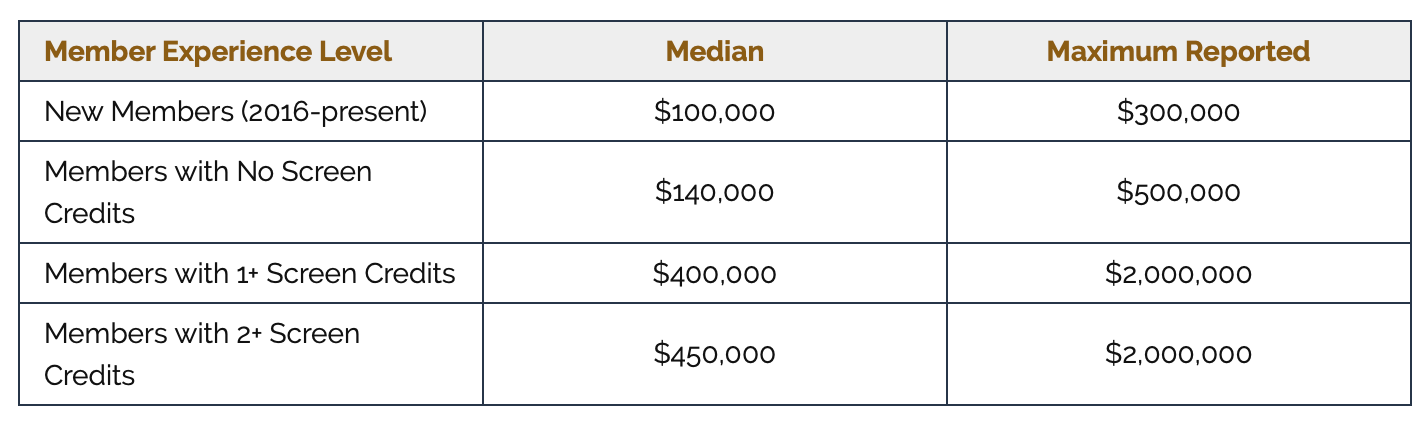
But it’s also important to check the facts. Earlier this year, the WGA examined over a thousand feature contracts to look at trends in compensation. One finding: credit matters a lot.

Chart showing that a feature writer with no credit earns median $100,000 while one with a single credit earns $140,000

The median guaranteed payment for a screenwriter with no credits was $140,000. The median guaranteed payment for a screenwriter with one credit was $400,000.

A single feature credit more than doubled a screenwriter’s pay.

Would receiving an “Additional Literary Material” credit result in the same bump? Likely not to the same degree. But it would show that a screenwriter worked on a film that got made. I strongly believe that’s going to be worth real dollars to that writer. In my discussions with newer writers, agents and executives, most of them agree.

This impacts quite a few writers. In 2020, 185 participating writers wrote on produced features for which they ultimately received no credit.

I should also note here the Guild’s Inclusion & Equity Group’s concern that the status quo disproportionately affects women and writers of color, for whom these resume gaps can be a substantial barrier to future employment.

When comparing the theoretical harms of end credits to the actual harms of doing nothing, I think it’s better to solve the real problems members are having.

Finding a middle path

Even after acknowledging my survivorship bias and the actual harms screenwriters are facing, I wouldn’t have supported many of the more aggressive proposed changes to the credit system. For example, I don’t believe in changing the thresholds for the “by” credits, expanding the definition to include non-writing roundtable participants, or having all participating writers share in the residuals pool.

Instead, what the committee came up with after a year of sometimes-heated debate was a proposal that narrowly addresses the “resume problem” of missing employment credits without changing anything about the traditional writing credits. The result closely mirrors the system used in television for decades, where writers are credited for both their employment and their authorship.

The term “Additional Literary Material” is incredibly dull, but it’s also accurate. It reflects the reality that the people listed wrote material for the film without passing any judgement. It clearly delineates actual writing — words on paper — from participating in a roundtable.

Rather than diluting the authorship credit of the “by” writers, I’d argue the “Additional Literary Material” credit reinforces it. By definition, any writer listed it this block did not meet the thresholds for receiving “by” credit. (And if a writer chooses not to be included in “Additional Literary Material,” it’s their decision alone.)

In summary, I changed my mind on end credits because I realized I wasn’t looking at the reality experienced by many screenwriters in 2021. This proposal addresses a specific problem with minimal disruption to long-established screen credit processes.

Voting on the referendum begins November 2nd. I urge you to vote yes.


Supporters of the proposal are gathering signatures for a Pro statement. You can read it here.

WGA members can sign on by sending an email to yesonendcredits@gmail.com with the subject line “PLEASE ADD MY NAME TO THE CREDITS PRO STATEMENT. Please include your name and preferred email address.

Getting Apple Pay to work on my M1 MacBook

April 29, 2021 Geek Alert, How-To

I love my 2020 MacBook Air and have had very few issues with it, except that I couldn’t get it to work with Apple Pay. Transactions would fail, and it wasn’t clear why. For months I just lived with it and used alternate ways of paying for things.

But man, I missed the convenience of Apple Pay, which worked fine on my much older machine. (This was my first Mac with Touch ID, which is relevant.)

Last night, while trying to buy two t-shirts at Cotton Bureau, I was determined to find a solution to my Apple Pay woes.

Checking the Wallet & Apple Pay pane in System Preferences showed my credit cards were there but disabled. It pointed me to this page at Apple:

If Apple Pay on your Mac is disabled because security settings were modified

Had my security settings been modified? No idea.

That page pointed me to this one:

About Startup Security Utility

It seemed that maybe I needed to boot into Recovery Mode and use the Startup Security Utility to set my Mac to a higher security threshold.

The article said you get to Recovery Mode by booting while holding down Command-R. But on the new M1 Macs, instead you hold down the power (Touch ID) button instead. This tripped me up for a few minutes.

In Recovery Mode, it was clear that all my system settings were fine.

Here’s what ultimately worked: Deleting the credit cards in Wallet & Apple Pay, then re-adding them. After that, transactions worked great.

My hunch is that the credit cards were imported when I set up this Mac but not properly authorized. Apple should change the language of the warnings or link to a better explanation.

In the meantime, hopefully this writeup has saved you some hassle.

« Previous Page
Next Page »

Primary Sidebar

Newsletter

Inneresting Logo A Quote-Unquote Newsletter about Writing
Read Now

Explore

Projects

  • Aladdin (1)
  • Arlo Finch (27)
  • Big Fish (88)
  • Birdigo (2)
  • Charlie (39)
  • Charlie's Angels (16)
  • Chosen (2)
  • Corpse Bride (9)
  • Dead Projects (18)
  • Frankenweenie (10)
  • Go (29)
  • Karateka (4)
  • Monsterpocalypse (3)
  • One Hit Kill (6)
  • Ops (6)
  • Preacher (2)
  • Prince of Persia (13)
  • Shazam (6)
  • Snake People (6)
  • Tarzan (5)
  • The Nines (118)
  • The Remnants (12)
  • The Variant (22)

Apps

  • Bronson (14)
  • FDX Reader (11)
  • Fountain (32)
  • Highland (75)
  • Less IMDb (4)
  • Weekend Read (64)

Recommended Reading

  • First Person (87)
  • Geek Alert (151)
  • WGA (162)
  • Workspace (19)

Screenwriting Q&A

  • Adaptation (65)
  • Directors (90)
  • Education (49)
  • Film Industry (489)
  • Formatting (128)
  • Genres (89)
  • Glossary (6)
  • Pitches (29)
  • Producers (59)
  • Psych 101 (118)
  • Rights and Copyright (96)
  • So-Called Experts (47)
  • Story and Plot (170)
  • Television (165)
  • Treatments (21)
  • Words on the page (238)
  • Writing Process (177)

More screenwriting Q&A at screenwriting.io

© 2026 John August — All Rights Reserved.