• Skip to primary navigation
  • Skip to main content
  • Skip to primary sidebar

John August

  • Arlo Finch
  • Scriptnotes
  • Library
  • Store
  • About

John

The Free Stuff

August 11, 2022 Apps, Bronson, Highland, Meta, News, Software, Tools, Weekend Read, Writer Emergency Pack

My friend Nima recently pointed out that most of the stuff our company makes is free.

That’s probably not a great business model, but it’s always been our culture. We only charge for those things that have significant ongoing costs — like upkeep and hosting — or a per-unit cost to produce.

If you’re a writer, here are the things we offer at absolutely no cost. As in free.

johnaugust.com

This blog has been running since 2003. Nearly all of its 1,500 posts are screenwriting advice. The Explore tab on the right is a good way to get started looking through the archives. For example, you might start with the 129 articles on formatting.

Scriptnotes

Craig Mazin and I have been recording this weekly screenwriting podcast for over ten years. It’s always been free, with no ads whatsoever. The most recent 20 episodes are available in every podcast player. Back episodes are available to Scriptnotes Premium members, or can be purchased in 50-episode “seasons.”

Inneresting

Chris Csont edits this weekly newsletter, which serves as a good companion to Scriptnotes. Every Friday, it has links to things about writing, centering on a given theme. It’s a Substack, but completely free.

Highland 2

For years, I’ve written all my scripts and novels in this terrific app our company makes. It’s a free download on the Mac App Store. The Standard edition is fully functional, with no time limits. Students can receive the enhanced Pro edition through our student license program.

Courier Prime

English-language screenplays are written in Courier, but not all Couriers are alike. Many are too thin, and the italics are ugly. So we commissioned a new typeface called Courier Prime. It’s Courier, but better. Since it’s free and open licensed, you can use it through Google Fonts and similar services.

Weekend Read

Reading a screenplay on an iPhone is a pain in the ass — unless you use Weekend Read. It melts down screenplay PDFs so they format properly on smaller screens. Weekend Read also has an extensive library of older scripts, including many award nominees. It’s free on the App Store.

The Library

The Library has most of the scripts I’ve written, and hosts a few other writers’ work as well. For several projects, I’ve included treatments, pitches, outlines and additional material.

Screenwriting.io

While johnaugust.com offers detailed articles on various topics, screenwriting.io answers really basic questions about film and TV writing. If you’re Googling, “how many acts does a TV show have?” we want to give you the answer with no cruft or bullshit.

100 Most Frequently Asked Questions about Screenwriting

We gathered the 100 most frequently searched-for entries on screenwriting.io in this handy 85-page PDF.

Launch

I recorded this seven-episode podcast series about the pitch, sale, writing and production of my first Arlo Finch book. If you’ve ever thought about writing a book, you’ll want to check it out. Free wherever you listen to podcasts.

The Paid Stuff

Given all the free stuff we put out, how does our company make money? We sell things.

Highland 2 Pro

Highland 2 Standard Edition is free, but most users choose to upgrade to Pro for its added features: revision mode, priority email support, extra templates, custom themes, and watermark-free PDFs. It’s an in-app purchase, $39 USD. ((Prices may change. Also note that Apple sets international pricing, so some apps cost a little more or a little less in some countries.))

Writer Emergency Pack

Writer Emergency Pack began its life as a Kickstarter, and is now one of the most popular gifts for writers of all ages. Available through our store and Amazon.

Bronson Watermarker PDF

Bronson is the app I needed when watermarking scripts for a Broadway reading. Now it’s become the default watermarking app in Hollywood. It’s $20 on the Mac App Store.

T-shirts and hoodies

We used to print and ship our own t-shirts, but we now sell them through Cotton Bureau. We put out a new Scriptnotes shirt every year. It’s definitely not a profit center, but it’s fun seeing merch out in the wild.

Weekend Read Unlocked

Users can unlock their expanded library for $10 USD.

Scriptnotes Premium

The Scriptnotes podcast runs out of a separate LLC from our software business. Premium subscriptions pay for the salaries of our producer, editor and transcriptionist, along with hosting and management fees. Craig and I don’t make a cent off it.
Clarifying scene geography

July 15, 2022 Follow Up, Formatting, Scriptcast, Words on the page

Based on an earlier Three Page Challenge entry — and with the blessing of writer Andrew McDonald — I’ve posted a new video in which I revise a scene in real time. Along the way, I discuss how small choices on the page can help (or hurt) a reader’s ability to understand where characters are and what’s happening.

As a fun bonus, Andrew has also filmed a demo version of his vision.

The Odd Joy of the Wizard/Paladin

May 5, 2022 Film Industry, First Person, Random Advice, Television

On Scriptnotes 541, Craig and I discussed which of the classic D&D attributes (Strength, Intelligence, Wisdom, Constitution, Dexterity and Charisma) were most important for an aspiring film and TV writer. We ranked intelligence first, while acknowledging that charisma was important for the social aspects of the job. We felt wisdom was gained through experience — which it is, in the real world.

Our discussion generated a lot of listener emails. Nick Roth’s response felt like it deserved its own post. So here it is in full.


Sometimes, as a writer earlier in your career, and especially in the context of tv writing (my background is as a lower level writer on a network sitcom), it feels like you can’t just be a wizard who has maximized intelligence with secondary emphases on charisma and wisdom.

It feels like you have to multi-class as a Wizard/Paladin.

It’s a stupid multiclass. You have to approach your work like you’re on a holy quest, and everyone expects you to be a melee tank, but all you really want is to cast spells from the shadows. You have to have intelligence and charisma, and you have to have both strength and constitution to survive in a writers’ room, where you need thicker skin than mage armor can provide. And you also need to get yourself into the right place at the right time, so you can’t even take dexterity for granted, because there are barbarians out there with advantage on initiative rolls who will beat you to opportunities.

You have literally no dump stat. And, in this campaign setting, there are famously OP Backgrounds you probably don’t have access to — like having famous parents or being literally Malia Obama.

The point is it can feel impossible to roll this character. But here’s the thing: the best characters and the best campaigns aren’t made by rolling great attributes and min-maxing your abilities. They are made by figuring out the most hilarious and surprising and heartwarming ways of interpreting your critical successes and your critical fails. Okay, so you’ve insanely chosen to be a wizard-paladin and you rolled three negative modifiers. Big whoop. You can still have the best time saving the multiverse with this zany School of Police Procedurals Wizard who has taken an Oath of Musical Comedy. Maybe you fight a dragon, or maybe you reboot Cop Rock!

I feel like I lost the thread there, but you get the idea. Just like we must imagine Sisyphus happy, we have to love all the parts of being a screenwriter, no matter how absurd a multi-class it requires, even when we roll a 1 and had -3 to the check to begin with.

What to do about fake scripts

February 23, 2022 Aladdin, Projects, Rights and Copyright

A listener pointed me to this listing on Barnes & Noble for “Aladdin: Screenplay” by Meredith Day. The listener writes:

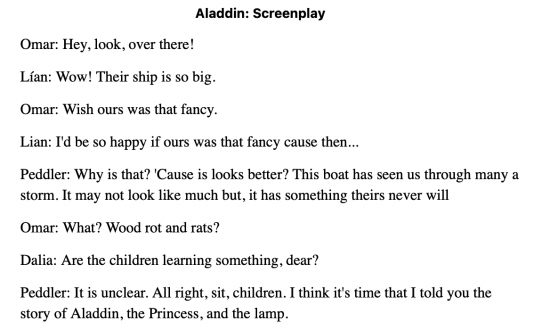
This is clearly a bootleg, and the Kindle preview shows it’s just a movie transcript without any proper formatting. You don’t even get credit as a screenwriter in the book.

On Amazon you can find dozens of books by Meredith Day, all of them “screenplays.” But they’re not actual screenplays. At most they’re transcripts, perhaps pulled from the closed captioning.

aladdin transcript page

The text isn’t the only thing that looks to be yoinked without permission. The cover artwork shows up in the Artstation portfolio of Vietnamese artist Khánh Khánh as “Aladdin 2019 Fanart.”

The listener asks:

I was wondering if you ever do anything to legally take these down? Have you ever considered official publications of your previous screenplays besides just the digital releases in your library?

Let’s take a moment to look at the copyright issues here.

Aladdin — both the character and the basic story elements — are wholly in the public domain. Everyone has the right to retell the story of the kid, the lamp and the genie.

Disney’s Aladdin, including its songs and dialogue, are property of the Mouse House. This book isn’t the public domain version of Aladdin; it’s a transcript of the film. It’s hard to imagine it passing any of the standards of fair use, as it’s a commerical endeavor that uses the work in whole without commentary or transformation.

What’s more, it invites confusion about whether it’s an authorized product. To my knowledge, Disney hasn’t published the screenplay anywhere, but they have put out a well-reviewed novelization.

As one of the credited writers of Aladdin, I considered filling out Amazon’s “Report Infringement” form, but Disney is the more properly aggrieved party here. It’s their call. ((Because the 2019 Aladdin is based on Disney’s IP, I don’t control any of the separated rights, including publishing a book of the script.))

As frustrating as it is to think of someone profiting off this hacky transcript, I honestly don’t think they’re profiting that much. A quick Google search will find you the same text for free. The best case for taking these fake scripts off Amazon and Barnes & Noble is that they’re terrible and certain to disappoint anyone who purchases them.

« Previous Page
Next Page »

Primary Sidebar

Newsletter

Inneresting Logo A Quote-Unquote Newsletter about Writing
Read Now

Explore

Projects

  • Aladdin (1)
  • Arlo Finch (27)
  • Big Fish (88)
  • Birdigo (2)
  • Charlie (39)
  • Charlie's Angels (16)
  • Chosen (2)
  • Corpse Bride (9)
  • Dead Projects (18)
  • Frankenweenie (10)
  • Go (29)
  • Karateka (4)
  • Monsterpocalypse (3)
  • One Hit Kill (6)
  • Ops (6)
  • Preacher (2)
  • Prince of Persia (13)
  • Shazam (6)
  • Snake People (6)
  • Tarzan (5)
  • The Nines (118)
  • The Remnants (12)
  • The Variant (22)

Apps

  • Bronson (14)
  • FDX Reader (11)
  • Fountain (32)
  • Highland (75)
  • Less IMDb (4)
  • Weekend Read (64)

Recommended Reading

  • First Person (87)
  • Geek Alert (151)
  • WGA (162)
  • Workspace (19)

Screenwriting Q&A

  • Adaptation (65)
  • Directors (90)
  • Education (49)
  • Film Industry (489)
  • Formatting (128)
  • Genres (89)
  • Glossary (6)
  • Pitches (29)
  • Producers (59)
  • Psych 101 (118)
  • Rights and Copyright (96)
  • So-Called Experts (47)
  • Story and Plot (170)
  • Television (165)
  • Treatments (21)
  • Words on the page (238)
  • Writing Process (177)

More screenwriting Q&A at screenwriting.io

© 2026 John August — All Rights Reserved.