• Skip to primary navigation
  • Skip to main content
  • Skip to primary sidebar

John August

  • Arlo Finch
  • Scriptnotes
  • Library
  • Store
  • About

Chris Csont

Corpse Bride article in Script magazine

September 1, 2005 Corpse Bride, Projects

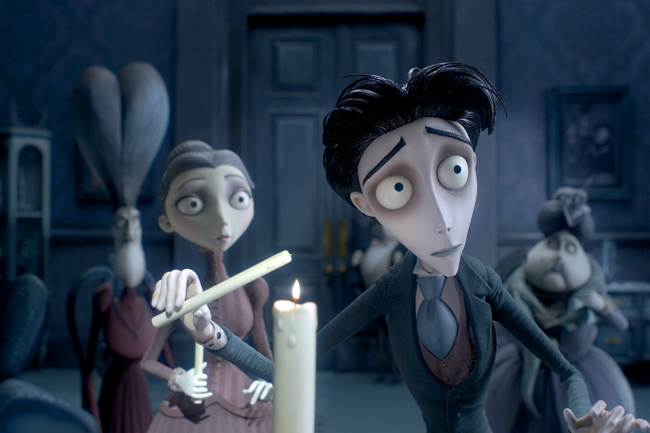
Corpse BrideThe new issue of Script magazine has a long-ish article about Corpse Bride, interviewing both Pamela Pettler and yours truly about the story and process. Pamela, Caroline Thompson and I share writing credit on the movie, but I was never really clear who wrote what and when. From the article, it appears that Caroline wrote a detailed outline, while Pamela wrote the first real script. I was the in-production guy, who did tweaks and fixes, smoothing out rough spots and writing lyrics for a few new songs.

Since it wasn’t a WGA-covered movie — animation often isn’t, much to the WGA’s chagrin — there wasn’t a normal arbitration process to figure out who got what writing credit for the movie. Fortunately, the final credits as determined by the studio seem right to me. Again, since it’s not WGA, none of us will get residuals. Which blows. But we knew that going in.

The movie, incidentally, is great.

One of the cool/weird things about working on an animated movie (this is my second, after Titan A.E.), is that you get to see the entire movie a lot while it’s in production. Every couple of weeks, I’d get a new tape via FedEx from London, showing the newly animated scenes and the pencil storyboards for what was about to shoot, with a mixture of real and temp voices for all the characters. In all, I’ve probably seen the entire film 20 times in various incarnations.

About a month ago, I finally got to see the finished product at a test screening in the Valley. The movie is flat-out gorgeous on the big screen, with the stop-motion animation having a realer-than-real quality. It’s so sharp that it looks 3D.

But what really surprised me is that all the story tweaking we did along the way feels so seamless. You wouldn’t know that characters got added and dropped along the way, or that significant points of backstory were still in discussion midway through shooting. Or that it wasn’t always so musical.

All films, including live-action, go through major changes during editing, but with this kind of animation, there really is no distinction between production and post-production. Once you shoot a frame, it’s finished, forever. So it’s heartening to see that the nail-biting decisions paid off. It feels like it was shot from a locked, finished script. It wasn’t.

The other great lesson you learn from writing animation is surrendering your monopolistic control over every little word, the cinematic “Not Invented Here” syndrome. Moving from the page to the (miniature) soundstage means going through the storyboard artists, who often find new ways of playing a beat that you never considered. During production, a lot of my job was tweaking dialogue to match new bits of business that the artists had invented. While actors in a live-action movie will improvise, that kind of multiple-voices collaboration doesn’t happen as often. In the case of Corpse Bride, it really helped.

How I Learned to Stop Worrying and Love Courier

February 10, 2005 Formatting, Geek Alert

Update 2025: since the original posting of this blog, we’ve developed our own font, Courier Prime. It’s like Courier, but better. And, it’s free to download.

I originally posted this as a reply in a screenwriting forum, but it’s pretty relevant here.

When I bought my first LaserWriter printer (probably 1993), I freaked out because Courier was suddenly ghastly thin. On my old StyleWriter inkjet, it had looked properly typewriter-like, but coming out of the laser printer, it was a shadow of its former self.

It bothered me enough that I used Fontographer to pull the Type 1 Courier outlines from the printer, then chunk-ify them a bit and save them as a Type 3 font, which I called Dorphic. (I have no idea why I picked that name, but it seemed to fit.)

So for many years, I happily used Dorphic on all my scripts. GO, for example, was in Dorphic. I would probably still be using that face, but the shift to OS X made Type 3 fonts impossible. I scoured the net for new options, and settled on Courier Ragged, which I used for a year or two.

But a new problem came up. Up until about 2003, when I needed to turn in a script to a producer or studio executive, I would print it out and call for a messenger. I could be certain the script would look right, because I was printing it myself. But once executives (and their assistants) became more internet-savvy, it made a lot more sense to turn in scripts in .pdf form. So, while I could use Courier Ragged, there was no guarantee it would look right when they printed it out.

All of which leads me back full-circle to plain old Courier. Of the natural alternatives (Courier New, or Courier Final Draft), it’s the best-looking to me, both on-screen and printed.

A side-note: Before I became a screenwriter, I made a meager living in graphic design. So the cruelest irony is that I’ve now spent a decade using nothing but 12-pt Courier, or its imitators.

Cover page artwork

December 26, 2004 Formatting, QandA

Is artwork that only appears on the title page of a screenplay frowned upon?

— Darryl McD

Yeah, that’s kind of cheesy. If I had to choose between two scripts in front of me, I’d probably pick the one without the artwork.

That said, if you look in the Downloads section, you’ll see that I used a circle around ‘Go’, largely because the word itself is so small. And the cover page for Prince of Persia has the title in the logo font, but since it’s based on a hugely popular videogame, there’s a good reason for it.

For the other 20 or so scripts I’ve worked on, there hasn’t been any artwork on the cover. I’ll occasionally use a font other than 12pt Courier for title itself, but always something simple.

Discover the basics of title page formatting here!

Formatting a montage sequence

March 31, 2004 Formatting, QandA

I was just wondering what is the actual format to cite a montage? Is it similar to:

EXT. MONTAGE – DAY

There are so many images coming from so many different places, how does one cite such a thing as a montage? Thanks for your time and help.

–Mike
North Carolina, USA

A montage is a collection of very short scenes, sometimes only a single shot each, designed to show a series of actions over time. Depending on the needs of the sequence, there are a few different options for how to write a montage in screenplay form.

The easiest example is when all the action is taking place in one location. For instance, say you have a character trying on clothes — the infamous Changing Room Montage. It might read something like this:

INT. CHANGING ROOM – DAY

Holly enters with a massive armload of clothes. Kyle’s eyes bulge. Holly pulls the curtain shut.

MONTAGE

Holly emerges, dressed in different outfits, each more elaborate than the last. Kyle watches in horror and dismay, checking his watch as the madness continues.

And when it’s time to finish, a single line of “END MONTAGE” lets the reader know you’re going back to normal time.

When a montage moves between multiple locations, the situation gets a little more difficult. Often the best choice is to not even say “MONTAGE” and just let it be a series of short scenes — just a slugline and a sentence or two of description. The reader will correctly intuit that there’s a montage occurring.

If all the locations in the sequence fall within one larger location, the most economical choice may be to just change the slugline:

INT. MARY’S HOUSE – VARIOUS ROOMS

MONTAGE as Mary chases after the dog, trying to put in the eyedrops. Every time she has him cornered, he manages to escape, ducking under the coffee table or vaulting over the bed.

My advice is to pick the simplest version that gets the point across. You may find that you’re using two or three different formats in a single script, depending on the needs of each sequence.

Learn more about formatting montages here!

« Previous Page
Next Page »

Primary Sidebar

Newsletter

Inneresting Logo A Quote-Unquote Newsletter about Writing
Read Now

Explore

Projects

  • Aladdin (1)
  • Arlo Finch (27)
  • Big Fish (88)
  • Birdigo (2)
  • Charlie (39)
  • Charlie's Angels (16)
  • Chosen (2)
  • Corpse Bride (9)
  • Dead Projects (18)
  • Frankenweenie (10)
  • Go (29)
  • Karateka (4)
  • Monsterpocalypse (3)
  • One Hit Kill (6)
  • Ops (6)
  • Preacher (2)
  • Prince of Persia (13)
  • Shazam (6)
  • Snake People (6)
  • Tarzan (5)
  • The Nines (118)
  • The Remnants (12)
  • The Variant (22)

Apps

  • Bronson (14)
  • FDX Reader (11)
  • Fountain (32)
  • Highland (75)
  • Less IMDb (4)
  • Weekend Read (64)

Recommended Reading

  • First Person (87)
  • Geek Alert (151)
  • WGA (162)
  • Workspace (19)

Screenwriting Q&A

  • Adaptation (65)
  • Directors (90)
  • Education (49)
  • Film Industry (489)
  • Formatting (128)
  • Genres (89)
  • Glossary (6)
  • Pitches (29)
  • Producers (59)
  • Psych 101 (118)
  • Rights and Copyright (96)
  • So-Called Experts (47)
  • Story and Plot (170)
  • Television (165)
  • Treatments (21)
  • Words on the page (238)
  • Writing Process (177)

More screenwriting Q&A at screenwriting.io

© 2026 John August — All Rights Reserved.