
• Skip to primary navigation
  • Skip to main content
  • Skip to primary sidebar

John August

  • Arlo Finch
  • Scriptnotes
  • Library
  • Store
  • About

Chris Csont

Shazam! It ain’t happening.

January 5, 2009 Dead Projects, Projects, Shazam

marvelBefore the holidays, I promised a post-mortem on Shazam!, the big-screen adaptation of the DC comic I’ve been working on since early 2007. In case you’re not familiar with the character, here’s what I wrote when I first announced the project:

Captain Marvel is a superhero roughly as powerful as Superman, minus the heat-vision and cold breath. What’s unique about the character is that in ordinary life, he’s teenager Billy Batson. Speaking the name of the wizard who gave him his powers (Shazam) calls down a magic thunderbolt, transforming him into the studly superhero. But he’s still a teenager in there.

If this to you sounds, “Like Big, but with superpowers,” then congratulations! You now understand Hollywood.

So that you may further understand Hollywood, let me briefly fill you in on what’s happened in the meantime.

I wrote a draft for New Line. Around the time I turned it in, there was a lot of speculation about whether New Line would continue to remain in business, but there was enough enthusiasm that the mini-studio ran the numbers and considered going into production before a potential actors’ strike. (The WGA strike hadn’t yet happened, but it looked inevitable.) Director Pete Segal was busy on Get Smart, costarring Dwayne Johnson, and rumors began building that The Rock would play Black Adam. A lot of people liked that idea, me included.

I would describe this draft as a comedy with a lot of action. It mostly centers on Billy Batson getting and learning how to use his powers, and discovering what happened to his parents that left him an orphan. One of the appeals of the project is that Billy is a comic book hero who actually reads comic books. Black Adam ultimately becomes the adversary, but he works much like Voldemort in the Harry Potter movies — a dark force to battle at the end, not a constant presence throughout. I wrote the draft I had pitched, and was very happy with how it turned out.

I got notes from New Line and the producers — mostly about set pieces, and keeping Black Adam from becoming too sympathetic — but before I could get started, the WGA went on strike. I couldn’t write, nor did I talk to anyone involved for 100 days.

When the strike was over, Shazam! was suddenly a Warner Bros. movie. ((Warners has a relationship with DC Comics that goes beyond the corporate kinship with New Line, so they apparently could have gotten involved even if New Line had remained separate.)) The new executive at Warners said he agreed with the New Line notes, and told the producers I should go ahead with my rewrite. We weren’t on the official production schedule, but there were discussions about budgets and timelines. We were definitely Pete Segal’s next movie, and many of the stories coming out of the press junkets for Get Smart were about Shazam.

When we turned the new draft in to the studio, we got a reaction that made me wonder if anyone at Warners had actually read previous drafts or the associated notes. The studio felt the movie played too young. They wanted edgier. They wanted Billy to be older. They wanted Black Adam to appear much earlier.

(I pointed out that Black Adam appears on page one, but never got a response.)

I expressed my frustration that I’d wasted months of my time and a considerable amount of the studio’s money on things that should have been discussed at the outset. I asked for a meeting with the executive in charge. He and I had one phone call, then I got a new set of notes that didn’t gibe with what we had discussed. (The written studio notes, I will say, were well-considered. I disagreed with the direction they were taking the movie, but they were thorough and self-consistent.)

In retrospect, I can point to two summer Warner Bros. movies that I believe defined the real issue at hand: Speed Racer and The Dark Knight. The first flopped; the second triumphed. Given only those two examples, one can understand why a studio might wish for their movies to be more like the latter. But to do so ignores the success of Iron Man, which spent most of its running time as a comedic origin story, and the even more pertinent example of WB’s own Harry Potter series. I tried to make this case, to no avail.

I was under contract to deliver one more draft. So I took them at their (written) word and delivered what they said they wanted: a much harder movie, with a lot more Black Adam. This wasn’t “Big, with super powers” anymore. It was Black Adam versus Captain Marvel, with a considerable push into dark territory and liminal badlands like Nanda Parbat. It wasn’t the action-comedy I’d signed on to write, but it was a movie I could envision getting made. The producer and director liked it, and turned it in to the studio while I was in France.

By the time I got back, the project was dead.

By “dead,” I mean that it won’t be happening. I don’t think it’s on the studio’s radar at all. It may come back in another incarnation, with another writer, but I can say with considerable certainty that it won’t be the version I developed. ((Keep in mind that press releases often have little relationship to reality. The same week I found out that Shazam! was dead, Variety and several online news outlets ran stories about Pete Segal’s new overall deal with Warners, which highlighted Shazam! as his next project. I got several “Congratulations!” emails.))

Yes, that sucks. And obviously, I can only share my interpretation of what transpired. There were dozens of meetings and phone calls in which I had no participation. As a reader, you should certainly consider the possibility that I wrote shitty scripts they simply didn’t want to make. Because Warners controls copyright on them, I can’t put them in the Library for you to read yourself. So you have to decide whether to take my word on it.

The larger point of this retelling is to help readers understand that at every level in a screenwriter’s career, there are projects that simply don’t happen, mostly for reasons you couldn’t anticipate at the outset. I’ve had good experiences at Warner Bros. (Charlie and the Chocolate Factory, Corpse Bride) and bad experiences (Tarzan, Barbarella). My next movie is at that studio, so while I’m frustrated by the way they handled this project, I have no axe to grind. When they have a movie they want and support, they’re top-notch.

I got paid well to write Shazam, and I get to keep that money. The real cost is an opportunity cost — the other projects I could have written that might be in production now. More than anything, that’s one of the reasons production rewrites are so appealing to established writers: you know those movies are going to get made.

Also softening the blow is that I’m already writing a new project, one I might have had to pass up if Shazam had dragged on any further. The first half of 2009 is going to be very busy. So while I’ll miss Shazam, and the movie it could have been, I won’t feel too bad if this is the last post I ever write about it.
Money 101 for screenwriters

December 18, 2008 Film Industry, How-To, WGA

Most of the questions I answer on this site are from readers who hope to become professional screenwriters. A small percentage of these readers will succeed, and suddenly face a new category of questions about What Happens Next. Having watched former assistants and other young writers cross the line into professional work, I’ve noticed that one of the biggest mysteries is money.

I want to offer a brief financial education for the newly-employed screenwriter. For most of you, this won’t apply — yet, if ever. But for others, this may be worth a bookmark, because there are some specific, unusual things you need to know. Screenwriting is a strange profession, and handling the money it generates is more complicated than you’d think.

1. Don’t quit your day job — until you have to.

Before writing this post, I asked a dozen working writers for their recommendations, and this was by far the most-often made point.

The natural instinct is to immediately quit your crappy day job once you’re hired to write something (or sell a spec). After all, isn’t that the dream? Isn’t this why you came to Hollywood? Every waiter and barrista in Los Angeles considers himself a screenwriter, so quitting your day job is an important way to distinguish yourself as a True Screenwriter, the kind who gets paid actual money to push words around in 12-pt Courier.

But don’t. Don’t quit your job right away.

Even if you sell a spec for $200K, it will be months before you see a cent. The studio will sit on your contract as lawyers exchange pencil notes about things you can’t believe aren’t boilerplate. When I was hired for my first job, (I adapted the kids book How to Eat Fried Worms for Imagine) it took almost four months before I got a paycheck. I was living off of money from a novelization, but when that ran out, I had to ask my mom for help paying rent.

Nearly every screenwriter I speak with has a similar story — you’re never as broke as when you first start making money.

Beyond the initial delay in getting paid, keep in mind that there’s no guarantee you’ll have a second writing job. I haven’t seen numbers, but my hunch is that a substantial portion of new WGA members aren’t getting paid as screenwriters two years later. A career is not one sale. As one writer friend says, “I always think of myself as six months away from teaching community college.”

If all goes well, the needs of your career will eventually force you to give up your day job. You’ll have meetings at 11 a.m. on a Wednesday, and no more excuses to offer your boss. Or you’ll be hired on a TV show, which is at least two full-time jobs. So don’t panic when it comes time to quit. Just try to leave on good terms, with back-of-mind awareness that at some point you may need to get a normal job again.

Here’s how the transition happened for my former assistants:

  • Rawson finally quit working for me because the movie he was directing (Dodgeball) was in preproduction. He went from being an assistant to having an assistant in less than a week.
  • Dana had a movie greenlit and another script under a tight deadline.
  • Chad met with Aaron Sorkin on a Tuesday morning — and got hired in the room. He had to start working on Studio 60 that afternoon.

Each of them left, but only after the needs of their writing career made it impossible not to. In the meantime, they had regular hours and health insurance. That last part is especially worthy of attention, because it may take months to get WGA health insurance started after making a sale.

2. It’s less money than you think.

We’re used to getting paychecks that have all of the taxes and expenses taken out. Maybe you’re bringing home $850 per week. The math is relatively straightforward: you know how much you need for rent, food, utilities and whatnot. And next week, you’ll get another check.

Screenwriting is nothing like that. You get paid in chunks, from which you have to pay taxes and percentages to all the people working for you. The money shrinks at an alarming rate. Worse, you have limited ability to predict when you’ll get paid again.

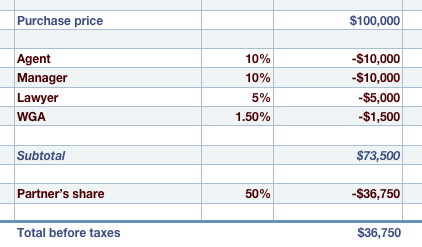
As an example, let’s say you and your writing partner sell a spec script to a studio for $100,000. That seems like pretty good money. But how much of it do you get to keep? Let’s run the numbers.

100k grid

Out of all that money, you have less than $37K, and that’s before you’ve paid a penny of taxes. So don’t buy your fractional Net Jet just yet.

Some points while we’re here:

  • Not every writer has a manager. I never did. Many beginning writers find managers helpful in making contacts and working on pitches. Your mileage may vary.
  • While most managers get 10%, that’s not fixed by law the way it is with agents.
  • You can also pay attorneys by the hour — but they’re well worth the 5%.
  • You generally don’t write a check for your agent and attorney — that money is deducted by the agency when they collect from the studio for you.
  • The WGA sends you a form every quarter on which you list what you’ve been paid by signatory companies. It’s your responsibility to pay dues.

Flipping through Variety, you might think that all screenwriters are rich. For instance, you might read that Sally Romcom sold a pitch for “low six figures.” That’s slanguage for $100 to $250K — still a lot of money. But if you actually looked at her deal, you’d see that the money is structured in a way that she’s unlikely to get it all at once, or even in the same year.

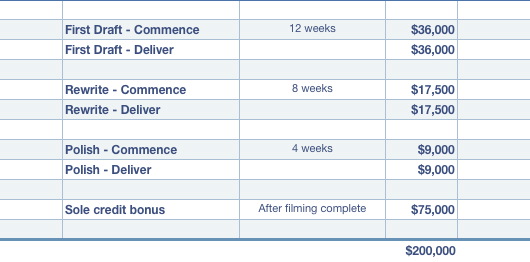
deal steps

Sally is getting paid in three steps: first draft, rewrite and polish. For each step, she is being paid half at commencement, and half when she delivers. Each step has a time frame, ranging from 12 weeks for the first draft to four weeks for the polish. There is generally a four-week guaranteed reading period between each step, which means that the fastest she could expect to be paid for these three steps is 32 weeks (12 + 4 + 8 + 4 + 4).

She’ll get $125K for these three steps. The $75K sole credit bonus only happens if (a) the movie gets made, and (b) she’s the only credited writer on it. The shorthand for Sally’s deal would be “125 against 200.” The first number is what she’s guaranteed to make, while the second represents what she’ll get if the movie is made.

In order to pay her bills, Sally needs to be able to predict when she’s going to be getting more money. For years, I kept a spreadsheet tracking projects and expenses across upcoming months, to make sure I’d have enough cash to pay rent six months down the road.

3. WGA membership happens automatically

One day, you’re an aspiring screenwriter who hopes to join the Writers Guild. The next, you’re a working screenwriter who must join the guild by law.

The first time you sell a script to (or are hired to write by) a signatory company, (There are a few indie companies which are not under the WGA deal, but every major studio is) you need to join the Guild. Odds are, the guild will contact you as soon as paperwork crosses the right desk, but you can also jumpstart the process by calling the Los Angeles office.

You’ll have to pay a fee of $2,500 to join. (WGA East costs $1,500 to join. No, I don’t know why it’s cheaper.) Ask nicely, and they’ll let you spread out the payments.

The most immediate benefit to joining the guild is the health insurance. The plans and benefits are confusing but extensive, with trade-offs for Preferred Providers versus HMOs. It’s worth spending a few hours getting it set up correctly. Once you’re in the plan, you’ll need to keep working in order to maintain eligibility.

4. Splurge on one thing

Once you start making money, there’s a natural instinct to upgrade every aspect of your lifestyle, which has probably stalled out in a post-college, heavy-Ikea phase. Don’t. You’ll burn through your money and wonder what you spent it on. Instead, buy one thing you really want and can afford. Make that your reward.

For me, it was getting a dog. I’d wanted one since I was 10, and I was determined to move to an apartment that allowed dogs. I found a duplex off Melrose and got my pug. Twelve years later, he’s still sleeping at my feet. He’s a good dog and a good reminder of how my career started.

Your dog equivalent may be a car, a painting, or a 30-inch monitor. Buy it and enjoy it.

But don’t feel any pressure to act rich. I drive a six-year old Toyota. We buy store brands and clip coupons. We fly coach. (Though we’re pretty canny with upgrades. Get a credit card that pays you either frequent flier miles or hotel points, and use that for everything.)

Over time, you will probably start spending more on housing, clothing, travel and food as your standards rise. That’s okay. But spend your mad money on those few things that actually make you happy.

5. Don’t rush to pay off your student loans

Everyone wants to be debt-free, but classic federal student loans are some of the cheapest money you’re ever going to find. Until you feel confident that you’ll have enough money to last you a solid year, keep paying your normal amount.

Instead, pay off your credit cards and private student loans, which tend to have much higher interest rates.

6. Sock it away

Whether you’ve made a bunch of money at once in a spec sale, or carefully grown a nest egg through steady assignments, you’ll want to put your money in two virtual boxes. In the first, stash enough to live on for six months (including taxes). In the second box, put all the rest of the money you make — and pretend it doesn’t exist.

I’m not qualified to talk about investments, pensions or retirement, but I feel absolutely certain giving you this financial advice: save your money. Get financial advice about about smart places to put it, and then leave it alone. Except for rare occasions — buying a house, for example — you should never need to touch it. Your living expenses should be more than covered by new money coming in the door.

7. At some point, you’ll incorporate

When a studio hires me, they actually hire my loan-out corporation, which provides both tax advantages and liability benefits. I didn’t become a corporation until after Go, at which point my agent and attorney told me it was time. (I’ve often heard $200K/year as being the threshold at which point incorporation makes sense, but it may be higher or lower depending on circumstances.) It’s a lot of paperwork to set up — your attorney will do most of it — and a fair amount of responsibility, with quarterly taxes and other filings.

Like heart surgery, it’s smart to ask a lot of questions, but you ultimately want it handled by professionals who do it every day.

Before becoming a corporation, I was managing my money easily with Quicken and Excel. The added complexity of the corporation led me to hire a business manager and accountant. The best resource for finding a good business manager is other writers. You want someone responsible, reachable and thorough. Keep in mind that a business manager is not an investment guy. A business manager is writing checks to keep the lights on. The only financial advice you’ll be getting from your business manager is to spend less money, which is always worth hearing.

TV in movies

March 21, 2007 How-To, Words on the page

I just finished writing a scene where a television news report was playing in the background and it reminded me how hard it is to get these moments right. Unless you’re literally having the characters stare at the TV set, you’re basically dividing the audience’s attention between two planes of information. If you don’t do it carefully, the audience won’t know where to look, and the scene will be a disaster.

Off the top of my head, here are four (hopefully) helpful guidelines:

  1. The TV can only tell you one thing. It can say the big snowstorm is coming, but it can’t also say that mobster Carmine DeSomethingorother has escaped from custody.
  2. Use the naturally empty moments of the scene. If there’s information that’s important for the audience, but not necessarily the characters, start on the TV and let the characters enter the scene where it’s playing. If a character’s waiting on hold, or is looking for dijon mustard in the fridge, that’s another moment you could cut to the TV.
  3. Get the rhythm right. TV news in particular has a cadence, and you can’t just shove your exposition in to make it fit. Always think how the reporter would actually report the story and balance his goals with your goals.
  4. Don’t make it too convenient. Don’t have a character flip on the TV, only to find exactly the story about them — unless it really is reasonable that there’s 24-hour coverage about the situation. Perhaps the only thing worse than this cliché is when a character rushes in, saying, “You’ve got to see this!” before grabbing the remote.

On the whole though, it’s amazing how little television people watch in movies as opposed to real life.

Corpse Bride has risen

September 16, 2005 Corpse Bride, Projects

Corpse Bride Corpse Bride is in theaters starting today — if you live in Los Angeles, New York or Toronto. For the rest of North America, and other parts of the world, you can begin seeing it next week, September 23rd.

Last night, I spoke at USC’s 466 class, which screens a different film each week. At the Q & A afterwards, host Leonard Maltin talks with someone involved with the picture, often an alumni. I used to be in the class, so it’s bewildering to realize this was my sixth 466 (after Go, Charlie’s Angels, Charlie’s Angels: Full Throttle, Big Fish, and Charlie and the Chocolate Factory).

In many ways, this was the easiest of all the classes I’ve spoken at, because with this film I don’t have as much of that please-please like it I beg you instinct. I feel much less ownership of Corpse Bride than the others. Don’t get me wrong — I’m proud of it — but working in animation is inherently much more collaborative in terms of story. For starters, I was the third writer to work on it, after Caroline Thompson and Pamela Pettler. Then there’s a whole department called “Story,” whose job it is to figure out how to convert the screenplay into storyboards, and along the way, a lot gets changed and rearranged. Altogether, it’s much less “my” movie than the others.

But it was a lot of work.

Often, I’d get storyboards from London for scenes that were about to shoot, and would have a day or less to tweak the dialogue before an actor would record the needed lines. Whenever I visited the stages outside London, most of my time was spent watching the scenes already shot, and discussing with the rest of the team how to handle this moment or that. At absolutely no point could I get precious about things needing to stick closer to how they were written. I was there to help, so I helped where I could. I felt like a craftsman rather than artist, and that’s fine.

Reviews so far have been really good, so here’s hoping it gets a good reception. A lot of people ask me, “Isn’t it too scary for kids?” Not really. If your kids like Halloween, they’ll be fine. It’s never gory, and the Land of the Dead stuff is pretty light and breezy.

Corpse Bride article in Script magazine
New, longer Corpse Bride trailer up

Next Page »

Primary Sidebar

Newsletter

Inneresting Logo A Quote-Unquote Newsletter about Writing
Read Now

Explore

Projects

  • Aladdin (1)
  • Arlo Finch (27)
  • Big Fish (88)
  • Birdigo (2)
  • Charlie (39)
  • Charlie's Angels (16)
  • Chosen (2)
  • Corpse Bride (9)
  • Dead Projects (18)
  • Frankenweenie (10)
  • Go (29)
  • Karateka (4)
  • Monsterpocalypse (3)
  • One Hit Kill (6)
  • Ops (6)
  • Preacher (2)
  • Prince of Persia (13)
  • Shazam (6)
  • Snake People (6)
  • Tarzan (5)
  • The Nines (118)
  • The Remnants (12)
  • The Variant (22)

Apps

  • Bronson (14)
  • FDX Reader (11)
  • Fountain (32)
  • Highland (75)
  • Less IMDb (4)
  • Weekend Read (64)

Recommended Reading

  • First Person (87)
  • Geek Alert (151)
  • WGA (162)
  • Workspace (19)

Screenwriting Q&A

  • Adaptation (65)
  • Directors (90)
  • Education (49)
  • Film Industry (489)
  • Formatting (128)
  • Genres (89)
  • Glossary (6)
  • Pitches (29)
  • Producers (59)
  • Psych 101 (118)
  • Rights and Copyright (96)
  • So-Called Experts (47)
  • Story and Plot (170)
  • Television (165)
  • Treatments (21)
  • Words on the page (238)
  • Writing Process (177)

More screenwriting Q&A at screenwriting.io

© 2026 John August — All Rights Reserved.