• Skip to primary navigation
  • Skip to main content
  • Skip to primary sidebar

John August

  • Arlo Finch
  • Scriptnotes
  • Library
  • Store
  • About

flagged

Michelle Pfeiffer, Supervolcanoes and the Yellowstone Fallacy

May 27, 2005 Los Angeles, Television

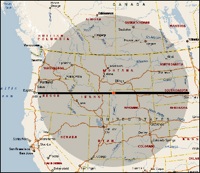
ash falloutI recently watched the Discovery Channel’s Supervolcano, a docu-drama about what would happen if the massive caldera underneath Yellowstone National Park were to erupt.

The program had been sitting on my TiVo for a while, because it’s hard for me to commit to an hour of Alias, much less a three-hour made-for-cable movie. But I knew I’d eventually watch it, because from the moment I first heard about the Yellowstone supervolcano, it was one of those nagging, back-of-my-mind fears. So much so, that I actually included a lengthy monologue about it for a script I was writing. (That scene got cut, so feel free to write your own.)

For those who don’t know, Yellowstone National Park, home of the Old Faithful geyser, is actually the caldera of a massive volcano. And not just a “theoretical” volcano: it’s erupted at least three times before: 2.1 million years ago, 1.3 million years ago and 640,000 years ago. Which, if you do the quick math, suggests that it erupts every 800,000 to 660,000 years. Which means it’s due to erupt now.

timeline

Which is very, very bad.

When Yellowstone erupts, it will be big-summer-disaster-movie apocalyptic. Think Armageddon x The Day After Tomorrow. Twenty feet of jagged volcanic ash strewn across the Midwest, tapering down to a centimeter on the East Coast. Global temperatures will fall. The monsoon will fail. Drought, famine, starvation lasting for years. As Discovery says on the website:

A modern full-force Yellowstone eruption could kill millions, directly and indirectly, and would make every volcano in recorded human history look minor by comparison.

Suddenly, moving to Australia looks a lot more enticing. Yes, there’s the global famine, but at least you don’t have ash falling on your head.

But here’s the thing: Yellowstone is not actually “due” to erupt. That’s a logical fallacy. And the celebrity spokesperson who proved it to me is Michelle Pfeiffer.

Let me provide context.

michelle pfeifferIn 1994, my friend Elizabeth and I went to see The Madness of King George at a movie theatre on the Third Street Promenade in Santa Monica. The movie theatre was pretty full, so we ended up sitting next to a man and woman — who turned out to be Michelle Pfeiffer and her husband David E. Kelly. Being good Los Angelenos, we pretended we didn’t know they were beautiful and famous. We just ate our popcorn, watched the movie, and gossiped after they left.

[Read more…] about Michelle Pfeiffer, Supervolcanoes and the Yellowstone Fallacy

Holy Buckets! It’s the Charlie and the Chocolate Factory trailer!

May 26, 2005 Charlie, Projects

wonka trailerThe full trailer for Charlie and the Chocolate Factory is finally here in all its Quicktime glory. For now, it’s exclusively at Moviefone, but you can see it in theaters starting on Friday. It should be attached to Madagascar most places.

Does bad work spoil mine?

May 18, 2005 Psych 101, QandA, Recycled

questionmarkI work for a small production company.
While trying to break into the "next" (bigger)
level as a screenwriter, I work here as a reader. Basically, I spend a lot
of time writing coverages for awful scripts that never should have been written
in the first place. I often wonder what is going through some of these people’s
minds when they send this junk out.

I don’t really know when it happened, but at some point it
seems that everyone in the world decided they wanted to be screenwriters. My
question is this: does all that subpar work poison the water for the rest of
us truly
capable folks?

–Aaron Saylor

I hear you, brother.

I worked as a reader for about a year and a half, both at Tri-Star and at
a little production company based at Paramount. During that time, I read the
worst scripts of my life — horrible, horrible atrocities worse than a dozen
cable movies.

In writing coverage, half the time my plot summary was much clearer than the
script’s true narrative, and my comments section became an exercise in finding
creative ways to express the same underlying truth: this script is not a movie,
and this writer doesn’t know what he’s doing.

I got a taste of my own medicine later, when I slipped one of my scripts under
a pseudonym to an intern whose opinion I respected. His coverage lambasted
the screenplay and the untalented hack who created it. I actually got nauseous
reading his critique.

Since then, I’ve learned to temper my disgust for poorly written scripts,
and try to view them as the little lessons they are. Once you start looking
for the common problems, you can avoid these pitfalls in your own writing:

  • Bad scripts introduce ten characters in the first four pages,
    without giving you any real information about them, or making clear which ones
    are important.
  • In bad scripts, characters talk about events you just saw happen, which makes
    seeing them redundant.
  • In bad scripts, characters are always walking through doors, as if it’s a
    play where they need to make entrances and exits.
  • In bad scripts, characters do exactly what you expect they’re going to do.

What’s interesting is that many of these lessons can only be learned by reading
bad screenplays. In a good script, you’d never know what you were missing.
So rather than blaming these bum writers for doing terrible work, rejoice in
their suckiness, and remember that their low standards make your great script
all the more unusual.

A movie by any other name

May 14, 2005 QandA, Words on the page

Arguably, the most important part of a film (besides it being good) is the title. Great titles have graced the silver screen, only to have the film bite all kinds of ass. But the title did its job, it got the suckers to watch the flick (i.e. The Phantom Menace). Conversely, a bad title can take the wind out of the sails of a very good film (I won’t watch Divine Secrets of the Ya-Ya Sisterhood cause the title screams chick flick).

My question is, how do you come up with the titles to the films you write? What process do you go through to come up with a title that’d grab the audience by the Ya Yas?

— Americo
San Francisco, California

The majority of my movies have been adaptations, either of books or existing properties, such as Charlie’s Angels. Obviously, it’s not too hard to pick a title for those ones. (Trivia: the “Full Throttle” moniker for the sequel was picked by the marketing team; the working subtitle title was “Halo,” named for the McGuffin of the story.)

I have been through the name game on several movies.

Go started out as a short film script called ‘X,’ named for the ecstasy Ronna’s character is trying to deal. When I wrote the full version, my working title was ’24/7,’ but then I saw reviews for a British film called Twentyfourseven, so I nixed that.

About the same time I was writing this script, I’d made a holding deal with Imagine, for whom I’d just adapted the kids book How to Eat Fried Worms. As part of the deal, I had to pitch them five projects. One of my ideas was a Die Hard-y thriller about involving a bomber and a TV news crew, which I called “Go.” Imagine ultimately passed on all of my ideas, but I really liked the title “Go,” so I just took it for the script I was writing.

It was only after seeing the finished film about four times that I realized how often characters say “go” in the movie — and usually at crucial moments. It seems intentional, but trust me, it wasn’t.

One of my never-ending horrors is that an early Columbia press release listed the title as “Go!” rather than “Go”, so many reviews and articles about the movie include the exclamation point, thinking that’s really the title. It’s not.

I hate that exclamation point with an unmitigated fury. If it somehow became a sentient being, I would kill it without remorse.

Anyway.

Shortly after Go, I was hired to work on an animated movie for Fox called “Planet Ice.” That sounds like a sci-fi movie, and it was. The odd thing, I thought, was that there was no icy planet anywhere in the script. The title was a hold-over from many drafts ago. So along with the rewrite, I turned in a list of proposed titles for the movie, most of them centering around the long-lost spaceship at the center of the story.

Two years later, I went to a screening of the nearly-completed movie, which was now called Titan A.E.. “Titan” is the name of the missing ship, and the “A.E.” stands for “After Earth.” I guess. I never really got confirmation on that.

At any given point, I have a list of about 30 movies I’d like to write, and a good 50% of them have titles. Sometimes, that’s all they really have.

For example, that same thriller I pitched to Imagine is sitting on my to-write list as “Southland.” I think that’s a good title, but I doubt I’ll ever use it, since (a) I’ll probably never get around to writing the script, and (b) it’s too much like Richard Kelly’s upcoming Southland Tales.

I think some projects sell mostly on their title. A vampire thriller set in Alaska is an okay-not-great idea. But 30 Days of Night is a kick-ass title, which is why Sony bought it. On the flip side, my unsold zombie western has been through at least four titles: Deadfall, Devil’s Canyon, Prey, and Frontier. I don’t love any of them, and neither do readers.

But if you have a good title for it, by all means share.

« Previous Page
Next Page »

Primary Sidebar

Newsletter

Inneresting Logo A Quote-Unquote Newsletter about Writing
Read Now

Explore

Projects

  • Aladdin (1)
  • Arlo Finch (27)
  • Big Fish (88)
  • Birdigo (2)
  • Charlie (39)
  • Charlie's Angels (16)
  • Chosen (2)
  • Corpse Bride (9)
  • Dead Projects (18)
  • Frankenweenie (10)
  • Go (29)
  • Karateka (4)
  • Monsterpocalypse (3)
  • One Hit Kill (6)
  • Ops (6)
  • Preacher (2)
  • Prince of Persia (13)
  • Shazam (6)
  • Snake People (6)
  • Tarzan (5)
  • The Nines (118)
  • The Remnants (12)
  • The Variant (22)

Apps

  • Bronson (14)
  • FDX Reader (11)
  • Fountain (32)
  • Highland (75)
  • Less IMDb (4)
  • Weekend Read (64)

Recommended Reading

  • First Person (87)
  • Geek Alert (151)
  • WGA (162)
  • Workspace (19)

Screenwriting Q&A

  • Adaptation (65)
  • Directors (90)
  • Education (49)
  • Film Industry (489)
  • Formatting (128)
  • Genres (89)
  • Glossary (6)
  • Pitches (29)
  • Producers (59)
  • Psych 101 (118)
  • Rights and Copyright (96)
  • So-Called Experts (47)
  • Story and Plot (170)
  • Television (165)
  • Treatments (21)
  • Words on the page (238)
  • Writing Process (177)

More screenwriting Q&A at screenwriting.io

© 2026 John August — All Rights Reserved.