• Skip to primary navigation
  • Skip to main content
  • Skip to primary sidebar

John August

  • Arlo Finch
  • Scriptnotes
  • Library
  • Store
  • About

flagged

Please state your purpose

September 6, 2005 Education, QandA

questionmarkI’m in the middle of applications for USC and UCLA, where I hope to get an MFA in screenwriting.

Any tips on writing the ultimate statement of purpose? Also, what kind of references play well? Should I get industry types or not — I have a couple of contacts in L.A.

I notice you went to USC. Was it very expensive?

— Matt
London

Last question first: yes. Film school is and was expensive. In my case, it was definitely worth it, but for every film school grad who’s making a living at it, there are probably three who aren’t. It’s certainly not like an MBA, where you’re pretty much guaranteed to get some kind of decent job at the end.

I was tempted to dig back through the archives (which are probably on floppy disk) to find my original application letter for the Peter Stark Producing Program at USC. Laziness trumped temptation, and I didn’t. But here’s my recollection of my “statement of purpose”:

I want to learn about the film industry in a comprehensive way, everything from loading a camera to analyzing a marketing plan. In specific, I’m curious to learn how the industry learns from its successes and failures, both critically and commercially.

My letters of recommendation came from a journalism professor and a marketing professor at Drake, and a film instructor I’d had for a summer program at Stanford. I think if you have a film-related reference, use it. But make sure at least one of your references is someone who knows you well and can really speak to your unique strengths with specific examples. To me, there’s nothing worse than a hollow, generic letter of recommendation from someone who seems to be a near-stranger.

For USC requirements, I also had to take the GRE exam. Apparently, the Stark program doesn’t really care about the scores, but I’ll gloat and say I did well. I really miss standardized tests.

The Stark program didn’t ask for a writing sample, so I didn’t need to send in anything for that. What’s weird to realize is that back then, I really didn’t know what screenwriting was.
How to get into film school
Is film school necessary?

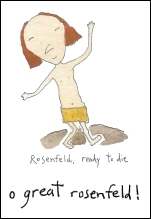
O Great Rosenfeld!

September 2, 2005 News

rosenfeldThe fifty or so friends and family on my Christmas card list this past year got signed copies of Daniel Wallace’s O Great Rosenfeld!, which tells the story of a hapless prehistoric tribe.

Daniel describes it as a kid’s book for adults. Being a crass Hollywood type, I say it’s Quest for Fire meets The Office.

Either way, it’s very funny.

Daniel, you may recall, wrote Big Fish: A Novel of Mythic Proportions, which became the film of the same title (though not subtitle). My adaptation of his novel was the first screenplay he ever read. He liked the format so much he became a screenwriter himself. (He’s also a witty illustrator, which benefits Rosenfeld greatly.)

As of last Christmas, O Great Rosenfeld! hadn’t yet been officially published, so Daniel and I did a special press run, with numbered copies. Friends who got the book would always ask me where they buy it for their friends, but Daniel was always a little evasive on the answer. He said something unusual was happening with it, and that he’d tell me when he could.

It turns out, Amazon bought the book as part of its new Amazon Shorts project.

Most of the stuff available on Amazon Shorts is bonus material from top authors: essays, short stories, deleted chapters. Think of them as the literary equivalent of DVD extras. Everything on Amazon Shorts is delivered electronically, and best of all, it only costs 49 cents. (Of that, the writer gets a very significant portion, since there’s no printing or storage costs.)

Daniel’s O Great Rosenfeld! is divided into two parts, so it costs a whopping 98 cents to find out what ever becomes of “Our Esteemed Leader, Rosenfeld, and His Tribe of 33 and 1/2 Followers” as they strive to protect Sally, the most beautiful woman in their tribe. It’s money very well spent.

And if you’d like Daniel to sign it, he probably will. He’s a friendly guy.

Corpse Bride article in Script magazine

September 1, 2005 Corpse Bride, Projects

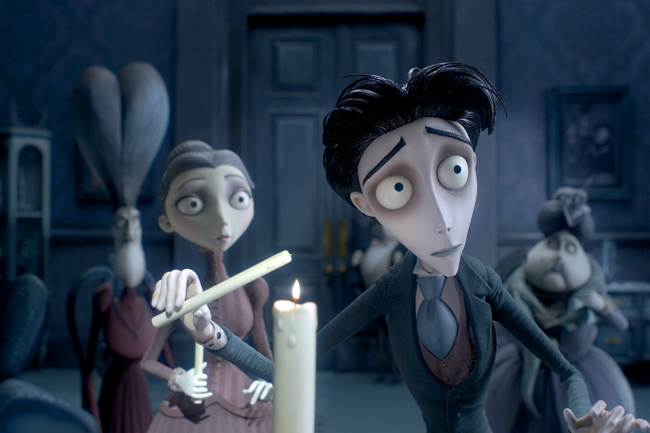
Corpse BrideThe new issue of Script magazine has a long-ish article about Corpse Bride, interviewing both Pamela Pettler and yours truly about the story and process. Pamela, Caroline Thompson and I share writing credit on the movie, but I was never really clear who wrote what and when. From the article, it appears that Caroline wrote a detailed outline, while Pamela wrote the first real script. I was the in-production guy, who did tweaks and fixes, smoothing out rough spots and writing lyrics for a few new songs.

Since it wasn’t a WGA-covered movie — animation often isn’t, much to the WGA’s chagrin — there wasn’t a normal arbitration process to figure out who got what writing credit for the movie. Fortunately, the final credits as determined by the studio seem right to me. Again, since it’s not WGA, none of us will get residuals. Which blows. But we knew that going in.

The movie, incidentally, is great.

One of the cool/weird things about working on an animated movie (this is my second, after Titan A.E.), is that you get to see the entire movie a lot while it’s in production. Every couple of weeks, I’d get a new tape via FedEx from London, showing the newly animated scenes and the pencil storyboards for what was about to shoot, with a mixture of real and temp voices for all the characters. In all, I’ve probably seen the entire film 20 times in various incarnations.

About a month ago, I finally got to see the finished product at a test screening in the Valley. The movie is flat-out gorgeous on the big screen, with the stop-motion animation having a realer-than-real quality. It’s so sharp that it looks 3D.

But what really surprised me is that all the story tweaking we did along the way feels so seamless. You wouldn’t know that characters got added and dropped along the way, or that significant points of backstory were still in discussion midway through shooting. Or that it wasn’t always so musical.

All films, including live-action, go through major changes during editing, but with this kind of animation, there really is no distinction between production and post-production. Once you shoot a frame, it’s finished, forever. So it’s heartening to see that the nail-biting decisions paid off. It feels like it was shot from a locked, finished script. It wasn’t.

The other great lesson you learn from writing animation is surrendering your monopolistic control over every little word, the cinematic “Not Invented Here” syndrome. Moving from the page to the (miniature) soundstage means going through the storyboard artists, who often find new ways of playing a beat that you never considered. During production, a lot of my job was tweaking dialogue to match new bits of business that the artists had invented. While actors in a live-action movie will improvise, that kind of multiple-voices collaboration doesn’t happen as often. In the case of Corpse Bride, it really helped.

Abolish the states, mate

August 30, 2005 First Person

Australian John AugustIn an article published today, one of the other John Augusts argues persuasively that the states should be abolished.

Before you take up arms against him, you should know that he’s Australian, and he’s talking about “states” like New South Wales and Queensland. Which sound like made-up Risk territories, if you ask me.

It’s important that you not be confused by the other side’s rhetoric. For instance, listening to them you might think all of the members of Beyond Federation…

  • are cheering Howard;
  • hail from Whitlam;
  • claim a monopoly on wisdom;
  • only have advocates in New South Wales and Victoria;
  • ignore the need for independent regional initiative;
  • refuse to acknowledge population differences within Australia;
  • and are “centralists”.

I have no idea what this means.

Ever since I first fired up Netscape lo these many years ago, I’ve been following the career of this other John August like he’s my long-lost brother. (He’s not, incidently.) I’ve seen him posting in scientific Usenet groups. Once, he even acknowledged that there’s an American screenwriter with whom he shares a name.

But what to make of his desire to abolish the Australian states? Is he a Socialist, a conservative, a progressive, a forward-thinker, a wacko? I don’t know, because I have zero understanding of Australian politics.

From the picture, he looks like a friendly sort, capable of telling jokes that a specific subset of friends would find hilarious. (For instance, people who know Monty Python backwards-and-forwards.) Also worth noting: he seems to have more hair than he knows what to do with. I do not.

I guess I’m saying, I want him to be good. I don’t need an evil twin. That’s what my subconscious is for.

[His name is my name, too](https://dev.johnaugust.com/archives/2004/my-namesake-also-a-screenwriter)

« Previous Page
Next Page »

Primary Sidebar

Newsletter

Inneresting Logo A Quote-Unquote Newsletter about Writing
Read Now

Explore

Projects

  • Aladdin (1)
  • Arlo Finch (27)
  • Big Fish (88)
  • Birdigo (2)
  • Charlie (39)
  • Charlie's Angels (16)
  • Chosen (2)
  • Corpse Bride (9)
  • Dead Projects (18)
  • Frankenweenie (10)
  • Go (29)
  • Karateka (4)
  • Monsterpocalypse (3)
  • One Hit Kill (6)
  • Ops (6)
  • Preacher (2)
  • Prince of Persia (13)
  • Shazam (6)
  • Snake People (6)
  • Tarzan (5)
  • The Nines (118)
  • The Remnants (12)
  • The Variant (22)

Apps

  • Bronson (14)
  • FDX Reader (11)
  • Fountain (32)
  • Highland (75)
  • Less IMDb (4)
  • Weekend Read (64)

Recommended Reading

  • First Person (87)
  • Geek Alert (151)
  • WGA (162)
  • Workspace (19)

Screenwriting Q&A

  • Adaptation (65)
  • Directors (90)
  • Education (49)
  • Film Industry (489)
  • Formatting (128)
  • Genres (89)
  • Glossary (6)
  • Pitches (29)
  • Producers (59)
  • Psych 101 (118)
  • Rights and Copyright (96)
  • So-Called Experts (47)
  • Story and Plot (170)
  • Television (165)
  • Treatments (21)
  • Words on the page (238)
  • Writing Process (177)

More screenwriting Q&A at screenwriting.io

© 2026 John August — All Rights Reserved.