• Skip to primary navigation
  • Skip to main content
  • Skip to primary sidebar

John August

  • Arlo Finch
  • Scriptnotes
  • Library
  • Store
  • About

flagged

Two sides to the story

November 15, 2005 Ops

Right now, we’re starting casting for Ops, the Fox pilot we’ll hopefully shoot after the holidays. Since most readers out there have never been through network casting — or any casting — I thought I’d talk you through the process. Or at least, the start of the process.

The first thing we had to do was hire a casting director. That was easy; I picked Robert Ulrich, who did the casting for my last pilot. He put together a master list of every name-brand actor to consider for the two lead roles.

Last week, we had a “casting concept” meeting with the network and the studio (both Fox, but different divisions), and talked through the list. I’m always amazed at (a) how many of the names I recognize, and (b) how few of the shows I’ve even heard of.

  • THEM
  • Tom Cavanagh is unavailable. He’s a series regular on Love Monkey.
  • ME
  • What the hell is ‘Love Monkey?’
  • THEM
  • It’s on CBS.
  • ME
  • Is it on now?
  • THEM
  • Maybe?

So, barring unforeseen circumstances, don’t count on Tom Cavanagh being in the show. (Although he is apparently in How to Eat Fried Worms, which was one of my old projects. God bless you, IMDb.)

The two lead roles in the show are Joe McGinty and Theo Vanowen. Ideally, one or both roles would go to bigger name actors who are “offer only.” That means that they don’t audition. You call their agents and ask, “Hey, does [fill in the name] want to be in the show?” If they say yes, boom, you’re done.

At the casting concept meeting, we decided to go after one actor who was offer-only. We also talked through all of the actors with which Fox has special holding deals. That’s the dream: you have the guys you want, and you haven’t gone through a lot of auditions/meetings/aggravation to get there.

But in case it doesn’t happen so easily, we decided to begin auditions.

The first step is sending out the breakdown, which describes the roles that are up for audition. The form itself is copyrighted; a company called Breakdown Services handles the process, and given how often they mark “CONFIDENTIAL” on everything, I won’t include the real form so as to avoid pissing them off.

But here’s what we wrote about the characters in the script:

  • The driver is an American: THEO VANOWEN (mid-30’s to 40’s). Effortlessly intimidating, he’s fought on four continents and killed many men — but not one more than he had to. He keeps both eyes scanning the road.
  • …
  • His business partner, JOE MCGINTY (late 20’s to 30’s), is more MBA than Marine. Much better with words than weapons, he’s an expert negotiator who could talk his way past St. Peter. Both men wear body armor.

Both roles are marked “PLEASE SUBMIT ALL ETHNICITIES.” From experience, I can tell you that if you don’t do that, you only end up with white people.

Once a part hits Breakdown, every talent agent in Los Angeles, New York and elsewhere has access to the information. A related service called Screenplay Online lets actors, agents and managers download .pdf versions of the script, along with the sides.

Ah, the sides.

First, a definition: “Sides” are the scenes from the script that actors read for their auditions. It’s up to the showrunners (me and Jordan) to pick which scenes we want to hear read. For Ops, we’re focussing on casting the two lead roles, so we picked scenes that have both guys in them, and showed a range of emotions, from jovial to pissed off. (That’s pretty much the full range of emotion for this particular show.)

When picking the sides, you want to pick your best scenes, since these are the moments that the studio, the network, and everyone else will see when they watch casting tapes. Every time they hear your clever dialogue, you want them to fall more and more in love with your show, so they’ll give it a plum spot on the fall schedule.

But in many ways, you really don’t want to use your best scenes in the sides, because of one horrible truth: you will hear the exact same scene 5,000 times. You will hear it read by great actors, decent actors, and people you can’t believe have the nerve to call themselves actors. The words will blur together into a meaningless mush.

You will hate these scenes so much that you will rewrite them before you shoot the actual show, just so you can stand to hear them.

But I’m getting ahead of myself. The first casting session is tomorrow. The actors will be talented. The words will be fresh. And casting will proceed apace.
Charlie out on DVD

November 8, 2005 Charlie

Charlie DVD
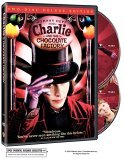
Charlie and the Chocolate Factory is out on DVD today (at least, in North America). There are three versions available: a widescreen version, a full screen version, and a two-disc set with bonus features.

Obviously, don’t get the full screen version.

It’s frustrating that they even sell one, much less call it “full screen.” In order to make the film fit on a conventional television set, they lop off a little on the right and left, or pan-and-scan. That means you’ll lose any Oompa-Loompas at the edge of the frame.

You wouldn’t kill an Oompa-Loompa, would you? So get the widescreen version.

Or better yet, get the two-disc set. The bonus disc has a lot of featurettes about the making of the film, including how they did the squirrels and Oompa-Loompas. On Amazon, it only costs $19.98, compared to $15.98 for the single-disc version.

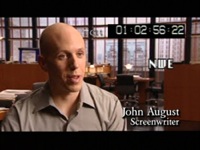
john dvdI show up in several of the bonus features. My advice for any screenwriter lucky enough to have their movie come out on DVD: be really nice to the crew that films the bonus features. Think about what they’ll need when they’re editing. Specifically:
  1. Tell the story. They need someone to help fill in pieces of the plot so that it makes sense.
  2. Speak clearly.
  3. If you screw up, or start rambling incoherently, just stop. Take a breath, and start over. They’ll use your clean take.
  4. They won’t use the interviewer’s voice, so when they ask you a question, you have to answer as if unprompted. For example:
  • INTERVIEWER
  • Was is intimidating working with a book you loved so much?
  • YOU
  • It was intimidating working on this book I loved so much as as kid. I felt this responsibility to make sure that not just Roald Dahl’s words, but his spirit…etc.

As I’ve mentioned before, the screenwriter doesn’t get a particularly big cut of the DVD profits. But it’s something. For Charlie, I’ll also get royalties for “Wonka’s Welcome Song,” for which I co-wrote lyrics.

If you feel like shooting an extra few pennies my way, you can order through Amazon here.

Does Corpse Bride have a happy ending?

November 7, 2005 Corpse Bride

Corpse BrideI know you were brought in late on Tim Burton’s Corpse Bride
and from what I gather, weren’t responsible for much
of the story, but I’m curious about your thoughts on
one particular story element.

Is the ending a happy one for Victor?

The way it plays, it seems as though it is intended to
be a happy ending for him when he winds up with
Victoria, but from the audience’s perspective, I’m not
sure we see evidence that he would be happier with
Victoria than he’d be with the Corpse Bride. The
inclusion of the scene where Victor connects with the
Corpse Bride while playing piano with her is of course
necessary to propagate the plot, but seems to indicate
that he’d be just as content living among the dead as
he would be with Victoria.

— Rob
Los Angeles

You point out one of the real challenges with Corpse Bride. Generally in a fairy tale like this, you’d be really clear about which woman the hero is “supposed to” be married to at the end.

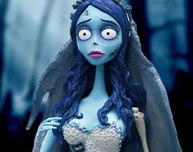
At the start of the movie, it seems pretty straightforward: Victor meets Victoria, and both of them are surprised how much they like each other. Corpse Bride seems like a monster when she first appears, but is quickly revealed to be funny and sweet. She’s rotting, but not rotten.

As we worked on the story, Corpse Bride kept becoming more and more likable, to the point where we started to wonder exactly the question you ask, “Shouldn’t, maybe, Victor end up with Corpse Bride?”

The solution wasn’t to diminish Corpse Bride, but rather to beef up Victoria. Over the drafts, we made sure to give her more initiative (such as escaping the mansion to plead for the Pastor’s help) and make her situation more dire (the wedding to Barkis was a surprisingly late addition).

Through it all, we never wanted to back away from what was unusual about the story: it’s a love triangle in a kid’s film, and you’re sort of rooting for all three characters.

Corpse Bride’s decision to stop Victor from drinking the Wine of Ages (added in the last draft) is less about saving his life (after all, death isn’t so bad) and more about seeing herself in Victoria. It goes back to want-versus-need. Corpse Bride wants to be married, but what she needs is to free herself from her self-imposed curse. While we’re deliberately unclear about the exact cosmology of the afterlife, the Land of the Dead seems to be a kind of goofy Purgatory. Her transformation at the end would seem to be the next step in the process of life.

But is it a little wistful? Yeah.

And I wonder if that lack of clearly happy ending limited the upside to the film — which I have to say, performed much better than any movie called “Corpse Bride” could be expected.

But I wouldn’t change it. To me, it’s nice to be able to show kids a movie where everything resolves well but not perfectly. I think it’s more honest to show that you can be happy and sad at the same time.

Four quadrants of screenwriting style

October 30, 2005 Words on the page

I’ve gotten a few questions from readers who’ve gone through the scripts in the Downloads section, many of them asking about my use of “we,” as in…

We hear SCRAPING as something behind the door moves closer.

Who is “we?”

I use this “we” all the time, and I’ve never really thought about it much. I guess it means either “you and I” (the reader and the writer) or “we the audience.” But which one?

Sort of both. The example above feels like it’s from the audience’s point-of-view. But in many cases, I’m using it more as the creator, such as…

As the pickup ROARS away, we reveal...

TWO BURNING SCARECROWS.

I love “we.” To me, it helps include the reader, giving the sensation of watching a movie, rather than just reading words on a page. But you should know that a fair number of screenwriters loathe this use of “we,” arguing that it’s always possible to write the same moment without it…

The pickup ROARS away, revealing...

TWO BURNING SCARECROWS.

In the end, there is no right or wrong. It’s just a matter of preference.

This got me thinking back to college, when I first had to take a Myers-Briggs personality type test. If you haven’t taken one, it’s definitely worth the twenty minutes, because it has an interesting way of breaking down personality along four basic axes. (Note: plural of “axis,” not synonym of “hatchets.”)

Even with different sets of questions, I come out pretty reliably — if not always strongly — as an ENTJ. It’s worth pointing out that Myers-Briggs-style assessments aren’t trying to say “who you are” as much as what your preferences tend to be.

I think the same characteristics can be found in screenwriting style. Different screenwriters have different preferences, some more strongly rooted than others.

The following is pretty top-of-my-head, so please chime in if you can think of better descriptors for what I’m talking about.

→ Literalist versus Impressionist

The Literalist believes that screenplays should only include what can be seen or heard, since that’s the only information which makes it up on the screen. The Impressionist is willing to bend or break the audio-visual barrier. He may write about things which cannot be filmed, or which reference things outside the world of the movie. (Such as, “Mendoza’s Ferrari is almost as hot as the one I’m going to buy when I sell this script for a million fucking dollars.”)

Personally, I’m pretty much a Literalist, although I’ll generally allow myself one sentence of unshootable information upon introducing a new character.

→ Completer versus Fragmenter

The Completer writes in complete sentences, like this one, with a subject and a verb. The Fragmenter? Nope. Won’t. Not his thing.

I’m a Completer. While you’ll occasionally find a fragment in my action sequences, I’m generally not a fan of rapid-fire word shrapnel. My aversion to fragments makes it very hard to do surgical rewrites of certain screenwriters’ work. I either have to adapt to their style — or more likely — rewrite every sentence of action.

→ Filmist versus Readerist

The Filmist writes screenplays that are intended for filmmakers, using specific film terminology (such as camera movement) and a minimum of fluff. The Filmist makes no concession to the non-professional. The Readerist writes for a more general audience, attempting to convey the feeling of cinematic devices without explicitly mentioning them, sometimes abstracting them to a literary “we see” and “we hear.”

I’m clearly a Readerist. I avoid mentioning the camera, and will even throw a “we” before a “CUT TO:” just so it reads a little better. But it’s worth noting that the classic screenplays, the ones that became the movies you loved, are almost all Filmist.

→ Show-er versus Teller

The Show-er attempts to include every important action in the story, while the Teller would rather forego some detail to convey the overall gist of a scene or sequence. Taken to the extreme, the Show-er would list every punch in a fight, while the Teller would leave it as: “They fight. Maddox wins.”

I’m a Show-er. For me, an action sequence is collection of a dozen smaller moments, and to breeze over them with a sentence or two is disrespectful. With a script, I’m trying evoke the feeling of having watched a movie, and that includes the action.

However, many of the top writers do compress action sequences, arguing that the only thing more boring than writing a long action sequence is reading one.

So, by my own system, I’d come out an LCPS LCRS. You?

Without their scripts in front of me, I’d put James Cameron down as an LCFS. Shane Black is probably an IFRT, but it’s been a while since I’ve read his stuff.

And again, this is all very work-in-progress. (I’ve already changed terms, messing up acronyms.) If you can think of better criteria for looking at screenwriting style (other than “good” and “hack”), please share.

« Previous Page
Next Page »

Primary Sidebar

Newsletter

Inneresting Logo A Quote-Unquote Newsletter about Writing
Read Now

Explore

Projects

  • Aladdin (1)
  • Arlo Finch (27)
  • Big Fish (88)
  • Birdigo (2)
  • Charlie (39)
  • Charlie's Angels (16)
  • Chosen (2)
  • Corpse Bride (9)
  • Dead Projects (18)
  • Frankenweenie (10)
  • Go (29)
  • Karateka (4)
  • Monsterpocalypse (3)
  • One Hit Kill (6)
  • Ops (6)
  • Preacher (2)
  • Prince of Persia (13)
  • Shazam (6)
  • Snake People (6)
  • Tarzan (5)
  • The Nines (118)
  • The Remnants (12)
  • The Variant (22)

Apps

  • Bronson (14)
  • FDX Reader (11)
  • Fountain (32)
  • Highland (75)
  • Less IMDb (4)
  • Weekend Read (64)

Recommended Reading

  • First Person (87)
  • Geek Alert (151)
  • WGA (162)
  • Workspace (19)

Screenwriting Q&A

  • Adaptation (65)
  • Directors (90)
  • Education (49)
  • Film Industry (489)
  • Formatting (128)
  • Genres (89)
  • Glossary (6)
  • Pitches (29)
  • Producers (59)
  • Psych 101 (118)
  • Rights and Copyright (96)
  • So-Called Experts (47)
  • Story and Plot (170)
  • Television (165)
  • Treatments (21)
  • Words on the page (238)
  • Writing Process (177)

More screenwriting Q&A at screenwriting.io

© 2026 John August — All Rights Reserved.