• Skip to primary navigation
  • Skip to main content
  • Skip to primary sidebar

John August

  • Arlo Finch
  • Scriptnotes
  • Library
  • Store
  • About

flagged

Giving credit where it’s due

May 31, 2007 Directors, Film Industry, QandA

questionmarkMy question is not about screenwriting per se, but rather about writing about films. Screenwriters, myself included, are not fond of essays about movies that ignore the contributions of writers. Do you have a stylistic preference for attributing authorship when writing about a movie, when each person’s individual contributions are not known? As an example, here’s a sentence from an essay I wrote about Armageddon:

In the real world, [a mission briefing] would probably happen in a briefing room. Michael Bay decided he wanted it to happen in the shuttle assembly building with a B-2 and 2 SR-71 Blackbirds.

Now I don’t know that this was Michael Bay’s decision — it may have been in one of the drafts of the script — or it may have been decided by Jerry Bruckheimer. But if I wanted to cover my bases, I would have to say:

Michael Bay, Jonathan Hensleigh, J.J. Abrams, Tony Gilroy, Shane Salerno, Robert Roy Pool, Jonathan Hensleigh, and Jerry Bruckheimer decided they wanted it to happen…

This seems incorrect. Alternatively, I could recast the sentence as:

“In the film, this happens in the shuttle assembly room…”
or
“In Armageddon, this happens in…”

But doing this consistently means treating the film as essentially authorless. This is probably truer of Armageddon than of most movies, but I don’t like it stylistically. What’s your preference? Say I was writing about Charlie and the Chocolate Factory, and specifically about something that happens in the film. Furthermore, assume I know nothing about the differences between the book, the script, and the finished film (which is usually the case when writing about a film). Would you prefer:

“Dahl, August, and Burton’s characters,”
“Dahl and August’s characters,”
“August’s characters,”
“Burton’s characters,”
“The characters in Charlie and the Chocolate Factory,”

Or some formulation I’m not seeing?

This isn’t entirely an academic question — I write about movies at Criterion Collection, and recently someone in the comments criticised me for saying things like “Scorsese’s version of Jesus” when writing about The Last Temptation of Christ. So I revised the essay to be more precise — but that meant a lot of sentences that read “the film’s version of Jesus,” and I’m hoping you can think of something more elegant.

Thanks for your time. I enjoy your blog immensely. My little sister recently graduated from Trinity, and hearing you deliver your “Professional Writing and the Rise of the Amateur” lecture was one of the highlights of her college career.

— Matt
Los Angeles

Normally, I lop off these thanks-for-your-blog comments, but I was feeling a little down, so that perked me up. Now, on to your question.

I don’t think there’s a perfect way to address authorship of a movie, but you’re right to be sensitive to the ambiguities. The characters in Charlie and the Chocolate factory are mine, and Dahl’s, and Tim’s, and the actors’. At every step in the process, choices were made by many people for many reasons. The same can be said for the sets, the music, the wardrobe, and the choreography.

If you’re writing about Tim Burton’s body of work, I think it’s absolutely fair to use a phrase like, “Burton’s characters tend to…”, since you’re pointing out a consistency across many different films. (You could do the same for characters in the films I’ve written, or the characters Johnny Depp has played.) Even if the person you’re talking about didn’t create these characters, the fact that there’s similarity between them indicates a certain mindset. An actor or a director might be consistently drawn towards artistic outsiders, for example.

It’s only when you’re looking at one specific film that you need to be careful not to hand out credit indiscriminately. Constructions like, “The characters in Burton’s film,” make it clear you’re not talking about the 1970 version.

I have no issue with the attributive apostrophe. It’s Tim Burton’s film; it’s Richard Zanuck’s film; it’s Warner Bros.’s film. Nor do I mind “A Joe Schmo Film” — it’s including the film in the director’s (or a star’s) canon. The only credit that sets my teeth on edge is “A Film By Some Director.” Both on-screen and in print, the “by” feels like an unwarranted grab for authorship. Even a writer-director is working with a crew of talented professionals to make the movie you’re seeing. That’s why I refused the credit on The Nines. But I know a lot of smart and good people who do use the credit, so I’m not slamming them for it.

In a previous post, I’d mentioned that the screenwriter’s name seems to be much more likely to show up in a negative review than a positive one. No one’s taken me up on the challenge to see if that’s really true, but the offer’s still out there. If anyone wants to do a statistical study of a few films on Rotten Tomatoes or Metacritic, I’d love to publish what you find.


Life is now worth living

May 29, 2007 Awards, Meta

awardIn a bold choice that shocked, well, me, The Morning News gave this very site one of its 2007 Editors’ Awards for Online Excellence, which is pretty cool considering it’s a damn screenwriting blog.

The other award-winners are more deserving quite interesting, and worth a click-through. I’m particularly enamored by Mindy Kaling’s awesome Things I’ve Bought That I Love. Not that I really need to know about the best elixir for whiteheads and why they’re a unique challenge for Indian women. It’s just very funny, particularly if you read it in her Kelly Kapoor voice.

Calling on the hive mind

May 22, 2007 Challenge, Projects, The Nines

beeOne advantage of having a brilliant and devoted readership like mine is that I can occasionally reverse the Q&A process and appeal for your insight. Here’s the situation…
At Sundance, I talked about my plan-slash-pipe-dream of releasing the underlying footage of The Nines simultaneously to its DVD release. Essentially, you could load it into your Avid or Final Cut system and it would show up neatly divided into bins. From there, you could cut your own version — or better yet, mash in other content to create something unique: The Nines vs. The Grifters, or Donnie Darknines: The Koalapocalypse.Just typing that makes me eager to shoot new koala footage.

Yes, you could do some of this just by ripping the DVD, but having the original material allows for much more sophisticated re-cutting, just as the a cappella version of Jay-Z’s The Black Album enabled a thousand remixes and reinterpretations.

There are legal and political hurdles to be sure, but all of that’s months away.

Right now, we’re surprisingly close to having an official trailer.Once the official trailer comes, you’ll find a link here, and no doubt a lengthy talkback on a certain site. After seeing vastly different approaches–comedy to thriller to existential drama–it became clear that no matter what the tone, there are approximately 15-20 shots which were in nearly every version of the trailer. Which is a pretty small number. Which raises a natural question…

Why not let people cut their own trailer?

Surprisingly, everyone who could veto the idea hasn’t. So I think we’re going to do it. But that means there’s a lot to figure out, much of which falls well outside my area of expertise. I know this blog has a significant readership beyond aspiring screenwriters, so I’m hoping that editors, web-heads and other folks with useful insight will de-lurk and offer some of their genius.

Format

My hunch is that most of these trailers will end up on YouTube, where the ideal input format is MPEG-4, 320×240. (Update March 2011: Outdated, obviously.) It’s certainly compact. The trouble is, editing systems like Final Cut would rather ingest almost anything other than .mp4. Which leads to my first question:

1. What’s the best video format for sending out the trailer footage?

We’re trying to strike a balance between a few competing goals. First, it needs to look and sound pretty good, both as edited, and ultimately, as re-compressed by YouTube. Second, it needs to be fairly compact, so that it’s feasible download (or torrent) the footage.I’m going to guess and say that we’re looking at about six minutes of raw footage, if that helps the back-of-the-envelope calculation. Third, it should be something fairly industry-standard. No doubt there is a clever proprietary format out there, but if it requires special plug-ins, people are much less likely to bother.

2. One clip, or many?

Would it be more efficient to offer one long clip (perhaps with chapter marks) or a folder of the individual clips? The latter seems more convenient — you could just drop it into your system as a bin. But does more clips mean more chances for things to go wrong?

Logistics

Beyond the video format, there are other questions about the smartest way to do this. Such as…

3. Should it be a competition?

I suspect many people would participate just because they thought it was interesting, but my experience with the Scene Challeges is that even a phantom prize gets a lot more people invested. Assuming the trailers end up on YouTube, would a standard tagging scheme be enough to help identify the contenders, or should there be a forum for people to list/hype their entries?

3A. If there’s a competition, how long of a deadline?

Assuming the footage came out on a Thursday, would the following Monday be enough time? I suspect there’s a sweet spot between enough time and too much time.

4. What’s the best way to get the footage out there? Torrent? Download?

I’ve barely torrented, and have never set up any seeding situations, so I’m almost fully ignorant on the best ways to make this sizable file available. (In coming up with solutions, you can safely assume we have almost no money to spend on this.)

No doubt there will be other smart questions asked amid the answers in the comments thread. If you’re addressing any of the technical issues, it would be helpful if you mentioned your experience, or provided links. Thanks in advance.

Title page trouble with Final Draft .pdfs

May 21, 2007 How-To, Rant, Screenwriting Software, Software

Reader Josh C wrote in with one solution to a problem that’s been frustrating me for months. When you want to save a script as a .pdf, Final Draft won’t always include the title page. It’s frustratingly inconsistent. The obvious workaround is to save the title page as a separate file, which is what I’ve often done. But then you end up emailing two documents, increasing the confusion on the other end.

Josh was using Final Draft version 6.0.6.0. It turns out, the issue is whether the “Title Page…” window is open or closed.

1. Save your screenplay as normal (as a .fdr)

2. With your saved screenplay still open, go to Document > Title Page. A new, blank Title Page opens.

3. Fill in the blanks, then just CLOSE THE TITLE PAGE. This is the part that I got hung up on forever. If you leave the title page open, then try to save as a PDF, it won’t work. The Title page WON’T attach itself to the PDF if the Title Page is still open when you try to Save as. Just close the Title Page. It saves automatically to your screenplay.

4. With your screenplay still open, go to File > Save As — then select Adobe Acrobat Document (*pdf) – or whatever your computer says. Save the new PDF file somewhere and open it up. The Title Page should be attached at the top of the screenplay where it should be 🙂

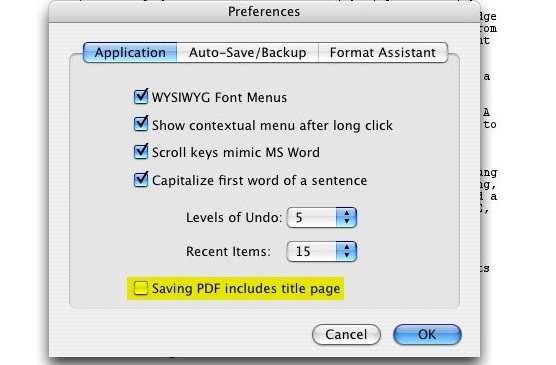
In my tests with 7.1.3, the .pdf will also include the title page even if that window is still openHowever, if you haven’t closed or saved the title page, it won’t be updated until you do. — provided you have a certain checkbox checked in “Preferences.”

checkboxYes, I’ll admit that I didn’t read the manual with version 7 of Final Draft. But this is a pretty questionable place to put this checkbox. After all, sometimes you’ll want to include the title page, sometimes you won’t. Does it really make sense to have this be an application-wide preference, housed in a panel that has nothing to do with printing, saving or the specific document you’re working on? It’s pretty much the last place I’d think to look for it.

What’s more, at least on the Mac, Final Draft is using the built-in .pdf facility of OS X. It’s basically just printing to a file.You can test this by choosing a two-page layout in the Print dialog box. The next time you choose to Save as PDF, you’ll get facing pages. Since it seems to be using the standard print architecture, you’d think that choosing the “Print Title Page” option in the Print dialog box would have some effect. It doesn’t. And that’s why it’s frustrating.On the Mac, you always have the option of using the “Save as PDF” function built into the Print dialog box. But I’ve never had any luck getting that to include a title page. My guess is that Final Draft treats the title page as a separate document. When you print to a traditional printer, you’ll notice a one-page progress dialog flash for a second. I think Final Draft is kicking out the title page as a distinct job. It never incorporates it into the “real” script.

Whenever I complain about Final Draft, I get a nice note from the developers asking me to help out with the next version, and a few emails from companies working on competing applications. So let me make it clear where I stand. Despite its annoyances, I end up using Final Draft because what it gets right generally outweighs what it gets wrong. There’s certainly some inertia on my part, but given a better alternative, I’d switch in a heartbeat. The shipping versions of Screenwriter, Montage and Celtx aren’t better, particularly when it comes to revisions.

I’m hoping the upcoming Screenwriter 6 gives Final Draft some real competition, because that’s what’s lacking. When we were cutting The Nines, I realized that editing software has benefitted tremendously from the battle between Avid and Apple, with new features, better interfaces, and dramatically lower prices. I started out a Final Cut Pro man, while my editor was firmly Avid. We had the luxury of both being right. Both systems are terrific, and I think that’s largely because of the competition.

« Previous Page
Next Page »

Primary Sidebar

Newsletter

Inneresting Logo A Quote-Unquote Newsletter about Writing
Read Now

Explore

Projects

  • Aladdin (1)
  • Arlo Finch (27)
  • Big Fish (88)
  • Birdigo (2)
  • Charlie (39)
  • Charlie's Angels (16)
  • Chosen (2)
  • Corpse Bride (9)
  • Dead Projects (18)
  • Frankenweenie (10)
  • Go (29)
  • Karateka (4)
  • Monsterpocalypse (3)
  • One Hit Kill (6)
  • Ops (6)
  • Preacher (2)
  • Prince of Persia (13)
  • Shazam (6)
  • Snake People (6)
  • Tarzan (5)
  • The Nines (118)
  • The Remnants (12)
  • The Variant (22)

Apps

  • Bronson (14)
  • FDX Reader (11)
  • Fountain (32)
  • Highland (75)
  • Less IMDb (4)
  • Weekend Read (64)

Recommended Reading

  • First Person (87)
  • Geek Alert (151)
  • WGA (162)
  • Workspace (19)

Screenwriting Q&A

  • Adaptation (65)
  • Directors (90)
  • Education (49)
  • Film Industry (489)
  • Formatting (128)
  • Genres (89)
  • Glossary (6)
  • Pitches (29)
  • Producers (59)
  • Psych 101 (118)
  • Rights and Copyright (96)
  • So-Called Experts (47)
  • Story and Plot (170)
  • Television (165)
  • Treatments (21)
  • Words on the page (238)
  • Writing Process (177)

More screenwriting Q&A at screenwriting.io

© 2026 John August — All Rights Reserved.