• Skip to primary navigation
  • Skip to main content
  • Skip to primary sidebar

John August

  • Arlo Finch
  • Scriptnotes
  • Library
  • Store
  • About

flagged

Preacher

January 21, 2009 Adaptation, Preacher, Projects

Other places are suddenly reporting it, so I might as well confirm the news: I’m writing a big-screen version of Preacher,
an adaptation of the acclaimed graphic novel series by Garth Ennis and Steve Dillon. Sam Mendes is attached to direct. Neal Moritz is producing for Sony Pictures.

To answer your first four questions: there’s no release date, no cast, no locations, no nothing. I’m writing a script which could become a movie if everything lines up correctly. So here’s hoping. It’s a terrific project that I’m excited to be writing.
Cablevision and the infinite TiVo

January 12, 2009 Film Industry, Television, WGA

This morning, the Supreme Court asked the Justice Department to weigh in on a service Cablevision hopes to introduce. It’s an issue every screenwriter (or TV viewer) should be watching closely, because it could have a huge impact on the entertainment industry.

The case is called Cable News Network vs. CSC Holdings. The case made it to the Supreme Court after a U.S. Appeals court reversed a lower court’s decision. The case will probably end up back at the Supreme Court this fall.

The issue is deceptively straightforward: Cablevision wants to offer its customers a “remote storage digital video recorder.”

At first blush, this seems pretty unobjectionable. Under current U.S. law, it’s legal for a consumer to record television programs for later viewing. This is considered time-shifting, and was first made possible by the VCR. Conventional DVRs are high-tech cousins to VCRs, with a hard drive replacing the videotape. In the U.S., many cable and satellite companies provide boxes that include DVR functionality, generally for an additionally monthly fee.

Cablevision wants to offer DVR as a service instead of a device. Rather than recording 30 Rock on the box attached to your TV, the show will be recorded at Cablevision’s headquarters. Then, when you want to watch it, Cablevision will send the show to your television. If it works right, it should feel just like a normal DVR. Only without the cost of the DVR.

If Cablevision offers this service, I think it will be very successful. Less hardware means less things to break, and the service could presumably send a show to any TV in the house. (Some conventional DVRs can do that, but it’s often a hassle.) Plus, storage scales very well. Cablevision could offer a user much more recording space than a conventional DVR.

In fact, Cablevision could offer unlimited storage. And that’s where it gets dangerous.

Say Mary Jones sets her Cablevision RS-DVR to record 30 Rock. So does Bob Smith. Cablevision only needs to record it once. They can send the bits to Mary or Bob whenever one of them asks for it. ((Alternately, Cablevision could partition drives so that every customer has a certain number of gigabtytes (terabytes? petabytes?) of storage, and record each show in that partition just like a conventional DVR. But this is tremendously inefficient, and nearly impossible to audit.))

Given that Cablevision has more than four million customers, it’s a fair bet that at least one of their customers would be interested in any given show, so it makes sense for Cablevision to record and catalog every channel it distributes, 24/7/365.

Conventional DVRs only record what you ask them to record, with some modifiers, such as “new episodes of The Simpsons,” or “movies with Steven Seagal.” So for Cablevision’s service to work like a conventional DVR, it should only offer you programs you specifically chose to record. No fair waking up Friday and asking for last night’s The Office.

But wait. Cablevision is already recording every show. Why don’t they just offer a “Record Everything” option?

Once they offer you the choice to record everything, you suddenly have the ability to watch any show broadcast since you signed on to the service. This is transformative, a Wayback Machine for television.

It would also destroy television as we know it.

Here’s where I put in my obligatory, “I’m no Luddite” disclaimer. I was the first person I know to have a DVR (the original ReplayTV), and consider myself highly familiar with the legal and less-legal options for watching video on computers and TV. As a consumer and geek, I would love to have a service like Cablevision’s. But I don’t think Cablevision should be allowed to do it their way.

Cablevision’s RS-DVR is back-door video-on-demand. They’re trying to offer the networks’ output to their customers on their own temrs, without paying any additional fees.

But it’s worse than that.

A service like Cablevision’s makes reruns absurd. Why would anyone watch a rerun of Desperate Housewives when it’s always been available for free on the RS-DVR? And it’s not just television shows that are affected. In a Cablevision universe, a feature film loses all its television value the first time it’s shown. Why would HBO want to show Slumdog Millionaire more than once, considering everyone who could ever want to see it would have it available for free in perpetuity via Cablevision?

For that matter, why buy a DVD, or spend $9.99 to buy a movie through iTunes when that same film is sitting on your (virtual) DVR?

Without reruns and ancillary markets (like DVDs and iTunes), there are no residuals, so that’s obviously a concern for writers.

But it’s worse than that.

Without reruns and ancillary markets, there are no feature films and no scripted television. Outside of lower-cost reality programming, it is simply not profitable to make a movie or TV show that can only be shown theatrically, or once on television. Very, very few movies are profitable in their theatrical release. Most make their money on video and television, which would largely be irrelevant with services like Cablevision’s. A movie studio could decide to never permit their films be shown on any station carried by Cablevision. For television, that’s not an option.

So what should happen?

The Supreme Court should rule that copyright holders (the studios, in this case) retain the right to profit from the distribution of their work for a given period of time. Yes, copyright law is frustrating, and corporations routinely abuse their authority through DMCA and endless extensions. Generally, the studios are the bad guys, so it’s hard to be on their side. But if they’re not getting paid, nobody’s getting paid. And if nobody’s getting paid, there is no industry.

The studios should then negotiate with Cablevision and all the other cable and satellite providers to roll out a system that calls this service what it really is: video-on-demand. A consumer should be able to watch (or record in their home) an episode when it’s first broadcast, or get it through VOD for a fee. That fee should be low, cheap enough to make it an appealing alternative to piracy.

And studios should continue to support Hulu, iTunes and all the other competing services. Television will change, and it will probably resemble something like what Cablevision is trying to do. But it needs to keep paying the people who make the shows, both corporations and individuals. Or there’s no television left.

‘Wherefore’ does not mean where

January 7, 2009 Rant, Words on the page

A headline in today’s Hollywood Reporter:

Wherefore art thou, ‘Juliet’? It’s at Uni.

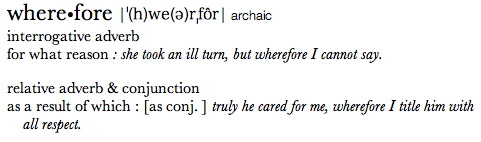
The story is about a book set up at Universal. The headline is incredibly frustrating. Wherefore isn’t a fancy way of saying where. It’s a fancy way of saying why or therefore:

wherefore

As longtime readers will know, I’m generally not Mr. Stickler when it comes to word usage. I’ve gotten several terms wrong over the years, including “begging the question.” I fully understand that words change meaning over time as languages grow and adapt. English is particularly nimble in this regard, and that’s a good thing. English is not Latin.

So why my beef with “wherefore?”

Wherefore isn’t a modern word in any sense. Its only use is in lame callbacks to the balcony scene in Shakespeare’s Romeo and Juliet. So every time it’s misused as a synonym for “where,” the writer reveals a fundamental misunderstanding of the iconic scene.

JULIET

O Romeo, Romeo, wherefore art thou Romeo? Deny thy father and refuse thy name; or if thou wilt not, be but sworn my love and I’ll no longer be a Capulet.

ROMEO

(aside)

Shall I hear more, or shall I speak at this?

JULIET

‘Tis but thy name that is my enemy: thou art thyself, though not a Montague. What’s Montague? It is nor hand nor foot, nor arm nor face, nor any other part belonging to a man. O be some other name!

She’s not asking where he is. She’s asking why this hot guy she’s in love with has to be Romeo, a Montague, member of the rival gang. If we were writing that line now, it would be something like:

JULIET

O Romeo, Romeo, why must thou be Romeo?

But the where/wherefore mistake is so fundamentally entrenched that we now expect Juliet to be straining at the edge of the balcony, looking out in the night with hopes of seeing her true love. It sets up the idea that she knows he’s coming, that a rendezvous has been set. It changes the scene in fundamental ways.

I’m a realist: this fight will never be won. I’m certain I’ll go to my grave having just read a headline on the Mentalinet which makes the exact same mistake. I’m calling it out simply in hopes that some of my readers might join the fraternity of people who know that it’s wrong, and will bristle when they see it.

iMovie 09: Almost certainly maddening

January 6, 2009 Rant, Video

Among the products Apple announced today is iMovie 09, an update to their entry-level video editor that I currently find completely unusable. They have demo videos up showing some of the new features, which range from very helpful (stabilization) to fairly gimmicky (the animated maps).

What’s most clear, however, is that they’re sticking with the bizarre and unfortunate editing interface.

Yes, I have the curse of knowledge: I know how an editing system is “supposed to” work, as it does in Final Cut, Avid and to some degree, the original iMovie. But I’m always game for a new and better idea, particularly if it makes heretofore complicated things easier for newcomers to understand. iMovie is supposed to let ordinary Mac users cut together simple videos. I get that.

But worse than being unlike real editing systems, iMovie is unlike any normal Mac application. Take a look at how Precision Editor works in the new iMovie.

You move the mouse along the gray bar, or inside one clip or inside another clip. You’re not clicking or dragging; you’re just floating. Unlike every other Mac application in which a click selects something (or moves the insertion point), a click in iMovie is a cut — or more precisely, it adjusts the out point of the top clip. A click in the lower clip adjusts its in point. There’s feedback, in the sense that the video suddenly jumps, but it’s not immediately clear what’s changed, or what would be undone if you hit Undo.

Throughout iMovie, there’s a lot of WTF? Important things are hidden in pop-up menus, often attached to clips. I understand and support the idea of attaching actions to objects, but how is Precision Editor an action? It’s a noun, not a verb, and opens as a separate viewer.

The timeline is the other major frustration. Anyone who has ever watched YouTube understands that in video, time moves from left to right. If you drag the playhead — the little circle — you’re moving forward and backward in the clip. But not in iMovie. In iMovie, time wraps like text, left to right then up and down. Apple has created a new and inferior grammar for no good reason.

Fortunately, Final Cut Express is only $169 on Amazon. It can import iMovie projects, and you’ll definitely want to. While it seems more complex at the start (more menu items), it consistently rewards your expectations about how video and Macs are supposed to work.

« Previous Page
Next Page »

Primary Sidebar

Newsletter

Inneresting Logo A Quote-Unquote Newsletter about Writing
Read Now

Explore

Projects

  • Aladdin (1)
  • Arlo Finch (27)
  • Big Fish (88)
  • Birdigo (2)
  • Charlie (39)
  • Charlie's Angels (16)
  • Chosen (2)
  • Corpse Bride (9)
  • Dead Projects (18)
  • Frankenweenie (10)
  • Go (29)
  • Karateka (4)
  • Monsterpocalypse (3)
  • One Hit Kill (6)
  • Ops (6)
  • Preacher (2)
  • Prince of Persia (13)
  • Shazam (6)
  • Snake People (6)
  • Tarzan (5)
  • The Nines (118)
  • The Remnants (12)
  • The Variant (22)

Apps

  • Bronson (14)
  • FDX Reader (11)
  • Fountain (32)
  • Highland (75)
  • Less IMDb (4)
  • Weekend Read (64)

Recommended Reading

  • First Person (87)
  • Geek Alert (151)
  • WGA (162)
  • Workspace (19)

Screenwriting Q&A

  • Adaptation (65)
  • Directors (90)
  • Education (49)
  • Film Industry (489)
  • Formatting (128)
  • Genres (89)
  • Glossary (6)
  • Pitches (29)
  • Producers (59)
  • Psych 101 (118)
  • Rights and Copyright (96)
  • So-Called Experts (47)
  • Story and Plot (170)
  • Television (165)
  • Treatments (21)
  • Words on the page (238)
  • Writing Process (177)

More screenwriting Q&A at screenwriting.io

© 2026 John August — All Rights Reserved.