• Skip to primary navigation
  • Skip to main content
  • Skip to primary sidebar

John August

  • Arlo Finch
  • Scriptnotes
  • Library
  • Store
  • About

flagged

Spelunking the Kindle market

June 2, 2009 Books, Follow Up, Projects, The Variant

How many books does Amazon sell on Kindle each day? How closely does it follow the 80/20 rule, in which a few top sellers account for a huge percentage of total sales? Is there a classic long tail — and is it even worth being on it?

Amazon is incredibly opaque with the details, even when you’re publishing on their system.

The day after its debut, my story The Variant briefly reached #18 on the Kindle bestsellers list. While that was exciting, I still don’t know exactly what it means.

Like other Amazon statistics, it seems to get recalculated hourly, but there’s no indication whether it’s a pure number of sales that hour (which would make for very erratic swings) or some sort of sliding average over time. Based on how it’s handled for physical books, it’s probably a combination:

Only the top 10,000 books are updated every hour and the ranking does not depend upon the actual number of books sold, but rather, on a comparison against the sales figures of the other 9,999 books within that same hour. Simultaneously, a trending calculation is applied to arrive at a computerized sales trajectory. So, hypothetically, a book that held a ranking of 2,000 at 2pm and 3,000 at 3pm, might hold a 4,000 ranking at 4pm, even if it actually sold MORE books between 3-4 than it did between 2-3.

All I really know is that the day I hit #18, I sold about 500 copies. So my hunch is that titles around that spot in the list (say, 15 to 25) might sell around 500 copies per day. That is, they probably sell 500 as opposed to 50 or 5,000. I’m only try to get a sense of how many zeroes are involved.

Stephenie Meyer is rich
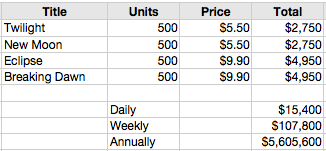
twilight salesAs it happens, all four of Stephenie Meyer’s Twilight books fall into this range, and have been here for quite a while. They’re priced at $5.50 (for the first two) and $9.99 (for the second two).

If each is selling around 500 copies each day, that means the four of them are generating $15,400 per day, or $107,800 per week. Granted, that 500 is a guess, but it’s probably a number with two zeroes.

We don’t know the split between Meyer, her publisher and Amazon — it’s possible that the retailer is deliberately taking a loss on the Twilight books in order to woo Kindle buyers — but it’s clearly a nice bit of money with no paper, shipping or inventory costs. ((Yes, clearly Meyer and her publisher are making great money off the printed versions of the books, which probably account for 95%+ of sales. But the Kindle sales aren’t insignificant.))

Worst bestsellers

Unlike the iTunes App Store, Amazon doesn’t distinguish between free and paid content on their Kindle bestseller list. In fact, 19 out of the top 50 books are free. There’s nothing wrong with free, but it’s a semantic and tactical mistake to include them on a “bestseller” list.

The current system keeps Serial in the #1 slot for no real reason other than being free. I envision many brand-new Kindle owners powering up their devices for the first time, and wanting to download a book to test out the service.

Where do they find a book? The bestseller list. And look! The bestseller is free!

This isn’t a knock on Serial or its authors. In fact, one of the writers has a useful post of his experiences with publishing on the Kindle. He notes that…

The freebies are being downloaded and read. There isn’t money changing hands, but branding and name-recognition — two essentials for every successful author — are happening.

Free should always be a choice. But I’d argue the free preview feature on every Kindle title is designed for exactly this sort of try-before-you-buy. If after forty pages you haven’t convinced a reader to pony up at least 99 cents, I don’t know that “branding” is really the issue.

By letting bestsellers be free, Amazon also makes it easy to game the system. The Cook’s Illustrated How-to-Cook Library got into the top 20 as a free book, then jacked up the price to $9.99. ((Indeed, many of the reviews are some variety of “I can’t believe it’s free!”)) Letting author-publishers change the price is smart; letting them monkey with your bestseller list is dumb.

I’d propose Amazon keep the zero-price option, but move free titles to their own list. After all, nothing else in Amazon’s ranking system has to compete with free.

But until they make that change, I’m considering organizing an online flash mob for The Variant. For one predetermined hour, I’ll set the price to zero and invite everyone I know to “buy” it. I’m curious how high I could get on the list.

Overall impressions

As I noted in my earlier post about formatting for Kindle, getting a book published on Amazon’s platform is surprisingly straightforward. But I really hoped for better reporting. Should one raise or lower the price? Do ads work? Do reviews help?

Without better information, it’s tough to make any of these decisions.

The Kindle isn’t currently the (mythical?) indie goldmine the iTunes App Store has become. Despite Amazon’s first-mover advantage, there is clearly opportunity for competitors, like Google, Apple or Sony.

More pressingly, there’s a need for better international ebook distribution. The Kindle is U.S.-only, likely due to do rights issues. A European solution would be great; a global version would be better. My e-Junkie/PayPal system for pdfs and ePubs is just barely workable. If I could graft it onto a trusted store like Amazon or iTunes, everyone would feel more comfortable.

Welcome, NY Times readers

June 1, 2009 Follow Up, Projects, The Variant

The NY Times has an article today about The Variant, the Kindle, and my Twitter followers.

Mr. August, who wrote it for possible inclusion in an anthology of work by well-known screenwriters, tested the story with about two dozen of the 6,000 or so people who follow him on Twitter. They persuaded him to change the first sentence, trim some paragraphs and shorten the title from “The Egyptian Variant.”

You can read the whole article here.

One correction: In the interview, I said that I’d earned enough to buy “about four Kindles.” But I misremembered how much they cost: $359.

As of Friday, I’d made enough to buy 2.73 Kindles.

Mapping The Variant

May 29, 2009 Geek Alert, Hive Mind, Projects, The Variant

I’ll release sales info for The Variant on Monday, but I wanted to offer up one bit this afternoon in case data-miners were inspired to do something with it over the weekend.

Sales of the Kindle version are pretty opaque; I only know totals. But the downloadable versions (pdf and ePub) give me names and shipping addresses. I was curious how many readers were international, particularly since Amazon’s Kindle is U.S.-only. (The answer: 37%.)

There may be other interesting things to explore and/or mash up, so I’ve stripped out identifying information and uploaded it in Excel and .csv formats. The file shows only transaction date/time, initials, city, state, postal code and country. ((Originally, I was going to include first name, which adds a nice degree of personality. But in a couple of cases, I worried that it was too individualizing, particularly with unusual names in smaller towns.))

If you do something interesting with the data, leave a link.

Kurtzman and Orci on Trek and writing together

May 27, 2009 Adaptation, Film Industry, Story and Plot, Writing Process

My assistant Matt went to the Writers Guild Foundation event in Beverly Hills last night featuring Roberto Orci and Alex Kurtzman, and took notes for readers who couldn’t make it.

Take it, Matt.

The Writers Guild Foundation hosted and coordinated the ticketed event, which was ably moderated by Paul Attanasio.

Working first as assistants for Sam Raimi on his Xena and Hercules series, the then twenty-three year old Orci and Kurtzman broke in early but struggled to get past the stigma of the fantasy genre until they met J.J. Abrams. Abrams appreciated their ability to give “A treatment to B material” and brought them onto Alias. The success of that relationship lead to work on Abrams’s Mission Impossible 3, Fringe (which they co-created), and Star Trek.

Collaborations with Michael Bay include The Island, Transformers and its upcoming sequel. They produced Eagle Eye (with Steven Spielberg) and the Sandra Bullock/Ryan Reynolds comedy The Proposal.

The ninety-minute talk to a theater nearly full of writers and a sprinkling of suits, notably Stacey Snider and her posse from Dreamworks, covered collaboration, craft and the creative process.

The partners also defined a new-to-me screenwriting term: the structurefuck.

But most in attendance were there to ask (and gush) about the duo’s latest hit, which elicited some story lessons worth sharing.

Nero

Nero’s storyline in Star Trek was much longer in both the script and the shoot. Much was left on the edit room floor. Nero was tortured by Klingons, had to wait out twenty-five years somewhere and spit out bitter monologues, etc. All but one shot was cut from the final version. They found in post that anytime they took the story away from the heroes it sagged. Nero served only as a force to bring everyone together. The more screentime spent away from Kirk and Spock, the more defocused the movie became so they reeled him in significantly in post.

Lesson: Sequels are for villains; origin stories are for heroes. Heroes determine structure. In further support, Alex Kurtzman offered the example of Iron Man, which he said was all about Robert Downey Jr. and the suit he forges. As for what Jeff Bridges was up to? No idea. Didn’t matter. Good as he may be on screen, we’re really just waiting to see Downey in the suit again. (Not much Vader in Star Wars Episode IV compared to The Empire Strikes Back come to think of it.)

Kirk n’ Spock

Kurtzman and Orci researched heavily, studying partnerships – Lennon and McCartney, Billy Wilder and I.A. Diamond, for example — to explore why the core relationship of Kirk and Spock worked so well creatively for the series. Like Lennon and McCartney, both Spock and Kirk lose a parent. It’s something fundamental and shared that allows for a connection even with the contention and heated power struggle. Halfway through writing the first draft, Kurtzman and Orci discovered their own relationship as friends and writing partners had infused itself into the Kirk and Spock dynamic.

Destroying Vulcan

The writers felt they had to tie in the current climate and break from the past in a visually and emotionally dramatic way. Destroying Vulcan felt to Orci like seeing 9/11 and the Holocaust all at once. While that was said in jest, I think, the sentiment and desire to break this movie out from the era of the series was genuine. Something radical needed to happen.

Why does Spock get the girl?

It was a visual way to show Spock’s choice: his human/mother’s side had won out over his Vulcan side. It compressed Spock’s arc and made the writers love Uhura more for making the unexpected choice while messing with audience expectations.

Finally, for those interested in process, it took five months to break the story and two-and-a-half more for them to write it.

Advice for the aspiring

Mop floors, do anything you can to get inside and “reveal a surprise.” At age 23, the partners fetched coffee for the producers of Xena and Hercules. They wrote a spec episode and had it ready when the time was right. Wasn’t quite good enough but they were given an episode to play with and when the showrunner left, they were given the helm. They were twenty-four.

Kurtzman noted that P.T. Anderson was a PA smoking outside a set and started chatting with Philip Baker Hall. They hit it off, which lead to Hard Eight. In short, move to Hollywood, look for your moment and be ready when luck strikes.

Once you’re working, see studios as clients not villains out to ruin your art. Learn to love the process of rewriting. Be married to the sprit of words but not the words themselves. Often the studios have forced them to get beyond the “kernel” of the story in the first draft to explore new avenues and ultimately improve the story. (Notably, there were no horror exec stories typical of writers’ panels.)

How does their partnership work?

They’d met in high school but it wasn’t until after college when they began editing each other’s love letters that their partnership began. Neither had any idea how to write, but they were able to expose embarrassing parts of themselves without worrying about being judged or “thrown in a locker.” Each has their strength – Kurtzman at creating moments and Orci on the macro story elements.

They’ve been writing partners for 17 years. They credit that success to treating their relationship with the care of a marriage and applying some of the same addages: Don’t go to bed angry. Make sure one side doesn’t feel like they’re doing all the heavy lifting. Respect strengths and weaknesses.

UPDATE

To structurefuck is to disrupt a linear narrative by playing a scene twice in order to achieve a surprise reveal upon second viewing of that scene. The idea being to plant information in the audience’s heads early, when they’re likely to accept it as truth. When the scene plays again later, you alter (or “fuck with”) the perception of fact and force the audience to reevaluate the story by ripping off a mask or showing that the gun shot a blank or that the heroine actually dodged the bullet and didn’t fall to her death but was hanging naked by a bed sheet caught on a piece of glass.

« Previous Page
Next Page »

Primary Sidebar

Newsletter

Inneresting Logo A Quote-Unquote Newsletter about Writing
Read Now

Explore

Projects

  • Aladdin (1)
  • Arlo Finch (27)
  • Big Fish (88)
  • Birdigo (2)
  • Charlie (39)
  • Charlie's Angels (16)
  • Chosen (2)
  • Corpse Bride (9)
  • Dead Projects (18)
  • Frankenweenie (10)
  • Go (29)
  • Karateka (4)
  • Monsterpocalypse (3)
  • One Hit Kill (6)
  • Ops (6)
  • Preacher (2)
  • Prince of Persia (13)
  • Shazam (6)
  • Snake People (6)
  • Tarzan (5)
  • The Nines (118)
  • The Remnants (12)
  • The Variant (22)

Apps

  • Bronson (14)
  • FDX Reader (11)
  • Fountain (32)
  • Highland (75)
  • Less IMDb (4)
  • Weekend Read (64)

Recommended Reading

  • First Person (87)
  • Geek Alert (151)
  • WGA (162)
  • Workspace (19)

Screenwriting Q&A

  • Adaptation (65)
  • Directors (90)
  • Education (49)
  • Film Industry (489)
  • Formatting (128)
  • Genres (89)
  • Glossary (6)
  • Pitches (29)
  • Producers (59)
  • Psych 101 (118)
  • Rights and Copyright (96)
  • So-Called Experts (47)
  • Story and Plot (170)
  • Television (165)
  • Treatments (21)
  • Words on the page (238)
  • Writing Process (177)

More screenwriting Q&A at screenwriting.io

© 2026 John August — All Rights Reserved.