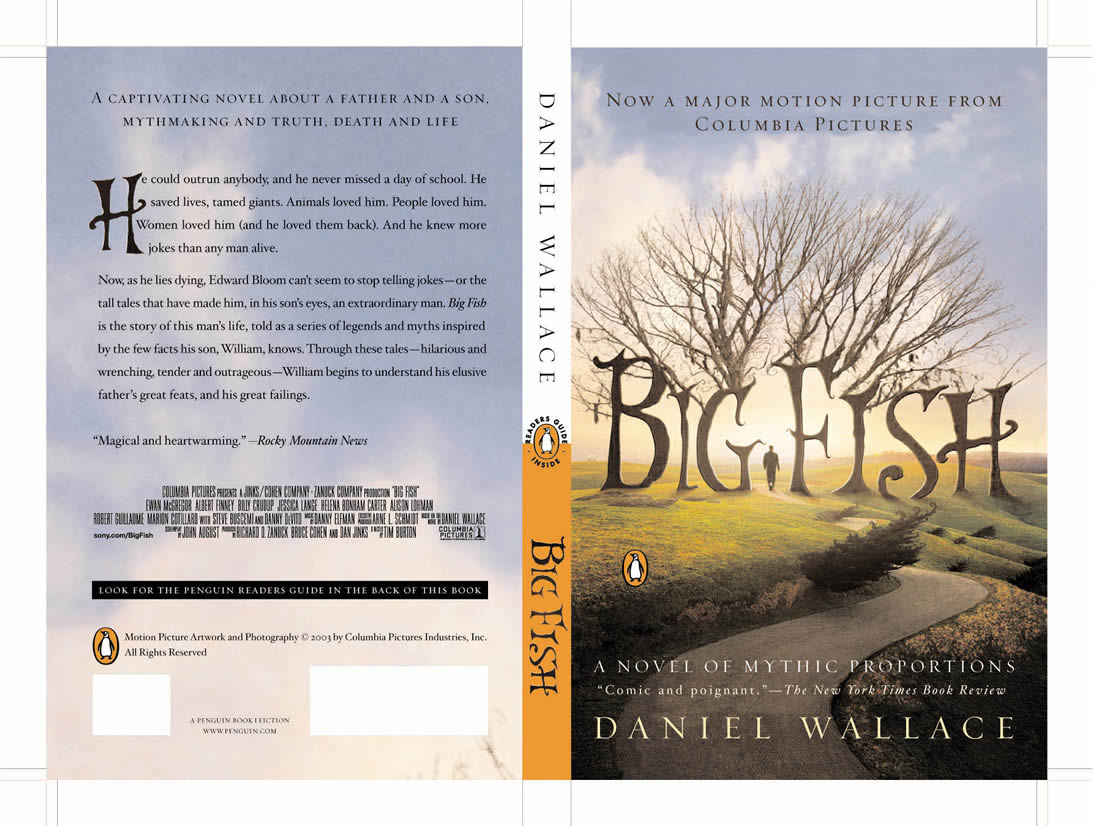
Penguin is issuing a special paperback version of Daniel Wallace’s “Big Fish” with the new cover artwork. (You can see the bigger version of it here.) The cover is essentially the same as the upcoming one-sheet poster.
Penguin is issuing a special paperback version of Daniel Wallace’s “Big Fish” with the new cover artwork. (You can see the bigger version of it here.) The cover is essentially the same as the upcoming one-sheet poster.
My question involves networking.
I’m at the level where most of my trusted, objective readers agree I have a
legitimate shot, but I live far from Hollywood. Time and again I hear how important
it is to network to get one’s work in the hands of the industry players, but
I don’t have access, being so far away (DC). Do you have any good ideas about
how to make such connections apart from simply relocating to LA?
–Robert Remy
Unfortunately, I don’t have any brilliant suggestions. Outside of a few screenwriter-specific
competitions, such as the Nichols Fellowship or the Austin Film Festival’s
screenwriting awards, the kind of networking you’re talking about relies on
some face-to-face interaction, and that’s pretty much impossible if you’re
in the wrong city.
If you’re trying to make Hollywood movies, this may be the time to move to
LA. If it’s independent films you aspire to, you may find just as many opportunities
in New York, Austin, Seattle, San Francisco or other metropolitan cities. The
Baltimore/D.C. area does have a film community (we used a crew based there
for my television show), so it’s even possible you could make a movie right
where you live.
But I suspect it’s big movies you’re talking about, and big movies require
big money, which pretty much means LA. Some of the bigger screenwriters live
outside of Southern California, but most of them started their careers here
or in New York. If you’ve done everything you can in D.C., consider whether
you feel ready to make the move.
 I’ve been busy
writing a script, and I have the whole idea mapped out in my head. But for
some reason, my writing doesn’t seem to flow. I struggle to get from one point
to the next. Is this normal? If I go back through the script
again after I’ve jotted down my rough dialogue, will it flow then? Do you do
a quick rough draft before you get into the real writing?
–Bob
 Well, are you a good writer? I ask because it sounds like this is your first
screenplay, and there’s every chance you’re a terrible writer. It’s my experience
that most people in Los Angeles feel like they could write a good movie. The
reason why most of them aren’t successful screenwriters is that they’re really
aren’t good writers.
It’s easy to see how they get mislead: If you read a script, you’d think any
monkey could do it. Most monkeys can’t.
I’m not picking on you, honestly. I hope you’re a terrific writer who’s just
realizing how incredibly difficult screenwriting can be. It’s great when the
writing flows, but most of the time, it doesn’t. You work your ass off to get
to the end of a sentence, then start another. You end up deleting scenes that
took you four hours to write, then rewriting entire scripts based on problems
you should have spotted before you even started writing.
It’s not grueling, back-breaking labor like building a road, but it is labor.
It’s exhausting. And while Final Draft might make formatting your script easier,
it’s still just as hard to write.
Often, when I approach a scene, I will do a quick rough draft, by which I
mean all of a scene’s crucial dialogue lines scribbled on the back of an envelope.
It’s mostly just to get the shape of the scene, but it is "real" writing
just as much as the endless tweaking that will inevitably be entailed.
Above all this, I would stress: Don’t wait for flow. It might come; it might
not. But it’s your job to keep writing anyway.
I am writing
a script that could have either a male or female lead. I need to make the decision
because it will either be the mother or father of the central figure. It is
a futuristic action script. I have outlined it and completed drafts both ways.
If all things are equal, is a Male or Female action lead easier to sell?
–David
Male. Which is stupid and wrong.
I’m currently working on an action script that has a male lead. Since I haven’t
pitched the story to anyone, I could easily change him to a her. I’ve thought
about it many times: it would be an interesting if somewhat arbitrary change.
Yet in the back of my mind, I know that having a female lead would cap the
budget at a lower level than the male equivalent, and since the nature of
the movie is hellaciously expensive, I worry it might not get made at all.
So he stays a man, and the stupid and wrong Hollywood system is perpetuated.
Although, in my defense, I wrote both CHARLIE’S ANGELS movies, so I might get
off the hook.