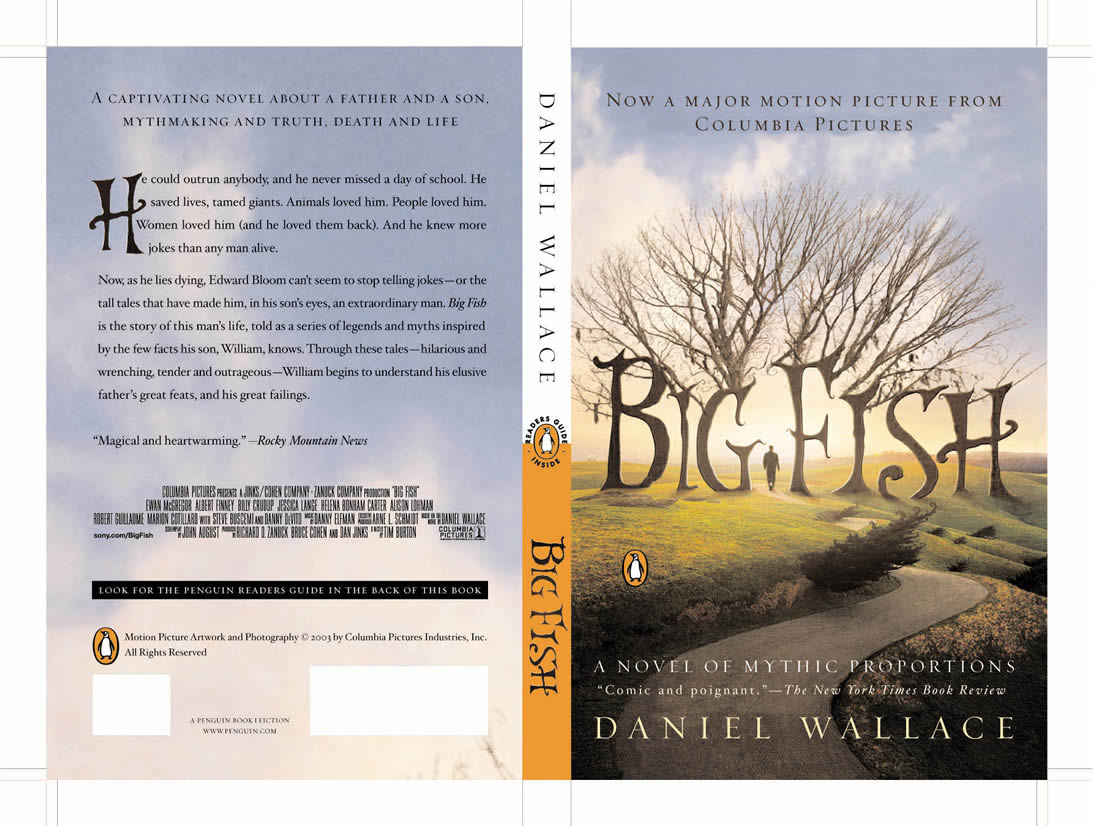
Penguin is issuing a special paperback version of Daniel Wallace’s “Big Fish” with the new cover artwork. (You can see the bigger version of it here.) The cover is essentially the same as the upcoming one-sheet poster.
Penguin is issuing a special paperback version of Daniel Wallace’s “Big Fish” with the new cover artwork. (You can see the bigger version of it here.) The cover is essentially the same as the upcoming one-sheet poster.
 I’m a 20-year old university student from London, currently studying film and creative writing at Buckinghamshire University. I’ve got a few questions that I would really appreciate you answering:
–Scott Macinnes
 (Scott actually had five questions, but other columns probably answered the other three. So let’s address the England question.)
While your assessment of the British film industry is funny, I also think it’s a little unfair. Considering its size, the U.K. has a pretty substantial film business, with a wider variety of genres than you’d admit. True, if you want non-James Bond big summer popcorn movies, you’re out of luck. But you can find good examples of almost every other kind of movie.
Unless you’re dying to leave England, my advice is to stay put and see what you can learn there, at least for a year or two. It’s much easier to make the transition to Hollywood if you have something to show for yourself.
For instance, Christopher Nolan went from the tiny-budgeted FOLLOWING (shot in the UK), to the small-budgeted MEMENTO (shot in the U.S.) to the studio feature INSOMNIA.
But if you’re sure it’s L.A.-or-nothing, then by all means come. But make sure you’re going to be able to get some kind of work or educational visa that will let you stay in the country for a few years.
Your advice of 110 to 120 pages for script length agrees with what others
say, but upon sampling a large number of films I find their lengths usually
fall between 85 and 115 minutes, including five minutes of credits. At a minute
per page, something doesn’t click. Do producers expect 15 extra pages because
they feel scripts usually have fat that needs trimming? Or perhaps producers
know that during script development, writers find it less distressing to eliminate
scenes and hope no one notices, rather than turn them into something far removed
from the original vision. Just a thought.
–Ryall
It’s true that a lot of movies clock in at 100 minutes or less, and that the
one-minute-per-page rule of thumb really depends on whose thumbs are doing
the measuring. Moviemaking is more art than science, so it never holds up to
much mathematical scrutiny. Whatever the reason for the discrepancy, I assure you
it doesn’t come from producers trying to spare writers’ feelings.
One variable that really effects running time is pacing. GO was about 102
minutes long. The script was 126 pages, and almost nothing was dropped. The
movie never dawdled, however, which is how it got the story told so quickly.
Even movies that end up at 85 minutes probably began as screenplays in the
110 to 120 page range. In the course of production, or post-production, scenes often get cut. Either they are never filmed, or they end up on the cutting
room floor, just waiting for the DVD version.
Since scenes are going to get cut, why not just start out with a shorter script?
It’s not a bad question. In television, where programs have to be delivered
to the network at a precise running time (at ABC, it is 42 minutes, 20 seconds
for a "one-hour" drama), it is obviously preferable to avoid shooting
scenes that couldn’t possibly fit into the allotted time.
In terms of features, however, anything shorter than 100 pages "feels" too
short. It’s literally just not enough pages in your hand. And if you go much
beyond 120 pages, people get nervous. Even if it’s great, it feels long.
I am writing
a script that could have either a male or female lead. I need to make the decision
because it will either be the mother or father of the central figure. It is
a futuristic action script. I have outlined it and completed drafts both ways.
If all things are equal, is a Male or Female action lead easier to sell?
–David
Male. Which is stupid and wrong.
I’m currently working on an action script that has a male lead. Since I haven’t
pitched the story to anyone, I could easily change him to a her. I’ve thought
about it many times: it would be an interesting if somewhat arbitrary change.
Yet in the back of my mind, I know that having a female lead would cap the
budget at a lower level than the male equivalent, and since the nature of
the movie is hellaciously expensive, I worry it might not get made at all.
So he stays a man, and the stupid and wrong Hollywood system is perpetuated.
Although, in my defense, I wrote both CHARLIE’S ANGELS movies, so I might get
off the hook.