• Skip to primary navigation
  • Skip to main content
  • Skip to primary sidebar

John August

  • Arlo Finch
  • Scriptnotes
  • Library
  • Store
  • About

fixed

Race and the screenwriter

January 3, 2006 Rant

Craig Mazin and Alex Epstein both recently tackled a topic that was on my to-blog list. Yes, I keep a list of things I intend to blog. And yes, I tend to just write whatever strikes me at the moment anyway. But since Alex and Craig got to it first, I might as well say what I was going to say.

At issue is whether it’s a good idea for the screenwriter to specify ethnicities for various characters. Alex believes in doing the “diversity pass” to keep his script from being lily-white. Craig feels this is absurd and racist.

Craig is wrong.

But not for the reasons you’d expect. While Craig and I tend to be on different wavelengths politically, he tends to come down on the side of common sense. And I think there’s a very practical matter that’s being overlooked.

Unless it’s important for understanding a story point, I rarely specify a race for a character. But that’s not to say I won’t give some strong hints. I will often make the lieutenant GONZALEZ rather than GOODMAN. The internist is more likely to end up DR. CHO than DR. CHASE. The schoolteacher will be PATEL rather than PETERS.

Is it liberal guilt? No. It’s readability.

Screenplays are read quickly. Unlike a novel, you don’t linger for a few paragraphs getting to know minor characters, setting up their memorable quirks. Rather, you meet them on page 20, then see them again on page 64. As a screenwriter, you want the reader to instantly recall that they’ve encountered a certain character before.

A reader is much more likely to remember an international banker named Abebayehu Tegene than Abe Thompson.

You can debate why this is. Maybe it’s just that the name is more interesting. But in most cases, I think it’s because we’re hard-wired to match race to surnames. We see Abebayehu Tegene and we think, “This character is black. Not only that, he’s probably African.” We form a mental picture of “African banker,” then move on.

With Abe Thompson, the reader has nothing to latch onto. Abe Thompson is just a name.

Note that giving a character an African surname doesn’t remove the burden of actually making this character interesting. If he says more than a few lines, there better be something notable about him independent of race. Both Tegene and Thompson might be condescending snobs who openly mock our hero.

But come page 64, you’ll still remember Tegene over Thompson.

In the real world, what are the implications of implying ethnicities for these characters? As I’ve noted earlier, when casting, the assumption tends to be “white unless otherwise specified.” But if you write “Judge Fujimoro” rather than “Judge Foster,” there’s a pretty good chance you’ll end up with a Japanese judge.

You might find that stereotypical, or an example of blatant tokenism, such as the “black lieutenant syndrome” which hit cop shows in the ’90’s. After all, shouldn’t the part go to the best actor, regardless of race?

Yes, in theory. In reality, for a small supporting role, it’s a binary decision. Either the actor is Good Enough or Not Good Enough. If you’re casting a judge in Los Angeles, there’s no question you’ll find plenty of Good Enoughs. It might take an extra 20 minutes to find Japanese Good Enough. To me, it’s time well spent.

Obviously, there’s a lot more that can be written about race and screenwriting. As I noted in an earlier post, the role of Ronna in Go was written as African-American. We ended up casting Sarah Polley, perhaps the whitest Canadian you could find. So was I right to write “Black” in the script? Was I wrong to take it out?

Just as it’s naive to think that making a minor-but-likable character Iraqi will better the world, it’s foolish to assume that leaving a character “race-less” lets the screenwriter off the hook. Readers, including directors, studio executives, and casting directors, will assume that European names belong with white people, and that surgeons are white men in the early 50’s, unless you tell them otherwise.

So I say, make the geophysicist Abdul Kalam. Don’t do it for diversity. Do it for your script.
Dude, I got a Grammy nomination

December 8, 2005 News

This morning I opened my email to find a note from my friend James LaRosa, congratulating me on my Grammy nomination. I had no idea what he was talking about.

But I went to the Grammy site, and lo and behold, there’s my name. Apparently the announcements were this morning in New York.

The nomination is for “Wonka’s Welcome Song,” the annoying (yet catchy) jingle that the puppets sing at the factory gates. I share lyric credit with Danny Elfman, who also sang it.

There’s other news on other fronts, but nothing trumps unexpected kudos, so I’ll save that for later.

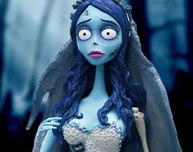
Does Corpse Bride have a happy ending?

November 7, 2005 Corpse Bride

Corpse BrideI know you were brought in late on Tim Burton’s Corpse Bride
and from what I gather, weren’t responsible for much
of the story, but I’m curious about your thoughts on
one particular story element.

Is the ending a happy one for Victor?

The way it plays, it seems as though it is intended to
be a happy ending for him when he winds up with
Victoria, but from the audience’s perspective, I’m not
sure we see evidence that he would be happier with
Victoria than he’d be with the Corpse Bride. The
inclusion of the scene where Victor connects with the
Corpse Bride while playing piano with her is of course
necessary to propagate the plot, but seems to indicate
that he’d be just as content living among the dead as
he would be with Victoria.

— Rob
Los Angeles

You point out one of the real challenges with Corpse Bride. Generally in a fairy tale like this, you’d be really clear about which woman the hero is “supposed to” be married to at the end.

At the start of the movie, it seems pretty straightforward: Victor meets Victoria, and both of them are surprised how much they like each other. Corpse Bride seems like a monster when she first appears, but is quickly revealed to be funny and sweet. She’s rotting, but not rotten.

As we worked on the story, Corpse Bride kept becoming more and more likable, to the point where we started to wonder exactly the question you ask, “Shouldn’t, maybe, Victor end up with Corpse Bride?”

The solution wasn’t to diminish Corpse Bride, but rather to beef up Victoria. Over the drafts, we made sure to give her more initiative (such as escaping the mansion to plead for the Pastor’s help) and make her situation more dire (the wedding to Barkis was a surprisingly late addition).

Through it all, we never wanted to back away from what was unusual about the story: it’s a love triangle in a kid’s film, and you’re sort of rooting for all three characters.

Corpse Bride’s decision to stop Victor from drinking the Wine of Ages (added in the last draft) is less about saving his life (after all, death isn’t so bad) and more about seeing herself in Victoria. It goes back to want-versus-need. Corpse Bride wants to be married, but what she needs is to free herself from her self-imposed curse. While we’re deliberately unclear about the exact cosmology of the afterlife, the Land of the Dead seems to be a kind of goofy Purgatory. Her transformation at the end would seem to be the next step in the process of life.

But is it a little wistful? Yeah.

And I wonder if that lack of clearly happy ending limited the upside to the film — which I have to say, performed much better than any movie called “Corpse Bride” could be expected.

But I wouldn’t change it. To me, it’s nice to be able to show kids a movie where everything resolves well but not perfectly. I think it’s more honest to show that you can be happy and sad at the same time.

Four quadrants of screenwriting style

October 30, 2005 Words on the page

I’ve gotten a few questions from readers who’ve gone through the scripts in the Downloads section, many of them asking about my use of “we,” as in…

We hear SCRAPING as something behind the door moves closer.

Who is “we?”

I use this “we” all the time, and I’ve never really thought about it much. I guess it means either “you and I” (the reader and the writer) or “we the audience.” But which one?

Sort of both. The example above feels like it’s from the audience’s point-of-view. But in many cases, I’m using it more as the creator, such as…

As the pickup ROARS away, we reveal...

TWO BURNING SCARECROWS.

I love “we.” To me, it helps include the reader, giving the sensation of watching a movie, rather than just reading words on a page. But you should know that a fair number of screenwriters loathe this use of “we,” arguing that it’s always possible to write the same moment without it…

The pickup ROARS away, revealing...

TWO BURNING SCARECROWS.

In the end, there is no right or wrong. It’s just a matter of preference.

This got me thinking back to college, when I first had to take a Myers-Briggs personality type test. If you haven’t taken one, it’s definitely worth the twenty minutes, because it has an interesting way of breaking down personality along four basic axes. (Note: plural of “axis,” not synonym of “hatchets.”)

Even with different sets of questions, I come out pretty reliably — if not always strongly — as an ENTJ. It’s worth pointing out that Myers-Briggs-style assessments aren’t trying to say “who you are” as much as what your preferences tend to be.

I think the same characteristics can be found in screenwriting style. Different screenwriters have different preferences, some more strongly rooted than others.

The following is pretty top-of-my-head, so please chime in if you can think of better descriptors for what I’m talking about.

→ Literalist versus Impressionist

The Literalist believes that screenplays should only include what can be seen or heard, since that’s the only information which makes it up on the screen. The Impressionist is willing to bend or break the audio-visual barrier. He may write about things which cannot be filmed, or which reference things outside the world of the movie. (Such as, “Mendoza’s Ferrari is almost as hot as the one I’m going to buy when I sell this script for a million fucking dollars.”)

Personally, I’m pretty much a Literalist, although I’ll generally allow myself one sentence of unshootable information upon introducing a new character.

→ Completer versus Fragmenter

The Completer writes in complete sentences, like this one, with a subject and a verb. The Fragmenter? Nope. Won’t. Not his thing.

I’m a Completer. While you’ll occasionally find a fragment in my action sequences, I’m generally not a fan of rapid-fire word shrapnel. My aversion to fragments makes it very hard to do surgical rewrites of certain screenwriters’ work. I either have to adapt to their style — or more likely — rewrite every sentence of action.

→ Filmist versus Readerist

The Filmist writes screenplays that are intended for filmmakers, using specific film terminology (such as camera movement) and a minimum of fluff. The Filmist makes no concession to the non-professional. The Readerist writes for a more general audience, attempting to convey the feeling of cinematic devices without explicitly mentioning them, sometimes abstracting them to a literary “we see” and “we hear.”

I’m clearly a Readerist. I avoid mentioning the camera, and will even throw a “we” before a “CUT TO:” just so it reads a little better. But it’s worth noting that the classic screenplays, the ones that became the movies you loved, are almost all Filmist.

→ Show-er versus Teller

The Show-er attempts to include every important action in the story, while the Teller would rather forego some detail to convey the overall gist of a scene or sequence. Taken to the extreme, the Show-er would list every punch in a fight, while the Teller would leave it as: “They fight. Maddox wins.”

I’m a Show-er. For me, an action sequence is collection of a dozen smaller moments, and to breeze over them with a sentence or two is disrespectful. With a script, I’m trying evoke the feeling of having watched a movie, and that includes the action.

However, many of the top writers do compress action sequences, arguing that the only thing more boring than writing a long action sequence is reading one.

So, by my own system, I’d come out an LCPS LCRS. You?

Without their scripts in front of me, I’d put James Cameron down as an LCFS. Shane Black is probably an IFRT, but it’s been a while since I’ve read his stuff.

And again, this is all very work-in-progress. (I’ve already changed terms, messing up acronyms.) If you can think of better criteria for looking at screenwriting style (other than “good” and “hack”), please share.

« Previous Page
Next Page »

Primary Sidebar

Newsletter

Inneresting Logo A Quote-Unquote Newsletter about Writing
Read Now

Explore

Projects

  • Aladdin (1)
  • Arlo Finch (27)
  • Big Fish (88)
  • Birdigo (2)
  • Charlie (39)
  • Charlie's Angels (16)
  • Chosen (2)
  • Corpse Bride (9)
  • Dead Projects (18)
  • Frankenweenie (10)
  • Go (29)
  • Karateka (4)
  • Monsterpocalypse (3)
  • One Hit Kill (6)
  • Ops (6)
  • Preacher (2)
  • Prince of Persia (13)
  • Shazam (6)
  • Snake People (6)
  • Tarzan (5)
  • The Nines (118)
  • The Remnants (12)
  • The Variant (22)

Apps

  • Bronson (14)
  • FDX Reader (11)
  • Fountain (32)
  • Highland (75)
  • Less IMDb (4)
  • Weekend Read (64)

Recommended Reading

  • First Person (87)
  • Geek Alert (151)
  • WGA (162)
  • Workspace (19)

Screenwriting Q&A

  • Adaptation (65)
  • Directors (90)
  • Education (49)
  • Film Industry (489)
  • Formatting (128)
  • Genres (89)
  • Glossary (6)
  • Pitches (29)
  • Producers (59)
  • Psych 101 (118)
  • Rights and Copyright (96)
  • So-Called Experts (47)
  • Story and Plot (170)
  • Television (165)
  • Treatments (21)
  • Words on the page (238)
  • Writing Process (177)

More screenwriting Q&A at screenwriting.io

© 2026 John August — All Rights Reserved.