
• Skip to primary navigation
  • Skip to main content
  • Skip to primary sidebar

John August

  • Arlo Finch
  • Scriptnotes
  • Library
  • Store
  • About

QandA

Is that how the line was supposed to go?

July 14, 2005 Go, QandA

GainesSomething that’s always bothered me about Go. When Ronna is in Todd’s apartment she says “Todd, I would never fuck you like that.” And he says, “How would -you- fuck -me-?”

Like, how would a nothing like you ever screw over a big drug dealer like me? But he just explained how she could fuck him: twenty hits is intent to distribute. Did you mean for the line to be read like “How -would- you fuck me?” As in, why should I trust you? And if so, how did the director fuck that up so badly?

— Rebecca
Los Angeles

Actually, the intent behind the line is completely different — and this is an example of how acting choices and editing room decisions can impact a scene. If you download the original script, you’ll see that the scene in question actually reads:

  • GAINES
  • You come here out of the blue asking for twenty hits. Just so happens twenty is the magic number where intent to sell becomes trafficking.
  • RONNA
  • Todd, I would never fuck you like that.
  • GAINES
  • How would you fuck me? Would you strap it on?
  • He climbs over the sofa to a dresser. In a drawer, he digs down through a pile of socks to find a wide-mouthed bottle. And an empty Tylenol bottle. Blows out the dust.

The “Would you strap it on?” line makes it clear that he’s sort-of-joking, in a very sexual way. Unfortunately, on the night we shot this scene, the energy was all wrong.

The producers and I still talk about that bad night, because Timothy Olyphant, who completely nailed the role of Gaines otherwise, was not finding the right rhythms. That’s incredibly frustrating as a writer on the set, because you can hear in your head just how the line should sound, but nothing you do can get it to come out that way. And this isn’t a criticism of Tim or director Doug Liman. Everyone has bad nights; they’re usually not captured on film for posterity.

In fact, the next night we ended up re-shooting Gaines’ side of the later Claire scene, when Tim suddenly had a breakthrough and really figured out how to play the moments. Those are some of my favorites moments in the movie, and it’s all credit to Tim’s acting.

That still left us with some challenges cutting together the Ronna scene. Ultimately, the version that worked best dropped the “Would you strap it on?” line. But you’re right: the inflections in the previous line don’t really make sense. I cringe a little when I watch it.

The other reason I miss the strap-it-on reference is that it played into Ronna having balls. In an earlier scene, Ronna said she’d go straight to Todd, because buying through a middle man would cut her profit: “That’s like, a hundred dollars I’d be pissing out my dick.” I love that Ronna sees herself as hard-boiled, even when she’s terrified.
Writing characters you would hate in real life

July 11, 2005 QandA, Writing Process

How do you go about writing characters that you don’t identify with, or even find abhorrent, as good as the ones you like?

— Dan
Redditch, England

The same way many actors find playing villains liberating, I often enjoy writing characters who, in real life, I would actively avoid.

For instance, in Go, the four guys who go to Vegas in the middle chapter are sort of my bete noire. Simon is id-driven, wantonly impulsive, and only gets away with it because of his accent. Marcus is too righteous by half, the self-appointed leader who only got the title by picking the least-capable of travelling companions. Tiny is a faux-Black chihuahua, and Singh is sort of a perma-stoner. They’re all little lizard brains, and I kinda love them, though I wouldn’t want to be within 20 feet of any of them.

[For the record, the character in Go who I best relate to is Claire. Like her, I’m the one who’s always trying to be the voice of reason. But eventually I give up, and hook up with the hot, scary guy.]

In many ways, it can be easier to write characters with whom you don’t have a lot in common. Unlike a novel, where you’re digging inside a character’s head, screenwriting is about what you see and hear. Even the most rigorous self-examination probably won’t reveal the dialogue and behavior you would notice just watching actual people going about their lives. Sometimes, the most fascinating people are the most annoying, or the most abhorrent.

So don’t strive for likeability. It’s a fool’s errand. Rather, aim for believability. Make sure your characters are consistent, and real within the universe you’ve built for them. The audience will happily watch loathsome characters doing terrible things, as long as you keep them engaging.

Deciding which parents get to visit the factory

June 24, 2005 Charlie, Projects, QandA

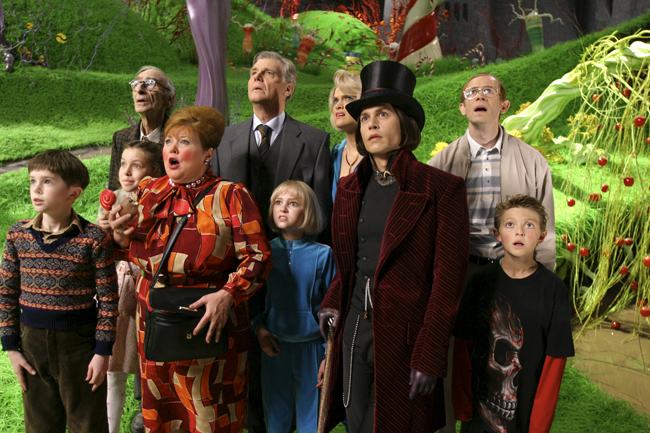
Charlie Tour GroupI have a question about your upcoming film, Charlie and the Chocolate Factory. What made you decide to have each child bring only one guardian to Wonka’s factory, and how did you choose which one would go?

–Michael
Daphne, Alabama

In Roald Dahl’s book, each of the four rotten kids (Veruca, Violet, Augustus and Mike) brings both of their parents on the tour of the factory. Charlie only bring Grandpa Joe, for reasons that are never entirely clear. According to the rules on the Golden Ticket, he’s allowed to bring two parents, but he doesn’t.

When Tim Burton and I first sat down to talk about how we were going to adapt Dahl’s book for the screen, the two-parent issue was one of my first questions. In addition to being a little unfair to Charlie, having each of the rotten kids bring both parents presented a lot of problems.

With a book, the reader can conveniently forget that Mrs. Teavee hasn’t said anything for a long time. In a movie, however, that character is always going to be on-screen. Which means she needs to be doing something, saying something. She has to interact with all the other characters in the scene, who in turn have to interact with each other, which steals focus from Charlie, Willy Wonka, and the rotten kids.

Basically, twice the parents means everyone gets half as much to say and do.

So we quickly decided that the rule on the Golden Ticket would be that every kid gets to bring one parent or guardian. No fuss, no muss.

Then the question becomes, which parent goes with which kid?

In my mind, piggy Augustus got that way because he had a mother who equated food with love. So Mrs. Gloop would be the first parent. We don’t learn much about her except that she and her husband own a sausage shop in Germany.

Violet Beauregarde claimed to be the world record-holder in chewing gum, so we decided to make her hyper-competitive, her ego stoked by sports mom Ms. Beauregarde, herself a former baton champion. We never say anything about Violet’s father.

Veruca Salt is a daddy’s girl gone wicked, manipulative and bossy. So it only made sense for her to bring her father, a British nut baron.

Finally, there’s Mike Teavee. In Dahl’s book, he’s obsessed with TV westerns and shoot-em-up cop shows. Updating it a bit, we gave him violent videogames and a well-meaning but completely over-his-head father, who is literally bullied by his son.

Even with just these four characters, it took work to find enough for everyone to do and say. In the Chocolate Room, for instance, we have to keep track of Willy Wonka, Charlie, Grandpa Joe, Augustus, Mrs. Gloop, Violet, Ms. Beauregarde, Veruca, Mr. Salt, Mike and Mr. Teavee. That’s eleven characters, not counting the Oompa-Loompas. If we’d added four more parents to the scene, we’d probably still be shooting it.

Organizing reality

June 21, 2005 Television

Yesterday, the WGA announced plans to begin organizing writers working on reality television shows. Unlike writers working on traditional dramas or sitcoms, these writers haven’t been covered by the guild, which means they receive no health insurance, no residuals, and no set pay minimums.

As WGAw president Daniel Petrie put it in the press release:

The secret about reality TV isn’t that it’s scripted, which it is; the secret is that reality TV is a 21st-century telecommunications industry sweatshop.

Most readers of this site are familiar with one kind of writing when it comes to film and television. It happens on three-holed paper, with uppercase scene headers and neatly indented blocks for dialogue and parentheticals. But the truth is that much of the work a professional writer does in Hollywood takes on other formats: treatments and beat sheets, outlines and season patterns. Even in non-reality shows, a lot of the writing takes place before you type “FADE IN:”. So it’s a mistake to confuse “unscripted” with “unwritten.”

Many of the people who the WGA would like to organize are currently called producers — which is the norm in television. Be it The Simpsons or The Sopranos, many of the writers in television are called producers of some stripe: Executive Producer, Co-EP, Supervising Producer. Despite the title, there’s no doubt they’re writing. Every episode says “written by” or “teleplay by.”

In reality TV, there’s usually no “written by” credit. But it would be a mistake to think there’s no writing.

In addition to the obviously-scripted moments (someone has to tell Jeff Probst what to say), every episode needs writers to figure out what the hell the story is. Yes, video crews will capture the action, and a team of editors at Avids will ultimately cut the footage together, but the decisions about what actually happens in a given episode fall upon the writers, who have to tease plot, character development, comedy and tension out of hundreds of hours of “real life” taking place.

These people are, in fact, organizing reality. Which is why they deserve to be able to organize under the WGA umbrella. You can read more about the situation here.

UPDATE: After reading a note left in the comments section, I don’t want to understate the role editors often have shaping the “what happens” in reality TV. They’re often performing functions that would normally be the purview of writers; the question is, why aren’t they being compensated for it?

[Formatting a reality show proposal](https://dev.johnaugust.com/archives/2004/formatting-a-reality-show-proposal)

« Previous Page
Next Page »

Primary Sidebar

Newsletter

Inneresting Logo A Quote-Unquote Newsletter about Writing
Read Now

Explore

Projects

  • Aladdin (1)
  • Arlo Finch (27)
  • Big Fish (88)
  • Birdigo (2)
  • Charlie (39)
  • Charlie's Angels (16)
  • Chosen (2)
  • Corpse Bride (9)
  • Dead Projects (18)
  • Frankenweenie (10)
  • Go (29)
  • Karateka (4)
  • Monsterpocalypse (3)
  • One Hit Kill (6)
  • Ops (6)
  • Preacher (2)
  • Prince of Persia (13)
  • Shazam (6)
  • Snake People (6)
  • Tarzan (5)
  • The Nines (118)
  • The Remnants (12)
  • The Variant (22)

Apps

  • Bronson (14)
  • FDX Reader (11)
  • Fountain (32)
  • Highland (75)
  • Less IMDb (4)
  • Weekend Read (64)

Recommended Reading

  • First Person (87)
  • Geek Alert (151)
  • WGA (162)
  • Workspace (19)

Screenwriting Q&A

  • Adaptation (65)
  • Directors (90)
  • Education (49)
  • Film Industry (489)
  • Formatting (128)
  • Genres (89)
  • Glossary (6)
  • Pitches (29)
  • Producers (59)
  • Psych 101 (118)
  • Rights and Copyright (96)
  • So-Called Experts (47)
  • Story and Plot (170)
  • Television (165)
  • Treatments (21)
  • Words on the page (238)
  • Writing Process (177)

More screenwriting Q&A at screenwriting.io

© 2026 John August — All Rights Reserved.