• Skip to primary navigation
  • Skip to main content
  • Skip to primary sidebar

John August

  • Arlo Finch
  • Scriptnotes
  • Library
  • Store
  • About

QandA

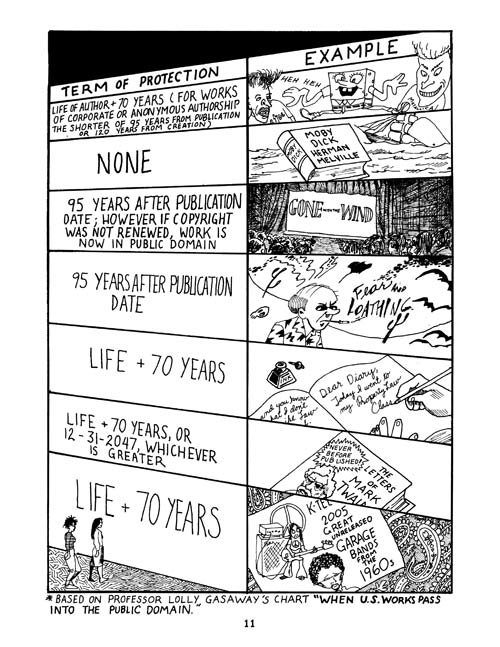
Copyright: The Comic Book

March 16, 2006 Rights and Copyright

comic bookIt seems every fourth question I get has the word “rights” in it: “Do I need the rights to…”, “How do I get the rights to…”, “Im not a gud speller I like to rights…”

Reader Chris Little wrote in to point out this terrific comic book — Tales from the Public Domain: BOUND BY LAW? It’s prepared by Duke University’s Center for the Study of the Public Domain. Not only does it describe situations where you have to be careful, it points out the absurdities of modern copyright law, where a cell phone ringing in the background can cost you $10,000.

A lot of the information skews toward documentary filmmaking, but it’s useful for anyone interested in portraying reality, and the near-impossibility of doing it as long as everything is protected by copyright.

You can read it all (for free!) here.

Professional Writing and the Rise of the Amateur

March 1, 2006 First Person, Rant, So-Called Experts

Last night, I had the pleasure of giving a guest lecture at Trinity University in San Antonio. While I speak at various screenwriter-oriented functions fairly often, this was unusual in that the event was university-wide, and the focus wasn’t specifically on film.

Part of the deal was that I had to announce the title of my speech months in advance. I picked, “Professional Writing and the Rise of the Amateur,” figuring that in the intervening months I would think of inspiring examples of how the World of Tomorrow was going to be a wonderland of possibility for the undergraduates in the audience.

But the more I thought about it, the less I wanted to talk about the future. Instead, I wanted to focus on one of the biggest challenges of today: in our celebration of the amateur, we kind of forget what it means to be professional.

As I spoke with various classes before the big presentation, I promised I’d post the whole speech on the site for those students who had night classes. And, of course, for anyone else who might be interested.

Let me warn you: this is long. My speech lasted 45 minutes, and that was without a lot of riffing. So if you’d rather read the whole thing as a .pdf, you can find it here.

. . .

It’s a pleasure to be here talking with you tonight. Over the last two days, I’ve been visiting a lot of classes, talking about screenwriting and movies, and well, basically talking about myself. Which I’m really good at. But when I agreed to give a formal public lecture, one of the requirements was that the presentation actually have a title. By which I mean a topic, a thesis. A point.

It all feels very academic, and I love that. I miss that. None of you will believe me now, but some day you’ll look back on your college careers and be wistful. Nostalgic. Because there’s something comforting about having to write a fifteen page paper on the use of floral imagery in “Pride and Prejudice.”

I think what it is, is that even if you’re completely wrong, it just doesn’t matter that much. For the rest of your life, you’re going to get called on bullshitting. In college, you’re graded on it.

Anyway.

I decided I wanted my lecture tonight to be not strictly about screenwriting, but about writing in general. Because everyone in this room is a writer. You might write screenplays; you might write research papers. You definitely write emails. Every one of you is, and will be, a professional writer in some field.

So I wanted to talk about what that means.

[Read more…] about Professional Writing and the Rise of the Amateur

How to format lyrics in scripts

February 23, 2006 Formatting, QandA

I was quite curious as to how one would write a scene with characters singing a song, musical style. Do we just include “singing” as an action within the handy parentheses? Or is there some other formatting we must use? And how much mention are we supposed to give to the music itself?

— Adam Scott
Perth, Australia

For movies and television, the convention is to put the lyrics in italics. It’s probably helpful to include a “(singing)” parenthetical the first time you do it, because some readers may not catch it otherwise. And yes, dialogue in italics can also be used for foreign languages, so you’ll need to make sure it’s clear in context.

Here’s where the former graphic designer in me resurfaces. Screenplays are written in 12-pt. Courier, which is not the most attractive typeface in the world, but certainly sturdy and readable. There’s an italic form of Courier that’s rounded and a little more like handwriting, which would be quite suitable for lyrics.

However, the “italic” form of Courier you find on most computers is really just normal Courier with a slant effect applied (called “oblique”), and it seriously blows. It’s ugly on screen. It’s ugly printed.

It’s impossible to write beautiful lyrics in such an ugly typeface.

So, having written lyrics in many of my scripts, I’ve come to use a different typeface altogether for the songs. For Big Fish, I used 11 pt. Stone Sans Italic. For Charlie and Corpse Bride, I switched to 11 pt. Verdana Italic, because I needed to send those scripts in as .pdf files, and you can safely count on just about any computer having Verdana installed.

Why 11 pt., when the main text is set at 12 pt.? That’s because Verdana looks much bigger than Courier when set at the same point size. You’re also more likely to get a full lyric line in without a break at that size. (Although I feel no guilt cheating a margin slightly to avoid a break in any event.)

Some scripts I’ve read will include a slash “/” at the end of each sung line. I don’t find that helpful, so I never use it.

In terms of talking about the music, your best bet is to describe the general style and tone, such as “bright, Sousa-like march” or “melancholy dirge.” You can give an example if it’s particularly apt, but I’d avoid a reference that makes the reader stop and think, “Hmm, how does that go?”

Note that the convention for songs in stage musicals is completely different. For those, lyrics are placed in uppercase along the left margin. You can see examples of the format in the templates for Final Draft or Screenwriter.

Write-up of my recent WGA Foundation Q&A

February 16, 2006 First Person, QandA, So-Called Experts

Screenblogger Devon DeLapp was generous enough to type up his notes of my recent Q&A at the Writers Guild Foundation. He did a good job keeping up with a rambling conversation. I only have a few real corrections/clarificatons:

  • Go really didn’t change that much from the first draft.
  • Charlie’s Angels was a positive experience, but not “a total love fest.” [clears throat]
  • My dad died several years before I read Big Fish.
  • For Thief of Always, I was fired for a very specific reason: the director and novelist hated my script.
  • Drew Barrymore’s relative star power wasn’t the deciding factor on Barbarella; there were complicated studio politics at work.
  • “I can beat myself with the best of them.” Well, I probably said that, but it sounds kind of naughty out of context.
  • Although I write longhand (a scribble version, followed by a readable one), what my assistant types up is exactly the script, not notes. I’ll try to scan some of these scenes so people can see what I mean.
  • “Get job as a writer on TV” — as if it’s that easy. But I really do think that every screenwriter should look at TV as just another screen, and pursue it if at all interested.

You can read the whole shebang here. Thanks again to Devon for putting it up.

« Previous Page
Next Page »

Primary Sidebar

Newsletter

Inneresting Logo A Quote-Unquote Newsletter about Writing
Read Now

Explore

Projects

  • Aladdin (1)
  • Arlo Finch (27)
  • Big Fish (88)
  • Birdigo (2)
  • Charlie (39)
  • Charlie's Angels (16)
  • Chosen (2)
  • Corpse Bride (9)
  • Dead Projects (18)
  • Frankenweenie (10)
  • Go (29)
  • Karateka (4)
  • Monsterpocalypse (3)
  • One Hit Kill (6)
  • Ops (6)
  • Preacher (2)
  • Prince of Persia (13)
  • Shazam (6)
  • Snake People (6)
  • Tarzan (5)
  • The Nines (118)
  • The Remnants (12)
  • The Variant (22)

Apps

  • Bronson (14)
  • FDX Reader (11)
  • Fountain (32)
  • Highland (75)
  • Less IMDb (4)
  • Weekend Read (64)

Recommended Reading

  • First Person (87)
  • Geek Alert (151)
  • WGA (162)
  • Workspace (19)

Screenwriting Q&A

  • Adaptation (65)
  • Directors (90)
  • Education (49)
  • Film Industry (489)
  • Formatting (128)
  • Genres (89)
  • Glossary (6)
  • Pitches (29)
  • Producers (59)
  • Psych 101 (118)
  • Rights and Copyright (96)
  • So-Called Experts (47)
  • Story and Plot (170)
  • Television (165)
  • Treatments (21)
  • Words on the page (238)
  • Writing Process (177)

More screenwriting Q&A at screenwriting.io

© 2026 John August — All Rights Reserved.