• Skip to primary navigation
  • Skip to main content
  • Skip to primary sidebar

John August

  • Arlo Finch
  • Scriptnotes
  • Library
  • Store
  • About

QandA

2007 Insomnia Film Festival

October 1, 2007 Education, Resources, Video

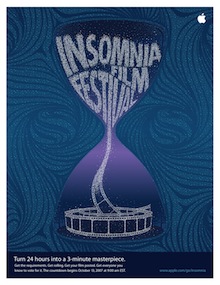
posterApple is sponsoring a 24-hour film festival for high school and college filmmakers. If you fall into this demographic, absolutely do it. You get 24 hours to write, produce, edit, score and deliver a 3-minute short film incorporating specific elements they only announce on the day.

I’ve had the pleasure of being a judge for the equivalent contest at USC, and while many of the resulting films are terrible, they’re mercifully short. A handful end up being truly inspired.

Some advice, since I obviously want my readers to win:

  1. Think about the most obvious ways to incorporate the required elements. Then don’t do those.
  2. Avoid bad puns. If all you have to offer is a witty title, you won’t score.
  3. Go funny. While there will no doubt be one or two dramatic shorts in the finals, the winner will be funny.
  4. Don’t forget to write a script. It’s tempting to rush out and start shooting. Spend a few of those first hours writing. What is the story? How does it progress?
  5. Sound matters more than picture. If we can’t understand your dialogue, you won’t win.
  6. Lighting matters more than resolution. A cheap camcorder with thoughtful lighting is better than a Red One at noon.
  7. Prepare to edit. You don’t want to get back to your computer only to find it’s impossible to get footage from the UDX-HR5 into the Mac.It is, incidentally. I had to install Windows in order to use Sony’s proprietary software to access the camera. Uggh.
  8. Protein, not carbs. Because you’ll likely be working all night, sugar will send you into a crash.
  9. Plan ahead to think of what locations, props and (most importantly) people you might have at your disposal. It’s also fine to think of general story ideas, but don’t get locked into anything. If the required elements feel tacked-on rather than integral, you won’t win.
  10. Lock your picture edit with enough time to tweak sound and music.

Other thoughts and suggestions? Add them in the comments.

(Thanks to Daring Fireball for the link.)

Skipping drama class

September 14, 2007 Education, QandA

questionmarkI’ve looked through your archives and have found nothing that closely applies to my question. I’ve been a visitor for about three years now, and for some reason have never gotten up the nerve to ask you a question.

I’m 16 and have wanted to pursue a career in filmmaking since 8th grade. I’m sure you’re not too old to remember what it was like to be 16 years old and trying your best to not ruin your own life forever. (I really don’t want to be a receptionist.)

So far I’ve been teaching myself the various techniques of screenwriting through books I find at Chapters, audio commentaries on my favorite DVDs and you.

And here I am. Terrified that I might be making all the wrong moves. Should I have taken drama and bitten my tongue every time that insane teacher opened her mouth? Should I be doing more after school type programs?

And, of course, should I go to film school? (I know you’ve done a response on this, but I’m more concerned with what I need to do before I get there.)

Thank you for your time, it really means a lot.

— Veronica

You’re sixteen. Go out and experience life. As interesting things happen, write them down. If something other than screenwriting appeals to you at some point, pursue it with full abandon and no regrets. You’re at an age when you don’t need to be making any firm decisions, or beating yourself up about missed opportunities. A bad high school drama class is a bullet dodged, in my opinion.

When you’re applying to universities, sure, apply to a film school if that’s still your dream. But if you don’t end up going there, you won’t have missed the boat. Most people in the film industry didn’t go to film school. It’s not like medical school, or law school. It’s not mandatory.

My one bit of trust-me-on-this advice: work on your spelling and punctuation. Your original email had seven mistakes, which I fixed so that they wouldn’t be the focus of a lot of the comments. What I’ve written about professionalism has no minimum age requirement. You’re writing in to get professional advice. Make sure you’re presenting yourself professionally.

Lecture over. Go be sixteen.

Moving to LA (via NYC)

September 10, 2007 Film Industry, First Person, Los Angeles

At the Nuart last weekend for The Nines, Kris Galuska re-introduced himself. He’s a writer I had met at the Austin Film Festival last year. On a short elevator ride, I had tried to convince him that he really needed to move to Los Angeles if he was serious about working as a screenwriter. Apparently, it worked.

At the screening, he started to fill me in on the last twelve months, but I was sure that his experiences would be especially valuable to readers, just as Adam Davis’s recent essay had been. So I urged him to write it up. Once again, Kris took me up on my suggestion.


first personI started writing as a way to pass the time during my first summer away at college. What began as a diversion soon became my obsession. A year or so later, that obsession led me to the amazing, uniquely writer oriented, Austin Film Festival. I chose a panel on pitching and was delighted to see that the writer of Big Fish (one of my favorite movies) was on the panel. Though, I have to admit, I knew nothing more about John August than what was written in his short bio in the festival program. As the panel began I was blown away by John’s ability to give honest and immediately useful advice. He was able to knock down many of the walls around the industry that countless books and “insiders”? had constructed in my mind. I changed my plans so I could attend the rest of the panels John was participating in. Eventually I got up the courage to step up and introduce myself.

I blurted out my name nervously and proceed to elaborate on my dreams of writing and the epic fantasy, action adventure, and science fiction movies I would help create. I wanted to make movies that entertained first and had a message second. I wanted to bring back the good name of the blockbuster and the popcorn flick. I pleaded with him for wisdom and any advice on how I could start my career and become the writer I dreamed I could be.

John’s answer was not a surprise, but it was an answer I dreaded. He told me to move to LA. To move away from the cheap apartments and light traffic of Texas and brave the ever growing expanse of Los Angeles. I left the festival and debated the decision until there were only three days left on my lease, and I would be forced to move out. My parents wanted me to work in New York, so that I could live close to them. I could even live in their house in Jersey until I found a place. NY had always held a certain lofty position in my head as a city made for writers, but I knew that John was right. The subject matter and the style of my writing was more in tune with the studios in California.

Unfortunately, as has been the case far too often, my expanding stomach led me to a different answer. It came in the form of two fortune cookies at a cheap, all I could shove down my face, Chinese buffet. The first said, “Spend this year with your family.”? The second continued, “Don’t be afraid to act now.”? Well who was I to argue with the wisdom of prepackaged, American made, Asian cookies? I packed what fit in my boxy little Scion and left for NY.

I don’t regret the six months I worked in Manhattan. NY is without a doubt a city every writer should spend some time in. You can’t walk down the street without a thousand stories striking your imagination. I worked each day with a constant monolog running through my mind – describing the people, the sights, the smells. Ah the smells”¦ like an expert wine taster you develop the ability to name the location and ingredients of the putrid perfume of alcohol and urine that give each corner of Midtown its distinct flavor.

Despite the unappealing smells and the layer of exhaust that forms a visible cloud of carcinogens in the belly of the Port Authority buss terminal, New York is still a charming, surreal city that I’ll remember fondly. Even though the city overflowed with creative energy, I knew I was not where I was meant to be. I met many artist, musician, and documentary film makers, and they were all passionate and creative people, but every person I met that was doing what I wanted to do ““ write and make movies ““ was visiting from Los Angeles. So, after a month of planning, I quit my job, repacked my motorized shoebox, and made my way from one coast to the other.

I’ve only been in LA for three months now, but I already know I made the right decision. In three months I’ve worked on the set of a commercial and a feature film. I had an internship at the production company responsible for amazing movies such as Kill Bill and Good Will Hunting, and recently I got an assistant job at a small talent agency. Though none of these experiences have been writing relate, they have given me insight, contacts, and a feeling of participation in an industry that was once impregnable.

The best part of living in LA is the realization that anything can happen. You never know who will have a contact that can push you that one step closer. While working as a boom operator on an independent feature, I made small talk with one of the actresses between takes. I explained how I really wanted to write, and I pitched her some of my screenplays. By the end of the day she gave me her card and asked me to send her a copy of “my quirky little thriller,”? as I like to call it, Sex and Pudding. It turned out that she was part of a new independent production company, and they were looking for scripts to pitch to investors. Less then a week later I received a call from her producer. We are now working together to get the project financed.

There is the strong possibility that the movie will not get made. If A-list producers and writers struggle to get their movies in front of an audience, how can an unknown writer with and unknown production company do any better. It is this impossibility that makes movies magic. Whether the movie gets made soon or not, I’ve already got the high from that first phone call. That first call when the producer said she loved my screenplay. It wasn’t a compliment from my mother or a friend or a competition I paid to enter. It was a compliment from another creative person that was willing to risk their time and energy in my story.

I have by no means “made it”? as a writer, so my advice is limited to my experiences so far, but maybe these three suggestions can help others about to make the trek to the magical land of sun, stars, and smog.

  1. Change your cell phone to a Los Angeles number as soon as you get out here — preferably with a 323 or an 818 area code. I spent the first month and a half living on Craig’s list, mandy, and other similar sites. I couldn’t even get an e-mail rejection. The day I changed my number I got three calls for gigs.
  2. Befriend the assistants and others just above you. Now if you have Jerry Bruckheimer eagerly listening to your pitch of “Lord of the Rings meets The Matrix, but with talking animals”? than by all means use that opportunity, but don’t waist your time stalking celebrities and producers, begging them to read your work. Get their assistant’s assistant to read it, and you’ll have a better shot.

  3. Don’t be afraid to pitch and talk to others about your script. I’ve met a lot of people that are afraid of getting their ideas stolen, but if no one ever hears about your project it will never get made. As I discovered, you never know who can help get your script to the right people. Even if nothing happens you’ll get practice pitching which can never hurt.

Looking back it is clear to me why it took me so long to finally make the move to Los Angeles. I was afraid. Not afraid of the move or of leaving my friends and family, I was afraid of loosing my excuse. The excuse that I needed to be in LA that it was my location not my writing that was the problem. If I moved to LA the only thing holding me back would be my own skills and ambition, and that terrified me. I’ve learned in my short life that the thing your most afraid to do is probably the thing you should be doing.

I’m not going to say that everyone of you that wants to be a screenwriter needs to pack up and move to Hollywood. Many great writers and directors have proven that with enough drive and passion you can make a movie anywhere, but for me it was the change… the step I needed to really push me forward. Don’t let fear hold you back. Yes, it is risky to uproot your life to fight for a dream, but risks are what make our lives adventures worth having stories about. Live your life so you have stories to tell, even if they’re made up along the way.


Questions, suggestions or encouragement for Kris? Leave them in the comments below.

Is it risky to spec something in the public domain?

August 27, 2007 Adaptation, Pitches, Producers, QandA

questionmarkLately I’ve been adapting novels and shorts stories that are in the public domain and I’m worried that some producer I query could just forget about me and hire someone else to adapt the same novel after my query letter puts it in their head it would make a good movie.

Now I know stealing ideas rarely happens and there isn’t anything I can do to protect my rights on a story in the public domain, but if a producer I query decides to adapt the same novel I have, without using my script, well then my script is pretty much dead in the water, right?

Basically I was curious to find out if you think I should stop worrying and pitch these adaptation, or should I focus on pitching the other two scripts I’ve written (which are based on true stories I control the rights to) and then pull out my adaptations once I forge a working relationship with a producer?

— Rob
Ohio

Would it suck if a producer, upon reading your query letter (or hearing your pitch), decided to go off and use the same public domain material as the basis for a different writer’s script? Yes.

Is it likely? Not really.

Let’s say you wrote an adaptation of some lesser-known Christopher Marlowe work. Say, “Dido, Queen of Carthage.” The producer is unlikely to know anything about the story, so if your pitch (or query) is interesting enough that he wants to know more, he’ll read your script. At that point, you’ve succeeded in getting a producer to read your material, and that’s the whole point of pitches and queries at this stage in your career.

Sure, you hope he loves it and wants to produce it. But that’s all dependent on his reaction to your writing. If he likes your writing, and he likes the idea, you’re golden. If he doesn’t like your writing, his loss.As a reminder, I assume that everyone writing in with a question is a fantastic screenwriter. This is an absurd postulate, but lets me sleep better at night.

Either way, I think it’s unlikely that your script would suddenly kindle an interest in a long-ignored literary property. I’m sure there are cases where that’s happened, but it feels like the exception, rather than the rule. So if the best script you have available is an adaptation of a public domain piece, by all means show it around.

« Previous Page
Next Page »

Primary Sidebar

Newsletter

Inneresting Logo A Quote-Unquote Newsletter about Writing
Read Now

Explore

Projects

  • Aladdin (1)
  • Arlo Finch (27)
  • Big Fish (88)
  • Birdigo (2)
  • Charlie (39)
  • Charlie's Angels (16)
  • Chosen (2)
  • Corpse Bride (9)
  • Dead Projects (18)
  • Frankenweenie (10)
  • Go (29)
  • Karateka (4)
  • Monsterpocalypse (3)
  • One Hit Kill (6)
  • Ops (6)
  • Preacher (2)
  • Prince of Persia (13)
  • Shazam (6)
  • Snake People (6)
  • Tarzan (5)
  • The Nines (118)
  • The Remnants (12)
  • The Variant (22)

Apps

  • Bronson (14)
  • FDX Reader (11)
  • Fountain (32)
  • Highland (75)
  • Less IMDb (4)
  • Weekend Read (64)

Recommended Reading

  • First Person (87)
  • Geek Alert (151)
  • WGA (162)
  • Workspace (19)

Screenwriting Q&A

  • Adaptation (65)
  • Directors (90)
  • Education (49)
  • Film Industry (489)
  • Formatting (128)
  • Genres (89)
  • Glossary (6)
  • Pitches (29)
  • Producers (59)
  • Psych 101 (118)
  • Rights and Copyright (96)
  • So-Called Experts (47)
  • Story and Plot (170)
  • Television (165)
  • Treatments (21)
  • Words on the page (238)
  • Writing Process (177)

More screenwriting Q&A at screenwriting.io

© 2026 John August — All Rights Reserved.