• Skip to primary navigation
  • Skip to main content
  • Skip to primary sidebar

John August

  • Arlo Finch
  • Scriptnotes
  • Library
  • Store
  • About

QandA

Things We Think About Games

September 30, 2008 Story and Plot, Videogames

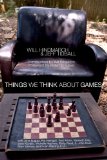
book coverI have an essay in the new book Things We Think About Games, a minor rewrite of “Seven things I learned from World of Warcraft.”

While I wouldn’t recommend buying the book just for my contribution, I’m happy to report the rest of Will Hindmarch and Jeff Tidball’s little book is terrific, full of observations and advice for gamers and game designers. Having worked with several of the latter, I’m struck by how nascent and unformed that field is. The fundamental questions are still being asked, and answered different ways: How do you make story playable? How explicitly do you set the rules? How much “work” is a player willing to do?

Whether MMORPG or paper-and-dice, alien-zapping or world-building, games have an active social component unlike anything you find in film or television, which makes them a uniquely challenging art form. Yes: you can watch a slasher movie with your friends, shouting back at the screen. But the film itself is unchanged by your participation. Not so with a good game, which demands involvement far beyond passive entertainment.

So if you find yourself thinking about games, I’d encourage to think along with this book.

On creating emotion

September 29, 2008 Big Fish, Directors, Projects, QandA, Words on the page

questionmarkI am writing an extended essay in order to get my IB Diploma for school, and Mr. LaRue is my coordinator. My extended essay is about film, especially about emotions in film. I was wondering if you could help me out by answering a few questions.

What causes emotional catharsis in a movie?

What sort of components (lighting, sound, dialogue,…) have the most emotional effect on the viewers, and do you have any examples?

What techniques are used to produce emotions within the viewer of a movie?

What are some things that you have specifically done (relating to the screenplays that you have written) in order to produce emotions in a movie?

— Danielle
Fairview High School

Danielle is attending my former high school, so I feel some duty to steer her in the right direction, if not exactly answer her questions. But for readers who didn’t grow up in Boulder, Colorado, a little background is in order.

Boulder is a medium-sized (100,000) city tucked right into the foothills of the Rocky Mountains. It has a much bigger national reputation than it should, largely because of its university (CU) and its reputation as a bastion for all things New Age-y. Mork and Mindy was set there, and quite believably; a man claiming to be an alien would not raise the slightest suspicion on its snowy streets.

There are two rival high schools in the city: Boulder High and Fairview. Except that Boulder High doesn’t really consider it a rivalry, because they’re too cool to give a shit. For example, Josh Friedman went to Boulder High, and would never need to answer a question from a student there, unless it was why his Terminator show glorifies violence at a time when G8 countries should be focusing on global debt relief.

It’s an accepted truth that schools are falling apart and today’s youth aren’t getting nearly the education older generations did, but by all accounts Fairview is actually a much more academically rigorous school now than when I attended. I took three AP classes, which would now be openly mocked by students like Danielle. I never wrote an extended essay about emotion in film. But if I did, I’d probably reach the following conclusions.

  1. Emotional catharsis is a direct function of how much the audience identifies with the character(s). Catharsis is a journey through dark territory, and you don’t go on that trek unless you can put yourself in a given character’s place, and feel like you’re living that experience.
  2. The triumvirate responsible for creating emotion are The Writer, who creates the character and lays out the obstacles; The Actor, who gives the character weight and breath; and The Director, who coordinates the technical elements (such as lighting, editing, and music) to achieve the emotional reaction desired.

  3. An example from my own work: Will telling Edward the final story in Big Fish.

GIANT SPOILER WARNING if you haven’t seen the movie.

On a writing level, the moment wouldn’t work if we hadn’t invested time in seeing their dilemma from both sides: the frustrated son, the slippery father. The script sets up a lot of elements and characters for recalls: Karl the Giant, the shoes, the Girl in the River.

The performances are strong, with actors continuing threads established earlier. In particular, Billy Crudup tends to get overlooked here: because he’s so prickly earlier on, it’s particularly affecting to see him struggle to hold on.

Finally, Tim Burton directs the elements calmly. From visuals to music, he’s careful not to push too hard or too fast, letting the emotion kindle.

Good luck with the essay.

The purpose of drama, and its relationship to Cameron Diaz’s ass

September 23, 2008 Film Industry, QandA, Rant, Story and Plot

Matías from Mallorca, Spain writes in:

I’d really like you to comment on these thoughts by David Mamet:

“People have tried for centuries to use drama to change people’s lives, to influence, to comment, to express themselves. It doesn’t work. It might be nice if it worked for those things, but it doesn’t. The only thing the dramatic form is good for is telling a story.”

I haven’t read Mamet’s full essay on “Countercultural Architecture and Dramatic Structure,” ((It’s apparently also in On Directing Film.)) but through the wonders of Google Book Search, I was able to look at the quote in context ((Page 224 may no be included in the Google Books preview.)). It’s part of a meandering rant, and not the key thesis of his essay. So I feel safe disassembling it without challenging the authority of a revered playwright.

He doesn’t detail his logic behind why drama doesn’t work for those four specific purposes, but it’s part of a larger criticism of how filmmakers spend too much energy making “statements” and too little effort on making movies. And fair enough.

I don’t have evidence to argue that drama can change people’s lives. I know it can affect them; I’ve got a folder full of emails about Big Fish. But “changing someone’s life” implies a marked and permanent alteration, and given my limited sample size (myself), I haven’t found that any drama has necessarily done that.

Can drama influence or comment? Certainly. We often think of comedy as the preferred means of making a social or political observation (Bulworth, 9 to 5, Borat), but there’s a long history of issue-oriented dramas, many of them top-tier (Reds, Traffic, Hotel Rwanda).

Can writers use drama to express themselves? Well, yes, obviously. Most artistic works, from graffiti to haiku, can be considered self-expression — though to my thinking, anyone who defends his work as self-expression is very likely a hack.

There’s no question that you can write a movie about how shitty your parents were. Mamet isn’t really denying that. He’s saying drama isn’t good for this purpose, the same way you can pound a nail in with a wrench, but it’s not the ideal tool. Maybe drama, with its demands of plot and tension and resolution, is not particularly well-suited to a lot of the tasks put before it.

Ultimately, I agree with his point if not his conviction. The foremost purpose of a movie should be the story itself. If a secondary purpose (such as social commentary, or “telling my journey”) weakens the story, you’ve weakened the movie.

I know this is high talk coming from a guy who co-wrote Charlie’s Angels: Full Throttle. But that trainwreck is actually a perfect example of how a movie collapses when nearly every element (wardrobe, choreography, wire-fu) is allowed to trump story. ((If you’re bored and curious, the DVD commentary between me and The Wibberleys is an amusing dissection of how Full Throttle got so messed up.))

WRITER

Why don’t the Angels just sneak onto the boat?

DIRECTOR

We need a striptease number.

WRITER

But what are they doing?

DIRECTOR

It’s going to be sexy -- lace stockings, riding crops and...

WRITER

But why are the Angels doing it?

DIRECTOR

I dunno. They need to get something. Think of something they need to get. You’re the writer.

(Repeat 149 times.)

What Mamet is arguing is that even high-minded goals like social commentary ultimately become Cameron Diaz’s swirling ass — attractive distractions that ultimately lessen a movie. And he’s got a point.

How to handle a phone meeting

September 10, 2008 Film Industry, How-To, Pitches, QandA

questionmarkI’m a 23-year-old aspiring screenwriter who recently placed in the Nicholl fellowship competition. I’ve heard from others who made the cut some years back to begin preparing for phone calls from managers, agents and producers who may be interested in my script — which is both exciting and terrifying.

I was wondering if you could share some insight/commentary about pitching over the phone for people like me who do not (yet) live in Los Angeles. I’d hate to squander an opportunity like this because of bad phone etiquette.

– Alexander
Worcester, MA

The life of a screenwriter, both employed and aspiring, involves a fair number of phone calls. Most are short “just-checking-in” calls. But at least twice a week I find myself in your situation, having to handle something on the phone that would ideally be done face-to-face. I can offer a few suggestions for making the best of it.

1. Put yourself in the room.
—-

Imagine that you’re sitting in the guy’s office, having a face-to-face meeting. Obviously, you have no idea what that office looks like, but you’re a screenwriter, so you should be able to conjure something up. More importantly, imagine whom you’re speaking with. You need a face in order to make eye contact. ((One downside of this technique: there are executives whom I’ve had long relationships with strictly on the phone and by email. By the time I meet them in person, my brain is locked into one image of them, and the actual person seems like an impostor.))

I know this sounds goofy, but I think it makes a huge difference. You’re much more engaged when you’re looking someone in the eye — even if it’s all make-believe. It changes your voice, your pace, your word selection. It really helps.

2. Don’t multi-task.
—-

If a phone call is important, dedicate every available brain cell to it. Turn off your computer and any other distraction. If possible, schedule the call. (Even then, there’s a high possibility that an assistant will call at the last minute to push it back 15 minutes. Don’t take any offense.)

3. Rehearse key points.
—-

Since you’re going to be talking with possible producers, agents and managers, you can anticipate the kinds of things that will come up.

* Do you see yourself as mostly writing TV or film?
* What are you working on now?
* What’s happening with that script from the Nicholl?

You want answers to those questions, ideally phrased in ways that make you sound confident, flexible and funny. For example, if they ask if you’re living in Los Angeles, a good answer is, “Almost. I’m packing as we speak.” That may not be entirely accurate, but the person on the other end needs to hear that you’re serious about getting to Hollywood.

4. Ask and listen.
—-
Don’t spend every brain cycle formulating the next clever thing to say. Ask questions and engage. If you’re speaking with someone for the first time, make sure you’re learning something about them as well.

Pitching on the phone is largely the same as pitching in person, with the added challenge of not being able to read body language. So keep it really short — like four sentences — unless they ask for more detail.

« Previous Page
Next Page »

Primary Sidebar

Newsletter

Inneresting Logo A Quote-Unquote Newsletter about Writing
Read Now

Explore

Projects

  • Aladdin (1)
  • Arlo Finch (27)
  • Big Fish (88)
  • Birdigo (2)
  • Charlie (39)
  • Charlie's Angels (16)
  • Chosen (2)
  • Corpse Bride (9)
  • Dead Projects (18)
  • Frankenweenie (10)
  • Go (29)
  • Karateka (4)
  • Monsterpocalypse (3)
  • One Hit Kill (6)
  • Ops (6)
  • Preacher (2)
  • Prince of Persia (13)
  • Shazam (6)
  • Snake People (6)
  • Tarzan (5)
  • The Nines (118)
  • The Remnants (12)
  • The Variant (22)

Apps

  • Bronson (14)
  • FDX Reader (11)
  • Fountain (32)
  • Highland (75)
  • Less IMDb (4)
  • Weekend Read (64)

Recommended Reading

  • First Person (87)
  • Geek Alert (151)
  • WGA (162)
  • Workspace (19)

Screenwriting Q&A

  • Adaptation (65)
  • Directors (90)
  • Education (49)
  • Film Industry (489)
  • Formatting (128)
  • Genres (89)
  • Glossary (6)
  • Pitches (29)
  • Producers (59)
  • Psych 101 (118)
  • Rights and Copyright (96)
  • So-Called Experts (47)
  • Story and Plot (170)
  • Television (165)
  • Treatments (21)
  • Words on the page (238)
  • Writing Process (177)

More screenwriting Q&A at screenwriting.io

© 2026 John August — All Rights Reserved.