• Skip to primary navigation
  • Skip to main content
  • Skip to primary sidebar

John August

  • Arlo Finch
  • Scriptnotes
  • Library
  • Store
  • About

QandA

What should I do in a general meeting?

March 4, 2009 Dead Projects, Film Industry, Projects, QandA

questionmarkI’m a new writer: I have an agent, I have a manager, I have a spec that’s a good sample but will never sell, I have a spec that might sell and that my reps are trying to attach elements to. For a month or two, I’ve been going on general meetings off of my sample spec as they wait for things to align before sending out my new one. In my meetings, people talk about how much they love my sample (but of course aren’t going to buy it), how much they want to read my new spec, and how much they like the ideas for future projects I talk about. That’s all great.

But — and, being very new at this, this may be a stupid question — now what? What should or could I be doing to help make myself/my projects easier to sell, either when my new spec goes out, or in the future? I trust my reps completely, but I’d love to do anything I can to make their jobs a bit easier.

I have this nagging feeling that I should somehow be trying to turn my general meetings into possible work down the line, but I’m not sure if that’s true, or if it is, how I would go about it. I just don’t want to look back a year from now and realize that I squandered what heat I had, if that makes sense.

— E.

You’re at the phase in your career in which you’re “taking generals.”

General meetings are the hey-it’s-nice-to-meet-you part of a screenwriting career, and while you do fewer of them once you have more credits to your name, they’re always an important part of the job. This is how you meet the junior executives who will later become senior executives, and get them thinking about you as the kind of person they would like to hire.

I had a ton of general meetings off my first script (Here and Now), which never sold. When I say ton, I mean fifteen or twenty, at least three a week for a while. Mostly, my agent was sending me out there so I could practice being in a room without making a fool of myself. After the first dozen or so, I learned How to Meet, and stopped worrying about being the worst-dressed person in the room.

Your goal in a general meeting is to figure out what they might be able to hire you to write. At a certain point, they’ll talk about the kinds of projects they have in development, and the things they’re looking for. If anything sparks, pursue it. Talk about it in the room, then follow up the next day, and the next week. You’ll be chasing a lot of half-baked projects, most of which will never come to be. But one or two might. And that’s what you need.

Your advantage at this point is that you’re cheap and available. A producer could likely hire you with discretionary funds to rewrite a mediocre project she has sitting on the shelf. And if that opportunity comes up, take it. Do an amazing job, then let your reps spin that in your next assignment. And your next.
Movie speak

March 3, 2009 Books, Film Industry, Rave

When the AD calls out that this is the Abby Singer, what should you do?

Well, nothing, because you’re the screenwriter. But being the observant sort, you might notice that the gaffers start tidying up. Craft service begins putting away the vegetable dip. The second AD dispatches some PAs to make copies of the call sheet.

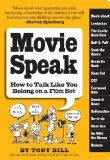
movie speak bookThe Abby Singer is the next-to-last shot of the day, or at a given location. And if you’ve never heard of it, or some of the other terms mentioned above, I can recommend Tony Bill’s book Movie Speak: How to Talk Like You Belong on a Movie Set. It’s by far the best guide and glossary I’ve seen to all the esoteric terms you hear on a movie set. And real terms, not goofy had-to-be-there catchphrases.

Keep in mind: as a screenwriter sitting at a computer, you’ll never use most of these terms. You’ll never, ever type them in a script. It’s only when you’re on a working set that you’ll hear them. But knowing them might save you some embarrassment and confusion.

(As a reminder, I’ve previously recommended The Hollywood Standard
as a go-to guide for screenplay formatting.)

The Kindle is not good for screenplays

March 2, 2009 Follow Up, Formatting, Geek Alert, News

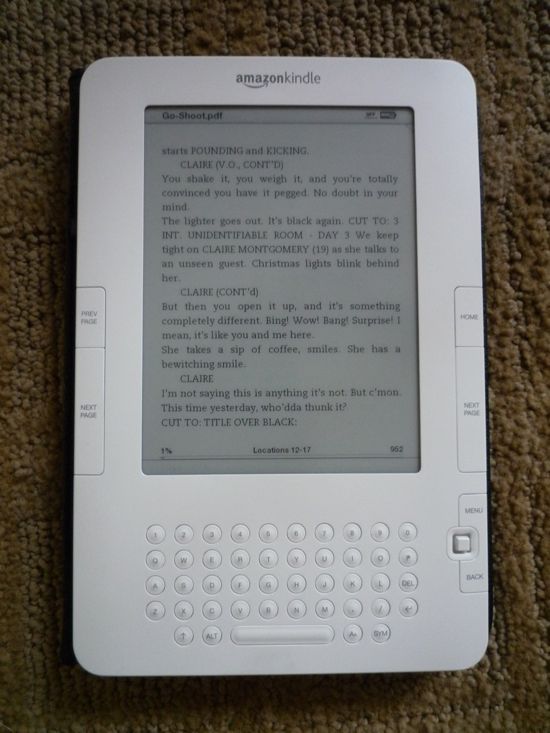
Many friends and readers have written to ask, so I thought I’d bump this note out of the comment thread. The new Kindle is terrific for books. But it doesn’t yet handle formatted text like screenplays well at all.

This is a sample of Go, converted from pdf:

kindle screen

(I’ve gotten roughly the same results when sending it in Word format.)

Are you an unemployed coder? A wanna-be web entrepreneur? Are you Nima?

Consider this a call to adventure. I’m envisioning a web service to which you could submit (or email) a screenplay pdf (or text file) and have it sent to your Kindle, nicely formatted. Charge a nickel for it, or just do it for free until Amazon buys you out.

Answer Finder

March 2, 2009 Geek Alert, Meta, QandA, Scrippets

I’ve had some version of this site up and running since 2003, when I became frustrated with how difficult it was to search through previous columns I’d written for IMDb. ((Remarkably, they’re still running these, even though it’s been years since I’ve written a new one.))

Unlike most blogs, ((I’m using “blog” in the 2009 sense of a series of short posts arranged chronologically, newest first. That is: a blog is a blog because of the way it’s formatted, not because of the content per se. It’s easy to forget that the term blog originally referred to weblogs, or online personal journals.)) many of the 1,000+ posts on this site are still highly relevant today. They’re answers to reader-submitted questions, and most of the questions haven’t changed. It’s often difficult to find these older entries, however, and the chronological blog format doesn’t help. I’ve struggled to find ways to make it easier to dig around.

The category archives at the bottom of (almost) every page are a start. Clicking on Education, for example, will take you to a listing of all the articles in that category, along with brand-new summaries — most of them written by Matt.

Another option is what I’m calling Answer Finder, which takes all the screenwriting-related entries and groups them together in a much more browsable interface. It’s an experiment, and your feedback is certainly appreciated. Two caveats:

  • There are known issues with Internet Explorer. In particular, the category box appears too far down the page. It’s a problem with IE’s box model, and if someone wants to grab the CSS and fix it, knock yourself out.
  • Some of the older entries have weird formatting, particularly with scrippets, because the specs have changed over the years. One by one, we’ll be going through old posts and fixing them. But if you see something wonky, feel free to note the URL in the comments to this post.

geek alertFor the truly curious, here’s how Answer Finder works. (You’re welcome to look at the source, of course.)

  1. Getting both categories and posts out of WordPress is more difficult than you’d think, which is why I’m happy to have found the plugin WP Categories and Posts.
  • I hacked the plugin to make it generate DIVs for each category. ((When I say “hack,” I really mean it. It works because it works, not because I really understand it. PHP makes baby Jesus cry.))

  • With a custom page template (an under-appreciated WordPress feature), I used jQuery to hide the DIVs, bind the category menu and place a session cookie to help you come back to the same place when navigating away. ((jQuery, by the way, is awesome. It lets a barely-programmer like me leverage a lot of CSS knowledge. And I have new respect for JavaScript, which is more Pythonic than I was anticipating. Given the speed boosts in the new Safari and Google Chrome, I’m looking forward to seeing what ambitious ideas will be coming down the pipe in 2009.))

  • Let me know how the new page is working, or not working, over the next week. You may see periodic downtime or wonkiness while things get sorted out.

    « Previous Page
    Next Page »

    Primary Sidebar

    Newsletter

    Inneresting Logo A Quote-Unquote Newsletter about Writing
    Read Now

    Explore

    Projects

    • Aladdin (1)
    • Arlo Finch (27)
    • Big Fish (88)
    • Birdigo (2)
    • Charlie (39)
    • Charlie's Angels (16)
    • Chosen (2)
    • Corpse Bride (9)
    • Dead Projects (18)
    • Frankenweenie (10)
    • Go (29)
    • Karateka (4)
    • Monsterpocalypse (3)
    • One Hit Kill (6)
    • Ops (6)
    • Preacher (2)
    • Prince of Persia (13)
    • Shazam (6)
    • Snake People (6)
    • Tarzan (5)
    • The Nines (118)
    • The Remnants (12)
    • The Variant (22)

    Apps

    • Bronson (14)
    • FDX Reader (11)
    • Fountain (32)
    • Highland (75)
    • Less IMDb (4)
    • Weekend Read (64)

    Recommended Reading

    • First Person (87)
    • Geek Alert (151)
    • WGA (162)
    • Workspace (19)

    Screenwriting Q&A

    • Adaptation (65)
    • Directors (90)
    • Education (49)
    • Film Industry (489)
    • Formatting (128)
    • Genres (89)
    • Glossary (6)
    • Pitches (29)
    • Producers (59)
    • Psych 101 (118)
    • Rights and Copyright (96)
    • So-Called Experts (47)
    • Story and Plot (170)
    • Television (165)
    • Treatments (21)
    • Words on the page (238)
    • Writing Process (177)

    More screenwriting Q&A at screenwriting.io

    © 2026 John August — All Rights Reserved.