• Skip to primary navigation
  • Skip to main content
  • Skip to primary sidebar

John August

  • Arlo Finch
  • Scriptnotes
  • Library
  • Store
  • About

QandA

Hulu is not dead to me

October 28, 2009 Film Industry, Rant

CNET has good interview with Eric Garland, the CEO of media measurement company Big Champagne, talking about file sharing and the future of film and television.

Most of his points aren’t new, but they’re delivered in less-hysterical terms than you often see.

The music people used to say, “How can you can compete with free?” And now you ask anybody in digital music and they’ll tell you, “I’m just trying to compete effectively with free.” They’ve embraced the very condition that up until very recently they said they would reject. I’m telling you, you are going to compete with free. Sometimes you’re even going to win, once you make the commitment to living in the marketplace as it is and not as you wish it were or as it once was.

Garland shares my sympathy for international viewers, who are often told to wait months for movies that the U.S. gets on day one. If you don’t give the audience a convenient and legal way to watch something, they’re going to find a convenient and illegal way. And it’s hard to blame them.

I have much less sympathy for users outraged that Hulu is going to start charging. “Hulu is dead to me” is the common refrain on messageboards and Twitter.

But here’s the thing: you don’t have a god-given right to free shows, just as you can’t walk into Barnes and Noble and start shoving books in your backpack. We’ve conflated the ideas of intellectual liberty and zero cost into a big bundle of entitlement.

While I disagree with many points in Chris Anderson’s Free
, he makes a useful distinction between flavors of “free.” I’d argue that movies and television need to be free as in accessible — by a global audience on their timetable. But you can have that kind of free without setting the price at zero. In fact, charging for something often makes it more accessible, by making it economically worthwhile to keep the systems running.

Right now, Hulu competes very effectively with free torrents on price. But if it chooses to move to a subscription model, it can ultimately offer more content at higher speeds, allowing it to compete better with free torrents on access.

Netflix is often seen as a tremendous bargain, offering a vast selection of movies and TV on demand for a low subscription price. That’s what Hulu may morph into, and that’s not cause for alarm.
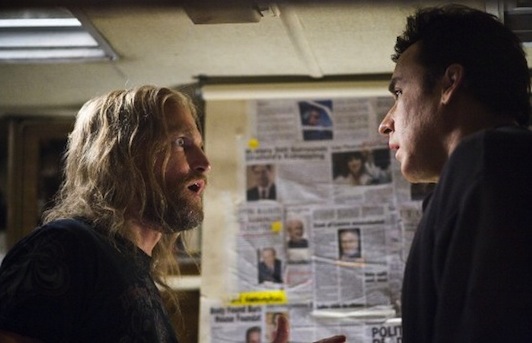
The wall of newspaper clippings

October 23, 2009 Rant, Words on the page

newspaper clippings

Gary Whitta wrote in with his proposed moratorium: the wall of expository newspaper clippings. They’re a movie staple, but I’ve never seen one of these in real life.

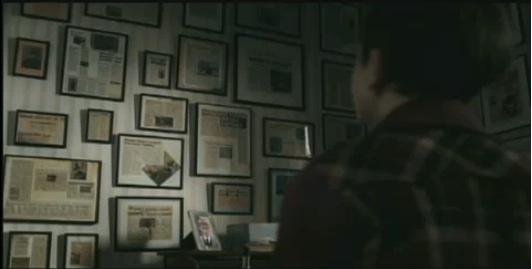
However, I have in fact seen parents’ shrines to their children’s accomplishments, which is why I’m (barely) able to give myself a pass for this moment at the end of Charlie and the Chocolate Factory:

charlie clippings

Part of the difference may literally be the framing. Newspaper clippings pinned to the wall reads as crazy/obsessive. Clippings nicely mounted and hung reads simply as pride.

Breathe, damnit!

October 22, 2009 Words on the page

My friend Rawson points out his most-hated movie cliché, one that’s due for a moratorium:

Jack continues mouth-to-mouth, but Lara shows no sign of coming around.

JACK

(desperate)

Breathe, damnit!

A beat, then Lara suddenly COUGHS back to life, spitting up a palm-full of water.

She looks around, disoriented. Then sees Jack looking down at her. Smiles.

Double negative points for saying something quippy after being revived.

Making Christian movies

October 22, 2009 Film Industry, Genres, Indie, QandA

questionmarkWhat is your take on the Christian movie scene?

I am new to all of this and just finished up a treatment for a Christian movie. I have been doing some research now on a few specific things and trying to read as much as I can on screenwriting. I just wonder if given the climate we are all living in if this is a good genre to focus on?

— Kimberlee
Denver, CO

It’s absolutely a valid niche/scene. Every year a few capital-c Christian movies — some starring Kirk Cameron — do serious business both theatrically and on video. But there are many more Christian films made that find an audience, even if they don’t make millions. So if that segment appeals to you, go for it.

A few points of advice — which could apply to almost any specially-targeted film:

1. **Pick your sweet spot.** A “Christian audience” is too broad a category. Are you making a film for teenage youth groups, or moms who sing in choir? Both are valid, but there’s not a lot of overlap. Know your target viewer precisely.

2. **Follow the examples.** Christian films are notable both for their themes and their omissions (sex, profanity, drug use). Study the successful movies of the past few years and figure out what your audience expects from this category — and just as importantly, which elements are deal-killers.

3. **Figure out the players.** Specialty films have specialty distributors. In the case of Christian films, you’ll likely find companies with a track record of marketing films through religious channels. They’re the people you’re going to want to release your film. You may even find a specific director just right for your script.

4. **Aspire to be the best in your category.** Films targeted at specialty audiences — Christian tweens, Latina lesbians, extreme skiers — can sometimes find success simply because they exist. These audiences seek them out, even if they’re not particularly good, because they want to see their lives and values portrayed on screen. But don’t let that be an excuse for making a mediocre movie. In the long run, quality always counts.

You want this to be your first movie, not your last. Be sincere and smart. You never want it to seem like a stepping stone to “real” movies — but of course, with success, those opportunities could come.

« Previous Page
Next Page »

Primary Sidebar

Newsletter

Inneresting Logo A Quote-Unquote Newsletter about Writing
Read Now

Explore

Projects

  • Aladdin (1)
  • Arlo Finch (27)
  • Big Fish (88)
  • Birdigo (2)
  • Charlie (39)
  • Charlie's Angels (16)
  • Chosen (2)
  • Corpse Bride (9)
  • Dead Projects (18)
  • Frankenweenie (10)
  • Go (29)
  • Karateka (4)
  • Monsterpocalypse (3)
  • One Hit Kill (6)
  • Ops (6)
  • Preacher (2)
  • Prince of Persia (13)
  • Shazam (6)
  • Snake People (6)
  • Tarzan (5)
  • The Nines (118)
  • The Remnants (12)
  • The Variant (22)

Apps

  • Bronson (14)
  • FDX Reader (11)
  • Fountain (32)
  • Highland (75)
  • Less IMDb (4)
  • Weekend Read (64)

Recommended Reading

  • First Person (87)
  • Geek Alert (151)
  • WGA (162)
  • Workspace (19)

Screenwriting Q&A

  • Adaptation (65)
  • Directors (90)
  • Education (49)
  • Film Industry (489)
  • Formatting (128)
  • Genres (89)
  • Glossary (6)
  • Pitches (29)
  • Producers (59)
  • Psych 101 (118)
  • Rights and Copyright (96)
  • So-Called Experts (47)
  • Story and Plot (170)
  • Television (165)
  • Treatments (21)
  • Words on the page (238)
  • Writing Process (177)

More screenwriting Q&A at screenwriting.io

© 2026 John August — All Rights Reserved.