• Skip to primary navigation
  • Skip to main content
  • Skip to primary sidebar

John August

  • Arlo Finch
  • Scriptnotes
  • Library
  • Store
  • About

QandA

Reading scripts on the iPad

April 3, 2010 Film Industry, Geek Alert, Reading

Screenplays are almost always distributed as .pdfs, so many screenwriters (and other film-and-TV-types) have been hoping that the iPad’s large screen and innate support for .pdfs would make it an ideal reading device.

Steve Jobs heard your prayers. It’s really, really good for reading scripts.

The iPad’s built-in apps handle .pdfs pretty transparently. Click a link in Safari, or an attachment in Mail, and the iPad shows you a very accurate Quick Look. For something short like a scanned article, it’s dandy.

But the default reader doesn’t scale well to screenplays:

  • Screenplays are long. They average around 120 pages — and there’s no way to skip ahead to page 48 without frantic swiping.
  • You can’t mark your place. Click the home button and you’re back to page one.
  • You can’t search. In an electronic version, you should really be able to find the first time HORATIO speaks.
  • You can’t annotate, highlight or copy. You’re really just seeing a picture of the document, not the words themselves.

App Store to the rescue

iconAs of this writing — on iPad’s launch day — there are at least six dedicated .pdf readers in the App Store. My favorite at the moment is GoodReader – Tablet Edition, which is currently priced at 99 cents. There will no doubt be more contenders in the weeks and months to come, so keep in mind this endorsement has an expiration date. It’s the best solution I’ve found today.

GoodReader has multiple ways of importing .pdfs. The most straightforward is Web Downloads. Use the built-in browser to poke around the web to the file you want, then let GoodReader slurp it in. Any of the scripts in the Library, for example, are clicks away.

Most of the scripts I read come attached to emails. All the readers in the App Store have means of shuffling these files from your computer to your iPad — most often through iTunes — but I wanted a solution that didn’t use an intermediary computer. That’s ultimately what put GoodReader ahead of the others.

GoodReader’s Connect to Servers tab lets you log in to your mail server and check for messages with attachments. Choose the message, select the .pdf you want to import, and it shows up in your sidebar. Keep in mind that GoodReader is actually accessing your mail account. This may make you (and your system administrators) uncomfortable. As a workaround, you may want to set up an email account (perhaps at Gmail) that is just for scripts you want to read. Forward scripts to that account, and give GoodReader that login info.

Just for reading

Once you have a .pdf open in GoodReader — or any of these apps — the experience is solid. Simple taps or gestures let you flip pages, while more-traditional scrollbars appear to let you zip ahead.
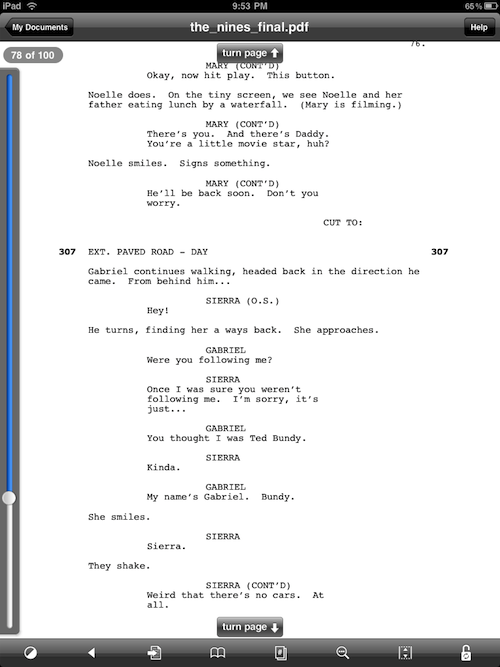
goodreader

This screenshot shows GoodReader at its most cluttered; a tap in the center makes all the UI go away. I found myself wanting to turn pages with taps on the edges like iBooks and Kindle, but an upward swipe ends up being fairly natural.

GoodReader has no markup or highlighters. Some of the competitors do, along with note-taking features. I often write on printed drafts of scripts, but will I ultimately do the same on the iPad? It’s too soon to tell.

All of these apps will get better. This article will quickly get outdated. But I’m happy to report that as of today, the iPad is already a much better reader for screenplays than anything that has come before it.

When two characters are played by the same actor

April 2, 2010 Formatting, Projects, QandA, The Nines, Words on the page

questionmarkIf a main part of a plot is that two characters look identical (but are not related…think the movie “Dave”), where/how in the script do I say they should be played by the same actor?
— Jeremy Kerr

As a general screenwriting rule, if it would be obvious to the viewer, make it obvious to the reader. Immediately after introducing the second character, include a hard-to-miss note explaining that the two characters are played by one actor.

PROFESSOR DONALD SCOTT isn’t your classic tweedy bookworm. With a short temper and a strong right hook, he’s more likely to settle arguments in back alleys than lecture halls.

[NOTE: Donald Scott and Thom Penn aren’t twins, but are played by the same actor -- for reasons that will soon become clear.]

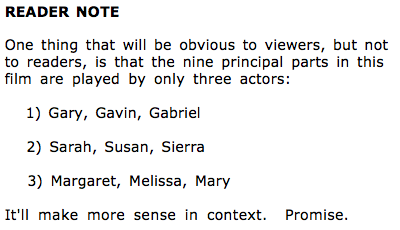
In the case of The Nines, a huge conceit was that the nine principal roles were played by three actors. I added a note just after the title page, so there was no chance a reader would miss it:

nines note

How to leave an agent

March 25, 2010 Film Industry, QandA

questionmarkI currently have a lit agent and a manager, both from boutique companies. I’ve been with them both for about three years. I like them a lot personally, but as I look back over the years, they have not produced a lot of results.

I have a feature script that won two writing competitions (one major), a drama serial pilot and a drama procedural pilot and am currently working on a thriller. The feature was optioned for a year, but nothing came of it. It’s about to be optioned again, both are for very little money from very small companies.

But they never seem to send my stuff out. I’ve only had one meeting of significance in the past three years that my agent got for me. Not one from my manager.

They are always very circumspect about exactly WHO is reading my material. And I always get the impression it’s because they are not sending it out. They say they love my writing, so why do they sit on it?

I think perhaps their strengths as representatives might not fit what I am writing. Their contacts and relationships aren’t of much value to me. But would they ever admit that?

If I decide to move on from one or both, what is the protocol?

In this climate, I’d rather not drop one of them before I have new representation. But it feels like bad form to give my material to people on the sly without them knowing, to see if there’s interest. But if I drop them before I know there’s interest, and I have trouble…I would have been better off keeping them and trying to work on it.

I feel like I’m stuck. Any advice?

— Raymond
Hermosa Beach

At this stage in your fledgling career, the job of both your agent and your manager is to put your work in the hands of people who might like it, then get you into rooms to meet with them. They can’t get you a job, or guarantee a sale. All they can do is help you make connections.

And they’re not doing it. So it’s time to change.

For readers new to this, a boutique agency is one with a relatively small group of agents and clients. Boutiques can be great, especially for writers and filmmakers with a very distinct sensibility that requires more careful positioning. ((In trying to think of examples of quirky filmmakers, I looked up Harmony Korine and Todd Solondz. It turns out they’re both at a giant agency, WME. But I stand by my general case.)) Because of the small size, you’re not going to be competing with your own agency’s clients for jobs. The downside is that a boutique agency isn’t going to have all the resources and information that a major agency would have.

My first agent was at a boutique; his name was on the door. He sent me out on dozens of meetings with the right level of junior executives — including Dan Jinks, who would ultimately produce Big Fish and The Nines. Everyone I met with loved my agent. My first two writing assignments were landed through my own contacts, but he made the deals and stood up for me. He was a good agent.

Unfortunately, our tastes didn’t really jibe. I wanted to write big Hollywood movies, while most of his clients worked on the (admittedly fascinating) periphery. Reading an early draft of Go, he didn’t see it as a movie. And I knew it was time to go.

It’s time to see other people
=====

Leaving an agent is breaking up. You’re telling someone who has been a friend and colleague that you believe someone else could do the job better. It’s going to hurt. Rip the Band-Aid off and deal with the sting.

Since you have both an agent and a manager, pick the one you think is the better fit and talk to him about your frustrations. If he has a list of ideas, consider them. If he tells you to keep things how they are, well, you need to leave him, too. It’s not working. Sticking around isn’t going to improve it.

Now is also the time to talk with trusted friends and colleagues about where you should go. The producers who just optioned your script may have opinions and recommendations. They might make some phone calls on your behalf.

Write something new and great
=====

You’ll be in a better position to sign a new agent or manager if you have something new to put in their hands. They’ll want to send out material no one has seen, so the thriller might be the thing. It needs to be great, better than the script that won you the awards.

Agents want clients who work. That’s why **the biggest change shouldn’t be who is representing you, but how you’re representing yourself.** As you take meetings, make them understand that you will work your ass off to land assignments, then work five times harder to deliver. Say it and mean it. Novelists can be hermetic artistes. Screenwriters have to be hunters, hucksters and hostage negotiators.

You don’t necessarily need to be at a bigger agency, though they’re often better equipped to handle both the TV and feature sides of your career. You’re wise to pursue both at full speed, by the way. Many writers ping-pong back and forth between the mediums.

Your question illustrates why most aspiring writers’ perception of the industry — *if I could only get an agent, then…* — is so naïve. Even with an agent, a manager and some acclaim, you’ve had a tough time moving from a spark of potential to an actual career.

Switching to new representation will only be an incremental improvement. The hard work will be capitalizing on their enthusiasm to make connections, set up projects, and write movies that get made.

(cont’d) vs. CONTINUOUS

March 17, 2010 Formatting, QandA

Via Twitter, I got a question about the variations on “continued” you often see in screenplays.

The first form, a contraction of the word, is widely used to indicate that the same character is speaking after an interrupting bit of scene description. Almost every screenplay you read will have it.

MARY

What’s wrong? Why are you smiling like that?

TOM

No reason.

Under the table, the dog begins licking the arch of Tom’s foot.

TOM (CONT’D)

Do you need any h-h-h-help with dessert?

Most screenwriting software will automatically generate the (cont’d), and you should let it. It’s standard, and particularly useful for actors. It’s your choice whether to have it be uppercase; (cont’d) or (CONT’D) are both fine. Pick one and stick to it. ((You may run into situations in which a character is both speaking and giving voice-over in a scene. Your software might try to flag those voiceovers as continuations of the character’s normal dialogue. Don’t let it.))

A related situation happens when a block of dialogue needs to extend off the bottom of the page. Screenwriting software will offer to put a (more), with a matching (cont’d) on the next page. Let it — though you might also consider tweaking the lines so that the dialogue doesn’t break there.

A second form of continued happens when a scene spans across multiple pages. If a scene continues off the bottom of a page, most screenwriting software will offer to put CONTINUED: at the top left of the next page, next to the scene number.

  A134 CONTINUED:

EDWARD

I have been nothing but myself since the day I was born. And if you can’t see that, it’s your failing, not mine.

You don’t need it. Turn it off.

The only time to use these continueds is when you’re headed into production, complete with a shooting schedule and scene numbers. They help reduce confusion when you have colored revision pages. Beyond that, they’re clutter. Get rid of them.

The final form of continued happens in scene headings. Some screenwriters use CONTINUOUS to indicate that action is ongoing despite changes of location:

INT. BEDROOM – NIGHT

Mary searches for Rex, checking under the bed.

INT. BASEMENT – CONTINUOUS

Tom WHISTLES, shaking Rex’s favorite toy.

I’m not a big fan of this use of continuous, because it’s all too easy to forget what time of day it’s supposed to be. In the (rare) cases in which I need to clarify that the action from one scene to the next is continuous, I put it in brackets.

EXT. BACKYARD – NIGHT [CONTINUOUS]

Rex digs his way under the fence.

« Previous Page
Next Page »

Primary Sidebar

Newsletter

Inneresting Logo A Quote-Unquote Newsletter about Writing
Read Now

Explore

Projects

  • Aladdin (1)
  • Arlo Finch (27)
  • Big Fish (88)
  • Birdigo (2)
  • Charlie (39)
  • Charlie's Angels (16)
  • Chosen (2)
  • Corpse Bride (9)
  • Dead Projects (18)
  • Frankenweenie (10)
  • Go (29)
  • Karateka (4)
  • Monsterpocalypse (3)
  • One Hit Kill (6)
  • Ops (6)
  • Preacher (2)
  • Prince of Persia (13)
  • Shazam (6)
  • Snake People (6)
  • Tarzan (5)
  • The Nines (118)
  • The Remnants (12)
  • The Variant (22)

Apps

  • Bronson (14)
  • FDX Reader (11)
  • Fountain (32)
  • Highland (75)
  • Less IMDb (4)
  • Weekend Read (64)

Recommended Reading

  • First Person (87)
  • Geek Alert (151)
  • WGA (162)
  • Workspace (19)

Screenwriting Q&A

  • Adaptation (65)
  • Directors (90)
  • Education (49)
  • Film Industry (489)
  • Formatting (128)
  • Genres (89)
  • Glossary (6)
  • Pitches (29)
  • Producers (59)
  • Psych 101 (118)
  • Rights and Copyright (96)
  • So-Called Experts (47)
  • Story and Plot (170)
  • Television (165)
  • Treatments (21)
  • Words on the page (238)
  • Writing Process (177)

More screenwriting Q&A at screenwriting.io

© 2026 John August — All Rights Reserved.