• Skip to primary navigation
  • Skip to main content
  • Skip to primary sidebar

John August

  • Arlo Finch
  • Scriptnotes
  • Library
  • Store
  • About

QandA

Writing for 3-D

April 26, 2010 Film Industry

As more of our big summer movies go 3-D, Steve Zeitchik wonders how it affects screenwriting:

But even as Hollywood goes z-axis crazy, many directors and writers are questioning the stampede. While they express a general enthusiasm for the form, they say executives don’t always grasp all the complexities of adding that extra dimension. As the 3-D storm continues to gather, they point out that 3-D will affect much more than whether a filmgoer picks up a pair of glasses: It will change what films get made, and even the very nature of cinematic storytelling.

I think that’s overstating it.

In the short term, yes, the rush towards 3-D may affect the kinds of movies that get greenlit. But the underlying “nature of cinematic storytelling” doesn’t tend to change much even in the face of tremendous technical innovations. Color and widescreen were both huge changes, but their impact on story and screenwriters were very minor. (Sync sound was obviously a Very Big Deal, since it allowed characters to speak.)

I’m currently writing a film which is designed to be black-and-white and 3-D. Reading the script, you’d never know it. A few times, I’ve had to remind myself not to describe things as red. But beyond a joke at the outset, I never needed to acknowledge the 3-D — just as I never mention the dolly or color-timing in scene description.

For screenwriters, 3-D is something that may come up in a pitch, but will have very little impact on the written word.

Numbers in dialogue

April 19, 2010 Formatting, QandA

questionmarkI’m writing a screenplay in which an administrator reads excerpts from a statistical report. I’m not quite sure how to write the numbers which he uses in dialogue. Should I use numerals? Words? Doesn’t matter?
— Marcus J

For dialogue, a screenwriter should use as few numbers as possible, and write them out unless it’s cumbersome to do so.

Write out:

* “We’ve got nineteen calls on hold.”
* “That joke’s got to be a hundred years old.”
* “Alaska may be the forty-ninth state, but it’s first in awesome.”
* “We have an unidentified craft, bearing thirty-one mark nine.”
* “This suit cost me five thousand. You stole yours from a hobo, I’m guessing.”

Use numbers for things like dates, codes and phone numbers:

* “According to this, he was born March 10th, 1970. That means he’s already forty.”
* “The combination is 21…34…17.”
* “Just call this number: 555-764-2002.”

In action lines, I generally spell out numbers less than ten. But I’ll happily break that rule if it looks better on the page. I never start a line with a numeral, and will favor unspecific counts when possible: a thousand stars rather than 1,000 stars.

Academy’s Film Noir series

April 19, 2010 Genres, Los Angeles, News

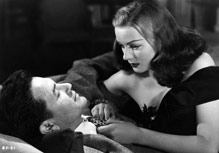
noirThe Academy is hosting a Monday night screening series focusing on film noir:

Fifteen film noir classics from the 1940s, all of which were nominated in the writing categories, will be celebrated in a summer-long screening series, introduced by contemporary screenwriters whose own work reflects the film noir style.

I’ll be handling “The Dark Mirror” on July 12. (Olivia de Havilland! Twins! Murder!)

It’s a unique chance to see these films on the big screen, with terrific prints.

Date Film
May 10 “The Maltese Falcon,” introduced by Lawrence Kasdan
May 17 “Shadow of a Doubt”
May 24 “Laura,” introduced by Scott Frank
June 7 “Double Indemnity,” introduced by Nicholas Meyer
June 14 “Mildred Pierce,” introduced by Callie Khouri
June 21 “The Killers,” introduced by Billy Ray
June 28 “The Strange Love of Martha Ivers,” introduced by Robin Swicord
July 12 “The Dark Mirror,” introduced by John August
July 19 “The Blue Dahlia,” introduced by Wesley Strick
July 26 “The Stranger”
August 2 “Body and Soul”
August 9 “Crossfire,” introduced by Brian Helgeland
August 16 “A Double Life”
August 23 “Kiss of Death”
August 30 “White Heat”

Tickets are $5, or $30 for the entire series. It may sell out, so if you’re interested, reserve now.

Should she take anxiety medication?

April 16, 2010 Psych 101, Random Advice

questionmarkI was recently prescribed an anti-anxiety medication, but it’s just sitting there on my desk, untouched. My concern is that it will affect my ability to work — I am a writer, in a Graduate program, coming to the end of the second semester of my second year (of three). Now is absolutely not the time to be inhibited in any way.

On the other hand, I was prescribed it for a reason, advised to take it on an “as-needed, it’s-up-to-you” basis. But I was also advised that the medication could cause drowsiness, an inability to focus, etc. So what would you do?

Say you had to have a second draft of a new screenplay, a first draft of an original TV pilot, a spec script for another TV show, 2 short scripts and a 20-page essay due for… an entertainment magazine (yes, this is an accurate reflection of what I need to finish in the next… 20 days or so), would you take a chance and pop a pill? Or power through and hope the stress does not overwhelm you?

— Jenny
New York

random adviceFollow the directions on the label: take it when you need it.

I’m not a doctor or pharmacist, but unless they told you otherwise, you don’t need to take it prophylactically, the way you take medication for depression or other conditions. If at this very moment you are spinning with anxiety that needs to be shot down, take the pill. Maybe it will help. Maybe it won’t.

My only experience with anxiety medication is Xanax. I take it so I can sleep on international plane flights. ((Yes, for sleeping on planes there are other medications I could take that are strictly sleep-related. But Xanax works and doesn’t make me freak out, binge eat or forget the past few hours. So I’m sticking with it.)) A writer/producer I worked with years ago took it much more casually, half a Xanax with a glass of wine at lunch.

It made him calm, which made my life less stressful. But his productivity was functionally nil.

Anxiety medication isn’t going to help you write. It may help keep you from running full speed off a cliff of panic.

More than any pill, you need some serious work intervention. There is no way you’re going to write all of those projects, so you’re better off dropping a few now rather than waiting for missed deadlines to drop them for you.

Aim for smaller victories to avoid bigger defeats.

Write the thing for which you’re being paid. If that’s the magazine piece, buckle down and get it done way ahead of schedule. Then take half a day, see a movie, and get started on the next most important project.

In a graduate school writing program, your grades don’t matter at all. So disabuse yourself of all valedictorian fantasies, or the desire to make your professors happy. You’re much better off leaving with two great scripts than eight decent ones. Don’t waste time writing things you don’t believe in.

Play this smart, and you may never need to open that bottle. But if you do, don’t beat yourself up over it.

Our brains are wired for a completely different existence, one with lions and bears trying to eat us. Your neurochemistry treats a spec pilot like a predator. It may need some help sorting itself out.

« Previous Page
Next Page »

Primary Sidebar

Newsletter

Inneresting Logo A Quote-Unquote Newsletter about Writing
Read Now

Explore

Projects

  • Aladdin (1)
  • Arlo Finch (27)
  • Big Fish (88)
  • Birdigo (2)
  • Charlie (39)
  • Charlie's Angels (16)
  • Chosen (2)
  • Corpse Bride (9)
  • Dead Projects (18)
  • Frankenweenie (10)
  • Go (29)
  • Karateka (4)
  • Monsterpocalypse (3)
  • One Hit Kill (6)
  • Ops (6)
  • Preacher (2)
  • Prince of Persia (13)
  • Shazam (6)
  • Snake People (6)
  • Tarzan (5)
  • The Nines (118)
  • The Remnants (12)
  • The Variant (22)

Apps

  • Bronson (14)
  • FDX Reader (11)
  • Fountain (32)
  • Highland (75)
  • Less IMDb (4)
  • Weekend Read (64)

Recommended Reading

  • First Person (87)
  • Geek Alert (151)
  • WGA (162)
  • Workspace (19)

Screenwriting Q&A

  • Adaptation (65)
  • Directors (90)
  • Education (49)
  • Film Industry (489)
  • Formatting (128)
  • Genres (89)
  • Glossary (6)
  • Pitches (29)
  • Producers (59)
  • Psych 101 (118)
  • Rights and Copyright (96)
  • So-Called Experts (47)
  • Story and Plot (170)
  • Television (165)
  • Treatments (21)
  • Words on the page (238)
  • Writing Process (177)

More screenwriting Q&A at screenwriting.io

© 2026 John August — All Rights Reserved.