
Daniel Wallace, author of the novel Big Fish, has opened his own website with information about his books, illustrations and screenplays. It’s great. In fact, it has me sick with envy. Daniel even has links through which you can buy his books from Amazon — which you should, because that way he’ll get an extra couple percent in addition to royalties.  And if that gets him to write more, well, you’ve done your part to make the world better.
Projects
New Big Fish paperback
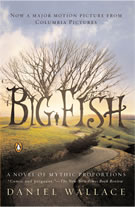
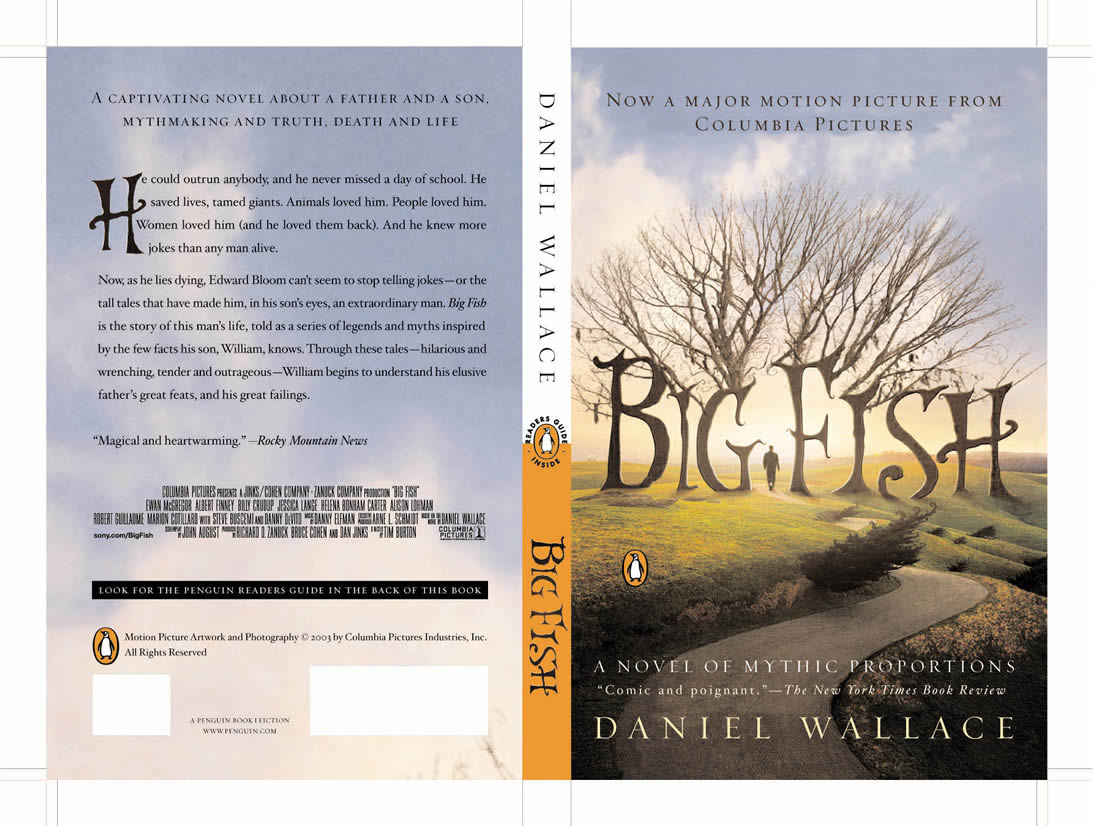
Penguin is issuing a special paperback version of Daniel Wallace’s “Big Fish” with the new cover artwork. (You can see the bigger version of it here.) The cover is essentially the same as the upcoming one-sheet poster.
Writers on art direction and cinematography
I am a film school student in southern CA, and I just saw
a preview for CHARLIE’S ANGELS. I was very intrigued with the mis-en-scene
of the picture and I wonder: How much influence does the writer (in this case)
have
over the
art direction
and style of photography?
–Anonymous
Well, clearly you’re a film student because you used the term "mis-en-scene."
In the case of CHARLIE’S ANGELS, I was more involved than usual during pre-production because of the overall coolness of the director, McG, and production issues
that would end up affecting the script. So I saw storyboards and got to know
Russell Carpenter, the director of photography. But that’s the exception, rather
than the rule.
In general, a writer doesn’t have a lot of direct input on the art direction
or photographic style of the movie. Unless it’s important, you don’t mention
the color of the walls or whether the light is incandescent or fluorescent.
Not only would all these details piss off the people whose job it is to make
these decisions, they would make your screenplay unreadable.
That said, remember that it is the screenwriter’s job to evoke the experience
of watching the movie through words. Somehow, you have to give a sense of the
visual style of the movie without mentioning it all the time. For instance,
CHARLIE’S ANGELS tweaks a lot of the conventions of the original TV show, with
triptychs and wipes, so when appropriate I included those in the movie. And
the plot itself lent a lot to the visual style, setting it entirely in Southern
California and featuring three beautiful women who go undercover in all sort
of disguises.
How much description is too much? The first time your script visits a location,
you can give a sentence or two to describe it. More if you really have to.
And if a character is wearing something important to the plot, you absolutely
need to describe it.
Reading reviews
I was wondering,
do you read reviews of films you’ve worked on? When you’re in a bookstore,
do you go to the film section and check out how many stars Maltin or Ebert
have given the films?
–Brenton
Thanks to the Internet, not only can I read what Maltin and Ebert say about
my movies, I can find out what the Pioneer Press and the Times of London thought.
And yes, I read them obsessively when the movie comes out, to the point where
I’ll be at my computer from midnight until 2:30 a.m. reading the Friday morning
reviews online, before the papers are even printed.
In addition to the "Reviews" links on IMDB, I love Rotten Tomatoes
because it gathers the reviews from thirty or forty different sources. I also
read the "User Comments" section on IMDB,
and sometimes the various be-your-own critic sites.
Honestly, my fondness for reading reviews is more a function of pride than
vanity. I don’t get excited reading my own name, but rather seeing what someone
thought of my baby. And of course, my attachment varies based on my involvement.
For GO and CHARLIE’S ANGELS, I was a veritable soccer mom. TITAN A.E., on the
other hand, was like a friend from summer camp you were never sure you’d see
again.