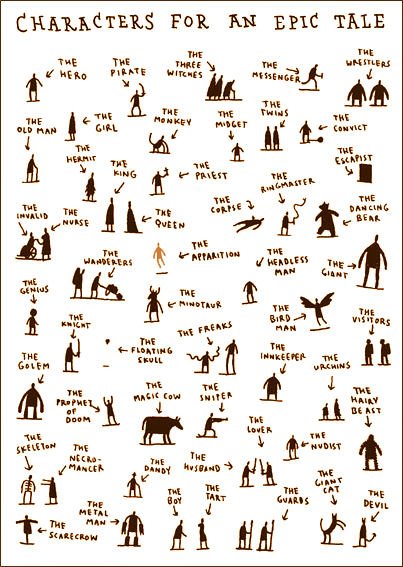
 Useful reference for all writers. (via Team Forty).
UPDATE: Thanks to Chris for the link to the artist, Tom Gauld.
SECOND UPDATE: Because I was curious…
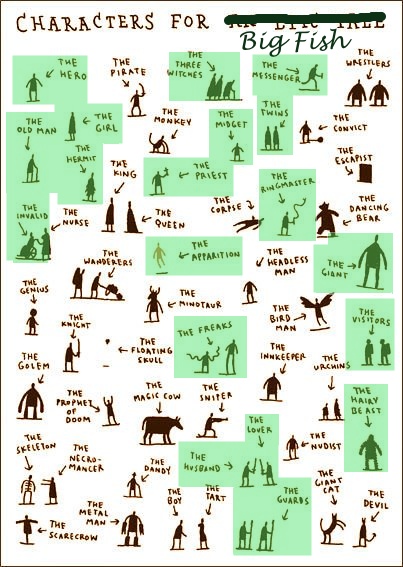
Useful reference for all writers. (via Team Forty).
UPDATE: Thanks to Chris for the link to the artist, Tom Gauld.
SECOND UPDATE: Because I was curious…
Having a cold in the age of the internet gives you none of the TV-watching, bed-resting benefits. You’re typing and clicking just a little more slowly than usual.
One page of screenplay translates to one minute of movie. Since most movies are a little under two hours long, most screenplays should be a little less than 120 pages.
That’s an absurd oversimplification, of course.
One page of a battle sequence might run four minutes of screen time, while a page of dialogue banter might zip by in 30 seconds. No matter. The rule of thumb might as well be the rule of law: any script over 120 pages is automatically suspect. If you hand someone a 121-page script, the first note they will give you is, “It’s a little long.” In fact, some studios will refuse to take delivery of a script over 120 pages (and thus refuse to pay).
So you need to be under 120. ((But! But! you say. In the Library)), both Big Fish and Go are more than 120 pages. I’m not claiming that longer scripts aren’t shot. I’m saying that if you go over the 120 page line, you have to be doubly sure there’s no moment that feels padded, because the reader is going in with the subconscious goal of cutting something. ((Go is 126 pages, but it’s packed solid. Big Fish meanders, but those detours end up paying off in the conclusion.))
Which usually means you need to cut.
Before we look at how to do that, let’s address a few things you should never do when trying to cut pages, no matter how tempting.
Don’t tweak margins. With the exception of Widow Control (see below), you should never touch the default margins: an inch top, bottom and right, an inch-and-a-half on the left. ((Page numbers, scene numbers, “more” and “continued” are exceptions.))
Don’t mess with the font. Screenplays are 12-pt Courier. If you try a different size, or a different face, your reader will notice and become suspicious.
All of these don’ts could be summarized thusly: Don’t cheat. Because we really will notice, and we’ll begin reading your script with a bias against it.
There are two kinds of trims we’ll be making: actual cuts and perceived cuts. Actual cuts mean you’re taking stuff out, be it a few lines, scenes or sequences. Perceived cuts are craftier. You’re editing with specific intention of making the pages break differently, thus pulling the end of the script up. Perceived cuts don’t really make the script shorter. They just make it seem shorter, like a fat man wearing stripes.
Fair warning: Many of these suggestions will seem borderline-OCD. But if you’ve spent months writing a script, why not spend one hour making it look and read better?
At this length, perceived cuts will probably get you where you need to be. (That said, always look for bigger, actual cuts. Remember, 117 pages is even better than 120.)
Practice Widow Control. Widows are those little fragments, generally a word or two, which hog a line to themselves. You find them both in action and dialogue.
HOFFMAN
Oh, I agree. He’s quite the catch, for a fisherman. Caught myself trolling more than once.
If you pull the right-hand margin of that dialogue block very, very slightly to the right, you can often make that last word jump up to the previous line. Done right, it’s invisible, and reads better.
I generally don’t try to kill widows in action lines unless I have to. The ragged whitespace helps break up the page. But it’s always worth checking whether two very short paragraphs could be joined together. ((I try to keep paragraphs of action and scene description between two and six lines.))
Watch out for invisible orphans. Orphans are short lines that dangle by themselves at the top of page. You rarely see them these days, because by default, most screenwriting programs will force an extra line or two across the page break to avoid them. ((While I rag on the program, Final Draft is smart enough to break lines at the period, so sentences always stay intact. It’s a small thing, but it really helps the read. Other programs may do it now, too.))
Here’s the downside: every time the program does this, your script just got a line or two longer. So anytime you see a short bit of action at the top of the page, see if there’s an alternate way to write it that can make it jump back to the previous page.
Nix the CUT TO:’s. Screenwriters have different philosophies when it comes to CUT TO. Some use it at the end of every scene. Some never use it at all. I split the difference, using it when I need to signal to the reader that we’re either moving to something completely new story-wise, or jumping ahead in time.
But when I’m looking to trim a page or two, I often find I can sacrifice a few CUT TO’s and TRANSITION TO’s. So weigh each one.
At this level, you’re beyond the reach of perceived cuts. You’re going to have to take things out. Here are the places to look.
Remove unnecessary set-ups. When writing a first act, your instinct is to make sure that everything is really well set up. You have a scene to introduce your hero, another to introduce his mom, a third to establish that he’s nice to kittens. Start cutting. We need to know much less about your characters than you think. The faster we can get to story, the better.
Get out of scenes earlier. Look at every scene, and ask what the earliest point is you could cut to the next scene. You’ll likely find a lot of tails to trim.
Don’t let characters recap. Characters should never need to explain something that we as the audience already know. It’s a complete waste of time and space. So if it’s really important that Bob know what Sarah saw in the old mill — a scene we just watched — try to make that explanation happen off-screen.
For example, if a scene starts…
BOB
Are you sure it was blood?
…we can safely surmise he’s gotten the necessary details.
Trim third-act bloat. As we cross page 100 in our scripts, that finish line become so appealing that we often race to be done. The writing suffers. Because it’s easier to explain something in three exchanges of dialogue than one, we don’t try to be efficient. So you need to look at that last section with the same critical eyes that read those first 20 pages 100 times, and bring it up to the same level. The end result will almost always be tighter, and shorter.
Entire sequences are going to need to go away. This happens more than you’d think. For the first Charlie’s Angels, we had a meeting at 5 p.m. on a Friday afternoon in which the president of the studio yanked ten pages out of the middle of the script. There was nothing wrong with those scenes, but we couldn’t afford to shoot them. So I was given until Monday morning to make the movie work without them.
Be your own studio boss. Be savage. Always err on taking out too much, because you’ll likely have to write new material to address some of what’s been removed.
The most brutal example I can think of from my own experience was my never-sold (but often retitled) zombie western. I cut 75 pages out of the first draft — basically, everything that didn’t support the two key ideas of Zombie Western. By clear-cutting, I could make room for new set pieces that fit much better with the movie I was trying to make.
Once you start thinking big-picture, you realize it’s often easier to cut fifteen pages than five. You ask questions like, “What if there was no Incan pyramid, and we went straight to Morocco?” or “What if instead of seeing the argument, reconciliation and breakup, it was just a time cut?”
Smart restructuring of events can often do the work for you. A project I’m just finishing has several occasions in which the action needs to slide forward several weeks, with characters’ relationships significantly changed. That’s hard to do with straight cutting — you expect to see all the pieces in the middle. But by focussing on something else for a scene or two — a different character in a different situation — I’m able to come back with time jumped and characters altered.
Look: It’s hard to cut a big chunk of your script, something that may have taken weeks to write. So don’t just hit “delete.” Cut and paste it into a new document, save it, and allow yourself the fiction of believing that in some future script, you’ll be able to use some of it. You won’t, but it will make it less painful.
 To: FILE
From: Studio Development Group
Date: June 16, 2008
RE: PUZZLE FARTER, 6/2/08 draft
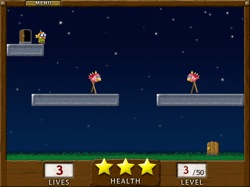
We think this draft represents progress from the 5/01/08 draft, but there are still areas that need to be addressed to make this the strongest possible casual videogame. As always, we look forward to discussing these issues with you.
We’re lacking a clear backstory and dramatic arc for Puzzle Farter. Why is this story happening to this character, now? Why is he so gassy? He is literally a fish out of water, but we never develop this idea.
Let’s consider PRETTY WOMAN as a template: Puzzle Farter is trying to navigate a world in which he doesn’t fit in, but in trying to understand it, reveals its absurdities. (And falls in love. See note #4.)
In this spirt, we’d like to consider adding an event (an “Inciting Incident”) early in the story, explaining how Puzzle Farter entered this world.
Also, Puzzle Farter needs to talk. He needs to clearly articulate his goals in a funny, relatable way. We see Joe Pesci for the role, but are open to other suggestions.
Currently, Puzzle Farter spends much of his time reacting to outside pressures. We would like to find ways to keep him more in charge of the narrative — and for his decisions to have a deeper resonance in the story.
For example, right now, his only response to threats is to jump or run. Can we see him kill or otherwise incapacitate the other characters (hopefully in a charming way)? Like Grand Theft Auto 4, we’d also like to see a mission-based interface which would allow the character to explore on his own. (The “sandbox” model.)
Also, we’d like a system for keeping track of gold points.
The addition of doors to each level has gone a long way towards making it clear what Puzzle Farter is attempting to achieve in each encounter. But we’re missing a bigger goal: What is Puzzle Farter hoping to find? What is his want? What does he need? (The conflict between these two questions can contribute a lot of second-act gravitas.)
Let’s consider adding a Fish Sister, who is kidnapped in the prologue. This would go a long way towards strengthening our Villain Plot.
Puzzle Farter needs a love interest, someone who can match him toot for toot. We think Rachel McAdams would be perfect.
Also, players need to be able to select gender, so as not to eliminate the gay gamer demographic.
The game needs to be multiplayer. We should also discuss making it a MMORPG.
To appeal to families, we need to be sensitive to content concerns. Let’s replace the farting with something less offensive.