• Skip to primary navigation
  • Skip to main content
  • Skip to primary sidebar

John August

  • Arlo Finch
  • Scriptnotes
  • Library
  • Store
  • About

John

Stack of Needles, and giving your characters too much of a good thing

June 24, 2015 Story and Plot, Writer Emergency Pack

Writers often create challenges for heroes by taking away something they desperately need or want. Billionaires go bankrupt. Children become orphans. Diamonds get dropped in the snow.

Faced with this setback, heroes must find new ways forward, often against staggering odds. In some cases, they’re searching of the proverbial needle in the haystack.

Like many of the cards in Writer Emergency Pack, Stack of Needles invites you to consider doing exactly the opposite.
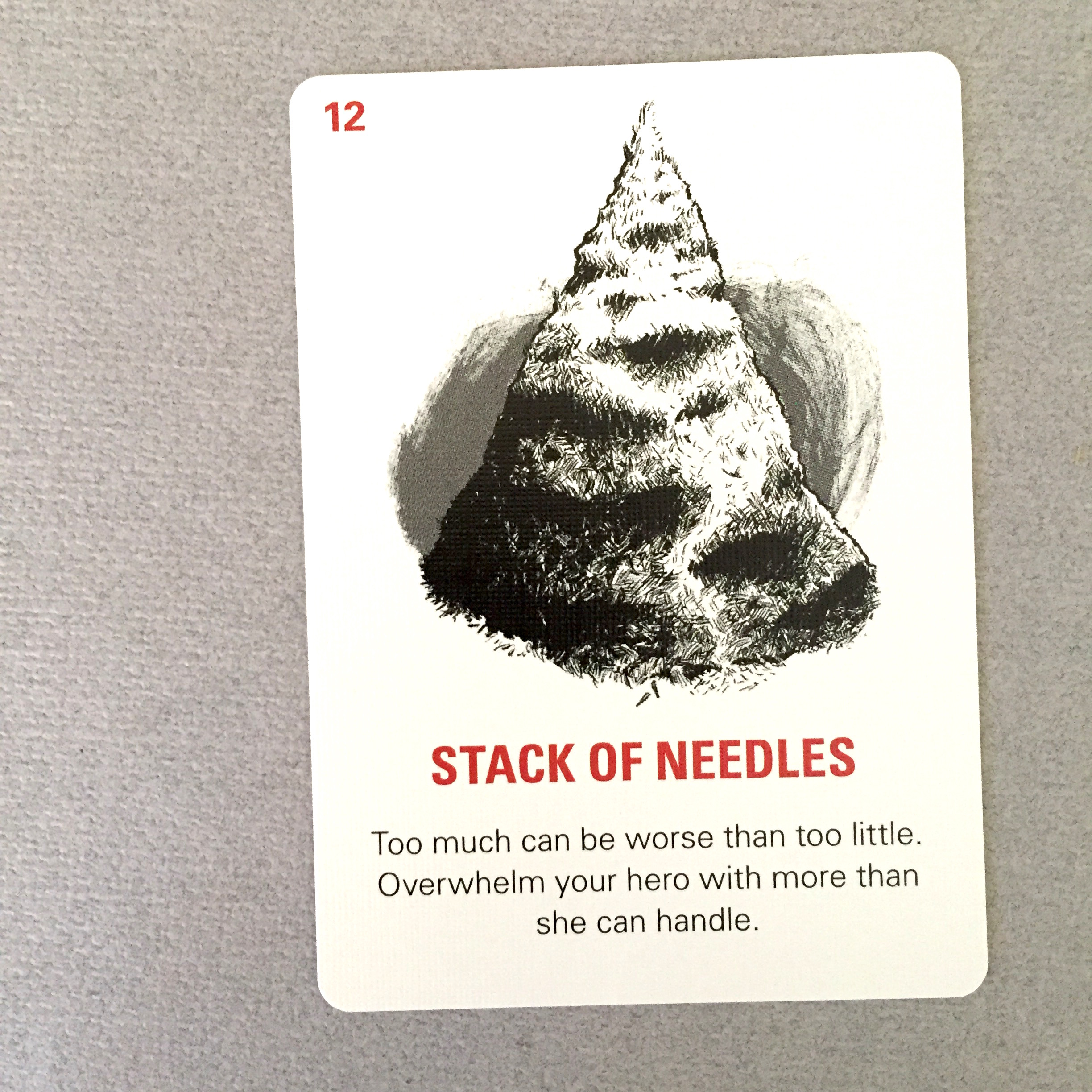
card

At first glance, Stack of Needles feels like a plot device — potentially an arbitrary one. You’re changing the trajectory of the story by introducing new elements.

Look a little deeper and you realize Stack of Needles can be a terrific way to reveal character. By giving your hero the thing she said she wanted, you force her to confront her true motivations, her future goals, and the burden of abundance.

“More tears are shed over answered prayers than unanswered ones.”
― Truman Capote
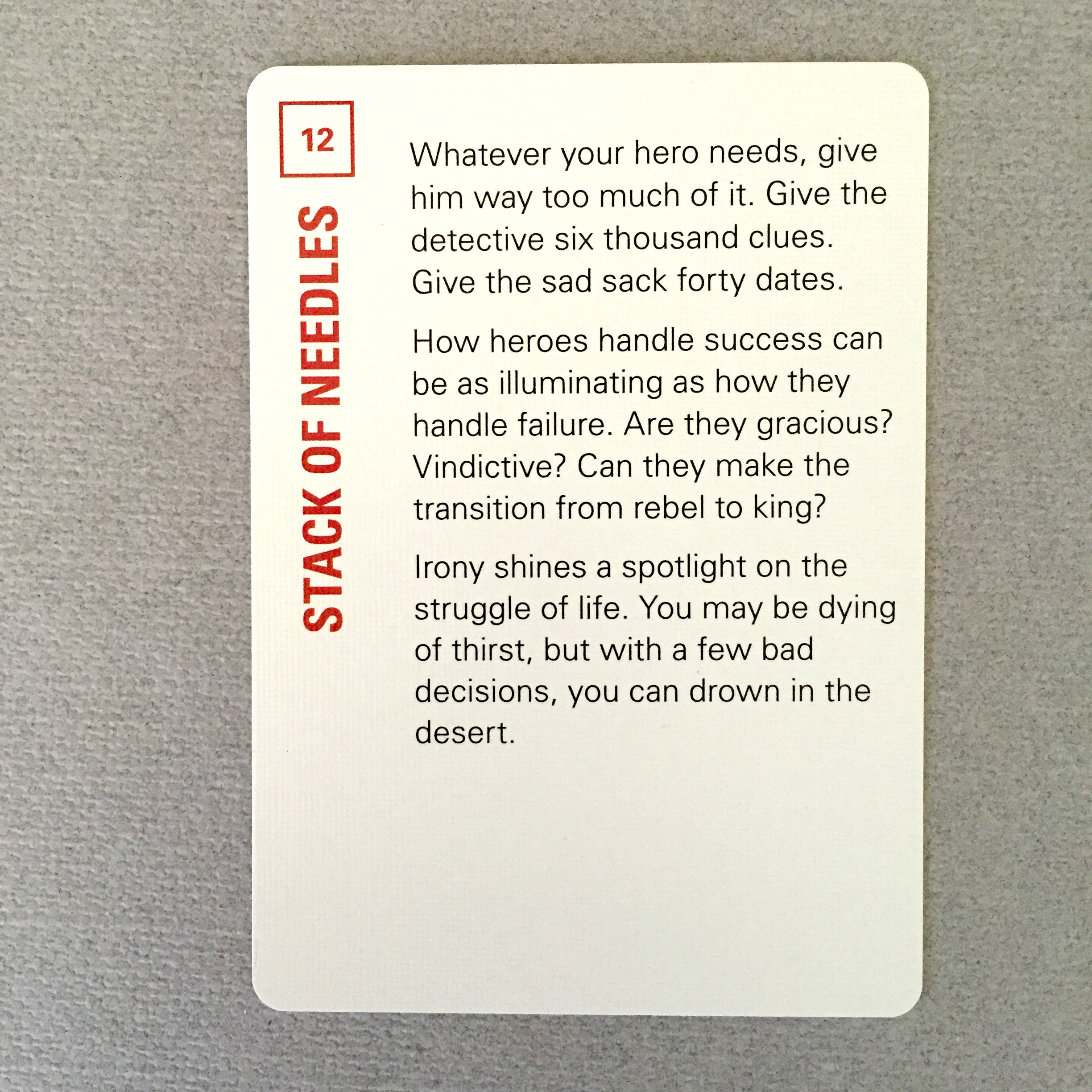
card

How much is too much?

In the second season of Silicon Valley, the small tech startup is frequently overwhelmed:

  • They raise too much VC money.
  • Hooli sends over hundreds of boxes of legal files, crowding them out of their living room.
  • Their dormant video feed suddenly goes viral, melting their servers.

In each of these cases, the heroes were challenged not by scarcity, but abundance. By getting what they wanted, they got screwed.
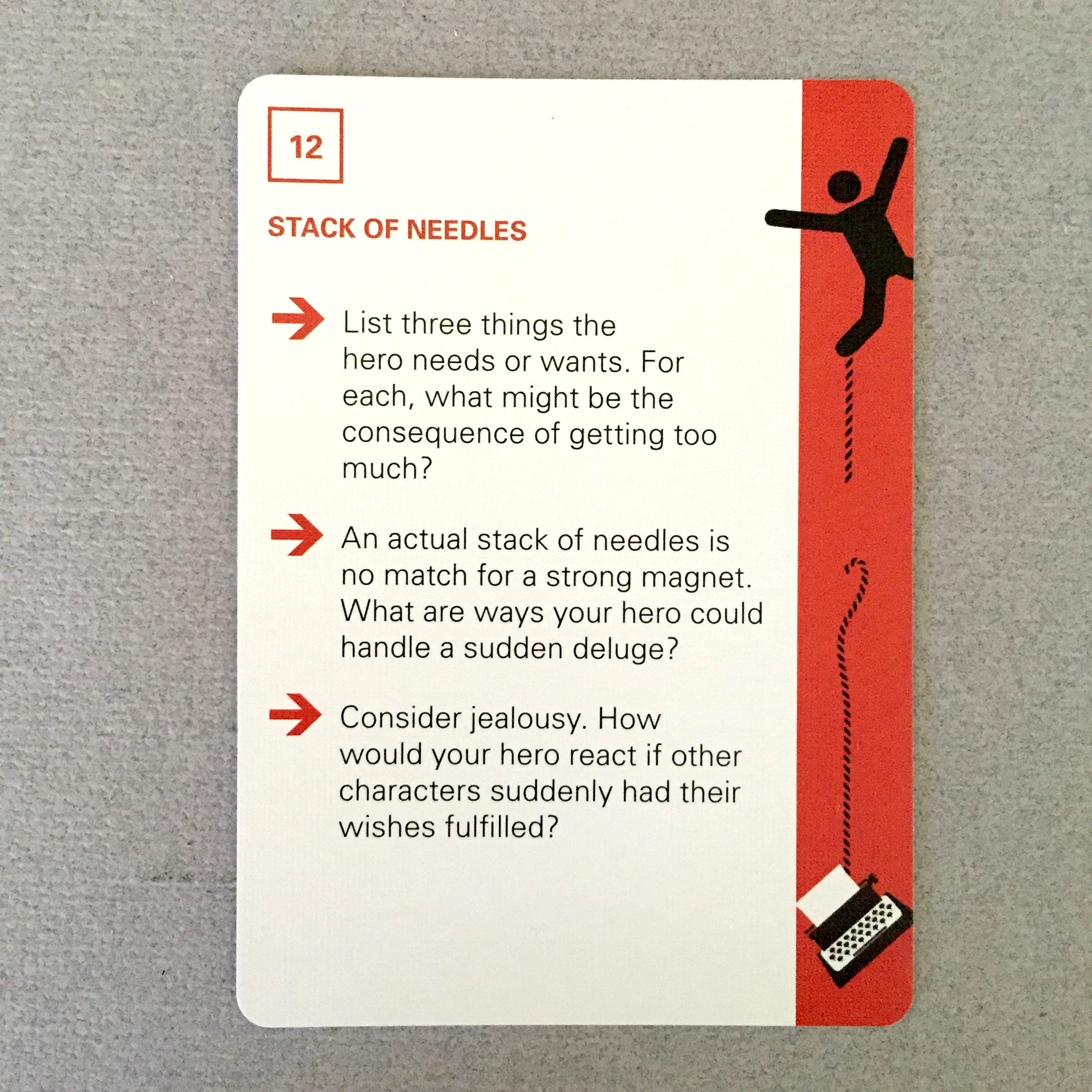
Stack of Needles Try This

The best consequences are the ones closely aligned with what the hero wants.

If your misanthropic baker wins the lottery, that’s not particularly special. But if his chocolate-horseradish muffins become a national obsession, that’s on-point and relevant. The thing he loves (baking) has brought him the thing he hates (people).

Sudden abundance forces characters to make choices they didn’t expect to make. When the pauper becomes a prince, will he bring his friends with him? When the zombie-outbreak survivors find a massive food cache, do they invite outsiders or close ranks?

Remember that nothing happens to just one character. Your hero’s success will affect everyone around her, for better or worse.

Using Stack of Needles

Like every card in Writer Emergency Pack, Stack of Needles can be used at both macro and micro levels of the story process.

Stack of Needles might be reflected in the main arc of your story. Does your hero struggle because of initial success? From Dreamgirls to Black Swan, many show-biz stories are built around this framework. Sequels often incorporate this idea as well, with the victorious heroes having to rediscover aspects of their earlier, simpler life.

On a sequence level, Stack of Needles works well as a mid-story twist. After finally discovering her real father’s name — Zebediah Obercampf — your hero will be frustrated to learn there are 100 men with that name living in the US.

Finally, Stack of Needles can be a great focus in a single scene. Your bank robber has just broken into the vault, but rather than one million dollars, he finds 100 million. Does he try to take it all? How will he get it out?

No matter how you use Stack of Needles, make the most of its much-ness. Give your hero more than he can handle, and watch what happens.


Stack of Needles is Card 12 of 26 in Writer Emergency Pack, which you can find in the Store and on Amazon.
When do characters deserve to die?

June 16, 2015 Genres, Psych 101, Story and Plot

Devin Faraci writes about the strange death of a certain character in Jurassic World (spoilers in the original article, but none here):

I would say it’s the most horrible death in the movie. It’s well-executed (oddly this could be the only set piece in the movie that is structured in a way to actually give weight and meaning to the action within it) but that execution only adds to how deeply disturbing it is. It’s possible that this is the most horrible death in the entire franchise, or at least that it is running neck and neck with the death of Richard Schiff in The Lost World. It’s gruesome and it’s painful and it’s protracted.

But, like, it’s a dinosaur movie! That’s what should happen, right? Sort of. Here’s what’s important to understand – and what Jurassic World does not understand – the deaths of your characters must be proportional, unless the unproportional nature of the death is, in and of itself, the point.

I saw Jurassic World over the weekend, and this one death also stuck out for me, because it didn’t feel deserved. Faraci tries to unpack what we mean by “deserved.”

Most often the character killed in these scenes brings about their own demise through their selfishness or cowardice. Evil characters also deserve it, and we find it truly satisfactory when they are destroyed – the bigger the bad guy, the more extravagant the death we want for them.

Death isn’t just for villains, obviously:

A good character can suffer a horrible death when saving other characters, or they can suffer a horrible death that is intended to illustrate just how bad the bad guy/monster really is. Predator is a great example of this, where characters we like get absolutely slaughtered. The key to all of these deaths, though, is that we feel something on some level. These aren’t slasher movie deaths, where the kids are glorified examples of background fodder getting offed – you will feel sad that the character died or proud that they stood their ground.

What makes this one death in Jurassic World so odd is that the character is neither hero nor villain. We’re not rooting for comeuppance, yet the sequence seems designed for exactly that — payback for a karmic debt owed.

I agree with Faraci that it feels like something got changed along the way. My hunch is that this death was originally intended for a villain — perhaps the same character, but with different scenes establishing gruesome-death-worthy motives — or that the sequence was originally designed to serve another purpose.

Or maybe it was always meant to be exactly how it plays in the movie, a giant WTF? On some level, I could respect that. The scene is noteworthy because it is so unexpected.

The movie I’m writing now has a considerable body count, so the question of who dies and how isn’t just theoretical.

Early deaths help establish the rules of the world. Late deaths create closure. It’s the middle deaths like this one in Jurassic World that are often the most challenging. Too mean-spirited, and you risk turning the audience against you. Too generic, and you’ve lessened the stakes for your hero.

Perhaps the key thing is that on-screen deaths should have an impact on the hero. When an established character dies just so the movie can kill someone, it feels hollow.

Really Short Stories

June 16, 2015 Big Fish, Words on the page

Daniel Wallace, who wrote the novel Big Fish, sent me the syllabus for the college writing class he’s teaching. I love the first week’s assignment:

Write a story as close to 100 words as possible, each and every word a single syllable.

Then write a story as close to 100 words as possible, a single syllable, but add this twist: no word can be used more than once.

For inspiration, he includes a link to 420 Characters.

The Automatic Gate

June 4, 2015 Genres, One Hit Kill

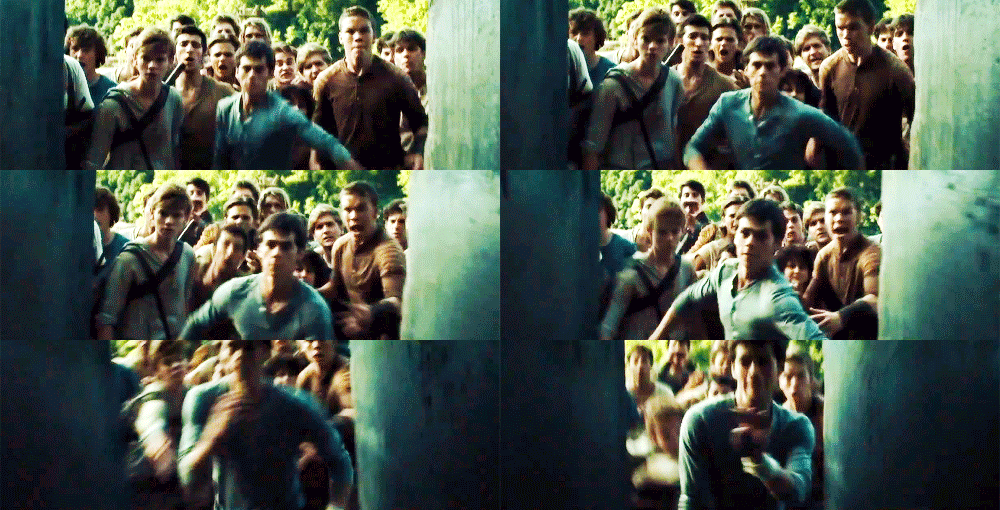
As a screenwriter, I’m always looking for ticking clocks to increase the tension in a story. One of my favorite sub-tropes is the Automatic Gate.

No matter what you do, it’s going to shut, and you’re either in or you’re out.

maze runner gif

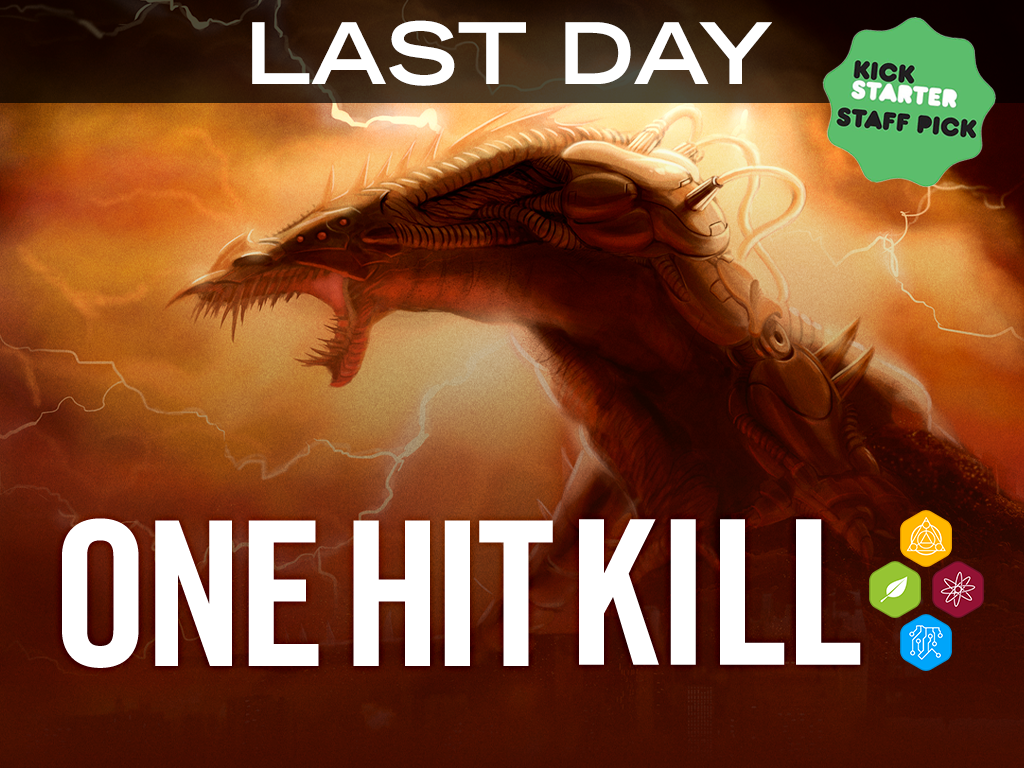
At noon Friday LA time, Kickstarter’s automatic gate will slam shut on One Hit Kill. The backers will be inside, and the rest of the world will need to wait.

I think part of the appeal of Kickstarter is that it’s an Automatic Gate at heart. From the moment I launched the campaign, there was nothing I could do to speed up or slow down the closing gate. The deadline really is a deadline, and nothing can stop it. ((One of my favorite Automatic Gates comes in The Abyss, where (mild spoiler) Ed Harris’s ring does in fact stop the gate. But I couldn’t find a good gif for that.))

We’re more than triple funded, and will be shipping OHK to backers in September. Some will see it a lot sooner at playtests. ((We’re always looking for great playtest venues, so by all means reach out if you have a spot.)) Everyone else will need to wait.

If you want to get it on One Hit Kill, and you want it in September, now’s the last chance. The clock on the Kickstarter page is literally counting down.

ks last day

In just a few hours, it’s One Hit Kill or squish.

« Previous Page
Next Page »

Primary Sidebar

Newsletter

Inneresting Logo A Quote-Unquote Newsletter about Writing
Read Now

Explore

Projects

  • Aladdin (1)
  • Arlo Finch (27)
  • Big Fish (88)
  • Birdigo (2)
  • Charlie (39)
  • Charlie's Angels (16)
  • Chosen (2)
  • Corpse Bride (9)
  • Dead Projects (18)
  • Frankenweenie (10)
  • Go (29)
  • Karateka (4)
  • Monsterpocalypse (3)
  • One Hit Kill (6)
  • Ops (6)
  • Preacher (2)
  • Prince of Persia (13)
  • Shazam (6)
  • Snake People (6)
  • Tarzan (5)
  • The Nines (118)
  • The Remnants (12)
  • The Variant (22)

Apps

  • Bronson (14)
  • FDX Reader (11)
  • Fountain (32)
  • Highland (75)
  • Less IMDb (4)
  • Weekend Read (64)

Recommended Reading

  • First Person (87)
  • Geek Alert (151)
  • WGA (162)
  • Workspace (19)

Screenwriting Q&A

  • Adaptation (65)
  • Directors (90)
  • Education (49)
  • Film Industry (489)
  • Formatting (128)
  • Genres (89)
  • Glossary (6)
  • Pitches (29)
  • Producers (59)
  • Psych 101 (118)
  • Rights and Copyright (96)
  • So-Called Experts (47)
  • Story and Plot (170)
  • Television (165)
  • Treatments (21)
  • Words on the page (238)
  • Writing Process (177)

More screenwriting Q&A at screenwriting.io

© 2026 John August — All Rights Reserved.