• Skip to primary navigation
  • Skip to main content
  • Skip to primary sidebar

John August

  • Arlo Finch
  • Scriptnotes
  • Library
  • Store
  • About

John

Writing for microdramas, aka verticals

September 24, 2025 Film Industry, Follow Up, Los Angeles, Television

Over the last six months, we’ve discussed microdramas (aka verticals) several times on Scriptnotes. For readers who don’t know, microdramas are a format originating in Asia in which a filmed narrative is broken into very short episodes intended to be watched on your phone. They’re often called verticals because they’re shot to be watched on a phone held vertically.

Typically, the first few episodes are free, and then each subsequent episode requires an in-app purchase. The overwhelming majority of microdramas are romances, often feeling like a heightened soap opera.

They’ve recently hit American shores, with U.S. productions shooting in Los Angeles, largely using non-union crews. They have provided work for underemployed actors and crew members — particularly recent film school graduates — and have some experienced producers kicking the tires.

Here’s an example from the ReelShort series The Hidden Billionaire in First Class.

Note that the WGA contract does cover this type of work. Guild writers should not be working on these productions unless they’re under a Guild contract.

We asked listeners who have written on these productions to share their experiences. Several wrote in. Here are two examples.


Risky Business writes:

I spent six months writing for Reelshorts. As a writer, it was terrible.

The first 10 chapters were pored over with repeated rewrites until all the joy was taken out of them, then pretty much they didn’t care. The rest of the story had little oversight as they didn’t expect people to watch.

The CEO repeatedly criticized the writers in company wide messages, while giving 100% of the credit for successes to the editors.

All while paying $22 an hour, with ‘no work’ orders between feedback cycles, and a constant “your contract can be cancelled at any time” hanging over your head, and expectation that you’d be immediately available the second they had feedback, which sometimes took over a week to receive. It ended up being less than minimum wage to basically hold all the blame for a possible failure poured on you from the entire company.

Creative decisions were entirely made by algorithms based on what was selling. The whole prediction model that hollywood is always trying to master contracted by the short production schedule.

I have not had the pleasure of joining any union, but the success of reelshorts definitely scares me. If the model succeeds, AI will definitely be writing the scripts, and the CEO can have his dream of never having to rely on a writer’s creativity again


Another listener wrote in with their experience:

In episode 693, Risky Business shared about his negative experience writing for verticals. I recently started as a screenwriter for one of the larger vertical drama companies as well, and I wanted to offer my perspective since I’ve had a more positive experience.

My salary is about $1540 a week–about $40/hr–with benefits. My lawyer also negotiated that my agreement be non-exclusive, so I am free to keep developing and writing non-vertical projects. Since I’m staffed, I still get paid when I’m waiting for feedback.

For sure, figuring out the soapy, melodramatic tone and structure of verticals has been a tough nut to crack. Even though there’s some room for innovation and creativity, at their core verticals are reverse-engineered around data-driven formulas. It’s kind of like doing a fill-in-the-blanks puzzle. It can be fun and even playful, but it’s a very different process from anything else I’ve done.

Because writing verticals often feels more like solving a puzzle than writing from scratch, I usually have a lot of creative energy left over to keep working on my own projects. I’m also able to write remotely outside LA, which has been a godsend for family reasons.

As a non-WGA writer, I’d love to see verticals get WGA coverage. But at this point, especially with the current state of the industry, I’m grateful for a screenwriting gig that pays the bills while leaving space for my own stuff.


To clarify, verticals already do have WGA coverage. WGA writers shouldn’t be writing on them, just as they shouldn’t be writing any film and television that’s produced without a Guild contract.
Robert Redford, RIP

September 16, 2025 News

Robert Redford built a remarkable career as an actor and a director, but most industry folk would agree his greatest achievement was creating the Sundance Institute. That’s the organization he co-founded in 1981 which runs the annual Sundance Film Festival. It’s no hyperbole to say that Sundance transformed the American independent film landscape, bringing attention and prestige to films (and filmmakers) that might otherwise go unnoticed.

But while the festival is the public face of Sundance, I believe the less-seen work of the Sundance screenwriter and director labs is an equally important legacy. Under the direction of Michelle Satter and her team, the labs bring together seasoned advisors with emerging filmmakers to work on their next films. I’ve had the privilege of serving as a Sundance advisor since 2000.

Pre-pandemic, the labs happened on-site at Redford’s gorgeous Sundance Resort in Utah. If Redford wasn’t off shooting something, he’d come to morning meetings, listening and offering suggestions. That’s where I met him. Given our handful of interactions, I can’t say I have any particular insight about him, but I greatly admired how he was able to build an organization that operated so well without his direct supervision. He chose great people and let them do great work. It’s a lesson more founders could learn.

I was sad to hear of Redford’s passing today, but I have no worries about its impact on the remarkable institution he envisioned. That’s a legacy to admire — not just what you accomplish in your life, but the good work that can continue long after you’re gone. May he rest in peace.

How much can a screenwriter expect to earn from a hit film?

August 18, 2025 News

Over the weekend, a Reddit question showed up as a notification:

What’s the estimated amount a writer could make from a blockbuster movie?
Even residuals too, like how much can the average writer ask for when it comes to a major franchise film or a film expected to do big numbers?

Several redditors helpfully chimed in, but I actually know this answer. Here’s what I posted.


tl;dr Between the low hundred thousands and low millions.

I’ve written seven WGA-covered features. The two that are most relevant for answering your question are Charlie and the Chocolate Factory and Aladdin (2019).

Charlie made $475 million worldwide at the box office. Aladdin made $1 billion.

Screenwriters earn money in two ways. The first is upfront. The second is backend.

Your upfront pay is a function of how much the studio thinks you’re worth at the time that you’re hired. It’s entirely based on your track record. At the time I was hired to write Charlie, I had already written two Charlie’s Angels films. My initial compensation was probably a few hundred thousand dollars. For Aladdin, it was more than a million.

Again: your upfront pay is a factor of how much the studio believes you can deliver a movie they want to make (and how much that’s worth to them). The floor is WGA scale (roughly $100K in 2025).

For backend, every writer has a net profit definition established in their contract. It’s worthless. The way film revenues are accounted, movies never become technically profitable. (Neither Charlie nor Aladdin are profitable per the statements I’m sent.) But writers often get some money beyond initial compensation for their drafts.

Depending on your contract, you might get a production bonus (say, $100K) on the day the movie goes into production.

You might also have box office bonuses tied to crossing certain thresholds in domestic or worldwide box office. For these two movies, I can’t specifically remember any specific box office bonuses, but they’re relatively common, and wonderfully transparent. They’re a way of rewarding the writer for a movie’s box office success.

Finally, there are residuals, which are collected by the WGA and sent out to the writer each quarter. Residuals are based on the money a film earns AFTER its theatrical run (basically home video in all its forms). Residuals are split between the credited writers for a film.

For Charlie, residuals to date total $3.2M. For Aladdin, it’s $4.2M.

Worth pointing out again that these are giant movies, the exceptions to the rule. My first movie, Go, has earned $389K in residuals, while my indie The Nines has earned $22K.

I wrote more about residuals and the relative mix of sources in an earlier post on my blog. It’s from 2020, but the basic trajectory hasn’t changed.

Design Dilemma: Any vs. All

July 10, 2025 Apps, Birdigo, Games, Projects

In Birdigo, the game that Corey Martin and I are releasing on July 30th, we’ve run into an interesting design question.

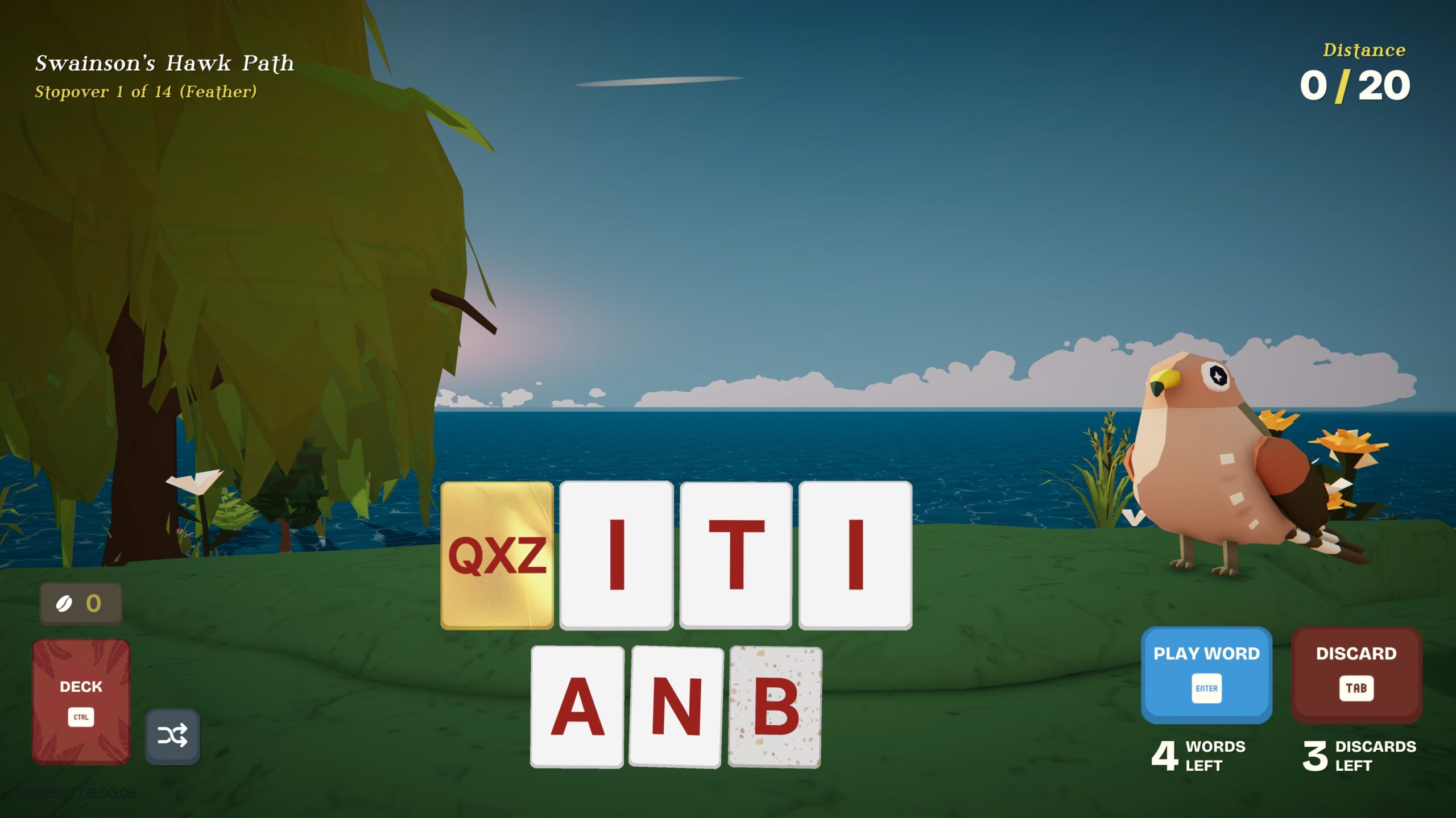
The central mechanic of the game is using letters in your hand to build words, much like in Scrabble. Each card has a single letter on it, with the exception of the QXZ card, which can be played as ANY of those letters.

Birdigo screenshot showing cards make ZITI
ZITI, not QITI or XITI

The QXZ card comes from my previous (physical) card game, AlphaBirds. It’s a useful innovation, turning a card that could be an albatross into something more flexible and useful. You’re not inclined to automatically discard QXZ like you might with a J.

Since Birdigo isn’t constrained by physical reality, we can do fun things to the cards themselves. They can be transformed into speckled, gold, platinum or diamond versions, scoring higher points when played. We can duplicate or destroy cards. We can even merge them using a special song:

Corncrake
Merge two selected cards

If you have a N and G in your hand, you can merge them into a NG card. But what exactly should that card do? In my head (and Corey’s coding logic), the card is counted as either an N or a G. You can use it to play words like LAWN or GRADE.

But that’s not how playtester Budgie saw it:

i combined N and G into one tile and the game frequently (but not always) fails to recognize words using the new tile. For example, e(ng)ine and leavi(ng) weren’t recognized as words, but fa(ng)s was.

Budgie saw the merged card as being both NG, not either N or G. But that’s not how the game logic works. It was letting him play FAN, but not ENINE, EGINE, LEAVIN or LEAVIG. It was user error, not a game bug.

Here’s the thing: Budgie’s mistaken assumption was potentially better than reality. Corey and I both got excited. What if Corncrake created cards that were ALL the letters rather than ANY of the letters? We could even let it fuse together more letters:

Corncrake
Merge up to three selected cards

This would make certain strategies much more plausible, including these feathers:

Do-er +20 flaps if word ends in ER
Click +20 flaps per played “CK”
Birdigoing +30 flaps if word ends in ING

The problem is, that would create a new design challenge. The QXZ card means “any one of these letters.” Should a corncraked ING card mean “all these letters in this order” or “any one of these letters” depending on context? How do you make the distinction clear to the player?

After a lot of back and forth, Corey came up with four scenarios:

Option A:
unpublish Corncrake
don’t have ALL cards, only ANY
+ simplest to implement
– least fun

Option B:
make an ALL card type
make Corncrake create ALL cards instead of ANY
QXZ is the only ANY card and is visually distinct from ALL cards
+ fun new game mechanic
– potentially confusing to existing players
– a fair amount of work

Option C:
turn ANY cards into ALL cards
split our Gold QXZ into Diamond Q, Platinum X and Platinum Z
+ easy to understand
– Q, X and Z are harder to play
– makes lean decks riskier to play

Option D:
make merged cards valid as ALL or ANY
+ maximum flexibility for player
– confusing ambiguity
– extra game logic

As of this publication, we’re trying Option B. We will redesign the QXZ card to make it visually distinct from merged cards. We’ll play around with it internally before pushing it out to testers.


I’ve honestly loved iterating on Birdigo. Design dilemmas like this challenge your assumptions, and force you to look at problems from multiple perspectives. I’ve have similar experiences with Highland, Weekend Read and Writer Emergency Pack, all of which benefited from a team poking and prodding at every detail.

As a screenwriter who’s always dealing with narrative hypotheticals, it’s gratifying to be able to talk through a change, see it implemented, and quickly decide if it works.

When I’m pushing words around on a page, I’m mostly trying to make my inner critic happy, because the feedback loop with executives, producers and directors is so much slower. Collaborative projects like Birdigo require consensus and compromise, disagreement and discovery. I love it.

« Previous Page
Next Page »

Primary Sidebar

Newsletter

Inneresting Logo A Quote-Unquote Newsletter about Writing
Read Now

Explore

Projects

  • Aladdin (1)
  • Arlo Finch (27)
  • Big Fish (88)
  • Birdigo (2)
  • Charlie (39)
  • Charlie's Angels (16)
  • Chosen (2)
  • Corpse Bride (9)
  • Dead Projects (18)
  • Frankenweenie (10)
  • Go (29)
  • Karateka (4)
  • Monsterpocalypse (3)
  • One Hit Kill (6)
  • Ops (6)
  • Preacher (2)
  • Prince of Persia (13)
  • Shazam (6)
  • Snake People (6)
  • Tarzan (5)
  • The Nines (118)
  • The Remnants (12)
  • The Variant (22)

Apps

  • Bronson (14)
  • FDX Reader (11)
  • Fountain (32)
  • Highland (75)
  • Less IMDb (4)
  • Weekend Read (64)

Recommended Reading

  • First Person (87)
  • Geek Alert (151)
  • WGA (162)
  • Workspace (19)

Screenwriting Q&A

  • Adaptation (65)
  • Directors (90)
  • Education (49)
  • Film Industry (489)
  • Formatting (128)
  • Genres (89)
  • Glossary (6)
  • Pitches (29)
  • Producers (59)
  • Psych 101 (118)
  • Rights and Copyright (96)
  • So-Called Experts (47)
  • Story and Plot (170)
  • Television (165)
  • Treatments (21)
  • Words on the page (238)
  • Writing Process (177)

More screenwriting Q&A at screenwriting.io

© 2026 John August — All Rights Reserved.